

GREEN CITY SERIES| ARTICLE 11
How river daylighting changed the argument in South Korea’s capital — and why the harder work of a green city lies beyond one celebrated stream
Few urban projects have entered the global planning imagination as forcefully as Seoul’s restoration of the Cheonggyecheon. The removal of an elevated highway and the return of a stream through the old downtown became an emblem of daylighting, ecological repair and post-car urbanism. Yet Seoul matters not because one project solved the city. It matters because the stream exposed a larger truth: that a greener city is a question of transport, heat, buildings, social inclusion, and the long politics of what an urban future is for.
Opening scene
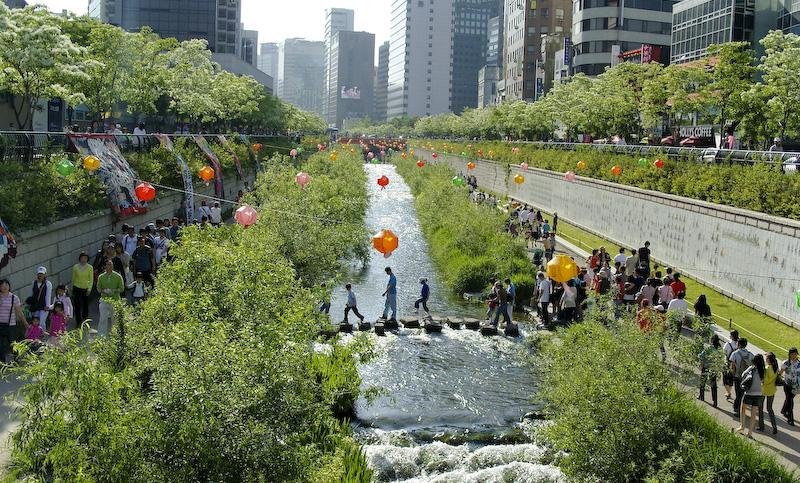
Twenty years on, the most striking thing about Cheonggyecheon is how quickly the eye accepts it. Office workers move along the stepped banks. Children lean toward the water. Couples pause at the bridges. The city’s noise does not vanish, but it drops a register. What had been one of the hard concrete signatures of developmental Seoul now reads as if water had always belonged here. In June 2025, marking the twentieth anniversary of the restoration, Seoul reopened part of the upstream section to the public and staged an international conference around urban resilience, a subtle acknowledgment that the stream has become more than an amenity. It is now part of the city’s civic self-description.1
The city before the turn
For centuries Cheonggyecheon had been part of Seoul’s practical life: a drainage line, a working stream, a social corridor, and, at times, a public-health embarrassment. By the twentieth century, and especially after war and rapid industrialization, it had become heavily polluted. The answer offered by the growth state was not restoration but concealment. From the late 1950s onward the stream was covered, and by the late 1960s an elevated highway ran above it — an infrastructure gesture that treated speed, concealment, and developmental symbolism as if they were synonyms for progress.2
By the 1990s that settlement was fraying. The old corridor was aging badly. Maintenance costs were climbing. Safety concerns had become impossible to ignore, and the wider political atmosphere in Seoul had changed after catastrophic infrastructure failures elsewhere in the city shattered public confidence in the permanence of heavy concrete modernity. The question was no longer simply whether the expressway could be kept standing. It was whether the city still wished to define itself that way.2
When the restoration was finally undertaken, from July 2003 to September 2005, it moved with unusual speed: 5.84 kilometres of the corridor were restored at a project cost of roughly KRW 386.7 billion. Seoul’s own project material still presents the transformation in stark terms: a buried, traffic-dominated infrastructure corridor reopened as a stream, trail, lighting and greenery system in the centre of the capital.1
The pressures
Seoul did not turn toward Cheonggyecheon out of sentiment alone. The city was already confronting the more familiar pathologies of East Asian metropolitan success: traffic saturation, polluted air, high summer heat, scarce open ground, pressure on public transport, and a dense built fabric that stored stress in asphalt, concrete, and long commuting patterns. In the city’s climate planning, buildings and transportation dominate the emissions picture. As of 2019, Seoul said buildings produced 68.7 percent of the city’s greenhouse-gas emissions, transportation 19.2 percent, and waste 6.4 percent. That is why the city’s 2050 greenhouse-gas reduction plan and its 2022–2026 climate action package both place so much emphasis on building retrofit, green mobility, greener energy, and waste reduction.4
Heat belongs in that ledger too. Seoul’s own 2022 climate-action announcement noted that the city’s average temperature had risen from 10.7°C in the 1910s to 13.0°C in the 2010s, while the number of extreme heatwave days had climbed sharply. More recent policy research suggests that Seoul has made genuine efforts on heat mitigation, but that its overall approach remains more incremental than transformative, with blue-green infrastructure widely used yet many policies still general, under-specified, or short of the scale required by intensifying urban heat.410
What the city is doing
The restoration of Cheonggyecheon became the emblem because it was visible. Its environmental effects were measurable and legible at once. Landscape Performance’s synthesis of published evidence found temperatures along the corridor 3.3°C to 5.9°C cooler than a parallel road several blocks away, a 35 percent reduction in small-particle air pollution, and a 639 percent increase in recorded biodiversity between pre-restoration conditions in 2003 and the end of 2008. Flood infrastructure was built into the project as well, with the restored channel designed to provide protection against major storm events.3
The transport implications were just as important. Cheonggyecheon was not simply a river project; it was a test of whether a city could remove a major traffic artery and survive the political panic that would follow. Earlier Seoul material noted warnings of ‘traffic disaster’ and responded with a familiar but still instructive package: discouraging car use in the city centre, improving metropolitan traffic systems, strengthening bus priority, and leaning harder on public transport. The wider Seoul transport system had already been under reform, but the restoration forced the city to prove that road removal need not mean civic paralysis.25
That logic now runs through much of Seoul’s broader climate programme. The city’s 2050 plan targets a 40 percent emissions reduction by 2030 and carbon neutrality by 2050, organized around green buildings, green mobility, green forests, green energy and what it calls a green cycle. In practice that has meant energy-efficiency upgrades for older buildings, a gradual tightening of zero-energy-building requirements, wider adoption of electric and hydrogen vehicles, and a stated ambition to reduce waste at source and move toward zero landfill.4
In transport, Seoul has also been trying to make the low-carbon choice feel ordinary rather than heroic. The Climate Card — an unlimited-use pass covering buses, subways, public bikes and now the Hangang Bus within its service range — is one expression of that effort. By late 2025, the city said the card had surpassed 720,000 daily users and 17 million cumulative recharges. In a city survey, users reported saving about KRW 30,000 a month on average, increasing public-transit use by 2.26 trips a week, and reducing private-car use by 0.68 trips a week.5
Seoul’s adaptation measures are also becoming more physically distributed. In August 2025 the city said it would add six more rooftop gardens that year and noted that since 2002 it had installed rooftop gardens on 785 buildings, creating roughly 330,000 square metres of added green space. The city covers up to 70 percent of construction costs for accepted private projects. Roof gardens are not a substitute for large urban parks or watershed repair, but in a dense capital they are a revealing sign of how seriously the administration now treats heat, energy use, and the need to insert vegetation into places once written off as sealed surfaces.7
What is working — and for whom
Seoul’s achievement is not imaginary. Cheonggyecheon altered the city’s image, but it also changed microclimate, habitat, flood handling, and everyday experience in the old downtown. The stream today is not merely looked at; it is inhabited, programmed, and repeatedly mobilized as public space. The 2025 anniversary events, including the conference on water circulation and the symbolic opening of part of the upstream section, suggest that the city still understands the corridor as a working argument about urban resilience rather than a completed piece of heritage.1
It is also clear that the restoration helped reset the planning imagination. The Guardian reported in 2025 that the city has since removed sixteen additional elevated highways, many replaced by widened pavements or public space. That is not a trivial legacy. Once a city has seen one iconic road come down without apocalyptic collapse, the cultural authority of the rest begins to weaken.6
Yet the benefits have not been distributed without friction. The environmental gains sit beside a more unsettled social story. Studies of the project’s land-use impacts and social inclusiveness found evidence of green gentrification, rising land values and the displacement or difficult relocation of small merchants in the Cheonggye area. The restoration made the old downtown cleaner, cooler and more desirable. It also raised the old question that shadows so many urban greening projects: who gets to stay for the improved version of the city?8
Contradictions, failures, and the limits of the symbol
Cheonggyecheon is often described as a restored stream. That is true, but only up to a point. It is also an engineered urban watercourse that must be actively sustained. Because the historic stream was seasonal and modern Seoul no longer yields reliable natural flow through the corridor, today’s Cheonggyecheon depends on pumped water. Recent reporting said the city maintains it with more than 48,000 tonnes of water a day, drawn from treated Han River water and groundwater, at an annual maintenance cost of roughly 2.9 billion won.6 Earlier project material described even larger planned pumping volumes in the initial scheme. The water may be returned to the city, but this is not a simple reappearance of untouched nature. It is a managed hydrological performance inside a megacity.29
There are design limitations too. The project’s own evaluative literature has long noted that some ecological and accessibility outcomes were less complete than the celebratory narrative implied. Landscape Performance records later recommendations to replace hard revetments with more vegetated low-flow edges, deepen habitat in places, create better detour channels for fish migration, and address accessibility problems that had to be retrofitted after complaints from users with mobility impairments.3
And beyond the stream, Seoul’s climate challenge remains enormous. The same heat-policy literature that credits the city with cooling centres and green-infrastructure measures also argues that vulnerability is still discussed too narrowly, often centred on age rather than a fuller range of social and spatial factors. Cooling centres may be broadly well distributed, one 2024 study found, but the policy conversation has not yet fully caught up with the layered realities of heat vulnerability in a dense, unequal, aging metropolis.10
The future vision
The next chapter for Seoul is therefore not another act of symbolic demolition. It is the slower work of metropolitan metabolism: reducing building emissions at scale, making transit cheaper and easier than driving, expanding heat resilience beyond pilot projects, and turning scattered green interventions into a more continuous blue-green system. The city’s 2025 Voluntary Local Review says Seoul aims to raise the public-transport share to 67.3 percent by 2030 while continuing to cut ultrafine dust and strengthen climate action. Those goals sit alongside the older ‘Triple 30’ ambitions to reduce automobile use, cut public-transit travel times, and expand green space in the city centre.511
The lesson of Cheonggyecheon is not that every city needs a river to daylight. It is that buried systems are political choices. Roads laid over water, heat stored in rooftops, money spent to subsidize driving, buildings allowed to leak energy, and neighbourhoods left without shade are all decisions that can be reversed, if slowly and at cost. Seoul’s stream became famous because it turned this truth into an image. The harder challenge is to turn it into routine policy.14
Conclusion
Seoul is one of the indispensable cities in any serious study of green urbanism because it shows both the power and the insufficiency of the flagship project. Cheonggyecheon deserved its reputation. It cooled the city, improved habitat, reduced pollution, and rewired the moral geometry of the old downtown. But it did not by itself solve Seoul’s emissions, its heat risk, or the social tensions that follow environmental improvement in valuable urban land.38
What Seoul offers now is something more mature than the legend of a single stream. It offers a city still trying to work out how water, transit, buildings, and heat belong together; a city that understands nature not as the opposite of infrastructure but as one of its forms; and a city that has learned, perhaps more vividly than most, that when you uncover a river you also uncover an argument about what a modern metropolis is willing to become.410
Endnotes
1. Seoul Metropolitan Government, “Cheonggyecheon Stream Restoration Project,” for project period, restored length and cost; and Seoul Metropolitan Government, “20-Year Milestone of the Cheonggyecheon Stream Sets the Stage for Water Seoul 2025 International Conference,” for the 2025 anniversary events and upstream opening.
2. Seoul Metropolitan Government / In-Keun Lee, “Cheong Gye Cheon Restoration Project” (2006); and The Guardian, “‘Everyone thought it would cause gridlock’: the highway that Seoul turned into a stream,” Jan. 17, 2025, for the historical covering of the stream, highway era, safety concerns, traffic volumes and political setting of the restoration.
3. Landscape Architecture Foundation, “Cheonggyecheon Stream Restoration Project,” for quantified findings on biodiversity, temperature, air pollution, flood protection, bridge numbers, recycled demolition materials, ecological recommendations and accessibility retrofits.
4. Seoul Metropolitan Government, “Achieving Carbon Neutrality in Response to Climate Change,” and “Seoul Announced Five-year Plan to Tackle Climate Issues,” for Seoul’s emissions breakdown, emissions-reduction targets, climate strategies, investment plan, and heat-wave context.
5. Seoul Metropolitan Government, “Climate Card”; Seoul Metropolitan Government, “Two Years into the Climate Card: Expanding Transportation Welfare Beyond Seoul”; World Bank, “Public and Active Transport Planning for Resilience and Health: Seoul Case Study”; and Seoul’s Voluntary Local Review 2025, for transit policy, service range, user impacts, green transport targets and public-transport ambitions.
6. Seoul Metropolitan Government, “Seoul Announced Five-year Plan to Tackle Climate Issues,” for zero-energy building requirements, energy-efficiency plans, renewable-energy goals and the five-year climate investment programme.
7. Seoul Metropolitan Government, “Little Forests for Rest and Temperature Control: Seoul Expands Rooftop Gardens,” Aug. 20, 2025, for rooftop-garden totals, city funding support and the adaptation logic attached to rooftop greening.
8. Hyunji Lim, “Urban regeneration and gentrification: Land use impacts of the Cheonggye Stream Restoration Project on Seoul’s central business district,” Cities 31 (2013); and Youngeun Kim, “Rethinking Cheonggye Stream Restoration Project: Is urban greening strategy socially inclusive?” Cities 143 (2023), for rising land values, merchant displacement and the social-inclusiveness critique.
9. The Guardian, “‘Everyone thought it would cause gridlock’,” for the current daily pumping volumes and maintenance cost of Cheonggyecheon; contrasted with the 2006 Seoul project presentation for the earlier planned pumped-water regime.
10. Ji Sun Lee and Albert Tonghoon Han, “Heat vulnerability and spatial equity of cooling center: Planning implications from the Korean case,” Urban Climate 55 (2024); and Suhyun An and Aysin Dedekorkut-Howes, “The Heat Is on: How Well Are Densely Populated Korean Cities Adapting to Increased Temperatures and Urban Heat Island Effect?” Environments 12, no. 3 (2025), for Seoul’s cooling-centre distribution, vulnerability gaps, and the critique that current heat adaptation remains limited or insufficiently transformative.
11. Seoul’s Voluntary Local Review 2025, for Seoul’s stated goal of raising the public-transport mode share to 67.3 percent by 2030 and continuing urban sustainability measures.
Source Note
This article draws primarily on official Seoul Metropolitan Government documents, a World Bank transport case study, and peer-reviewed research on Cheonggyecheon’s ecological, social and climatic effects. Those sources were supplemented by recent reporting, especially on the stream’s twentieth anniversary and its continuing maintenance burdens. The resulting picture is deliberately mixed: Seoul remains one of the world’s clearest demonstrations of river daylighting as urban reform, but the city’s broader climate challenge still lies in transport, buildings, heat adaptation and equity.


