

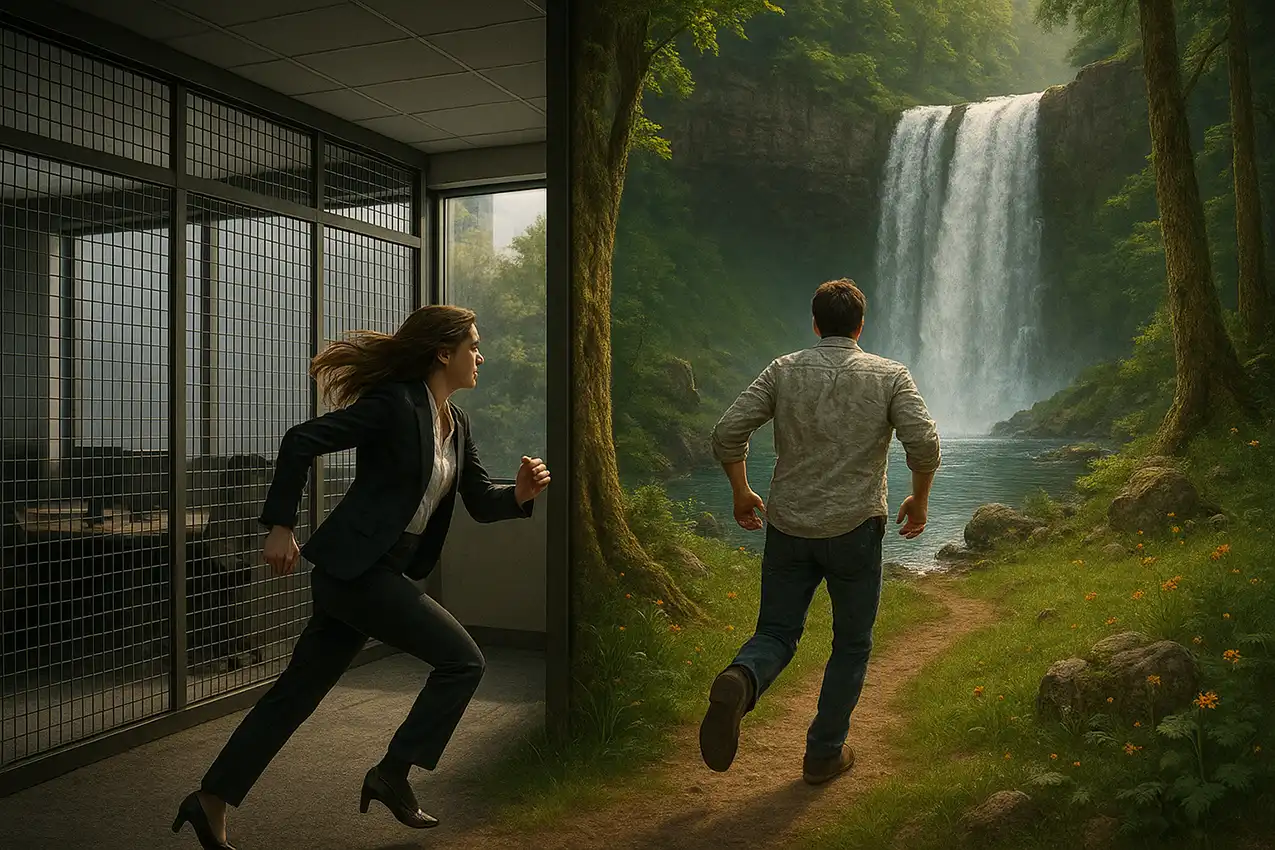
We are animals built for the wild, yet we live in a state of profound containment.
The glow of the screen is our new sunrise. The air we breathe is conditioned, recycled, and sealed inside enclosures where we spend, by some estimates, more than 90 percent of our lives, shuttling between buildings and vehicles.¹ We have engineered a world of astonishing comfort and convenience, a “microcosm” of our own design, yet we are haunted by the feeling that we are not built for it.² We are safe, and we are suffocating.
Into this paradox, a new word has taken root: rewilding.
In the popular imagination, rewilding is an ecological act, grand and external. It is the mass restoration of ecosystems.³ It is the reintroduction of “keystone species”—the wolf, the beaver, the bison—to landscapes that have fallen silent.⁴ It is a philosophy of conservation that, at its core, trusts the wild. It seeks to “reinstate natural processes” and then “let nature lead,” abandoning any “human-defined optimal point or end state.”⁵ It is a project of hope, but one that happens out there.
Now, a more intimate, urgent translation of this idea is emerging: “personal rewilding,” or “human rewilding.”⁶ This is the application of that ecological principle to the self. It is a “conscious undoing of human domestication.”⁷
If ecological rewilding is about freeing the land, personal rewilding is about freeing the person. It is an attempt to “revert back to a natural or untamed state of being,” to shake off the “stale rat race” and escape the “addictive cycle of virtual living.”⁸ It is not merely about learning “primitive skills” but is a “holistic approach to living.”⁹ The parallel is precise. As we have “domesticated” our landscapes, clearing forests for monocultures, we have “domesticated” ourselves, trading resilient, generalist bodies for specialized, fragile ones adapted only to a “forgiving urban environment.”¹⁰
This language, however, walks on fraught ground. The “human self-domestication” hypothesis has a dark and “plagued” philosophical history.¹¹ In the 19th and 20th centuries, it was “prone to misuse,” co-opted by Social Darwinists as a “causal explanation for the alleged degeneration” of populations and twisted into the eugenicist breeding programs of the Nazi regime.¹²
To speak of “undoing domestication” today requires us to first reclaim the term. Modern rewilding is not a biological-supremacist project. It is, as the eco-philosopher Theodore Roszak framed it, “postindustrial not anti-industrial.”¹³ It is not a call to “return” to a mythical, pure past. It is a post-modern, psychological quest to “rekindle our connection to nature” and “unlearn domestication” as a liberating, personal, and political act.¹⁴
The Ghost in the Machine: Why We Ache for the Wild
Why bother? Because the cage is unquiet. We are, as a culture, profoundly unwell, and the evidence suggests our ailment is one of separation.
In the United Kingdom, we are among the “least nature-connected nations in [the] world.”¹⁵ This disconnect is not a neutral fact; it is a wound. We are suffering from what the journalist Richard Louv termed “nature deficit disorder” in his 2005 book, Last Child in the Woods.
It is not, he clarifies, a formal medical diagnosis, but a “description of the human costs of alienation from nature.”¹⁶ This “alienation damages children and shapes adults,” linked by a growing body of research to rising rates of anxiety, depression, attention problems, and even shortsightedness.¹⁷ The causes are grimly familiar: “parental fears” of “stranger danger,” the loss of access to natural land, and the rise of screen-based technology that demands we “focus entirely on a screen” by “ignor[ing] most of our senses.”¹⁸
Louv’s diagnosis is visceral. “The woods were my Ritalin,” he writes. “Nature calmed me, focused me, and yet excited my senses.”¹⁹ His argument is a direct challenge to a culture that treats the outdoors as an amenity. “Time in nature is not leisure time,” Louv insists, “it’s an essential investment in our chidlren’s health (and also, by the way, in our own).”²⁰
If Louv diagnosed the modern symptom, the biologist E.O. Wilson identified its evolutionary source. Wilson’s “biophilia hypothesis” proposes that humans possess an “innate tendency to seek connections with nature and other forms of life.”²¹ The term was first used by psychoanalyst Erich Fromm to mean “the passionate love of life and of all that is alive,” but Wilson argued this “innately emotional affiliation” has, at least “in part, a genetic basis.”²² Our senses, our minds, our very spirits were “woven from” this propensity.²³ We are hard-wired to connect. Our disconnection is, therefore, a form of starvation.
The most profound, and perhaps most radical, framework for this ache comes from eco-psychology. Theodore Roszak, who coined the term, argued that our psychology is not sealed inside our skulls.²⁴ “The core of the mind,” he wrote, “is the ecological unconscious.”²⁵
This unconscious, he proposed, is the “living record of cosmic evolution” buried within us.²⁶ From this, Roszak derived a “synergistic interplay between planetary and personal well-being.”²⁷ His conclusion is staggering: “the needs of the planet are the needs of the person, the rights of the person are the rights of the planet.”²⁸
In this light, our rising rates of anxiety and depression are not individual failings. They are a sane, collective, and psychic response to a sick environment. As Roszak wrote, “The Earth’s cry for rescue… is our own cry for a scale and quality of life that will free each of us to become the complete person we know we were born to be.”²⁹
Feral: The Enchantment of What Is
This cry for rescue found its modern manifesto in Feral, the 2013 book by journalist George Monbiot.³⁰ He begins with a diagnosis similar to Louv’s: “civilisation has squeezed the wildness out of our environment and out of us.”³¹ But his prescription is a radical philosophy.
Monbiot draws a sharp line between “rewilding” and traditional “conservation.” Conservation, he argues, is often about control. It is about managing a landscape, like an anxious gardener, to maintain a specific, “special,” and often static state—what he calls a “conservation prison.”³² One example is a woodland meticulously managed for a single species of moth, where other native plants trying to establish themselves are weeded out.³³
Rewilding is the opposite. It is an abdication of control. “Rewilding… has no fixed objective,” Monbiot writes. “It is driven not by human management but by natural processes.” It “does not seek to control the natural world… but – having brought back some of the missing species – to allow it to find its own way.”³⁴
This philosophy is not an act of despair; it is a “work of hope.”³⁵ In an age of ecological grief and paralysis, it provides a new narrative. “The environmental movement up till now has necessarily been reactive,” Monbiot argues. “We also need to say what we would like. We need to show where hope lies.”³⁶ This is now a core principle of the movement: to “provide hope and purpose” and generate “visions of a better future.”³⁷
Here lies the philosophical key to personal rewilding. It is not a 10-step plan to bio-hack your way to a “better you.” It is a direct antidote to the hyper-optimized, data-driven wellness industry. It is a terrifying and liberating embrace of not knowing. It asks what happens if we remove the constant human management—the notifications, the processed foods, the rigid schedules—from our own lives? What happens if we, too, “let nature lead”?³⁸
For Monbiot, the personal and the ecological are inextricably linked. His most passionate call to action is for the human animal. “Of all the world’s creatures,” he writes, “perhaps those in the greatest need of rewilding are our children.”³⁹ He cites the “collapse of children’s engagement with nature,” noting that since the 1970s, the area in which a child in the UK may roam without supervision “has decreased by almost 90 per cent.”⁴⁰
The Body Electric: Nature on the Brain
This philosophy of re-enchantment is not just poetry. It is being validated by a cascade of research from psychology, immunology, and endocrinology.
First, it rebuilds the mind. The digital urban world “impose[s] increasing demands on our cognitive resources,” leading to what psychologists call “directed attention fatigue.”⁴¹ In the 1980s, Rachel and Stephen Kaplan developed Attention Restoration Theory (ART) to explain how nature heals this.⁴²
ART posits two types of attention: “directed attention,” which is effortful and finite (work, screens, navigating traffic), and “involuntary attention,” which is effortless.⁴³ Nature, the Kaplans found, is filled with “soft fascinations”—the play of light on water, the rustle of leaves, the drift of clouds—that “capture attention effortlessly.”⁴⁴ This “soft fascination” allows our depleted “directed attention” to rest and “recharge,” restoring our ability to focus and think clearly.⁴⁵
Second, it heals the body. The Japanese practice of Shinrin-yoku, or “forest bathing,” provides the most extensive data.⁴⁶ Shinrin-yoku is not a hike; it is a slow, sensory immersion, a “mindful walk” where you “soak in the sights,” “listen to the sounds,” and “breathe in clean, fragrant air.”⁴⁷
The physiological results are profound. Studies show that forest bathing measurably “increases human natural killer (NK) activity” and “intracellular levels of anti-cancer proteins,” suggesting a direct boost to the immune system’s ability to fight tumors and infections.⁴⁸
It calms us at a chemical level, reducing stress hormones like “salivary/serum cortisol” and “urinary adrenaline and noradrenaline.”⁴⁹ This, in turn, shifts the autonomic nervous system: it reduces the “sympathetic” (fight or flight) nerve activity and increases the “parasympathetic” (rest and recover) activity.⁵⁰ This nervous system shift has a direct physical payoff, “reduc[ing] blood pressure and heart rate.”⁵¹
Finally, it changes our emotions, which leads to a change in our behavior. This is the synthesis of the first two points. Dr. Miles Richardson at the University of Derby studies “nature connectedness,” the “closeness of an individual’s relationship with other species.”⁵² His research shows that high connectedness is linked to “improved wellbeing,” “lower depression and anxiety,” and, most critically, a higher likelihood of “act[ing] in environmentally friendly ways.”⁵³ His “30 Days Wild” campaign, which encourages people to do one small “wild” thing every day, “delivered clinically significant improvements in mental health” simply by training people to notice nature.⁵⁴
This raises a crucial question: is the benefit from the dose or the disposition? One major study of 20,000 people found a “hard boundary” for a physical “dose,” landing on “precisely 120 minutes” a week in green spaces for a high sense of well-being.⁵⁵ Yet the work of Dr. Lisa Nisbet at Trent University suggests the psychological relationship itself is a powerful elixir. Her research on “nature relatedness” found that “the sense of connection you have with the natural world seems to contribute to happiness even when you’re not physically immersed in nature.”⁵⁶
The implication is that rewilding is both a practice and a mindset. And this mindset creates a powerful feedback loop. As our personal connection to nature is restored, our health improves.⁵⁷ As our health improves, we become, as Nisbet puts it, “motivated to protect the places that will help us thrive.”⁵⁸
Getting Your Hands Dirty: Pathways to the Real
Personal rewilding, then, is the act of unlearning our domestication.⁵⁹ It is a toolbox of “ancestral practices” used to deconstruct the cage.⁶⁰
It can begin with the senses, in the forest. The “relational” practice of Shinrin-yoku is the simplest gateway.⁶¹ It is not about mileage. It is about “awaken[ing]… senses,” and certified guides are trained in a “standard sequence” to help participants “slow down” and “reconnect with the more than human world.”⁶² It is, as the Association of Nature and Forest Therapy guides states, “an inside job, one that requires us to go outside.”⁶³
It can move to the palate, with foraging. This is the “conscious undoing” in practice, learning to “eat wild food.”⁶⁴ It is a primary way to “connect to the land and understand plants better.”⁶⁵ But this practice is governed by profound ethical and safety rules. The first is absolute: “Never consume anything before identifying it.”⁶⁶ This requires using multiple, reputable field guides, or, better yet, starting with an expert-led tour.⁶⁷
The second is to forage “clean,” avoiding “busy roads,” “industrial areas,” or any land with “pesticides or contamination concerns.”⁶⁸ The third is to respect law and access: “Know your local foraging laws” and “always ask for permission” on private land.⁶⁹
The final and most important rule is sustainability. The guiding principle is to “Only take what you need.”⁷⁰ More specifically: “Never take the first. Never take the last… Never take more than half. Leave some for others.”⁷¹
Rewilding can also be intensely physical. We have become “frail and fragile versions of what we are truly capable of,” and “natural movement” systems like MovNat are a direct response.⁷² Founded by Erwan Le Corre, MovNat teaches “real-world physical capability” by rejecting “conventional fitness modalities” in favor of “contextual movement” in relation to the environment: crawling, jumping, balancing, lifting, and climbing.⁷³ It explicitly “merge[s] a passion for ecological resilience… with a quest for physical resilience.”⁷⁴
Finally, this practice is not a privilege reserved for those with access to wild frontiers. “No space is too small to contribute.”⁷⁵ Urban rewilding makes this “holistic way of life” accessible to all.⁷⁶ It can be as simple as planting “pollinator-friendly plants” in a window box or “creat[ing] a mini-meadow.”⁷⁷ It can mean installing “insect hotels” and “bird boxes.”⁷⁸
And from there, it becomes political. It means advocating for “wild areas in our parks,” an end to “the cutting back of weeds,” and a “reduc[tion] in the use of pesticides.”⁷⁹ It means transforming “desolate abandoned areas,” bus stop roofs, and “roadside verges” into habitats.⁸⁰ It is a way to “engage local communities” and ensure that the benefits of rewilding can be “experienced by all.”⁸¹
The Honorable Harvest: Rewilding as Reciprocity
This toolbox is powerful. But if it remains focused only on what we get—our health, our peace, our food—it is just another form of extraction. It remains a one-way, consumerist relationship.
This is where the ethics of personal rewilding must pivot, from a model of taking to one of giving.
In her book Braiding Sweetgrass, botanist and Potawatomi citizen Robin Wall Kimmerer calls for “restoration, not only for polluted waters and degraded lands, but also for our relationship to the world.”⁸² She offers a set of Indigenous principles for gathering called the “Honorable Harvest.” These principles form the ethical heart of a rewilded life.
They go far beyond the simple “don’t take too much.” They include: “Ask permission before taking. Abide by the answer. Never take the first. Never take the last. Take only what you need. Take only that which is given. Never take more than half… Give thanks for what you have been given. Give a gift, in reciprocity for what you have taken… Sustain the ones who sustain you and the earth will last forever.”⁸³
This ethic is born from a different worldview. Kimmerer explains that “in Potawatomi and most other indigenous languages, we use the same words to address the living world as we use for our families. Because they are our family.”⁸⁴ In this grammar, a raspberry bush is not an “it.” To use “it,” she writes, “robs a person of selfhood and kinship, reducing a person to a mere thing.”⁸⁵
When the world is a “thou,” not an “it,” a relationship of “reciprocity” becomes the only sane way to live.⁸⁶ The land is “a gift, not a commodity.”⁸⁷ Kimmerer argues that this restoration of relationship is how we heal our cultural “shame”—the shame of living in an extractive, destructive system.⁸⁸
This is the antidote to the ache from Part Two. The “anxiety and depression” diagnosed by eco-psychology is not just from a lack of nature. Kimmerer’s work suggests it is also from the shame of our broken, one-sided relationship with it.
The cure, therefore, is not just exposure. It is reciprocity. “Knowing that you love the earth changes you, activates you,” Kimmerer writes. “But when you feel that the earth loves you in return, that feeling transforms the relationship from a one-way street into a sacred bond.”⁸⁹
Rewilding for Whom? The Trouble with Wildness
This “sacred bond” is the ideal. The reality is fraught with power, privilege, and a violent history. A truly investigative look at personal rewilding must confront its “trouble.”
First, the term has been “co-opted.”⁹⁰ It is a booming “publishing genre” and has been absorbed into the commercial “wellness” industry, threatening to become another luxury pursuit for the “rich and famous.”⁹¹ Time for forest bathing, money for workshops, and access to “quality” green space are all forms of privilege. As the singer Ellie Goulding, a rewilding advocate, notes, knowing the landscape as a child gave her “a connection that is a type of wealth.”⁹²
Second, the practice is rife with cultural appropriation. Many rewilding retreats are “influenced by adaptations of Indigenous vision quest traditions,” an act that is “ethically contentious.”⁹³ This is a form of “extractivism,” where the dominant culture “use[s] their knowledge, ways of life, art… and spirituality… for capitalist consumption,” separating it from its context.⁹⁴
This is “playing indian.”⁹⁵ It is a settler “work[ing] cushy jobs… to buy land (stolen from them…)” for a “rewilding project,” while the Indigenous people who are the source of this wisdom “are struggling for even simple resources (like clean water).”⁹⁶
The third, and most damning, critique is that the entire rewilding movement can be a form of “eco-colonialism.”⁹⁷ The very idea of a “wilderness” to be “rewilded” is often a colonial myth, one that erases the Indigenous people who actively managed those landscapes for millennia. In Wales, large-scale rewilding projects have been resisted by local farmers as an “imposition… by a middle-class, Nature-deprived, English urban populace.”⁹⁸
This colonial history is most explicit in the simple act of foraging. The anti-foraging laws that remain on the books in many parts of the United States were not created to protect nature. They were created to control people.
Historically, they were used “to push Native Americans off of lands desired by white settlers.”⁹⁹ After the Civil War, they were “explicitly extended to Black and African American individuals” to “prevent newly freed slaves from being able to provide sustenance for themselves and their families,” forcing them back into plantation labor.¹⁰⁰
These laws are not relics. Foraging is illegal in many state and national parks, and people are still fined for picking dandelions or berries.¹⁰¹
This is the central friction point where “wellness” collides with “justice.” For a privileged person, foraging is a quaint act of self-discovery. For a Black or Indigenous person, it has historically been—and can still be—an act of criminality.
This is precisely why the work of modern foragers like Alexis Nikole Nelson (@blackforager) is so revolutionary. She is not just a TikTok star with a “sticky brain for plant information”; she is a political actor.¹⁰² She explicitly reclaims foraging as an act of justice. “Foraging,” she states, “has been a part of Indigenous food ways and the food ways of pretty much every underserved community, whether those people were enslaved or just not very high on the socioeconomic scale.”¹⁰³
By joyfully and publicly identifying free food in “city spaces,” she is linking the practice back to “reclaiming food sovereignty” for the Black community.¹⁰⁴ She is, in real-time, “decolonizing” the practice, dismantling a racist legal history with every singsong video.¹⁰⁵
The Re-Enchanted Activist: From the Personal to the Political
Personal rewilding, then, faces a stark choice. It can be a privileged, apolitical, and colonialist wellness trend. Or it can be a radical, decolonizing, and revolutionary act of reciprocity.
The scale of the global ecological crisis is “overwhelming to the individual.”¹⁰⁶ It fosters despair, paralysis, and a retreat from the world. Personal rewilding, when done critically, is the antidote to this paralysis.
It is, as the scientist Marc Bekoff writes in Rewilding Our Hearts, an invitation to “act from the inside out,” and to “allow [our] hearts to guide” us.¹⁰⁷ Personal rewilding “means letting our feelings lead to compassionate action.”¹⁰⁸ It is an “intimate process” that “fosters corridors of coexistence and compassion,” “rehabilitating our hearts” and “re-enchanting” us with the world.¹⁰⁹
This is not wishful thinking. It is the scientific feedback loop. The research is clear: a “strong” psychological “nature connection” is “robustly” related to “pro-environmental behaviour.”¹¹⁰ By healing our personal alienation, we become intrinsically motivated to defend the planet that sustains us.¹¹¹
The most effective activists have always understood this. Kristine McDivitt Tompkins, who with her husband has protected millions of acres of land in South America, states it plainly: “The first step to saving nature is the rewilding of our own minds.”¹¹²
The ultimate goal of the rewilding movement is a “paradigm shift in the coexistence of humans and nature.”¹¹³ But that paradigm shift cannot happen out there, in the landscape, until it first happens in here, in the self.
We began in the unquiet cage. We thought the cage was our office, our phone, our “domestication.” But the investigation reveals the cage is also our severed, extractive relationship. It is the colonial worldview that sees the Earth as an “it.” It is the history of racist walls built to keep some people in and other people out of the wild.
Personal rewilding, done with an eye toward justice and a heart committed to reciprocity, is the act of dismantling that cage. It is not an alternative to activism. It is its most sustainable and powerful source.
Endnotes
¹Psyche. How to reconnect with your wild nature.
²Citizen Zoo. CZ/principlesofrewilding.
³Roots of Nature. Why personal and ecological rewilding have a lot in common.
⁴Rewilding Britain. Rewilding glossary.
⁵Rewilding Britain. Defining rewilding; Rewilding Europe. Rewilding principles.
⁶Rewilding Britain. Rewilding glossary; Personal Rewilding. Finding a Deep Nature Connection.
⁷Rewilding Britain. Rewilding glossary. See also.
⁸Christiane Howe. The rewilding story; Personal Rewilding. Finding a Deep Nature Connection.
⁹Rewilding Britain. Rewilding glossary.
¹⁰Roots of Nature. Why personal and ecological rewilding have a lot in common; Earthrunners. Natural Movement Q&A with Stefano Tripney.
¹¹PMC. Domestication of the human species?
¹²PMC. Domestication of the human species?
¹³IES. Principles of Ecopsychology; Ceux D’ici. Roszak-eight-principles-of-ecopsy.pdf.
¹⁴Christiane Howe. The rewilding story; Arthur Haines. Rewilding Fundamentals.
¹⁵The Guardian. Britain-one-of-least-nature-connected-nations-in-world.
¹⁶Population Education. What is Nature Deficit Disorder.
¹⁷Environment and Society. Last Child in the Woods; Pachamama Alliance. Healing ourselves and the earth with ecopsychology; Population Education. What is Nature Deficit Disorder; ASLA. Children: Nature Deficit Disorder.
¹⁸Wikipedia. Nature deficit disorder; Population Education. What is Nature Deficit Disorder.
¹⁹SuperSummary. Last Child in the Woods Important Quotes.
²⁰AZquotes. Richard Louv Quotes; Goodreads. Last Child in the Woods Quotes.
²¹Britannica. Biophilia hypothesis.
²²Britannica. Biophilia hypothesis; PMC. The Biophilia Hypothesis.
²³Wikipedia. Biophilia hypothesis.
²⁴Naturally Balanced. Ecopsychology.
²⁵IES. Principles of Ecopsychology; Binghamton University. Ecopsychology.
²⁶IES. Principles of Ecopsychology; Binghamton University. Ecopsychology.
²⁷IES. Principles of Ecopsychology; Ceux D’ici. Roszak-eight-principles-of-ecopsy.pdf.
²⁸IES. Principles of Ecopsychology; Ceux D’ici. Roszak-eight-principles-of-ecopsy.pdf.
²⁹Pachamama Alliance. Healing ourselves and the earth with ecopsychology.
³⁰Env Hist Now. Rewilding heritage.
³¹The Guardian. Feral-searching-enchantment-monbiot-review.
³²Monbiot.com. Feral: Searching for Enchantment.
³³Roots of Nature. Why personal and ecological rewilding have a lot in common.
³⁴Goodreads. Feral Quotes.
³⁵Env Hist Now. Rewilding heritage.
³⁶Goodreads. Feral Quotes.
³⁷Ecosulis. Rewilding principles; Rewilding Europe. Rewilding principles.
³⁸Rewilding Europe. Rewilding principles.
³⁹Goodreads. Feral Quotes.
⁴⁰Goodreads. Feral Quotes.
⁴¹Taylor & Francis Online. Attention Restoration Theory: A systematic review.
⁴²Positive Psychology. Attention Restoration Theory (ART); PMC. Nature and Restoration.
⁴³Wikipedia. Attention restoration theory.
⁴⁴ECEHH. Attention Restoration Theory: a systematic review.
⁴⁵Positive Psychology. Attention Restoration Theory (ART); PMC. Nature and Restoration.
⁴⁶Japan.travel. Forest bathing.
⁴⁷Japan.travel. Forest bathing; Focuskeeper. What is nature immersion.
⁴⁸PMC. Shinrin-yoku (Forest bathing) and human health. See also.
⁴⁹PMC. Shinrin-yoku (Forest bathing) and human health; Psyche. How to reconnect with your wild nature.
⁵⁰PMC. Shinrin-yoku (Forest bathing) and human health; SDBG. Shinrin-Yoku Connecting People to Nature.
⁵¹PMC. Shinrin-yoku (Forest bathing) and human health; Fo-society.jp. Forest Therapy.
⁵²The Guardian. Britain-one-of-least-nature-connected-nations-in-world; University of Derby. Miles Richardson.
⁵³The Guardian. Britain-one-of-least-nature-connected-nations-in-world; Mental Health Foundation. Nature: how connecting with nature benefits our mental health.
⁵⁴Mental Health Foundation. Professor Miles Richardson.
⁵⁵Yale E360. Ecopsychology-how-immersion-in-nature-benefits-your-health.
⁵⁶APA Monitor. Nurtured by nature; Trent University. Psychological-other-benefits-from-nature; APA Monitor. Nurtured by nature.
⁵⁷Frontiers. Cultivating connection with neighborhood trees.
⁵⁸APA Monitor. Nurtured by nature.
⁵⁹Arthur Haines. Rewilding Fundamentals.
⁶⁰Psyche. How to reconnect with your wild nature.
⁶¹ANFT. Forest Therapy Guide Certification.
⁶²ANFT. Forest Therapy Guide Certification; Fo-society.jp. Forest Therapy.
⁶³ANFT. Forest Therapy Guide Certification.
⁶⁴Arthur Haines. Rewilding Fundamentals.
⁶⁵Greenify Me. Rewilding yourself.
⁶⁶She Made Digital. A guide to ethical foraging.
⁶⁷Powell Gardens. A guide to foraging; Greenify Me. Rewilding yourself; Learning Herbs. Ethical Foraging 101.
⁶⁸Powell Gardens. A guide to foraging; Learning Herbs. Ethical Foraging 101; Homestead Honey. Foraged Food Wild Edibles.
⁶⁹She Made Digital. A guide to ethical foraging; Powell Gardens. A guide to foraging; Homestead Honey. Foraged Food Wild Edibles.
⁷⁰Powell Gardens. A guide to foraging.
⁷¹Goodreads. Braiding Sweetgrass Quotes; Homestead Honey. Foraged Food Wild Edibles; Chestnut Herbs. Foraging for Wild Edibles and Herbs.
⁷²Earthrunners. Natural Movement Q&A with Stefano Tripney.
⁷³Movnat.com; Rewilding Drum. Movnat coaching from the best; Earthrunners. Natural Movement Q&A with Stefano Tripney.
⁷⁴Movnat. Diana Movnat Story.
⁷⁵Citizen Zoo. CZ/principlesofrewilding.
⁷⁶Christiane Howe. The rewilding story.
⁷⁷Mossy.Earth. Rewilding cities.
⁷⁸Mossy.Earth. Rewilding cities.
⁷⁹Mossy.Earth. Rewilding cities.
⁸⁰Greenify Me. Rewilding yourself; Mossy.Earth. Rewilding cities; Citizen Zoo. Urban rewilding.
⁸¹Biogeoscience. Urban rewilding; C40 Knowledge Hub. Urban rewilding; NCCEH. Urban rewilding and public health.
⁸²Goodreads. Braiding Sweetgrass Quotes.
⁸³Goodreads. Braiding Sweetgrass Quotes.
⁸⁴Medium. Top Quotes Braiding Sweetgrass.
⁸⁵Medium. Top Quotes Brailding Sweetgrass.
⁸⁶Goodreads. Robin Wall Kimmerer Quotes.
⁸⁷Goodreads. Robin Wall Kimmerer Quotes.
⁸⁸Goodreads. Braiding Sweetgrass Quotes.
⁸⁹Goodreads. Braiding Sweetgrass Quotes; Goodreads. Robin Wall Kimmerer Quotes.
⁹⁰Counterpoint Knowledge. Rewilding cultures self and spirituality.
⁹¹Counterpoint Knowledge. Rewilding cultures self and spirituality; University of Cambridge. Reclaim wellness from the rich and famous.
⁹²The Guardian. Ellie Goulding on rewilding.
⁹³Counterpoint Knowledge. Rewilding cultures self and spirituality.
⁹⁴Cultural Survival. Cultural appropriation another form of extractivism.
⁹⁵Discuss.Rewild.com. Misconception rewilders are racist.
⁹⁶Unsettling America. Towards an understanding of cultural appropriation in rewilding.
⁹⁷Rewild Everything. The wilderness myth decolonising rewilding.
⁹⁸Rewild Everything. The wilderness myth decolonising rewilding.
⁹⁹Reason.org. Foraging for berries and feeding the homeless shouldn’t be crimes.
¹⁰⁰ScholarWorks BGSU. Honors Projects; Reason.org. Foraging for berries and feeding the homeless shouldn’t be crimes.
¹⁰¹She Made Digital. A guide to ethical foraging; Reason.org. Foraging for berries and feeding the homeless shouldn’t be crimes.
¹⁰²Atmos.Earth. Alexis Nikole Nelson Black Forager.
¹⁰³Grist. This Tiktok star makes foraging a fun and revolutionary practice.
¹⁰⁴Grist. This Tiktok star makes foraging a fun and revolutionary practice.
¹⁰⁵ResearchGate. For wilderness or wildness Decolonising rewilding.
¹⁰⁶Personal Rewilding. Finding a Deep Nature Connection.
¹⁰⁷Psychology Today. The psychology of rewilding.
¹⁰⁸Psychology Today. Personal rewilding means letting our feelings lead.
¹⁰⁹Psychology Today. The psychology of rewilding.
¹¹⁰Earth.org. Human connection with nature; Mental Health Foundation. Nature: how connecting with nature benefits our mental health; APA Monitor. Nurtured by nature.
¹¹¹Global Rewilding. Engaging landowners in rewilding.
¹¹²YouTube. TED Talk Kristine McDivitt Tompkins.
¹¹³IUCN. Benefits and risks of rewilding.


