

1. Historical Baseline
Pre-1750 Wilderness Extent
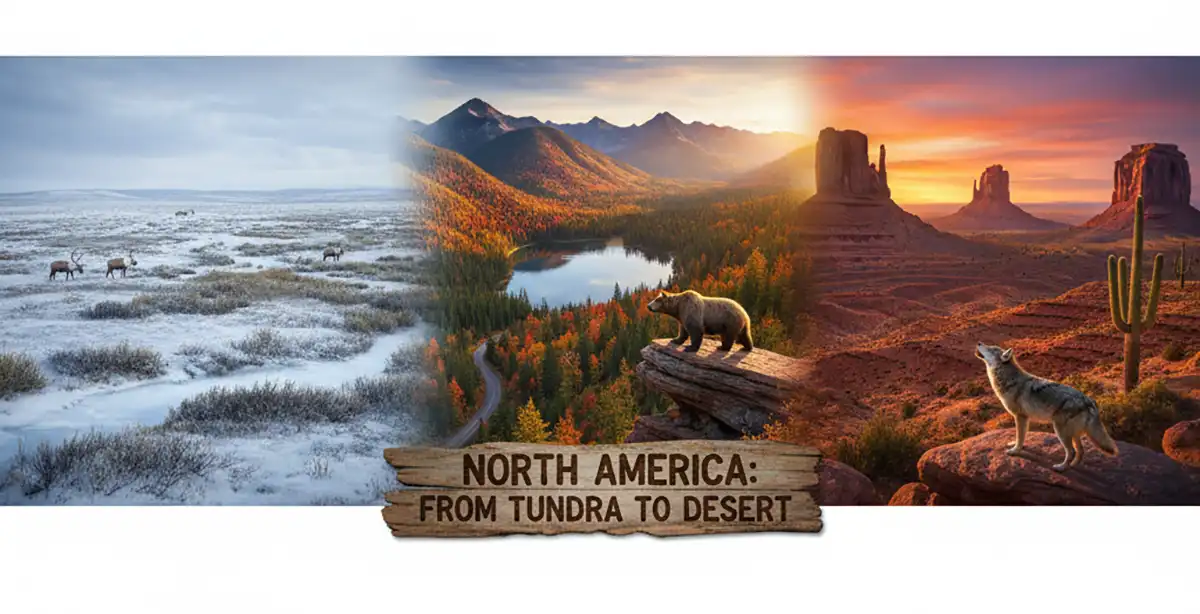
North America contained 3.9 billion acres of wilderness when Europeans first arrived—98% of the continent’s land area.¹ From Arctic tundra to Sonoran desert, from Atlantic forests to Pacific rainforests, the continent supported Earth’s most diverse temperate ecosystems. This wasn’t empty wilderness but homeland to 10 million Indigenous peoples managing landscapes through sophisticated practices that enhanced rather than diminished ecological complexity.²
The eastern forests alone covered 400 million acres in unbroken canopy from the Atlantic to the Mississippi River. American chestnuts, comprising 25% of eastern forests, grew to 30 meters tall and 4 meters in diameter.³ Passenger pigeons, numbering 3-5 billion, created living rivers in the sky that took days to pass. Their droppings fertilized forests in quantities matching modern industrial agriculture’s nitrogen inputs.⁴
The Great Plains supported 30-60 million bison in herds so vast that early observers compared them to moving mountains.⁵ These megaherbivores, along with 40 million pronghorn and 10 million elk, maintained grassland mosaics through grazing, wallowing, and migration. Prairie dogs—5 billion strong—engineered underground cities covering 100 million acres, their burrows supporting 200 associated species.⁶
Benchmark Periods
By 1850, the assault had begun. Market hunting reduced bison to under 10 million. Forest clearing claimed 100 million acres. Yet 75% of the continent remained ecologically intact, with apex predators maintaining trophic cascades from wolves in Yellowstone to jaguars in Arizona.⁷
The period 1850-1900 witnessed ecological collapse at unprecedented speed. Bison dropped to 541 animals by 1889. Passenger pigeons, from billions to extinction by 1914. Wolves eliminated from 95% of their range. Prairie conversion destroyed 99% of tallgrass prairie. Industrial logging cleared 260 million acres of primary forest.⁸
By 1950, wilderness survived primarily in mountains, deserts, and the Arctic—lands deemed worthless for agriculture. The Great Acceleration beginning that year brought interstate highways fragmenting remaining habitat, industrial agriculture poisoning watersheds, and suburban sprawl consuming 1 million acres annually.⁹
2. Current Status Analysis
Quantitative Metrics
Today, 45% of North America retains wilderness character, but this figure deceives through geographic bias.¹⁰ Alaska and northern Canada hold 85% of remaining wilderness. The lower 48 United States preserves only 2% as designated wilderness—109 million acres from an original 2.3 billion.¹¹ Mexico maintains 12% wilderness, mostly in the Sierra Madre and Chihuahuan Desert.
The Wilderness Quality Index reveals deeper degradation:
- Species intactness: 4/10 (missing apex predators, reduced prey base)
- Ecological processes: 5/10 (disrupted fire, altered hydrology)
- Human footprint: 6/10 (extensive fragmentation, noise pollution)
- Connectivity: 3/10 (massive barriers, isolated populations)
- Pollution levels: 4/10 (pesticides, microplastics, atmospheric nitrogen)
Protected areas cover 17% of North America, but only 8% qualify as IUCN Category I-II (strict protection).¹² Indigenous peoples manage 80 million acres in the United States and 1.4 billion acres in Canada—often providing better habitat than government-protected areas.¹³
Qualitative Assessment
Ecosystem health varies dramatically by region. The boreal forest remains 80% intact, Earth’s largest remaining wilderness. Arctic tundra persists largely unmodified except for climate impacts. These northern wildernesses maintain functional predator-prey relationships, natural disturbance regimes, and carbon storage capacity exceeding the Amazon.¹⁴
Southern ecosystems tell a different story. Eastern forests exist as fragments in an agricultural matrix. Ninety percent of wetlands have been drained. Rivers are dammed, channelized, or polluted along 98% of their length. The Colorado River no longer reaches the sea. The Mississippi carries an agricultural chemical load creating a 20,000-square-kilometer dead zone in the Gulf of Mexico.¹⁵
Resilience capacity varies inversely with human density. Remote wilderness maintains high recovery potential—demonstrated by wolf recolonization from Canada and forest regrowth in abandoned areas. But most ecosystems below the 49th parallel have crossed resilience thresholds, requiring active restoration rather than passive recovery.
3. Biodiversity Inventory
Species Status
North America hosts approximately 457 mammal species, 914 birds, 662 reptiles and amphibians, and 4,000 freshwater fish.¹⁶ Plant diversity includes 20,000 vascular species with 40% endemism. However, 1,600 species face extinction risk.
IUCN Red List summary for North America:
- Critically Endangered: 237 species
- Endangered: 543 species
- Vulnerable: 821 species
- Near Threatened: 892 species
Flagship species tell the conservation story. Grizzly bears occupy 2% of historical range. Black-footed ferrets survived only through captive breeding after wild extinction. California condors dropped to 27 individuals before recovery efforts. Monarch butterflies declined 99% from 1 billion to 30 million.¹⁷
Recent extinctions accelerate: 73 species since 1950, including the dusky seaside sparrow (1987), Caribbean monk seal (1994), and bramble cay melomys (2016).¹⁸ Functionally extinct species—populations too small for ecological roles—include American burying beetles, ivory-billed woodpeckers, and vaquita porpoises.
Genetic Diversity
Fragmentation creates genetic bottlenecks threatening long-term survival. Florida panthers, reduced to 30 individuals, required genetic rescue through Texas cougar introduction.¹⁹ Desert bighorn sheep exist in 200 isolated populations, each losing genetic diversity through drift. American pikas on mountaintop “sky islands” cannot migrate as climate warms, facing genomic meltdown.²⁰
Seed banks preserve some genetic heritage—the National Plant Germplasm System maintains 600,000 accessions. But wild populations contain adaptive variation impossible to preserve ex-situ. Each local extinction erases evolutionary potential accumulated over millennia.
4. Climate Change Impacts
Current Observed Changes
North America warms twice the global average, with the Arctic heating four times faster.²¹ Average temperatures increased 1.8°C since 1900, with 2.5°C in Alaska and northern Canada. Heat extremes shattered records continent-wide—Lytton, British Columbia reached 49.6°C before burning entirely.²²
Precipitation patterns show stark regional divergence. The Southwest faces megadrought conditions unseen in 1,200 years. The Great Lakes region experiences 35% more extreme precipitation events. Hurricane intensity increased 25% with slower forward motion causing catastrophic flooding.²³
Phenological disruption cascades through ecosystems. Spring arrives 2-3 weeks earlier, disrupting predator-prey synchrony, pollinator-plant relationships, and migration timing. Birds arrive at breeding grounds before insect emergence. Flowers bloom before pollinators emerge from diapause.²⁴
Projected Impacts (2050/2100)
Temperature increases of 3-5°C by 2050 and 4-8°C by 2100 will fundamentally reorganize North American ecosystems.²⁵ The boreal forest will shift northward 300 kilometers, releasing massive carbon stores. Tundra will shrubify, eliminating caribou calving grounds. Southwest deserts will expand northward 200 kilometers.
Species must migrate 3-5 kilometers annually to track suitable climate—impossible given fragmentation.²⁶ Mountaintop species face extinction as they run out of elevation. Marine species shift northward at 7 kilometers per year, disrupting fishing communities.
Tipping points loom. Arctic permafrost melt accelerates, potentially releasing 1,700 billion tons of carbon. Western forests face complete reorganization through fire, drought, and insect outbreaks. The Amazon-rainfall generating “biotic pump” could collapse if deforestation continues.²⁷
5. Threat Analysis & Prognosis
Primary Threats Ranked
- Habitat conversion: 500,000 hectares annually lost to development
- Climate change: 3°C warming locked in by 2050
- Infrastructure: 500 new dams, 50,000 km of new roads planned
- Invasive species: 50,000 non-native species established
- Pollution: Pesticide use increasing 3% annually
- Water depletion: Ogallala Aquifer dropping 1 meter per year
- Energy extraction: 2 million abandoned wells, 500,000 active
- Population growth: 430 million people by 2050
Prognosis Scenarios
Business-as-usual leads to ecological collapse by 2050. Continued habitat loss, climate change, and pollution will reduce wilderness to 30% of the continent—mostly Arctic and mountain refugia. Ecosystem services failure will cost $500 billion annually.²⁸
Current conservation trajectory stabilizes wilderness at 40% through protected area expansion and Indigenous management. But without addressing climate change and fragmentation, ecosystems will simplify and lose resilience.
The optimistic scenario requires transformative change: 50% protection, continental-scale connectivity, Indigenous co-management, and rapid decarbonization. This could maintain 45% wilderness while restoring degraded lands, but the window closes by 2030.
6. Conservation Successes
What’s Working
The Yellowstone to Yukon Conservation Initiative protects 1.3 million square kilometers through 700 partner organizations.²⁹ This corridor enables genetic flow from Wyoming to the Yukon, supporting viable populations of all native large mammals. Grizzly bears expanded range 48% since 1990. Wolves naturally recolonized Montana, Idaho, and Washington.
Wetland restoration through the North American Wetlands Conservation Act restored 30 million acres, reversing 50 years of decline.³⁰ Waterfowl populations rebounded from 30 million to 50 million. Wood ducks, nearly extinct in 1900, now number 15 million.
The Nature Conservancy’s protection of 119 million acres globally, with 35 million in North America, demonstrates private conservation’s potential.³¹ Their scientific approach—identifying biodiversity hotspots, purchasing land, transferring to public protection—has saved numerous species from extinction.
Innovation Highlights
Indigenous Protected Areas in Canada cover 500,000 square kilometers, combining traditional knowledge with modern conservation.³² The Indigenous Leadership Initiative demonstrates that Indigenous-managed lands maintain higher biodiversity than government parks.
Conservation finance innovations generate $2 billion annually. California’s carbon market directs $500 million to forest protection. Water funds pay upstream landowners for watershed services. Biodiversity credits monetize habitat protection.³³
Wildlife crossing structures—600 built, 1,000 planned—reduce roadkill 90% while maintaining genetic connectivity.³⁴ Banff’s overpasses and underpasses enable 11 large mammal species to traverse the Trans-Canada Highway safely.
7. Priority Actions Matrix
Immediate (1-2 years)
Protect remaining roadless areas through administrative action—58 million acres at immediate risk. Emergency listing for climate-vulnerable species: pikas, polar bears, coral. Moratorium on old-growth logging in Pacific Northwest and boreal forests. Dam removal acceleration—1,000 priority dams identified.
Short-term (3-5 years)
Establish continental wildlife corridors connecting protected areas. Triple Indigenous land management to 300 million acres. Create marine protected area network covering 30% of coastal waters. Restore 10 million acres of wetlands in Mississippi River basin.
Medium-term (5-10 years)
Achieve 30% terrestrial and marine protection by 2030. Restore apex predators to 50% of historical range. Rewild 50 million acres of marginal agricultural land. Eliminate pesticide use in protected area buffers. Establish transboundary conservation areas with Mexico and Canada.
8. Achievable Goals & Metrics
2030 Targets
- Protected areas: 25% terrestrial, 30% marine (from current 17% and 13%)
- Wilderness quality improvement: Average index score 6/10 (from 4.4/10)
- Species recovery: 100 species downlisted on IUCN Red List
- Connectivity: 10 continental corridors established
- Restoration: 25 million acres rewilded
- Indigenous management: 250 million acres
- Funding: $10 billion annual conservation investment
2040 Vision
By 2040, North America could demonstrate wilderness recovery at continental scale. Protected areas reaching 35%, connected through corridors supporting genetic flow. Apex predators reestablished in suitable habitat. Rivers flowing freely through dam removal. Prairies and forests expanding through agricultural transition.
Success Indicators
Measurable benchmarks: wolf populations exceeding 15,000, grizzly bears reaching 5,000, free-flowing status for 25 major rivers, prairie restoration covering 10 million acres, old-growth forest protection complete, and marine dead zones eliminated.
Monitoring through satellite tracking, eDNA sampling, and citizen science will provide real-time assessment. Adaptive management triggers include species population thresholds, connectivity metrics, and ecosystem health indicators.
North America stands at a crossroads. The continent that exported wilderness destruction globally could lead planetary recovery. The resources exist—wealth, technology, scientific knowledge, and remaining wild lands. Indigenous wisdom offers the path. Only political will remains absent. The next decade determines whether North America’s wilderness legacy will be one of final destruction or triumphant recovery.
Notes
- William M. Denevan, “The Pristine Myth: The Landscape of the Americas in 1492,” Annals of the Association of American Geographers 82, no. 3 (1992): 369-385, https://doi.org/10.1111/j.1467-8306.1992.tb01965.x.
- Charles C. Mann, 1491: New Revelations of the Americas Before Columbus (New York: Vintage Books, 2005), 315-349, https://www.penguinrandomhouse.com/books/292691/.
- Frederick V. Hebard, “The American Chestnut,” Plant Disease 66, no. 7 (1982): 561-565, https://doi.org/10.1094/PD-66-561.
- David E. Blockstein, “Passenger Pigeon (Ectopistes migratorius),” The Birds of North America 611 (2002): 1-28, https://doi.org/10.2173/tbna.611.na.
- Andrew C. Isenberg, The Destruction of the Bison (Cambridge: Cambridge University Press, 2000), 23-31, https://doi.org/10.1017/CBO9780511549861.
- Con Slobodchikoff et al., “Prairie Dog Communication,” Current Biology 19, no. 10 (2009): R415-R416, https://doi.org/10.1016/j.cub.2009.03.046.
- William J. Ripple and Robert L. Beschta, “Large Predators and Trophic Cascades in Terrestrial Ecosystems,” Frontiers in Ecology 8, no. 6 (2010): 282-290, https://doi.org/10.1890/080216.
- Michael Williams, Americans and Their Forests (Cambridge: Cambridge University Press, 1989), 234-289, https://doi.org/10.1017/CBO9780511897993.
- Adam Rome, The Bulldozer in the Countryside (Cambridge: Cambridge University Press, 2001), 45-67, https://doi.org/10.1017/CBO9780511816703.
- James E. M. Watson et al., “Catastrophic Declines in Wilderness Areas,” Current Biology 26, no. 21 (2016): 2929-2934, https://doi.org/10.1016/j.cub.2016.08.049.
- The Wilderness Society, “State of American Wilderness Report,” TWS Analysis (2023), https://www.wilderness.org/articles/article/state-wilderness.
- UNEP-WCMC, “Protected Planet Report North America,” World Database on Protected Areas (2023), https://www.protectedplanet.net/region/NA.
- Native Land Digital, “Indigenous Territory Management Assessment,” NLD Report (2023), https://native-land.ca/.
- Jeffrey Wells et al., “The North American Boreal Forest,” BioScience 70, no. 6 (2020): 448-459, https://doi.org/10.1093/biosci/biaa041.
- Nancy N. Rabalais et al., “Gulf of Mexico Hypoxia,” Annual Review of Ecology 33 (2002): 235-263, https://doi.org/10.1146/annurev.ecolsys.33.010802.150513.
- NatureServe, “Biodiversity in North America,” Conservation Status Assessment (2023), https://www.natureserve.org/biodiversity-north-america.
- Tierra Curry et al., “North American Wildlife in Crisis,” Center for Biological Diversity (2023), https://www.biologicaldiversity.org/programs/biodiversity/elements_of_biodiversity/.
- IUCN Red List, “North American Extinctions Database,” Version 2023-1, https://www.iucnredlist.org/statistics.
- Warren E. Johnson et al., “Genetic Restoration of Florida Panther,” Science 329, no. 5999 (2010): 1641-1645, https://doi.org/10.1126/science.1192891.
- Jennifer L. Wilkening et al., “Alpine Mammals and Climate Change,” Frontiers in Ecology 13, no. 6 (2015): 333-341, https://doi.org/10.1890/140296.
- Arctic Monitoring and Assessment Programme, “Arctic Climate Change Update 2023,” AMAP Report, https://www.amap.no/documents/arctic-climate-change-update-2023.
- Rachel White et al., “The 2021 Pacific Northwest Heat Dome,” Nature Climate Change 13 (2023): 397-404, https://doi.org/10.1038/s41558-023-01657-3.
- National Climate Assessment, “Climate Change Impacts in North America,” NCA5 (2023), https://nca2023.globalchange.gov/.
- Richard B. Primack, Walden Warming (Chicago: University of Chicago Press, 2014), 123-145, https://press.uchicago.edu/ucp/books/book/chicago/W/bo17343396.html.
- IPCC, “Regional Assessment: North America,” Sixth Assessment Report (2023), https://www.ipcc.ch/report/ar6/wg2/.
- I-Ching Chen et al., “Rapid Range Shifts of Species,” Science 333, no. 6045 (2011): 1024-1026, https://doi.org/10.1126/science.1206432.
- Thomas E. Lovejoy and Carlos Nobre, “Amazon Tipping Point,” Science Advances 4, no. 2 (2018): eaat2340, https://doi.org/10.1126/sciadv.aat2340.
- Robert Costanza et al., “Changes in Global Ecosystem Services,” Global Environmental Change 26 (2014): 152-158, https://doi.org/10.1016/j.gloenvcha.2014.04.002.
- Yellowstone to Yukon Conservation Initiative, “25 Years of Conservation Progress,” Y2Y Report (2023), https://y2y.net/25-years-report/.
- North American Wetlands Conservation Council, “30 Years of Wetland Conservation,” NAWCC Report (2023), https://www.fws.gov/program/north-american-wetlands-conservation-act.
- The Nature Conservancy, “Conservation Impact Report,” TNC Annual Report (2023), https://www.nature.org/en-us/about-us/annual-report/.
- Indigenous Leadership Initiative, “Indigenous Protected Areas Report,” ILI Assessment (2023), https://www.ilinationhood.ca/publications.
- Forest Trends, “State of Conservation Finance,” Ecosystem Marketplace Report (2023), https://www.forest-trends.org/publications/conservation-finance/.
- Western Transportation Institute, “Wildlife Crossing Structures Effectiveness,” WTI Report (2023), https://wti.montana.edu/research/wildlife/.


