
How Norway’s capital turned climate policy into budgets, procurement, and quieter streets — and why even Oslo is not yet a finished green city
Standfirst
Oslo is often invoked as proof that urban decarbonisation can move from aspiration to administration. The Norwegian capital has electrified large parts of its transport system, embedded climate targets in its annual budgeting, tightened rules for construction, expanded blue-green planning tools, and begun the long work of cutting emissions not only from cars but from waste, heat, and materials. Yet Oslo is not a utopia. It remains dependent on waste incineration, still carries too many cars for a city of its ambitions, and faces the harder next phase: cutting the emissions that survive after the easy symbols have gone.
Opening scene
At some construction sites in Oslo now, the first thing you notice is not what you hear but what you do not. The diesel snarl that once belonged to the city’s excavators and wheel loaders has thinned into a subdued electrical hum. Workers speak without shouting. Neighbours complain less. The street still bears the wounds of being remade, but the violence of the remake has changed register. In a climate age crowded with grand declarations, this is the sort of municipal detail that matters: a city deciding that even the machinery of transition should become cleaner and quieter.¹
The city before the turn
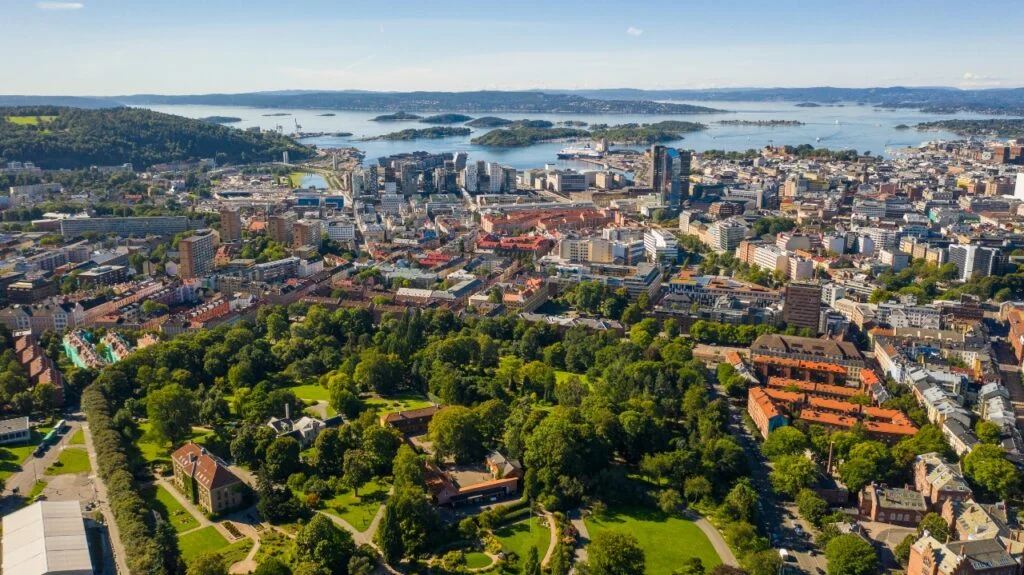
Oslo begins with a natural advantage and a political difficulty. It is a capital of modest scale by global standards, set between the Oslo Fjord and forested hills, with everyday access to water and woodland woven into civic identity. Its urban area is greener than many capitals, yet the city is still a real city: growing, building, pricing people out, and carrying the infrastructure burdens of the late twentieth century. In the city’s own recent account, Oslo’s population has now passed 700,000; 27 per cent of the urban area was zoned as green in 2021, while 47 per cent was covered by vegetation.²
That geography helps, but it does not save Oslo from modern urban contradictions. The capital may be surrounded by nature, yet much of its everyday environmental stress is concentrated where cities usually store it: along major roads, in central corridors, in construction zones, and in the hidden systems of heat, waste, sewage, freight and materials. Oslo’s achievement has not been to escape those pressures, but to force them into the centre of government. The signature instrument is the climate budget: a system that translates headline targets into sectoral measures, responsible agencies, and expected cuts, then revisits them year by year like a financial ledger with atmospheric consequences.³
The pressures
The numbers explain why Oslo’s self-image as a green capital could never rest on scenic beauty alone. In the 2022 emissions inventory, road transport still accounted for 44 per cent of the city’s direct greenhouse-gas emissions. Waste incineration and energy supply contributed 27 per cent, and other mobile combustion — much of it construction diesel — another 14 per cent. Emissions had fallen 28 per cent from 2009 to 2022, and 30 per cent by 2023 according to the city’s latest public status page, but that still left a long distance to the official 2030 target of a 95 per cent cut in direct emissions.³ ⁴
Air quality has improved, but Oslo is not finished with the health burden of traffic. Norway’s Environment Agency says nitrogen dioxide levels have fallen and that, after 2018, Oslo no longer breached the existing legal NO₂ limit values. Yet the same agency warns that new EU air-quality rules adopted in 2024 will be stricter, and that more municipalities may breach the tightened limits once those standards are incorporated into Norwegian law. Progress, in other words, has already been overtaken by a higher bar.⁵
There are social pressures too. Oslo’s own five-year sustainability report notes high property prices, pockets of economic inequality, and the uneven geography of pollution and noise. Surveys suggest people are happier with air quality, traffic levels and park use than they were in 2018, but the city also acknowledges that air and noise pollution remain greatest on major roads and in central districts. A green transition that improves averages while leaving exposure concentrated among those who live and work by the hardest edges of the network is not yet a settled success.²
What the city is doing
Oslo’s most visible revolution has taken place on the road. Electric cars now account for about 40 per cent of private vehicles, and around 90 per cent of new car sales in 2024 were electric, according to the European Commission’s summary of the city’s five-year report. The city has used a mix of tools to get there: toll-ring incentives, parking measures, charging build-out, public procurement, and a wider national tax environment that has made battery vehicles commercially irresistible. The point is not that Oslo abolished the car. It changed the economics of what kind of car most people buy.⁶ ⁷
Public transport has been pushed along the same arc. Ruter, the regional transit authority, reported that 80 per cent of buses in regular service in Oslo were emission-free at the beginning of 2024, after the rollout of large fleets of new electric buses in the inner city and east of the city. The same programme has been extended to ferries and regional bus contracts, with Ruter still targeting an emission-free public transport network across Oslo and Akershus by 2028. This matters because Oslo’s model is not simply private electrification. It is municipal and regional electrification, carried through contracts, depots, charging infrastructure and operating discipline.⁸
Construction is where Oslo has been unusually bold. The city has long required fossil-free municipal construction sites; from 1 January 2025 it moved to require zero-emission machinery on city-managed sites. According to reporting from 2025, municipal sites were already 98 per cent fossil-free in 2023, and, on projects managed by the urban environment agency, roughly two-thirds of machine hours in 2024 were powered by electricity rather than biofuels. The environmental gain is obvious. The sensory gain is easy to forget but equally urban: less exhaust, less noise, less of the metallic aggression that makes road works feel like an occupation.¹ ⁹
Oslo has also treated energy as a planning problem rather than merely a supply problem. District heating covers roughly a fifth of the city’s heating needs, with a mix that still relies heavily on waste-to-energy plants but also incorporates recovered heat, including a sewage-heat plant at Skøyen that processes around 3,800 cubic metres of sewage per hour and supplies enough heat for about 13,000 apartments. The city’s new energy-planning tool, launched in 2025, is designed to make grid constraints, district-heating opportunities, and local energy potential visible early in zoning and development decisions. This is a quieter form of climate policy than a bike lane or a new tram, but it may prove just as important.¹⁰
Then there is the harder industrial piece: waste. Oslo’s main waste-to-energy plant at Klemetsrud is fully integrated with the district-heating network, and the city has bet heavily on carbon capture to deal with emissions that electrification cannot touch. The climate budget now says a final investment decision to resume construction was made in January 2025 and that operations are expected to start in the third quarter of 2029. Earlier city planning documents estimated that carbon capture at Klemetsrud could reduce emissions from waste incineration and energy supply by around 60 per cent in 2030, with the full treatment effect equivalent to just under 165,000 tonnes of fossil CO2e.⁴ ¹¹
Oslo’s green turn is not only mechanical. It is also hydrological and ecological. The city requires stormwater management in planning cases, continues to strengthen blue-green infrastructure from the forested hills through the urban fabric to the fjord, and has made a point of reopening buried watercourses. The five-year report highlights peatbog restoration, flower meadows for pollinators, fjord clean-ups, and the steady expansion of green areas even as population rises. The blue-green factor — a planning tool used to safeguard waterways, vegetation and open green structure in construction projects — is part of this same administrative ecology.² ¹²
What is working — and for whom
Something real has happened in Oslo. Greenhouse-gas emissions have fallen materially over the past decade and a half. Municipal operations cut their own emissions by 86 per cent between 2012 and 2022. Household waste has declined. Air quality has improved. Walking remains a serious part of daily movement: the European Commission notes that 40 per cent of trips in 2023 were made on foot. Car-sharing has also been given physical room in the city, with nearly 1,000 dedicated spaces. This is what a green transition looks like when it leaves traces not only in policy documents but in travel habits, procurement standards and ordinary street life.² ⁶
Oslo has also shown that climate governance can be made mundane in the best sense. The climate budget does not make politics disappear, but it does make evasion harder. It asks each sector what it will do, how much it expects to cut, what it needs from national government, and what happens if the numbers no longer add up. Many cities have climate targets. Fewer have built a municipal culture in which those targets are tied to named measures, budget lines and follow-up routines. That is one reason Oslo matters well beyond Norway.⁴ ⁷
Contradictions, failures, and greenwashing risks
But Oslo is not a finished model. Its own climate-budget pages show the scale of the gap: direct emissions are down 30 per cent from 2009, while the current package of adopted measures is estimated to deliver a 70 per cent reduction by 2030 — substantial, but still well short of the 95 per cent target. The city is candid that some of the biggest remaining cuts depend on difficult measures, national approvals, new legal authority, or technologies not yet operating at full scale. Klemetsrud’s carbon-capture project is crucial precisely because Oslo still burns a great deal of waste. A green city that depends on incineration is greener than it was, but not yet clean in any absolute sense.⁴ ¹¹
Road space remains another unresolved truth. Oslo’s cars have become cleaner, but the city is not car-free, and perhaps never will be. The supporting material for the 2025 climate budget notes that the number of cars per 1,000 inhabitants has remained roughly stable at around 360 in recent years. It also notes that car use is highest in the outer city, where public transport, cycling and walking are less developed. Electrification removes tailpipe emissions; it does not by itself solve congestion, land consumption, sedentary transport habits, or the spatial unfairness of districts built around car dependence.³
Some of Oslo’s own measures also remain under-evaluated. The climate budget notes that no systematic evaluation of the city’s parking policies has yet been conducted. In blue-green planning, meanwhile, a 2026 peer-reviewed study found that Oslo’s Blue-Green Factor may bias developers toward low-cost, lower-performing measures such as simpler vegetation layers, while more complex installations — rain gardens, intensive roofs, green walls — often provide greater ecological benefit at higher cost. That is a useful warning. A city can have a sophisticated planning tool and still discover that the incentives inside the tool are not yet aligned with the ecosystem services it claims to prize.¹² ¹³
Construction is another frontier where leadership is real and difficulty is real. Oslo’s own modelling says the data on greenhouse-gas emissions from construction sites is incomplete and highly uncertain. Industry groups have also argued that not all electric machinery is yet available and that zero-emission requirements can raise costs. Oslo may be right to push the market forward anyway. But it is better to see this for what it is: not a frictionless victory, but an industrial transition in which the city is choosing to bear some of the early inconvenience in order to drag a wider supply chain with it.¹ ⁹
The future vision
The next phase of Oslo’s project is more demanding than the first. The city’s 2030 goals do not stop at direct emissions. They also include lower indirect emissions, 10 per cent lower total energy consumption than in 2009, stronger climate adaptation, and better protection of natural carbon sinks in vegetation and soils. Current planning work reaches from floodways and stormwater retention to more nature-friendly forestry, energy-data platforms, circular construction, and the possibility of tighter rules for zero-emission construction and commercial transport. By this point, Oslo is not merely trying to buy cleaner vehicles. It is trying to govern metabolism.⁴ ⁷
That ambition is why Oslo deserves attention. Not because it has found some Nordic shortcut to ecological innocence, but because it has accepted that a city becomes greener through procurement clauses, heat maps, toll categories, planning norms, sewage pumps, battery depots, reopened streams, and the awkward persistence of follow-up. Climate policy here is less a vision board than a filing system. That may sound unromantic. It is also, in municipal terms, close to revolutionary.
Conclusion
Oslo is one of the most serious green-city experiments now under way, but its achievement lies less in perfection than in method. It has shown that a city can embed climate goals in budget practice, use public purchasing power to alter markets, and push decarbonisation into transport, construction, heat and stormwater at once. It has also shown the limits of easy narratives. Electric cars do not erase car dependence. Waste-to-energy is not the same as circularity. A blue-green tool can still under-reward deeper ecology. And a capital that looks exemplary in European comparison can still be chasing a target that recedes as the hard emissions remain.² ⁴ ¹³
What Oslo offers, then, is not a fantasy of the completed green city. It offers a sterner and more useful lesson: that urban sustainability is an administrative craft, a sequence of enforceable decisions, and a willingness to keep going after the applause. In that sense the city’s greatest innovation may not be the electric bus or the silent excavator, but the insistence that climate action belongs inside the everyday machinery of government. For any city that claims to be serious, that is where the test begins.
Endnotes
1. City of Oslo / Klimaetaten, “Sites without sound: Oslo leads in quiet, low-emission electric construction,” reporting cited from The Guardian, 10 January 2025.
2. Klimaetaten, “European Green Capital – Oslo’s 5 year report,” 27 January 2025; European Commission, “Once a green capital, always a green capital: Oslo’s continued path to sustainability,” 4 February 2025.
3. Klimaetaten, Supporting Material for the Climate Budget 2025, 10 March 2025.
4. Klimaetaten, Oslo’s Climate Budget main page and Climate Budget 2026 status pages, accessed March 2026.
5. Norwegian Environment Agency, “Nitrogenoksider (NOx),” updated 2025.
6. European Commission, “Once a green capital, always a green capital: Oslo’s continued path to sustainability,” 4 February 2025.
7. Klimaetaten, Climate Budget 2023 and Supporting Material for Climate Budget 2025, on toll-ring, parking, and transport measures.
8. Ruter, Annual reporting and “The goal is emission-free public transport,” accessed 2025–2026.
9. The Guardian, “Sites without sound: Oslo leads in quiet, low-emission electric construction,” 10 January 2025; Klimaetaten, Supporting Material for Climate Budget 2025.
10. Klimaetaten, “Bringing you heat that’s been extracted from your sewage,” and “Energy planning tool,” 2025.
11. City of Oslo / NetZeroCities, 2030 Climate Neutrality Action Plan; Klimaetaten, Adopted Measures in the Climate Budget 2026.
12. Klimaetaten, Sustainability Report for the City of Oslo; 2030 Climate Neutrality Action Plan; European Green Capital five-year report.
13. Maximilian Nawrath et al., “Challenges in incentivising ecosystem services in urban planning: Oslo’s Blue-Green factor biases blue-green infrastructure design towards low-cost measures,” Landscape and Urban Planning 268 (2026).
Source Note
This article draws primarily on official Oslo climate and planning documents, the city’s climate-budget materials, the European Commission’s 2025 summary of Oslo’s post–Green Capital progress, Ruter reporting on public transport electrification, the Norwegian Environment Agency on air quality, and a recent peer-reviewed study on Oslo’s Blue-Green Factor. I have also used carefully selected journalism, particularly on zero-emission construction, where on-the-ground reporting adds texture that policy documents alone cannot.