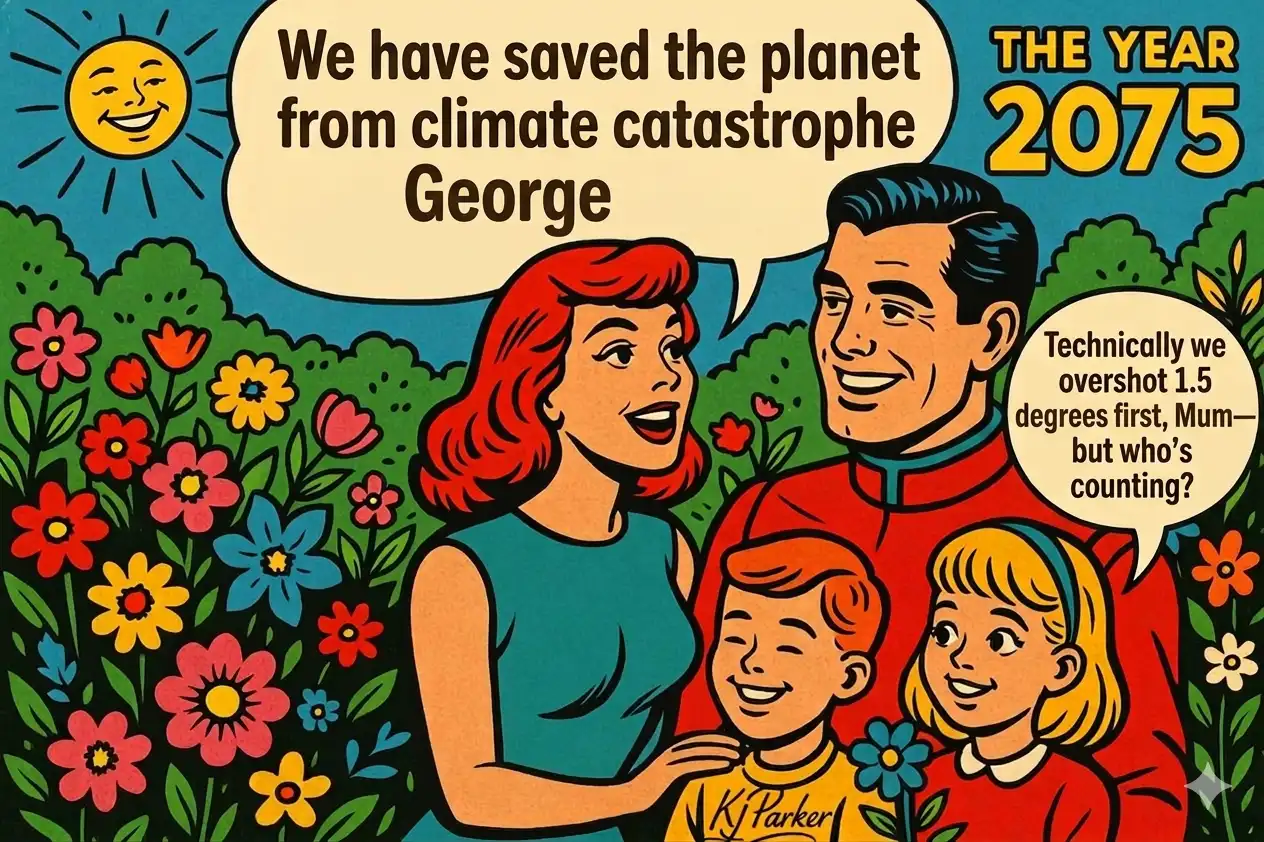

This is an updated and revised version of a piece that I published last year. Regrettably, all is not well in the golden valley of apricots when it comes to climate change reversal, it just keeps getting hotter and the weather wilder. All is not lost though fellow humans. Through a supreme act of collective will we can take the necessary action to change our current course – no, really, we can, I mean it, really, absolutely possible, really, totally doable, easy as…………. Kevin Parker -Publisher
Prologue: The Crossroads of Now (May 2026)
In the spring of 2026, humanity stands at a fateful crossroads — and the ground beneath it has shifted since this blueprint was first sketched a year ago. The numbers that frame the choice have grown starker, not gentler. Global greenhouse-gas emissions did not bend downward; in 2024 they climbed to a new record of roughly 57.7 gigatonnes of CO₂-equivalent, a 2.3% rise over the previous year and more than four times the average growth rate of the 2010s.
That record1 was matched by another the world had long dreaded: 2024 became the first full calendar year in which the global average temperature exceeded 1.5°C above pre-industrial levels — about 1.55°C by the World Meteorological Organization’s consolidated estimate — with 2025 following close behind as one of the warmest years ever recorded, leaving the multi-year average flirting with the very threshold the Paris Agreement was built to defend.2 A single year above 1.5°C is not the same as breaching the long-term goal, but the symbolism was unmistakable, and the physics underneath it indifferent to symbolism.
The window to limit warming to 1.5°C has narrowed to a sliver. The world’s leading scientists now calculate that, to keep that goal within reach, emissions must fall roughly 40% below 2019 levels by 2030 and around 55% by 2035 — with barely five years left to begin the steepest part of that descent. Yet behind those percentages lies the same stark choice as ever: one path leads toward irreversible tipping points and climate upheaval; the other toward a sustainable renaissance for our planet. Climate change is no longer a distant speculation but a lived global reality, with each year testing the resilience of communities through unprecedented heatwaves, floods, and wildfires.
At roughly 1.3–1.5°C above preindustrial levels, signs of strain abound — from bleached coral reefs to megadroughts — foreshadowing far worse if we delay action. Scientists caution that even 1.5°C of warming could trigger multiple self-perpetuating “tipping points,” such as the collapse of the West Antarctic ice sheet or abrupt permafrost thaw, locking in metres of sea-level rise and amplifying warming feedbacks.3 The stakes of inaction are civilisational. But so too are the rewards of bold collective effort.
The politics, too, have hardened. As this blueprint is revised, the world’s largest historical emitter — the United States — has once again withdrawn from the Paris Agreement, an exit that took formal effect in January 2026 and that kept its negotiators away from the year’s climate summit altogether. And that summit itself, COP30 in Belém — convened on the Amazon’s edge as the “COP of implementation” and timed to the Paris Agreement’s tenth anniversary — could not agree a roadmap to phase out fossil fuels, even as more than eighty nations pushed for one. The breakthrough many hoped for slipped away in the final hours; the host presidency salvaged the moment only by launching voluntary roadmaps on fossil fuels and on forests outside the formal text, alongside a pledge to triple adaptation finance. The lesson of the past eighteen months is sobering: the turn this blueprint describes must now begin from a worse position, and against stiffer headwinds, than its first draft assumed.
And yet the case for hope is not naive — it is empirical. In the same eighteen months, the world added more clean power than in any year in history, solar costs kept falling past the point of plausibility, and a clear majority of the global economy now sits in countries whose emissions have already peaked or begun to fall. Amid crisis, in other words, a vision for planetary healing has not merely survived; it has gathered material force. This narrative chronicles the fifty-year journey from 2025 to 2075 in which humanity mobilises a unified strategy to first stabilise, then gradually reverse global warming. It is a story of radical transformation — of energy, industry, land, and society — undertaken with urgent resolve and guided by principles of justice, innovation, and cooperation. It is a story that balances realism with hope: acknowledging the formidable hurdles ahead, yet illuminating a path to a cooler, more equitable world by the late 21st century.
What follows is the blueprint of that journey, told decade by decade. In these pages, policy meets poetry: the hard science of emissions trajectories entwines with the spirit of global solidarity. From the “Great Deceleration” of emissions growth in the 2020s, through a wholesale economic Transformation in the 2030s and 2040s, to the dawn of an age of Drawdown and Restoration in the 2050s and beyond — each chapter of this timeline builds on the last. Along the way, technological breakthroughs spark new possibilities even as age-old wisdoms find their voice in modern stewardship. Renewable energy scales at historic speed; forests and oceans become partners in carbon balance; emerging technologies like green hydrogen and direct air capture mature from nascent experiments to cornerstone solutions. Societies reinvent themselves, reorienting economies around circular principles and regeneration instead of waste and extraction. Importantly, those historically least responsible for climate change — indigenous peoples, developing nations, the poor — move from the margins to the centre of climate leadership, infusing the global project with values of equity and respect for nature. Each step is informed by the latest science and anchored in the ethic that the burdens and benefits of climate action must be shared fairly across nations and generations.
Looking back from 2075, the arc of this half-century journey reveals a humanity that, when pressed by crisis, found the courage to remake itself and forge a new covenant with the planet. It is not a tale of utopia or simple triumph; setbacks and uncertainties persist, and the impacts of earlier decades of pollution still echo. But it is a testament to what is possible — a future in which the long rise of global temperature is not only halted but gradually reversed, and in which the world that today’s youth inherit is healing, resilient, and profoundly more sustainable than the one we knew before.
2025–2035: The Great Deceleration — Turning the Tide
The first pivotal decade of action, 2025–2035, will come to be known as the “Great Deceleration.” Its overarching goal is as straightforward as it is monumental: bend the upward curve of emissions sharply downward. But this blueprint can no longer pretend the decade opened on schedule. Its first years were, candidly, a stumble: emissions rose to records in 2024, 2024 became the first calendar year above 1.5°C, a major power stepped back from the Paris framework, and the Belém summit of 2025 fell short of the fossil-fuel roadmap the science demanded. The deceleration this chapter describes therefore begins later and from a higher peak than once hoped. The wager of the decade is that the turn, though delayed, is not denied — that by the early 2030s the upward curve finally crests and the world is set on a path toward roughly a 40% cut from 2019 levels by 2030 and far deeper cuts thereafter. That pivot, when it comes, will be the result of an unprecedented alignment of policy, technology, and public will coalescing to meet the moment of truth.
Energy Revolution. The groundwork is being laid with an all-out push to transform the energy sector, the largest source of emissions — and here the early returns are genuinely encouraging. In 2024 the world added a record 585 gigawatts of renewable capacity, with solar alone contributing some 452 GW, the fastest annual growth on record. The catch is scale: even this record falls short of the roughly 16.6% annual growth needed to meet the global goal of tripling renewable capacity by 2030, and the gains remain wildly uneven — Asia accounted for over 70% of new capacity while Africa added barely a sliver. The task of the decade is therefore not to invent the technology but to triple its deployment and spread it justly, pushing toward 800–900 GW of new solar and wind each year by the early 2030s — a buildout on a scale never before sustained. Solar farms blossom across deserts and coastlines, while wind turbines become fixtures from the North Sea to the Chinese plains. By 2035, in this scenario, renewables provide a major share of global electricity, outcompeting and beginning to displace coal and gas.
The parallel revolution in transportation accelerates in earnest. Electric vehicles (EVs) surge from niche to norm in leading auto markets, climbing toward half of new car sales worldwide by 2035. This is enabled by massive investment in battery gigafactories and charging infrastructure, as well as policy mandates in leading markets to phase out internal combustion engines — even as some governments wobble on their timelines. Meanwhile, long-haul sectors once deemed “hard to decarbonise” take bold first steps. The shipping industry launches its first fleets of ammonia- and hydrogen-powered vessels, and airlines begin blending sustainable aviation fuels at scale, inching toward an eventual break from jet fuel. The message becomes clear: the era of unabated fossil fuels is starting to sunset.
Nature as Partner. Equally important, humanity begins healing its relationship with nature, recognising ecosystems as powerful allies in the fight against climate change. A global movement takes shape to protect and restore carbon-rich landscapes — an undertaking often dubbed the largest ecological restoration project in history. By 2030, dozens of countries have embarked on reforestation campaigns, together planting and regenerating forests over hundreds of millions of hectares. Previously degraded lands return to life as new forests and agroforestry systems, capable of sequestering gigatonnes of CO₂ while reviving biodiversity. In tandem, regenerative agriculture spreads as a quietly revolutionary force across farms on every continent.
Techniques like cover cropping, no-till, and agroforestry that rebuild soil carbon and fertility begin turning farms into carbon sinks while improving food security and climate resilience. Experts estimate that enhancing soil carbon through widespread regenerative farming could feasibly sequester on the order of 20-plus gigatonnes of CO₂ by 2050, a meaningful wedge of mitigation in line with a 1.5°C pathway.4 Coastal and marine ecosystems — once overlooked — also earn new protection as frontline defences. Countries marshal resources to halt the destruction of mangroves, salt marshes, and seagrasses, recognising that these “blue carbon” habitats trap immense amounts of carbon and buffer communities against storms. Crucially, this ecological turn is guided by those who know the land best.
Indigenous peoples, long marginalised, are finally empowered as key leaders and stewards. Indigenous communities receive greater legal rights to their territories and direct funding support, in recognition that they safeguard an estimated 80% of the world’s remaining biodiversity.5 Their traditional knowledge — fire management, holistic agriculture, forest guardianship — becomes integral to national climate plans. (At Belém in 2025, indigenous delegations turned out in their largest numbers at any COP to date, a sign of how far this shift has already advanced.) This era marks a philosophical change: rather than viewing nature only as a victim of climate change, humanity embraces it as a partner in a grand symbiosis to stabilise the planet.
Economic Overhaul and Investment. Achieving this great deceleration requires reimagining the engines of the global economy. Governments and financial institutions orchestrate a massive redirection of capital from high-carbon to low-carbon activities, swelling annual global investment in climate solutions into the trillions. The aspiration for this decade is to reach roughly $3.5–4 trillion per year by 2030 in renewable energy, electrified transport, grid upgrades, and efficiency — several times the early-2020s level, and akin in scale to a wartime mobilisation. While staggering, the figure is put in perspective by comparison: humanity already spends comparable sums on far more destructive pursuits, from fossil-fuel subsidies to military budgets. Policymakers reframe climate investment not as economic burden but as the “greatest arbitrage opportunity” in history — a chance to swap volatile, finite fossil assets for sustainable industries that pay societal dividends for generations.
New green financial instruments proliferate: green bonds, climate infrastructure funds, and public–private “climate banks” channel savings into clean energy and resilience projects worldwide. Perhaps most game-changing, a price on carbon emissions edges toward the near-universal. Following early models in Europe and Canada, more countries — prodded by citizen demand and climate diplomacy — adopt meaningful carbon pricing, whether through taxes or cap-and-trade. In leading jurisdictions, carbon prices climb into the $75–100-per-tonne range that economists have long identified as critical for shifting investment away from fossil fuels. Simultaneously, governments move to eliminate the perverse incentives of fossil-fuel subsidies, redirecting those budgets toward clean energy and transition assistance. The global financial architecture itself begins to adjust, with institutions like the World Bank and IMF integrating climate risk into lending and increasing support for renewable projects in developing nations — the long, contested work of moving from the hundreds of billions pledged at recent summits toward the $1.3 trillion a year that the Baku-to-Belém roadmap names as the developing world’s real need by 2035.
Circular Economy and Behavioural Shifts. Underpinning these changes is a quieter revolution in how society produces and consumes. The concept of a circular economy moves from slogan to operating principle across many industries. Companies redesign products for longevity, reuse, and recyclability, aiming to minimise waste and the need for virgin resource extraction. Major economies implement “right to repair” laws and extended producer-responsibility schemes, incentivising durable goods and remanufacturing.
These efforts begin to cut industrial emissions by reducing demand for energy- and carbon-intensive materials like steel, cement, and plastics — essentially “baking in” emissions cuts through smarter design and resource efficiency.6 Cities launch initiatives to become “zero-waste” and even net carbon sinks — using organic waste for compost and biogas, capturing CO₂ in building materials, and expanding urban forests. On the consumer side, cultural norms around food and mobility begin to shift. Plant-rich diets and alternative proteins gain mainstream acceptance, shrinking the climate footprint of agriculture and sparing forests from further conversion to pasture. Many urbanites embrace car-light lifestyles made possible by investment in public transit, bike infrastructure, and walkable planning. These behavioural shifts, individually small, aggregate to significant emissions savings and signal a broader transformation of values.
Global Solidarity and Justice. Importantly, the Great Deceleration is pursued with a consciousness of fairness and “common but differentiated responsibilities” — a principle tested, in these years, by the retreat of one major power and the hesitancy of others. A robust climate-justice movement insists that no community be left behind in the rush to decarbonise, and wealthy nations, recognising their historical responsibility for the bulk of atmospheric CO₂, are pressed to turbocharge support for developing countries’ transitions.
After years of delay, the long-sought Loss and Damage Fund was finally established under UN auspices and, by the mid-2020s, has begun disbursing resources — rebuilding communities after climate disasters and helping relocate those in irretrievably harmed areas — signalling to front-line nations that the world has not forgotten them.7 The unfinished business, made plain at Belém, is scale: pledges still lag the need, and the fight to triple adaptation finance is now an explicit plank of the global agenda rather than an aspiration. Meanwhile, coal-dependent regions from Appalachia to Shanxi pursue “just transition” programmes, with millions of fossil-fuel workers supported to retrain for careers in clean industries — from solar installation to electric-bus manufacturing — so that the clean economy creates broad-based prosperity rather than dislocation.
Indigenous and local community leaders are given formal roles in planning the restoration of forests, wetlands, and other natural areas — not only respecting their rights but improving outcomes, as studies show indigenous-managed forests have markedly lower deforestation rates and higher biodiversity than comparable lands.8 In sum, the ethos of “no one left behind” becomes a cornerstone of the climate blueprint in this decade, weaving social equity into the fabric of technical solutions — and, just as importantly, keeping the political coalition for ambitious action intact even when some governments waver.
By 2035, in this scenario, the results of the Great Deceleration are at last palpable. Global emissions, which kept rising into the mid-2020s, have crested and turned firmly onto a downward slope. The average carbon intensity of economies is dropping as clean technologies scale and old polluting infrastructure is retired. Urban air quality improves in cities that have curtailed coal power and traffic — a welcome co-benefit measured in lives saved. Perhaps most encouraging, the worst-case trajectories toward 3°C, 4°C or more are slowly taken off the table; under fully implemented pledges the projected end-of-century range has already edged down toward 2.3–2.5°C, and the task now is to close the gap between pledge and delivery. Still, there is no mistaking that this is only the opening battle in a very long war. Annual CO₂ emissions, while finally falling, remain on the order of 30-plus gigatonnes a year; atmospheric CO₂ climbs past 425 ppm. Climate impacts continue to worsen in the near term, for the warming already in the pipeline has not yet been reined in. Yet the significance of the moment cannot be denied: the juggernaut has begun to turn. The decade proves that rapid decarbonisation is possible and that nations can cooperate under a shared existential imperative even when one steps away. The stage is set for the next phase — one of sweeping transformation.
2035–2045: The Great Transformation — Reimagining Civilisation
If the 2020s were about hitting the brakes on emissions, the 2035–2045 period is about accelerating the transition to full speed. In these years the climate-action agenda graduates from emergency stabilisation to the complete Transformation of the global energy and industrial system. What began as a rapid but partial deployment of clean solutions evolves into a comprehensive overhaul of how humanity powers itself, moves goods and people, and manufactures the building blocks of modern life. The changes in this decade are not subtle; they are systemic and unmistakable, touching virtually every sector and region. By the mid-2040s, the foundations of a new carbon-neutral economy have been laid, and the world stands at the brink of an extraordinary milestone: peak global temperature.
Clean Energy Dominance. Renewable energy goes from upstart to the undisputed backbone of global power supply. Country after country smashes through previous targets as solar panels and wind turbines become ubiquitous features of landscapes and seascapes. By 2045, 80–90% of global electricity is generated from zero-carbon sources — predominantly solar, wind, hydro, and a growing fleet of next-generation nuclear and geothermal plants. Where renewables overproduce during sunny or windy periods, innovative grid management and storage allow excess power to be banked as hydrogen, in batteries, or in large thermal reservoirs, enabling round-the-clock clean power. The coal industry, dominant just two decades prior, has all but entered history; remaining plants are closed or converted. Natural gas, once cast as a “bridge fuel,” sees its bridge ending, relegated to a balancing role or to making hydrogen with carbon capture. Solar electricity becomes astoundingly cheap — under $0.01 per kWh in prime locations by the early 2040s — driving late adopters to abandon fossil power as a losing proposition.
Green hydrogen production scales from pilot projects to a major new global industry. By 2040, massive hydrogen “gigafactories” — powered by dedicated solar and wind farms — churn out hundreds of millions of tonnes of clean hydrogen annually, the feedstock for decarbonising heavy industry and fuelling long-distance transport. Steelmakers increasingly switch to hydrogen-based direct reduction, cutting coal out of steel production. The once-daunting challenge of cement is also being overcome: new chemistries and kiln processes, some of which mineralise CO₂ into the cement itself, mean concrete can effectively trap carbon rather than emit it. The concept of “carbon-negative materials” takes hold — materials that absorb more CO₂ in production than they emit — turning buildings into another tool for drawdown.
Electrification Everywhere. The transportation sector undergoes nothing short of a rebirth. Electric vehicles become the default mode of mobility on roads worldwide; by the early 2040s, over 90% of new cars are electric (or hydrogen fuel-cell in some heavy-duty uses), and many major cities have banned the sale of new internal-combustion vehicles. Oil demand drops so sharply that oil-export economies are forced into rapid diversification. Streets from Los Angeles to Mumbai grow quieter and cleaner as fleets of electric buses, vans, and rideshare cars hum along without exhaust. Personal car ownership begins to decline in many urban centres, replaced by autonomous electric ride-hailing and expanded transit, freeing road space that planners repurpose into parks, pedestrian zones, and bike superhighways.
Intercity transport transforms too: high-speed rail networks spread across continents, offering a low-carbon alternative to short-haul flights. Where flying remains necessary, the aviation industry makes vital progress — advanced biofuels and synthetic electrofuels (made from captured CO₂ and green hydrogen) power a significant share of flights, and the first hybrid-electric and hydrogen aircraft enter commercial service on regional routes. Shipping innovates with green ammonia and high-tech sails. Entirely new supply chains rise to support electrification: mining and recycling of critical minerals like lithium, cobalt, and rare earths become strategic industries, with strong safeguards to avoid replicating old extractive harms, while solid-state batteries with double the energy density of early-2020s models reach the market by 2040, extending EV ranges and enabling electric aviation.
Industry’s Renaissance. The 2040s are when heavy industries — long the stubborn holdouts — finally clean up at scale. Green steel becomes a booming business as more producers adopt hydrogen-based methods; by 2045 an estimated 70% of global steel is made with green processes. Cement manufacturers deploy carbon capture and novel chemistries, some plants achieving net-negative emissions by mineralising captured CO₂ into aggregates. The chemicals and plastics sector revolutionises its feedstocks, replacing petroleum with bio-based inputs and recycled carbon. A circular carbon economy takes hold in manufacturing — capturing CO₂ from industrial processes and repurposing it as raw material for chemicals, fuels, and materials, closing the carbon loop. Carbon capture and utilisation turns emissions into products; carbon capture and storage permanently buries what cannot be reused. What began as expensive demonstration in the 2020s becomes affordable necessity, as capture costs fall and carbon pricing makes emitting costly. Excess heat from data centres warms nearby homes; captured CO₂ from cement kilns feeds adjacent greenhouses. By eliminating waste and reusing outputs, industries cut emissions and operating costs alike.
Global Governance and Cooperation. This phase sees leaps in international cooperation, as climate action proves a great geopolitical unifier of the mid-21st century — a striking reversal of the fragmentation of the mid-2020s.
Building on the United Nations’ 2024 Summit of the Future and its Pact for the Future — which included a Declaration on Future Generations committing governments to weigh the rights of those not yet born9 — new forums institutionalise the coordination of climate action, technology-sharing, and enforcement. High-ambition coalitions, or “climate clubs,” agree to exceed baseline Paris targets and harmonise carbon pricing and standards; their carbon border adjustments effectively tariff carbon-intensive imports, incentivising outside countries to raise their game or face penalties. Over time, more nations join, spreading stringent policy through trade. Multilateral banks and the private sector collaborate through a Global Climate Finance Authority — a “Climate Marshall Plan” — mobilising, cumulatively, vast sums for clean infrastructure and resilience in developing countries, helping emerging economies leapfrog to clean pathways. The spirit of cooperation extends even to nature itself: several countries grant legal personhood to rivers, forests, and glaciers, allowing guardians to speak for them in court.
Socio-Ecological Awakening. At the cultural level, the 2040s witness what historians later call a “social tipping point” — a widespread awakening to values of sustainability, justice, and shared destiny. Education systems integrate climate science and ecological literacy into curricula; a generation graduates with an intimate understanding of humanity’s dependence on environmental health. Terms like degrowth, circularity, and regeneration move from academic jargon to mainstream discourse. A renaissance in arts and media celebrates harmonious human–nature relationships, countering decades of dystopian narrative.
Religious and spiritual communities across faiths find common ground in calls to care for Creation, lending moral narrative to the technical work of decarbonisation. Youth climate movements evolve into formal councils advising governments, keeping intergenerational accountability front and centre. The Declaration on Future Generations proves influential, prompting a number of countries to create official “Guardians” or ombudsmen for the unborn and to embed long-term thinking into law.9 Societies increasingly frame climate action not as sacrifice but as a journey toward a better quality of life — cleaner air, healthier communities, and economies powered by the limitless gifts of sun, wind, and human ingenuity.
By the mid-2040s the cumulative impact begins to manifest in the atmosphere itself. After edging up for decades, the growth of global temperatures slows. Models and observations suggest that, if mitigation and removal stay on track, peak warming likely arrives around the late 2040s at roughly 1.6–1.7°C above preindustrial — narrowly overshooting the 1.5°C goal but averting the 3–4°C futures that once loomed.10 The moment is met with mixed emotions: relief that catastrophe has been averted, sober recognition that even 1.6°C brings dangerous disruption. Glaciers and ice sheets still melt; seas still rise, if on a slower curve; extreme weather still intensifies, hurting vulnerable regions most. The work is far from over. Yet hitting peak temperature is a turning point that proves society has the tools to stop climate change from running endlessly out of control. The focus can now shift from stopping the problem worsening to actively beginning the long work of repair.
2045–2055: The Net-Zero Pivot — From Stabilization to Drawdown
The year 2050 arrives as a symbolic milestone and a sobering checkpoint. Long cited in scientific reports and political pledges as the target for worldwide net-zero, it is, by most accounts, met: around 2050, for the first time since the Industrial Revolution, net anthropogenic CO₂ emissions reach zero on an annual basis.11 The roughly 10% of emissions still coming from stubborn sources — methane from agriculture, CO₂ from certain industries — is entirely balanced by carbon removal. Flags fly and church bells ring in some cities to mark the “Zero Year.” Yet celebration is muted by reality: atmospheric CO₂ has peaked above 430 ppm and global temperature lingers well above the preindustrial norm. The world has braked the climate train, but it still teeters near the edge of danger. The imperative of the decade is thus to pivot from stabilisation to active reversal — entering the era of net-negative emissions, drawing down more carbon than we emit, year after year, to slowly undo centuries of accumulation.
Carbon Removal Becomes Big Business. In the 2050s, removing CO₂ from the atmosphere graduates from a fringe idea to one of the largest industries on Earth — though the journey there is longer than mid-2020s optimists assumed. As this is written, durable removals are still measured in the hundreds of thousands of tonnes a year, even as advance-purchase contracts have begun surging into the tens of millions of tonnes; the gap between contract and delivery is the defining challenge of the field’s adolescence. The scenario that follows assumes that gap is closed.
Governments and the private sector pour resources into a diverse portfolio of Carbon Dioxide Removal (CDR) strategies, treating it as a second front in the war on climate change. Direct air capture (DAC) — machines that scrub CO₂ directly from ambient air — sees a boom reminiscent of the rise of the oil industry a century prior, with gigantic DAC farms erected in arid regions near geological storage. By the mid-2050s, dozens of DAC hubs each capture on the order of millions of tonnes a year, collectively drawing down several gigatonnes annually; innovation and scale have driven costs below $200 per tonne and toward the $100 mark.10 Captured CO₂ is pumped deep into secure geological formations — saline aquifers, basalt, depleted oil fields — locking it away for millennia in a reverse fossil-fuel industry. Bioenergy with carbon capture and storage (BECCS) contributes too, generating power from sustainable biomass while capturing the resulting CO₂ for net-negative energy.
Nature-based removal enters a renaissance. A “restoration economy” blossoms, employing millions worldwide in planting and tending forests, mangroves, peatlands, and wetlands, with indigenous communities often at the helm, blending traditional knowledge with modern science. By 2055, global forest cover has expanded dramatically — some 350 million hectares of new forest since 2025, an area larger than India. On farmland, soil-carbon sequestration scales through regenerative practice, while biochar production becomes widespread and enhanced weathering — spreading crushed silicate rock on fields — gains traction in the tropics. Scientists cautiously trial ocean-based methods, from controlled alkalinity enhancement to kelp cultivation. By the mid-2050s, total removal capacity reaches the order of 5–6 Gt CO₂ per year and rising, aligning with scientific calls for roughly 7–10 Gt per year by mid-century to meet the Paris goals.12 A Global Carbon Removal Certification scheme under the UN ensures rigorous monitoring and verification, so that claims of “negative emissions” are credible and not overstated — a safeguard whose foundations are already being laid today in the first generation of high-integrity removal standards.
Beyond Fossil Fuels — The Last Gasp. As removals scale, the world pushes any remaining fossil-fuel use toward obsolescence. By 2050, wind and solar, augmented by advanced storage, meet the vast majority of electricity needs; the few coal or gas plants still running are mostly fitted with capture or kept only for critical backup. Oil dwindles to niche uses — certain chemical feedstocks, legacy aviation — where synthetic and bio-based alternatives progressively take over. Huge reserves of renewable hydrogen, stored in underground caverns, carry energy through winter and drought. Some nations deploy space-based solar power, beaming energy from orbit. A milestone of the early 2050s is the commercialisation of nuclear fusion, which finally delivers net power to the grid; though its share is modest by 2055, its psychological impact is profound — humanity has tapped the same energy source as the sun.
Fossil-fuel-centric industries undergo managed decline or reinvention. Surviving oil companies become energy companies focused on renewables, hydrogen, and carbon management; old refineries turn to biofuels, gas pipelines to hydrogen or CO₂. Regions that thrived on extraction diversify into manufacturing turbines and electrolysers and into environmental remediation. Global oil demand, having peaked in the 2020s, is by 2050 a fraction of its former self. Geopolitics evolves accordingly: the influence of petrostates wanes while countries rich in critical minerals or clean-energy exports gain new importance. The air is literally clearer — satellite imagery shows far less aerosol pollution than in 2020, confirming the near-term public-health dividend of leaving fossil fuels behind.
Justice and Adaptation. Despite reaching net zero, the world of 2050 still grapples with changes already set in motion. Roughly 1.6°C of warming has brought higher seas that swallow low-lying coasts and atolls, shifting rainfall that forces agriculture to adapt continuously, and biodiversity losses that diminish ecosystems like tropical coral reefs even amid restoration. Adaptation and justice are therefore no less urgent than mitigation. The global community strengthens support for sea walls, urban cooling, drought-resilient water systems, and social safety nets for the most vulnerable. The Loss and Damage Fund, now a permanent facility funded by novel sources such as air-travel levies and fossil-fuel fees, delivers finance to communities recovering from disaster. Historical emitters continue to acknowledge their climate debt through finance, technology transfer, and capacity-building — making cutting-edge removal and clean-energy technologies available to poorer nations via open patents or subsidised licensing. Indigenous leadership remains central to ecosystem-based adaptation, from controlled burns to mangrove restoration.
By 2055, the planet’s vital signs hint at stabilisation. Emissions are net zero and poised to go net-negative; atmospheric CO₂, having peaked, is no longer rising and is projected to begin a slow decline if negative emissions can be sustained. The world is, in effect, at the pivot point between a warming phase and a cooling phase. No one mistakes this for mission accomplished — it feels like reaching base camp on Everest, a moment for a deep breath with the hardest ascent still ahead. The collective mantra becomes “hold the line and start the recovery.”
2055–2075: Restoration and Renewal — The Long Cool Down
The final two decades of this saga are characterised by Restoration and Renewal. Having achieved net-negative emissions, humanity sets about the painstaking work of cooling the planet and repairing ecosystems in a journey spanning lifetimes. Early signs of climate healing tentatively emerge — small victories that affirm the chosen course, even as vigilance is needed to prevent backsliding. This era also solidifies deeper shifts in how civilisation relates to nature and to itself, cementing a paradigm of stewardship and intergenerational responsibility.
Earth’s Vital Signs Stabilise. In the 2060s, for the first time in at least two centuries, global average temperatures begin to decline — very slowly, but measurably. After hovering near a peak in the high 1.5s°C, the temperature dips a few hundredths of a degree, then a tenth, signalling the onset of a gentle cooling trend. This validates the massive effort to achieve sustained net-negative emissions on the order of 5–10 Gt CO₂ each year, drawing down the atmospheric concentration bit by bit. By 2075, atmospheric CO₂ trends closer to 400 ppm — still far above the preindustrial ~280 ppm, but significantly down from its mid-century peak above 440 ppm. Every fraction of a degree cooled means tangible relief: fewer extreme heatwaves, a slowdown in sea-level rise, breathing room for stressed ecosystems.
One closely watched indicator is the polar regions. The Arctic, whose summer sea ice shrank dramatically through the first half of the century, shows hints of recovery in late-summer extent by the late 2060s — patches of thin summer ice persisting where none had a few decades earlier, helped by cooler global temperatures and cautiously tested regional interventions. In Antarctica, the West Antarctic Ice Sheet, whose stability scientists feared might already be compromised, appears to avoid wholesale collapse; aggressive measures to cool waters around key ice shelves help prevent worst-case scenarios, and the melt rate stabilises by the 2070s. The Greenland Ice Sheet sees slightly reduced melt seasons as temperatures edge down. These trends are far from full recovery, but the fact that Earth’s great ice masses are no longer racing toward oblivion is a vast relief.
Ecosystems respond in varied ways. Coral reefs, nearly written off after repeated mass bleachings, get a second chance: heat-tolerant “super corals,” bred and transplanted over years, recolonise parts of reefs that had gone ghostly white, with modest but heartening revival in places like the Great Barrier Reef and the Maldives. The Amazon, which earlier in the century stood perilously close to a dieback tipping point, is restored in part through reforestation, improved fire management, and indigenous-led monitoring — by 2075 partly re-greened and regaining its role as a net carbon sink rather than a source. Species on the brink begin to rebound as habitats reconnect through wildlife corridors. Most symbolically, the late 2060s see permanent snow return to certain ranges and a few glaciers creep marginally forward instead of back — small examples that, with a cooler atmosphere, the cryosphere can heal on human timescales.
Planetary Stewardship and Governance. As the latter 21st century unfolds, the institutional and cultural frameworks to sustain a stable climate are firmly entrenched. Environmental governance evolves into what many call “planetary stewardship.” A Global Climate Authority takes on responsibility not just for emissions but for maintaining a healthy Earth system in perpetuity, coordinating everything from carbon-removal quotas to biodiversity targets as a guardian of the global commons. Nations retain sovereignty but embrace shared sovereignty over issues — climate, oceans, the ozone layer — that transcend borders, and by 2075 routine “climate-compliance” audits keep everyone honest long after the urgency of the 2020s has faded.
Crucially, the voice of future generations is institutionalised in governance. Inspired by the earlier Declaration on Future Generations, many jurisdictions incorporate “seventh-generation” thinking, drawn from indigenous principles, into law — requiring that major policies undergo impact assessments for their effects decades hence. Some countries seat youth and future-generation representatives with real power in parliaments or UN deliberations. The political climate stabilises around climate action: by the 2060s, essentially all major factions accept climate stability as a non-negotiable foundation for security and prosperity, and the climate denialism that still echoed in the 2020s has become an anachronism. A sophisticated global carbon-monitoring system, woven from AI and satellites, tracks atmospheric composition like a heartbeat, enabling dynamic balancing of the carbon cycle — an art and science akin to how central banks manage monetary policy.
Tending the New Economy. The late-century economy looks very different from that of the early 2000s: largely dematerialized, with more value from services and knowledge than heavy material throughput, and largely circular, with one process’s waste another’s raw material almost everywhere. Growth, where it occurs, means growth in knowledge, culture, and well-being rather than sheer consumption; a concept of “sufficiency” takes root — enough is as good as a feast. Earth’s population, having peaked mid-century, is more urbanized and better connected through clean transport, easing pressure on wild places. Cities are designed or retrofitted as “living ecosystems” that generate their own energy, grow food in vertical farms and community gardens, recycle water in closed loops, and thread green corridors throughout. Large-scale rewilding gains global traction: by 2075, bison and lynx roam parts of Europe unseen in centuries; tigers and elephants have wider corridors; indigenous-led initiatives restore bison to American prairies and reconnect forests for jaguars.
A New Ethos. Underlying all of this is a profound shift in values — an ethos summed up as “one planet, one community.” The climate struggle taught humanity a lesson in interdependence. By the 2070s, socio-ecological justice is mainstream: people widely accept that human well-being is inseparable from the health of the natural world, and that justice must extend across species and generations. The voices of previously marginalised groups — poorer nations, indigenous peoples, youth — carry significant moral weight, having proven instrumental in guiding the world through crisis. Earth’s cultural narrative, once dominated by stories of human dominion, has shifted to stories of collaboration with nature. In education, ecology and empathy are taught as core skills alongside mathematics and reading. Concepts like the “rights of nature” are legally recognised in many jurisdictions, granting rivers, forests, and other entities legal standing.
By 2075, those born in 2025 — now fifty — can look back in pride and some disbelief at the trajectory their world has taken. In their childhood the future looked increasingly dire; as they came of age they joined movements that demanded change; they witnessed the darkest hour when impacts ramped up, but also the mobilisation that met it. Now entering elderhood, they inhabit a world that, while not without problems, is firmly on a path to renewal rather than collapse. They tell their grandchildren of the scorching summers and smog-choked cities, and how things are different now: cleaner air, milder summers, more abundant wildlife, and a renewed sense of future. Humanity’s relationship with Earth has become one of humility and care — a stance of guardianship, comprehensive monitoring, ready response, and an ingrained culture of sustainability in everyday life. By 2075 the world has not “solved” climate change in the sense of reverting to a preindustrial climate — that world is gone — but it has succeeded in stopping the bleeding and beginning to heal.
Epilogue: A Vision Realised, A Vigil Kept
Standing at the threshold of 2075, we observe a world in renewal. Off the coast of a once-imperiled Pacific island, children snorkel in turquoise waters, pointing in delight at young corals re-colonizing a reef their grandparents feared would vanish forever. On a reclaimed grassland in North America, a herd of bison roams under the watch of tribal stewards, carbon-rich soil compacting beneath their weight as it did centuries ago. High above, a satellite network continuously measures the planet’s vital signs — CO₂, temperature, forest cover, ice extent — a technological guardian born from humanity’s vow never again to ignore warning signs. Each small recovery represents millions of lives and livelihoods secured.
The journey here was anything but easy. We faced down the inertia of the old ways, weathered economic and political storms — including, in the mid-2020s, the painful retreat of a major power and a global summit that fell short when the world most needed boldness — and mourned the irreplaceable losses that did occur: lives, species, and time we could not save. Whole regions had to reinvent themselves. There were moments of exhaustion and doubt when a stable, cooler climate seemed to recede faster than we could chase it. Yet the story of these fifty years is ultimately one of extraordinary human capacity — for innovation, yes, but more so for cooperation, sacrifice, and growth of spirit. In confronting our greatest collective threat, we rediscovered collective purpose.
History will record that when confronted with the possibility of a bleak future, humanity chose determination over despair. It will tell of accords and actions — from the Paris Agreement and beyond, through the hard decade after its tenth anniversary — where diplomacy and science aligned to bend the arc of destiny. It will note the emergence of new heroes: not only scientists and engineers, but farmers, teachers, indigenous knowledge-keepers, activists, and youths who rallied communities and nations to do what once seemed impossible. And future generations — for whom all of this was undertaken — will judge the legacy we left them.
If those future citizens could speak to us now, perhaps they would offer thanks, but also remind us that vigilance must be eternal. The climate journey does not end; it becomes a permanent mission of caretaking. The atmosphere will require a century or more of drawdown to approach preindustrial concentrations — a task for our children and grandchildren to carry forward. The ecosystems we nursed back will need guardians. And the harmony we sought to build among ourselves and with nature will require continuous nurturing, for the challenges of each new era will test our commitment to living within planetary boundaries and upholding justice.
But today, there is a serenity in knowing that the worst horrors of unchecked climate change were avoided by timely action — timely, in the end, by the slimmest of margins. We inhabit a world that, while warmer than the one our ancestors knew, is on a promising path: where clean energy flows abundantly and peacefully, where cities breathe easy, and where global solidarity is seen not as an abstract ideal but as the very scaffolding of our civilisation. We have learned that our collective will, once awakened, is more powerful than any obstacle — and that treating the symptoms of our planetary fever was never enough; we had to treat the cause, which lay in how we lived and what we valued. In healing the Earth, we began healing ourselves.
Looking ahead, one can envision a day — perhaps by the turn of the next century — when atmospheric CO₂ is back to safer levels, approaching 350 ppm, and warming is minimal or even trending back toward 1.0°C above preindustrial. On that day, future generations might declare the climate crisis officially over. If and when they do, it will be because of the seeds planted in the years 2025–2075 — the pivotal half-century when humanity made its choice to step back from the abyss and stride toward a better horizon. The story of Earth’s Great Turning will be told for ages: how, in the face of a challenge that knew no borders, humanity found its higher nature and forged a new chapter — one defined not by what we conquered, but by what we restored.
Notes (Updated May 2026)
- United Nations Environment Programme, Emissions Gap Report 2025: Off Target — Continued Collective Inaction Puts Global Temperature Goal at Risk (Nairobi: UNEP, November 2025). The report finds global GHG emissions rose 2.3% in 2024 to a record 57.7 GtCO₂e — over four times the average growth rate of the 2010s — and that warming projections under full implementation of pledges are now 2.3–2.5°C (2.8°C under current policies). unep.org/resources/emissions-gap-report-2025
- World Meteorological Organization, “WMO confirms 2024 as warmest year on record at about 1.55°C above pre-industrial level” (10 January 2025), and Copernicus Climate Change Service, “2024 is the first year to exceed 1.5°C above pre-industrial level” (January 2025). Copernicus data through late 2025 showed that year as one of the warmest on record, with the 2023–2025 average on track to exceed 1.5°C. wmo.int
- Ayesha Tandon, “Global Warming above 1.5°C Could Trigger ‘Multiple’ Tipping Points,” Carbon Brief, 8 September 2022, reporting research in Science finding that exceeding 1.5°C could likely trigger several major tipping points, including West Antarctic ice-sheet collapse and abrupt permafrost thaw. carbonbrief.org
- World Economic Forum, “How Regenerative Agriculture Can Make Climate Solutions More Resilient” (18 November 2024), citing IPCC findings that enhanced soil-carbon sequestration via regenerative agriculture could sequester up to ~23 Gt CO₂ by 2050. weforum.org
- World Economic Forum, “Here’s How Indigenous People Are Protecting the Planet” (9 August 2023): although Indigenous peoples are ~5% of the global population, they protect roughly 80% of Earth’s remaining biodiversity. weforum.org
- National Renewable Energy Laboratory, Circular Economy as a Climate Strategy: Current Knowledge and Calls-to-Action, NREL Report No. 84141 (2022), on how circular-economy strategies that cut demand for virgin materials can significantly reduce industrial GHG emissions. nrel.gov
- Lou Sherry, “Climate Justice and Loss and Damage,” Earth.Org, 28 March 2024, describing the establishment of the UN Loss and Damage Fund. At COP30 in Belém (November 2025), parties agreed to work toward tripling adaptation finance by 2035, while a fossil-fuel phase-out roadmap was left out of the formal text despite the backing of more than 80 nations. earth.org
- World Economic Forum, “Here’s How Indigenous People Are Protecting the Planet” (2023): deforestation rates within Indigenous-managed territories run significantly lower than the global average, with higher retained biodiversity. weforum.org
- Richard Ponzio et al., “Advancing the Pact for the Future and Environmental Governance,” in Global Governance Innovation Report 2025 (Stimson Center, June 2025), and International Peace Institute, “The Declaration on Future Generations: Moving from Vision to Reality” (April 2025), on the 2024 UN Summit of the Future, the Pact for the Future, and its Declaration on Future Generations. stimson.org
- Climate Action Tracker and UNEP Emissions Gap Report 2025 indicate that full implementation of strengthened pledges could limit end-of-century warming to roughly 2.3–2.5°C, versus ~2.8°C under current policies and just under 4°C at the time the Paris Agreement was adopted. The peak-warming and direct-air-capture cost figures cited for the 2040s–2050s are scenario assumptions, contingent on sustained mitigation and a rapid scale-up of carbon removal. climateactiontracker.org
- The 2050 net-zero milestone reflects the global target affirmed in IPCC assessments and the Paris Agreement process; reaching it on schedule remains contingent on closing the large implementation gap identified in the Emissions Gap Report 2025, which finds emissions must fall roughly 40% below 2019 levels by 2030 and ~55% by 2035 to align with 1.5°C.
- Steve Smith et al., The State of Carbon Dioxide Removal (University of Oxford / StateofCDR.org), finding that roughly 7–9 Gt of CO₂ removal per year will be needed by mid-century to meet the 1.5°C target, far above current deployment. As of early 2026, durable (“novel”) CDR delivery remains on the order of hundreds of thousands of tonnes per year even as advance-purchase contracts have surged into the tens of millions of tonnes — underscoring the gap between commitment and delivery that the scenario assumes is closed. ox.ac.uk