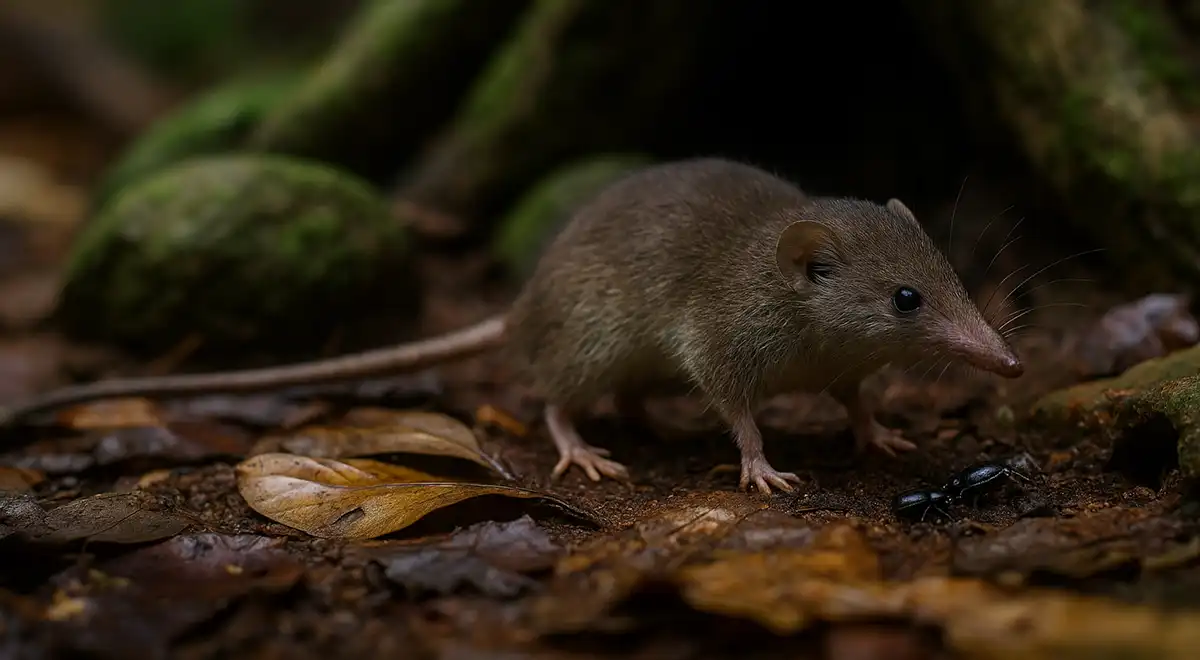
Epitaph for the Christmas Island Shrew

News in brief — 10 October 2025

  • The International Union for Conservation of Nature (IUCN) has officially declared the Christmas Island shrew (Crocidura trichura) extinct, in a Red List update released at the IUCN World Conservation Congress in Abu Dhabi. IUCN World Conservation Congress
  • Last confirmed records of the species were in 1985 (only four records since 1900), underscoring a long, quiet decline. CSIRO Publishing
  • The listing raises Australia’s known mammal extinctions since 1788 to 39, according to analysis accompanying the announcement. The Independent+1

Epitaph for the Christmas Island Shrew

Small whiskered pilgrim,
keeper of beetle-lanterns,
you read the rainforest by touch—
root and rock, leaf and loam—
a heartbeat threading the dark.

You asked for little:
a cool crevice, a damp morning,
the choir of insects to harvest and hush.
We answered with absence—
a silence that spreads like rust.

Go softly now, little one.
In the soil’s old library
your name is a marginal note—
smudged, but still legible
to those who kneel to read.

Sleep where the red crabs once marched,
beneath strangler figs and falling rain.
We did not count you in time.
We will carry you instead—
as a vow we owe the living.

By Kevin Parker

Contextual background

Christmas Island, part of Australia, a speck of rainforest rising from the Indian Ocean, is famed for its scarlet tides of migrating land crabs and for an extraordinary density of endemic life—species found nowhere else. Among its least conspicuous residents was a tiny shrew: fine-haired, sharp-nosed, with a tail longer than most of its kin. It foraged in the leaf litter and among buttress roots, nosing for beetles and other invertebrates, slipping into rock holes and root crevices at the edge of sight. It was the kind of creature you notice only when you pause and let the forest speak first.

Like many island endemics, the shrew’s world was small and exquisitely tuned. That tight fit made it vulnerable. Over the last century, Christmas Island’s biota has been battered by a suite of pressures: habitat disturbance from mining and settlement, predation and competition from introduced species (especially rats and cats), and ecological upheavals triggered by invasive insects—most infamously the yellow crazy ant—whose supercolonies have transformed forest dynamics and cascaded harm through the food web. On islands, such pressures don’t just add up; they amplify each other. For a creature that lived close to the ground and relied on rich, stable invertebrate communities, those changes were existential.

For decades, the shrew slipped from record into rumor. Surveys failed to find it. Hope narrowed, then became mostly ceremonial—the kind of hope biologists carry as a professional ethic. Its recent formal listing as extinct does not so much end a story as acknowledge the quiet way we can lose a thread until an entire tapestry thins. Extinction is not a single moment; it is a long unravelling that we too often notice only when the last fibre parts.

What remains is obligation. Christmas Island still shelters other irreplaceable lives—its flying-fox, hawk-owl, white-eye, emerald doves, geckos, skinks, and the crabs that aerate its soils. The shrew’s epitaph should therefore read like a work plan: stronger biosecurity to keep new invaders out; relentless control of established pests; sustained funding for on-the-ground monitoring (because you cannot save what you do not routinely see); protection and restoration of intact rainforest; and the humility to treat “small” species as large responsibilities. We also owe it our stories—teaching our children that a forest is made as much by the whisker-thin lives as by the towering trees.

If you ever walk there in rain, pause by a tangle of roots and listen. The forest carries memory in its damp. What we call gone, it sometimes calls by name.

Latest Posts

More from Author

Between Recovery and Reformation: Christianity’s Need to Reform Anthropocentric Theology

The question of whether Christianity can become genuinely "green" forces us...

The Vanished Cities of the Amazon: Evidence of Pre-Columbian Civilizations

Christianity must both recover suppressed creation-centered traditions and fundamentally reform anthropocentric theology—authentic recovery itself transforms doctrine.

Gaia Song

Gaia Frequencies — The Voice...

Read Now

Do Androids Dream of Electric Sheep? Philip K. Dick’s Question Meets Quantum Consciousness and the Age of AI

The question Philip K. Dick posed in 1968 was never really about sheep. It was about the ineffable thing that separates life from simulation, consciousness from computation, being from seeming. In his dystopian San Francisco, where nuclear fallout had rendered authentic animals nearly extinct, owning a real sheep...

Between Recovery and Reformation: Christianity’s Need to Reform Anthropocentric Theology

The question of whether Christianity can become genuinely "green" forces us into uncomfortable theological and philosophical territory. It requires confronting not merely lapses in practice but potential flaws in foundational doctrine, while simultaneously excavating buried wisdom that mainstream Christianity has systematically suppressed. The tension between recovering lost...

The Vanished Cities of the Amazon: Evidence of Pre-Columbian Civilizations

Christianity must both recover suppressed creation-centered traditions and fundamentally reform anthropocentric theology—authentic recovery itself transforms doctrine.

Gaia Song

Gaia Frequencies — The Voice of Earth · 600 CE *, *::before, *::after { box-sizing: border-box; margin: 0; padding: 0; } ``` :root { --font-display:...

Moltbook: The Bot-Only Social Network Isn’t the Singularity—It’s a Stress Test for the Agent Era

*An ABC Australia report on Moltbook (February 2026) and the ensuing security coverage is the spark for this commentary—because beneath the memes is a serious preview of where “agentic AI” is heading.*¹ - Kevin Parker - Site Publisher Moltbook arrived like a prank from the near future: a...

The Poles: Arctic and Antarctic Wilderness

Earth’s poles—vast, fragile, warming fast—anchor global climate. Indigenous wisdom, science, and cooperation are key to preserving these icy wildernesses.

The Large Language Model Landscape of February 2026

The Permian competition tightens: pruning, agentic browsers, and the energy bill becomes law. February 2026 doesn’t feel like a month of flashy invention. It feels like a month of selection. Not the Cambrian chaos of 2025—new architectures every week, new “god models” proclaimed hourly—but the colder logic of the...

The Attention Trap: Social Media Addiction, Behavioural Design, and the Architecture of Digital Wellbeing

The digital landscape of the mid-2020s is defined not by the information it provides, but by the relentless competition for the human focus that consumes it. This essay explores the phenomenon commonly termed "social media addiction," examining the delicate balance between the profound social utility of these...

Personal Rewilding: An Antidote to the Unquiet Cage

We are animals built for the wild, yet we live in a state of profound containment. The glow of the screen is our new sunrise. The air we breathe is conditioned, recycled, and sealed inside enclosures where we spend, by some estimates, more than 90 percent of our...

South Asia Wilderness – Sacred Groves to Tiger Reserves

1. Historical Baseline Pre-1750 Wilderness Extent The tiger's roar echoed through sal forests stretching from the Brahmaputra to the Indus, a distance of 3,000 kilometers unbroken by any major human settlement. In 1750, the Indian subcontinent's 4.4 million square kilometers contained 80% wilderness—dense forests, vast grasslands, and wetlands supporting...

Europe’s Biodiversity: A Continent at a Crossroads

Listen to our short audio summary to get a sense of this article The Fading Echo of a Wilder Europe Europe, to the modern eye, is a continent of profound human influence. Its landscapes are a mosaic of ancient cities, manicured fields, and managed forests, a testament to...

The Atomic Bodhisattva: The Life, Work, and Legacy of Joanna Macy

“Active Hope is waking up to the beauty of life on whose behalf we can act. We belong to this world.” Joanna Macy Although our paths never crossed, the life and work and work of Joanna Macy have been a significant influence on my own activism and impulse...
error: Content unavailable for cut and paste at this time