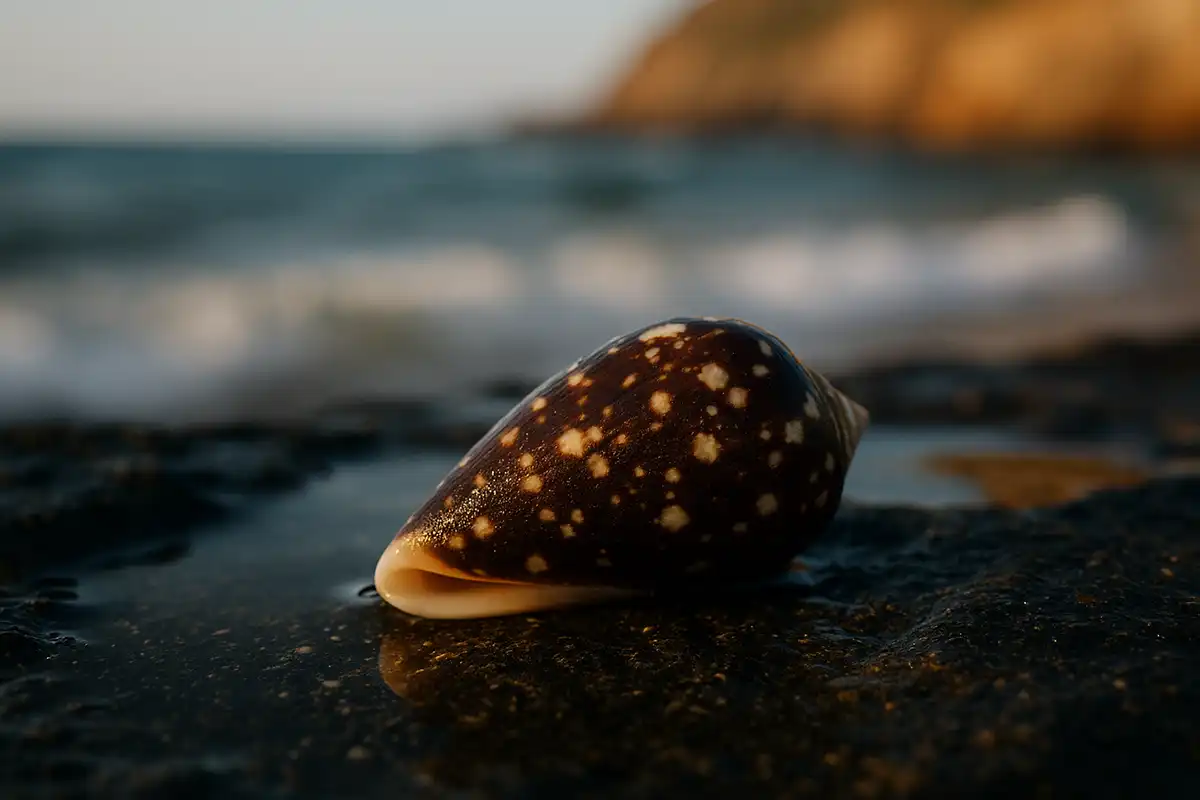
Epitaph for the Cape Verde Cone Snail

News in brief — October 2025

  • IUCN has listed the Cape Verde cone snail (Conus lugubris) as Extinct (EX) in its latest global Red List update released at the World Conservation Congress in Abu Dhabi. IUCN
  • Endemic to the north shore of São Vicente, Cape Verde; last seen alive in 1987. Researchers link its loss to coastal development destroying its narrow habitat. senckenberg.de
  • Cape Verde’s cone snails are a global hotspot of endemism (over 50 of 56 species occur only there), making shoreline protection pivotal. ScienceDirect

Epitaph for the Cape Verde Cone

Little spiral of night,
you drank the sea through a needle of light,
hunter in the tide’s hem.

A harbor grew where your shadow fed,
cement and glare replacing surge and stones.
We called it progress; your silence kept the bill.

Now the reef remembers in whispers—
a salt syllable, lugubris,
rolling back and back with the swell.

Contextual background

Conus lugubris was a tiny, peanut-sized marine snail known only from the north shore of São Vicente in the Cape Verde archipelago. It lived among wave-washed rocks in a postage-stamp range that left it exceptionally vulnerable to local change. No live animal has been recorded since 1987, despite targeted annual searches; in October 2025 the IUCN Red List formally classified it Extinct, with habitat loss from coastal development cited as the decisive factor.

The loss lands in a place famous among malacologists: Cape Verde harbors one of the world’s richest radiations of cone snails, with ~53 of 56 species found nowhere else. Endemism so concentrated means any hardening of shorelines, quarrying, port works, or pollution can erase entire evolutionary lineages in a single cove.

Cone snails are predatory and venomous, using a harpoon-like tooth to inject potent conotoxins into prey (worms, small fish, or other mollusks). While dramatic, that biology is also fragile: it depends on intact microhabitats and clean, structured shores. Protecting the remaining Cape Verde Conus species now requires strict coastal planning, safeguarding rocky intertidal zones, and long-term monitoring before rarity slips into rumor.

SOURCES

senckenberg.de+1

ScienceDirect

Animal Diversity Web

Latest Posts

More from Author

The Life and Legacy of Martin Luther King

Martin Luther-King was a profound influence on my peace activism and...

Labor–Greens Deal: A New Era for Australia’s Environment Laws

CANBERRA — For a quarter of a century, the silence of...

Nature Positive November 2025: Inside Australia’s Historic Environmental Law Overhaul

Executive Summary In November 2025, the Australian Parliament enacted a transformative suite...

Read Now

The Algorithm Will See You Now: Your Doctor’s AI Assistant Can’t Read Handwriting But Might Save Your Life

The first drug ever discovered entirely by artificial intelligence is working its way through human trials as I write this (November, 2025), a molecule dreamed up by silicon that may soon flow through human veins. Its name is rentosertib—a word that sounds like something out of a...

The Life and Legacy of Martin Luther King

Martin Luther-King was a profound influence on my peace activism and I still stand in-awe of his courage, his faith, vision and passion. A blessing on this most extraordinary human. I believe that I got into two jobs, one as State Co-Ordinator of People For Nuclear Disarmament...

Labor–Greens Deal: A New Era for Australia’s Environment Laws

CANBERRA — For a quarter of a century, the silence of the Australian bush—broken only by the crash of falling timber and the quiet disappearance of species—was matched by a deafness in the halls of Parliament. The Environment Protection and Biodiversity Conservation Act 1999 (EPBC), a legislative...

Nature Positive November 2025: Inside Australia’s Historic Environmental Law Overhaul

Executive Summary In November 2025, the Australian Parliament enacted a transformative suite of environmental legislation, fundamentally reshaping the Commonwealth’s approach to biodiversity conservation, project assessment, and regulatory enforcement. This report provides an analysis of the Environment Protection Reform Bill 2025, the National Environment Protection Agency Bill 2025, and...

Artificial Intelligence: Prospects, Progress, and Perils by 2035

Abstract Artificial intelligence (AI) stands at a pivotal juncture, poised for a decade of unprecedented evolution. This report reflects on AI's projected trajectory by 2035, exploring the profound roles and functions it is anticipated to fulfill across industries, from augmenting human capabilities in the workforce and revolutionizing healthcare...

Slow Living: Temporal Resistance in an Accelerated Age

Slow living resists speed-driven society, blending sustainability, urban design, and mindfulness to reclaim time, balance, and ecological harmony.

The Silent General: The Algorithm of War and the Need for Boundaries

AI warfare: autonomous weapons, cyber attacks, and algorithmic targeting transform modern conflict. What moral boundaries must we establish before war becomes fully automated?

Amazonia and South American Wilderness

1. Historical Baseline Pre-1750 Wilderness Extent South America contained 1.7 billion acres of wilderness in 1500—95% of the continent's land area.¹ The Amazon basin alone encompassed 1.4 billion acres of continuous rainforest, Earth's most biodiverse terrestrial ecosystem. This was not pristine wilderness but a cultural landscape shaped by...

Montessori Education: History, Philosophy, and Current Status

When Revolutionary Observation Transforms Pedagogy In January 1907, something extraordinary unfolded in Rome's impoverished San Lorenzo district—a physician's experimental classroom for sixty slum children would revolutionize global education. Within months, these economically disadvantaged five-year-olds were reading, writing, and demonstrating sustained concentration that drew international visitors. By 2022, this...

North America Wilderness: From Tundra to Desert

1. Historical Baseline Pre-1750 Wilderness Extent North America contained 3.9 billion acres of wilderness when Europeans first arrived—98% of the continent's land area.¹ From Arctic tundra to Sonoran desert, from Atlantic forests to Pacific rainforests, the continent supported Earth's most diverse temperate ecosystems. This wasn't empty wilderness but homeland...

The Enduring Majesty: Exploring the World of Birds

Listen to our five-minute summary of the article below before you fly-in! Birds, with their vibrant plumage, melodious songs, and breathtaking aerial acrobatics, have captivated human imagination across millennia. From the smallest hummingbirds to the towering ostriches, these feathered marvels inhabit nearly every corner of our planet, showcasing...

The Deceptive Bite: Unmasking Ultra-Processed Foods

The Quiet Takeover of the Global Diet The modern global diet is undergoing a quiet, pervasive transformation, one driven not by nutritional science or consumer need, but by engineered profitability. Public attention, recently highlighted by media reports concerning the dangers of processed foods, is beginning to align with...
error: Content unavailable for cut and paste at this time