

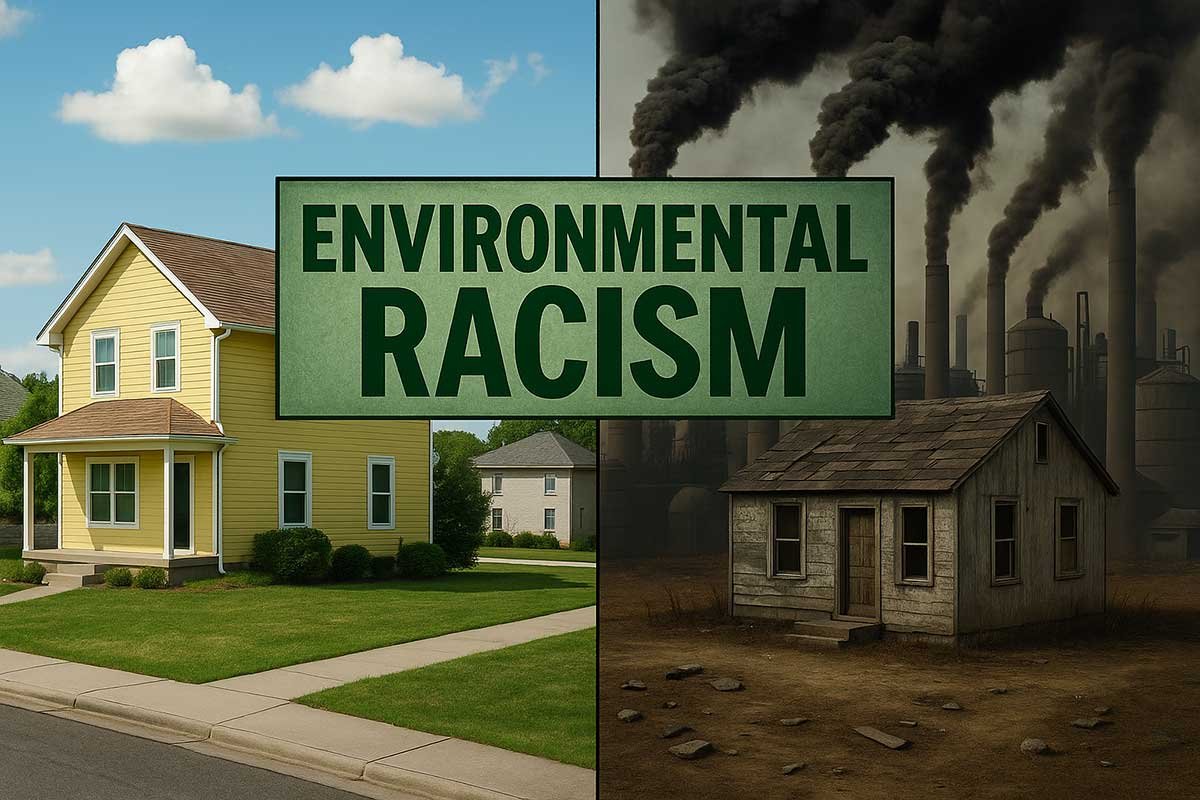
Way back in the early 90s when working with the Technology and Environmental Strategies Group at the University of Wollongong, I co-authored a report entitled ‘Social Equity and The Urban Environment’ produced for the Australian Federal Government. The report introduced the term ‘social-environmental equity’ and addressed two fundamental questions (i) To what extent do social stresses align with environmental stress (ii) To what extent and in what ways can policies be developed to simultaneously relive both. Another 1991 report, ‘Greenhouse Gas Emission and the Australian Coal Industry’ we produced was an early attempt in the then emerging climate change awareness to identify policy settings that would mitigate the projected impacts of climate change – over 30 years ago! Sadly, the world has continued hurtling towards climate change disaster despite all of the evidence to change course. This essay hones in on one of the consequences of inaction, Environmental Racism, something we flagged way back, that is amplified by our current climate crisis. -Kevin Parker Site Publisher
Brief audio overview of the article below.
Introduction
The escalating climate emergency, once a distant specter, is now an immediate and palpable reality. Its manifestations—from the intensification of extreme weather events to the inexorable rise of sea levels—are no longer confined to scientific projections but are lived experiences for millions globally. Yet, the burden of this crisis is not shared equally. Its impacts are distributed along the well-worn fissures of historical inequality, with marginalized communities bearing a disproportionate share of the suffering. The climate crisis is, therefore, fundamentally a crisis of justice, rooted in historical patterns of racial and colonial exploitation that have systematically devalued certain lives and landscapes. This essay traces the evolution of the environmental justice movement’s fight against localized “environmental racism” into the global call for “climate justice,” arguing that contemporary movements for Indigenous sovereignty and intergenerational equity represent the critical frontlines in the demand for a livable and equitable planet.
The central thesis of this inquiry is that the conceptual frameworks and activist strategies of the modern climate justice movement are not a recent invention but are the direct inheritors of a decades-long struggle against environmental racism in the United States. This struggle reframed environmentalism from a narrow concern with wilderness preservation to a core civil rights issue, demanding equal protection from environmental harm for all people, regardless of race or class. The principles forged in the crucible of local fights against toxic landfills and polluting industries have now scaled to the planetary level, providing the ethical and political language to confront a global crisis defined by profound inequities.
To build this argument, this essay is structured in three parts. Part I, “The Genesis of Injustice: Environmental Racism in the United States,” establishes the historical and intellectual foundations of the justice framework. It examines the pioneering work of scholars like Dr. Robert D. Bullard, the catalytic protests in Warren County, North Carolina, and the landmark 1987 report Toxic Wastes and Race, which together provided the empirical and moral basis for identifying environmental racism as a systemic feature of American society. Part II, “Scaling the Inequity: From Local Hazards to a Global Climate Crisis,” analyzes the conceptual shift from the local to the global. It defines the core tenets of climate justice and explores its international dimensions, including the disproportionate impacts on the Global South, the concept of “climate debt,” and the existential threats faced by Small Island Developing States. Through case studies of Hurricane Katrina and the displacement of Indigenous communities in Louisiana, it demonstrates how climate change acts as a “threat multiplier,” exacerbating the very injustices the environmental justice movement first identified. Finally, Part III, “Contemporary Frontlines and the Demand for Systemic Change,” investigates modern movements as the embodiment of these principles. It analyzes the struggle for Indigenous sovereignty at Standing Rock and the call for intergenerational equity from youth movements like Fridays for Future, arguing that these frontlines are not merely about environmental protection but are profound demands for systemic change, Indigenous self-determination, and the right to a viable future. By tracing this lineage, this essay contends that any meaningful response to the climate crisis must be grounded in the principles of justice, equity, and human rights that have been articulated by frontline communities for generations.
Part I: The Genesis of Injustice: Environmental Racism in the United States
The global framework of climate justice did not emerge from a theoretical vacuum. Its intellectual and ethical roots are deeply embedded in the soil of the American Civil Rights Movement and the subsequent, hard-fought struggle against environmental racism. This initial movement fundamentally challenged the mainstream environmental narrative, which had historically prioritized the preservation of pristine wilderness over the health and well-being of human communities, particularly communities of color. It argued that the right to a clean and safe environment was a fundamental civil right and that its denial was a form of racial discrimination. This part traces the origins of this paradigm shift, demonstrating how a powerful combination of grassroots activism, rigorous academic research, and strategic political organizing forged a new understanding of environmentalism as an issue of social justice. The principles established in these early battles against toxic waste and industrial pollution provided the essential foundation for the planetary-scale demands for justice that define the climate crisis today.
Forging a Framework: The Intellectual and Activist Origins
The concept of environmental racism was born from the direct experience of communities of color and was given its name and empirical validation through a powerful fusion of academic sociology and grassroots activism. It provided a language and a data-driven framework to describe a reality that Black, Indigenous, and other marginalized communities had long understood: that the toxic burdens of industrial society were not randomly distributed but were systematically imposed upon them.
The term itself was coined in 1982 by civil rights leader Rev. Dr. Benjamin Chavis, Jr., amidst the protests in Warren County, North Carolina.¹ He defined it not merely as a matter of disparate impact but as a deliberate and systemic form of discrimination. Environmental racism, in this formulation, encompasses “racial discrimination in environmental policymaking, the enforcement of regulations and laws, the deliberate targeting of communities of color for toxic waste facilities, [and] the official sanctioning of the life-threatening presence of poisons and pollutants in our communities.”² This definition reframed the issue from one of unfortunate circumstance to one of intentional policy and structural injustice, linking the placement of environmental hazards directly to the legacy of racial discrimination in America.
While Chavis gave the phenomenon its name, it was the meticulous research of sociologist Dr. Robert D. Bullard, now widely regarded as the “father of environmental justice,” that gave it its empirical backbone.³ His work began in 1979 when his wife, attorney Linda McKeever Bullard, filed the landmark lawsuit Bean v. Southwestern Waste Management, Inc., the first case in U.S. history to challenge the siting of a waste facility under civil rights law.⁴ Commissioned to conduct a study for the case, Dr. Bullard systematically documented the geography of waste in Houston, Texas. His findings were stark and undeniable: from the 1930s through 1978, all five of the city-owned landfills and six of the eight city-owned incinerators were located in predominantly Black neighborhoods, even though Black residents constituted only 25% of the city’s population.⁵ This pioneering study provided the first comprehensive empirical evidence of what would come to be called “ecoracism.”
Bullard’s subsequent work, most notably his foundational 1990 book Dumping in Dixie: Race, Class, and Environmental Quality, expanded this analysis across the American South, cementing the understanding that these patterns were not unique to Houston but were a regional and national phenomenon. This body of research was crucial because it moved the argument from anecdotal evidence to statistical proof, making the claims of discrimination impossible for policymakers and the legal system to ignore. The power of the nascent environmental justice movement derived precisely from this unique and potent symbiosis between academic rigor and on-the-ground activism. The moral outrage and political pressure generated by protests created the demand for data, while the data, in turn, provided the protests with unimpeachable legitimacy and a foundation for legal and policy challenges.
The systemic roots of this injustice run deep, intertwined with the foundational structures of American racial hierarchy. The siting decisions of the 20th century were not made on a blank map but on a landscape already shaped by segregation. Discriminatory housing policies, most notoriously the federally sponsored practice of “redlining” from the 1930s to the 1960s, systematically devalued neighborhoods inhabited by people of color, marking them as “hazardous” for investment.⁶ This not only denied residents access to wealth-building and resources but also made these areas prime targets for the siting of undesirable land uses, such as landfills, incinerators, and polluting industries. This structural vulnerability was reinforced by an ideological legacy that historically associated Blackness with filth and disease, creating a cultural logic that rendered the pollution of Black communities permissible.⁷ The result was a self-perpetuating cycle: marginalized communities lacked the political representation and economic power to resist the siting of hazards, and the presence of these hazards further devalued their communities and harmed their health, reinforcing their marginalization.
A Movement Ignites: Warren County and the UCC Report
If Dr. Bullard’s research provided the empirical proof of environmental racism, two pivotal events in the 1980s served as the catalysts that ignited a national movement. The 1982 protests in Warren County, North Carolina, and the 1987 publication of the United Church of Christ’s (UCC) report, Toxic Wastes and Race in the United States, transformed localized grievances into a cohesive, national crusade for environmental justice, forever changing the landscape of American environmentalism.
The Warren County protest is widely regarded as the watershed moment for the environmental justice movement. When the state of North Carolina chose a poor, rural, and predominantly African American county as the site for a landfill to dispose of soil contaminated with highly toxic polychlorinated biphenyls (PCBs), the community refused to be a passive dumping ground.⁸ Residents, organized as the Warren County Citizens Concerned, launched a six-week campaign of nonviolent civil disobedience, physically blocking the trucks carrying the toxic soil. The protests drew national media attention and the support of established civil rights leaders, including Rev. Joseph Lowery of the Southern Christian Leadership Conference and Congressman Walter Fauntroy of the Congressional Black Caucus. Over 500 people were arrested, including children and the elderly, in a powerful display of resistance that explicitly framed the environmental issue as a civil rights struggle.⁹ Though the landfill was ultimately built, the protests were a resounding political success. They galvanized communities across the country, demonstrating a powerful new model of resistance and putting the term “environmental racism” into the national lexicon.
The moral and political energy unleashed by Warren County created an urgent need for data to prove that this was not an isolated incident. As protest leader Dollie Burwell later recalled, “in the eighties you couldn’t just say there was discrimination. You had to prove it.”¹⁰ The UCC’s Commission for Racial Justice, which had been a key supporter of the Warren County protests, took up this challenge. Under the leadership of Rev. Chavis, the commission sponsored the first comprehensive national study on the demographics of hazardous waste facility locations. The resulting 1987 report, Toxic Wastes and Race in the United States, authored by Charles Lee, was an empirical bombshell. Its central finding was that race was the single most significant variable in predicting the location of commercial hazardous waste facilities in the United States—more significant than poverty, land values, or home ownership. The study revealed that three out of every five Black and Hispanic Americans lived in a community with an uncontrolled toxic waste site. It also found that communities with the greatest concentration of hazardous waste facilities had the highest composition of racial and ethnic residents. This landmark report provided the irrefutable, nationwide evidence that activists had been seeking, validating their claims of systemic discrimination and sparking a national debate on the issue.
The momentum generated by Warren County and the UCC report led to the rapid institutionalization of the environmental justice movement. In 1991, the First National People of Color Environmental Leadership Summit was held in Washington, D.C., bringing together hundreds of activists from across the country. The summit produced a seminal document, the “Seventeen Principles of Environmental Justice,” which has served as a guiding framework for the movement ever since. This surge in activism compelled a response from the federal government. In 1992, the Environmental Protection Agency (EPA) established the Office of Environmental Equity (later renamed the Office of Environmental Justice), and in 1994, President Bill Clinton signed Executive Order 12898, “Federal Actions to Address Environmental Justice in Minority Populations and Low-Income Populations.”¹¹ This order required all federal agencies to make achieving environmental justice part of their mission by identifying and addressing the disproportionately high and adverse human health or environmental effects of their programs, policies, and activities on minority and low-income populations. While the implementation of this order has been inconsistent, its signing marked a crucial victory, formally recognizing environmental justice as a legitimate and necessary focus of federal policy.
Table 1: Key Milestones in the U.S. Environmental and Climate Justice Movements
| Year | Event/Publication | Key Figures/Organizations | Significance |
| 1960s | Memphis Sanitation Strike (1968) | Civil Rights Movement | Early fusion of labor, civil rights, and environmental health concerns, framing dignity and safety as core issues. |
| 1979 | Bean v. Southwestern Waste Management, Inc. | Linda McKeever Bullard, Dr. Robert Bullard | First lawsuit in the U.S. to challenge environmental discrimination under civil rights law. |
| 1982 | Warren County, NC Protests | Rev. Benjamin Chavis, Jr., Dollie Burwell, UCC | Catalytic event for the national movement; Chavis coins the term “environmental racism.” |
| 1987 | Toxic Wastes and Race in the United States | United Church of Christ (UCC), Charles Lee | First national report to empirically document that race was the leading predictor of toxic waste site locations. |
| 1990 | Dumping in Dixie | Dr. Robert Bullard | Foundational academic text that chronicled and analyzed the emergence of the environmental justice movement in the South. |
| 1991 | First National People of Color Environmental Leadership Summit | UCC, various grassroots leaders | Issued the “Seventeen Principles of Environmental Justice,” a defining document for the movement. |
| 1994 | Executive Order 12898 | President Bill Clinton | First federal executive order mandating that all federal agencies address environmental justice in their operations. |
| 2000 | First Climate Justice Summit | Rising Tide Network | Held parallel to the UN’s COP6, it marked a key moment in explicitly linking environmental justice to the global climate crisis. |
Anatomy of a Sacrifice Zone: Louisiana’s “Cancer Alley”
Nowhere are the devastating, long-term consequences of environmental racism more viscerally apparent than in the 85-mile industrial corridor that stretches along the Mississippi River between Baton Rouge and New Orleans. Once known as “Plantation Country” for its sugar and rice plantations powered by enslaved labor, the region is now grimly referred to as “Cancer Alley” for its staggering rates of cancer and other diseases linked to industrial pollution. This area serves as a living case study of a “sacrifice zone”—a community deemed expendable for the sake of industrial profit, where the historical legacies of slavery and segregation have paved the way for modern environmental devastation.¹²
The demographic and industrial geography of Cancer Alley is a direct inheritance of its plantation past. After the Civil War, many freed African Americans established communities on small parcels of land, often near the very plantations where they had been enslaved. In the mid-20th century, as the petrochemical industry began to boom, these historically Black communities became prime targets for the siting of refineries and chemical plants. Today, over 150 such facilities dot this stretch of the Mississippi River, concentrated in parishes with high percentages of Black residents.¹³ This pattern is no coincidence. As one study noted, petrochemical plants began moving into the area in the 1940s, “purposely seeking out black communities to move into.”¹⁴ The result is a landscape where the smokestacks of industry loom over the descendants of the enslaved, a stark visual representation of the continuity of racial and economic exploitation.
The health and environmental impacts on the residents of Cancer Alley are catastrophic. The air, water, and soil are saturated with toxic chemicals, including known carcinogens like chloroprene and ethylene oxide. According to data from the EPA’s National Air Toxics Assessment, the cancer risk from air pollution in the census tract closest to the Denka/DuPont neoprene plant in St. John the Baptist Parish is the highest in the entire country—nearly 50 times the national average.¹⁵ A 2021 health study conducted by the University Network for Human Rights found a direct correlation between proximity to the plant and cancer prevalence, concluding that the rates of illness were so high they would almost never occur naturally. In a letter to Louisiana regulators, the EPA itself confirmed that children at a predominantly Black elementary school located just 1,500 feet from the Denka facility were being exposed to chloroprene at levels 11 times what the agency considers acceptable.
This public health crisis is the result of a profound and systemic failure of government regulation, a failure that community activists argue is itself a form of environmental racism. State and federal agencies have been accused of neglecting the concerns of Black residents and failing to enforce environmental laws, effectively sanctioning the poisoning of these communities. The EPA’s letter to Louisiana regulators acknowledged that these demographic patterns of exposure trace back to the Reconstruction era and that Black residents bear a disproportionate cancer risk from industrial air pollution. In response to this systemic neglect, a powerful grassroots resistance movement has emerged. Groups like the Concerned Citizens of St. John the Baptist Parish and Rise St. James, founded by local leader Sharon Lavigne, have organized protests, filed civil rights complaints, and engaged in relentless advocacy to demand accountability. They explicitly frame their struggle as a continuation of the Civil Rights Movement. As Lavigne stated, “The civil rights struggle that my parents fought for continues today… we fight for our survival against industrial polluters.”¹⁵ Their fight underscores the central tenet of environmental justice: that the right to breathe clean air and drink clean water is a fundamental human and civil right.
Part II: Scaling the Inequity: From Local Hazards to a Global Climate Crisis
The principles forged in the fight against localized environmental racism in places like Warren County and Cancer Alley have provided the essential framework for understanding the injustices of the global climate crisis. The same logic of disproportionate burdening—whereby the communities least responsible for creating a problem suffer its worst consequences—is now playing out on a planetary scale. Climate change acts as a “threat multiplier,” a term used by security analysts that is equally applicable in a justice context. It takes pre-existing vulnerabilities rooted in poverty, racism, and colonialism and exacerbates them to a catastrophic degree. This section bridges the conceptual gap between environmental racism and climate justice, defining the core tenets of this global framework and examining how its injustices manifest in the stark divide between the Global North and Global South, in the devastating impacts of climate-fueled disasters, and in the existential struggle of the world’s most vulnerable nations.
Conceptualizing Climate Justice
Climate justice fundamentally reframes the climate crisis from a purely environmental or technical problem to a profound issue of ethics, equity, and human rights.¹⁶ It moves beyond a narrow focus on greenhouse gas concentrations and temperature targets to ask critical questions about fairness, responsibility, and power. At its core, climate justice recognizes that the causes and effects of climate change are deeply unequal. It acknowledges the historical responsibility of wealthy, industrialized nations for having produced the vast majority of emissions that are destabilizing the climate, and it asserts their corresponding moral and financial obligation to help those who are least responsible but most vulnerable to adapt and recover.¹⁷
This comprehensive framework can be understood through four key, interconnected dimensions of justice, as identified by scholars such as Newell et al.¹⁸ First, distributive justice concerns the fair allocation of the burdens and benefits of climate change and climate action. This includes not only the distribution of negative impacts like extreme weather and sea-level rise but also the costs of mitigation and the benefits of a transition to a clean energy economy, such as green jobs and improved public health. Second, procedural justice demands fair, transparent, and inclusive decision-making processes. It insists that all people, particularly the most affected and marginalized groups—including women, youth, Indigenous Peoples, and communities in the Global South—must have a meaningful voice and a seat at the table in shaping climate policies at the local, national, and international levels.¹⁹ Third, recognition justice focuses on acknowledging and respecting the rights, cultures, and diverse knowledge systems of different groups. This is particularly crucial for Indigenous communities, whose sovereignty, land rights, and traditional ecological knowledge are often undermined by top-down climate solutions. Finally, intergenerational justice extends the concept of fairness across time, asserting that the actions of the present generation must not compromise the right of future generations to a stable climate, a healthy environment, and a livable planet. Together, these four pillars provide a robust ethical framework for evaluating climate policy, demanding solutions that not only reduce emissions but also dismantle the underlying systems of inequity that have created and exacerbated the crisis.
The Global North-South Chasm and the Concept of “Climate Debt”
The most profound manifestation of climate injustice is the stark chasm between the Global North and the Global South. The wealthy, industrialized nations of North America and Europe, while representing a minority of the world’s population, are responsible for the overwhelming majority of historical greenhouse gas emissions since the Industrial Revolution.²⁰ They have built their wealth and prosperity on a development model fueled by unrestricted fossil fuel consumption, effectively appropriating the planet’s shared atmospheric capacity. Conversely, the nations of the Global South—in Africa, Asia, and Latin America—have contributed the least to the problem but are suffering its most severe and immediate consequences, from devastating droughts and floods to the loss of lives and livelihoods.
From this reality emerges the powerful concept of “climate debt.” This framework posits that the Global North owes a debt to the Global South on two counts. First, an “emissions debt” for its disproportionate use of the atmospheric commons, which has foreclosed equitable development pathways for poorer nations. Second, an “adaptation debt” for the costs of coping with the climate impacts it has largely caused.²¹ The demand for climate reparations, therefore, is not a call for charity but a demand for justice—a reckoning for the historical and ongoing exploitation of a shared global resource. This is a central and non-negotiable demand of the international climate justice movement. One 2023 study attempted to quantify this obligation, calculating that the Global North will owe a staggering US$192 trillion in fair reparations to the Global South by 2050.²⁰
This framework of climate debt casts a critical light on the current state of international climate finance, revealing a system that often perpetuates rather than rectifies injustice. While wealthy nations have pledged to provide financial support to developing countries for mitigation and adaptation, the reality falls far short of the need and the obligation. The long-promised US$100 billion per year in climate finance has been delivered inconsistently, and a significant portion of what is delivered comes not in the form of grants but as loans, often at market interest rates.²² This practice pushes climate-vulnerable nations deeper into a vicious cycle of debt.²³ They are forced to borrow money to recover from climate disasters they did not cause, increasing their debt burden and diverting scarce public funds away from essential services like health and education and toward debt service payments.
This dynamic operates as a modern form of neocolonialism. The financial mechanisms ostensibly designed to help the Global South adapt to the climate crisis instead reinforce economic dependency and maintain the flow of capital from South to North. Many of these loans come with “tied aid” conditionalities, which require the recipient country to purchase goods or hire contractors from the donor country, a practice that can increase project costs by as much as 30% and ensures that a large share of the “aid” is recycled back to the wealthy nation’s economy.²⁴ This structure mirrors historical colonial economic relationships, where the metropole profits from its dealings with the periphery. In this way, the financial response to a crisis rooted in colonial-era industrialization is not dismantling the old exploitative system but rather updating it with new tools of indebtedness and dependency.
When the Deluge Comes: Climate as a “Threat Multiplier”
The abstract principles of climate justice become tragically concrete when climate-fueled disasters strike communities already burdened by legacies of environmental racism. In the United States, two cases from Louisiana starkly illustrate how the climate crisis acts as a “threat multiplier,” taking pre-existing social and racial vulnerabilities and amplifying them to a catastrophic scale. The sudden deluge of Hurricane Katrina and the slow, inexorable creep of sea-level rise on Isle de Jean Charles reveal two faces of the same fundamental injustice.
Hurricane Katrina, which made landfall in August 2005, was not simply a “natural” disaster; it was a social and racial catastrophe. The storm’s devastating impact on New Orleans was a direct result of decades of systemic racism and discriminatory urban planning. Black residents were disproportionately segregated into the city’s lowest-lying and most flood-prone neighborhoods, such as the Lower 9th Ward, which were protected by poorly maintained and inadequate levees. When those levees failed, these communities were inundated. Studies have shown that Black people comprised over 80% of those who lost their homes in the storm.²⁵ Katrina became an iconic and horrifying example of how climate change intersects with and magnifies pre-existing racial injustice. The disaster did not end when the floodwaters receded. The aftermath exposed a second layer of inequity in the deeply flawed federal recovery effort. The Federal Emergency Management Agency (FEMA) was widely criticized for its slow and inadequate response, particularly for vulnerable populations. Bureaucratic hurdles, such as requiring formal property deeds to access aid, disproportionately harmed Black families whose homes had been passed down through generations without formal legal paperwork, a common practice in the South.²⁶ The result was a recovery process that further entrenched racial inequality, with many Black residents permanently displaced from the city.
While Katrina was a sudden, violent manifestation of climate injustice, the fate of Isle de Jean Charles represents a slow-motion disaster. This narrow ridge of land in the Louisiana bayous, home to the Biloxi-Chitimacha-Choctaw tribe, is disappearing into the Gulf of Mexico. Since 1955, the island has lost 98% of its landmass.²⁷ This catastrophic land loss is the result of a toxic confluence of factors: natural subsidence of the Mississippi Delta, the carving of thousands of miles of canals for oil and gas exploration which allowed saltwater intrusion and accelerated erosion, and now, the relentless and accelerating pace of global sea-level rise.²⁸ The dense forests and marshes that once protected the island from storm surges are gone, leaving the community exposed and vulnerable. The residents of Isle de Jean Charles are now widely considered to be among America’s first “climate refugees.” In 2016, the community received a $48 million federal grant to fund a managed retreat—a planned relocation to a new settlement 40 miles inland. While intended as a solution, the relocation process has been fraught with conflict and heartbreak. It threatens to sever the tribe’s connection to their ancestral lands, disrupt their culture and way of life, and dissolve the social fabric of their community.²⁹ The tragic irony is that these Indigenous peoples, who were first pushed onto these marginal coastal lands to escape the forced removal policies of the 19th century, are now being displaced once again—this time by the consequences of an industrial system from which they have barely benefited. Their story is a powerful and poignant illustration of climate-induced displacement and the profound loss of culture, heritage, and sovereignty that it entails.
The Vulnerable Vanguard: SIDS and the Fight for Survival
On the international stage, the most powerful and persistent voices for climate justice have come from those with the most to lose: the Small Island Developing States (SIDS). Scattered across the Pacific, Caribbean, and Indian Oceans, these nations face an existential threat from climate change. For countries like Tuvalu, Kiribati, and the Maldives, rising sea levels are not a future risk but an unfolding reality that threatens to submerge their entire territory, erase their cultures, and extinguish their sovereignty.³⁰ This represents the ultimate climate injustice: the potential annihilation of entire nations that have contributed less than 1% of the global greenhouse gas emissions responsible for the crisis.³¹
Faced with this existential threat, these vulnerable nations have transformed themselves into a formidable diplomatic and moral force in global climate negotiations. In 1990, they formed the Alliance of Small Island States (AOSIS) to consolidate their voices and advocate for their collective survival.³² Despite their small geographic and economic size, AOSIS has consistently “punched far above its weight,” leveraging its moral authority to achieve significant diplomatic victories that have shaped the course of international climate policy.³³
Two achievements stand out as testaments to their influence. First is the inclusion of the 1.5°C warming limit in the 2015 Paris Agreement. For years, the international consensus had coalesced around a target of limiting global warming to 2°C above pre-industrial levels. However, for low-lying island nations, a 2°C world meant certain inundation. Beginning in 2008, AOSIS launched a relentless diplomatic campaign, arguing that anything less than a 1.5°C target was a death sentence for their people. Their moral clarity and persistence were instrumental in building a “High Ambition Coalition” of vulnerable and progressive nations that successfully pushed for the inclusion of the more ambitious 1.5°C goal in the final text of the Paris Agreement.³³ This was a landmark victory, enshrining their survival as a central objective of global climate policy.
Their second major achievement came after a thirty-year struggle. Since the earliest climate negotiations, SIDS and other vulnerable nations have argued that they are already experiencing climate impacts so severe that they cannot be adapted to. They demanded a mechanism to address this unavoidable “loss and damage.” For decades, developed countries resisted this call, fearing that it would open the door to legal liability and claims for compensation. However, the growing frequency and intensity of climate disasters, combined with the unwavering advocacy of AOSIS and its allies, made the issue impossible to ignore. At the UN climate conference in Sharm El-Sheikh, Egypt (COP27) in 2022, the international community finally agreed to establish a dedicated “Loss and Damage Fund.”³⁴ This historic agreement acknowledged the principle of climate justice—that those who have caused the most harm have a responsibility to help the victims recover from the resulting devastation. While the fund is still in its early stages of operationalization, its creation represents a monumental step toward rectifying one of the most profound injustices of the climate crisis.
Part III: Contemporary Frontlines and the Demand for Systemic Change
The principles of climate justice are not merely theoretical constructs; they are being actively forged and contested on the ground by a new generation of movements that have captured global attention. These contemporary struggles demonstrate a significant evolution in climate activism, moving beyond a narrow focus on emissions to encompass broader demands for Indigenous sovereignty, intergenerational equity, and a fundamental restructuring of the global economy. The 2016-2017 resistance to the Dakota Access Pipeline at Standing Rock and the global youth climate strikes inspired by Greta Thunberg represent two of the most powerful expressions of this new frontline. They illustrate how the fight for a stable climate has become inseparable from the fight for self-determination, human rights, and a just future for all.
“Mni Wiconi—Water is Life”: Standing Rock and Indigenous Sovereignty
The 2016-2017 resistance against the construction of the Dakota Access Pipeline (DAPL) at the Standing Rock Sioux Reservation became a global symbol of the fight for climate justice. The movement, known by the hashtag #NoDAPL, was far more than a conventional environmental protest. It represented a powerful nexus of interconnected struggles: a fight for Indigenous sovereignty, a defense of treaty rights guaranteed under the 1851 and 1868 Fort Laramie Treaties, a stand to protect sacred ancestral burial grounds, and a battle for the fundamental right to clean water.³⁵ The pipeline’s proposed route, crossing under the Missouri River at Lake Oahe, was just upstream from the reservation’s sole source of drinking water, posing a direct threat to the health and survival of the Standing Rock Sioux Tribe.³⁶
What made the Standing Rock movement particularly potent and resonant was its foundation in ceremony-centered resistance. The thousands who gathered at the protest camps, most notably the Sacred Stone Camp established by tribal historian LaDonna Brave Bull Allard, did not primarily identify as “protestors” but as “water protectors.” This deliberate reframing shifted their actions from the realm of political opposition to that of a sacred duty. The daily life of the camps was organized around spiritual and cultural practices: continuously tended sacred fires, daily water ceremonies at the river’s edge, and collective prayer circles.³⁷ This deep integration of spiritual practice with political action provided a source of profound resilience and unity, sustaining what became the largest gathering of Indigenous peoples in North America in over a century.³⁸ The Lakota phrase “Mni Wiconi”—Water is Life—became the movement’s global rallying cry, a simple yet profound statement that connected the specific fight against a pipeline to a universal understanding of ecological interdependence and the sanctity of life’s most essential element.
This reframing of the conflict proved to be a strategically powerful move that allowed the movement to transcend the typical “jobs versus environment” narrative often used to dismiss environmental activism. By centering their identity as a sovereign nation with treaty rights and framing their resistance as a sacred obligation, the water protectors transformed the struggle into a compelling story of historical injustice, broken promises, and the defense of a way of life against the forces of corporate power and settler colonialism.³⁹ This narrative resonated globally, attracting a broad and diverse coalition of supporters, including environmental groups, human rights organizations, and thousands of U.S. military veterans who traveled to Standing Rock to act as “human shields” between the water protectors and the heavily militarized police force. The movement brought unprecedented global attention to the issue of Indigenous sovereignty and exposed the profound failures of the U.S. government’s legal obligation to meaningfully consult with tribal nations on projects affecting their lands and resources.
Although the pipeline was ultimately completed and began operating in 2017, the struggle is far from over. The movement’s legal challenges have continued, leading to significant court victories. In 2020, a federal judge ordered a full Environmental Impact Statement (EIS) to be conducted for the Lake Oahe crossing, finding that the U.S. Army Corps of Engineers had violated the National Environmental Policy Act (NEPA) by approving the pipeline without adequately considering the risks of an oil spill.⁴⁰ The legal and political battle continues to this day, a testament to the enduring legacy of a movement that redefined the frontlines of the fight for climate justice.
“You Are Failing Us”: Fridays for Future and Intergenerational Justice
While the water protectors at Standing Rock centered their struggle on the defense of ancestral lands and sovereign rights, another powerful climate justice movement emerged from a different form of disenfranchisement: that of the young. The Fridays for Future (FFF) movement, which began with the solitary protest of 15-year-old Swedish activist Greta Thunberg in August 2018, rapidly blossomed into a global phenomenon, mobilizing millions of school students in weekly strikes to demand that political leaders take the climate crisis seriously.⁴¹ This youth-led movement powerfully articulated the principle of intergenerational justice, arguing that the failure of current leaders to act on climate change constitutes a profound betrayal of their responsibility to future generations.
The core message of the FFF movement is a searing indictment of the inaction and complacency of the adult world. In her now-famous speeches at the United Nations and other international forums, Thunberg gave voice to the anger and fear of a generation whose future is being jeopardized. “You have stolen my dreams and my childhood with your empty words,” she told world leaders at the 2019 UN Climate Action Summit. “We are in the beginning of a mass extinction, and all you can talk about is money and fairy tales of eternal economic growth. How dare you?”⁴² This rhetoric of betrayal is central to the movement’s power. It reframes the climate crisis not as a distant policy problem but as an immediate moral failure, a violation of the fundamental duty of care that each generation owes to the next.⁴³ The movement argues that young people, who will have to live with the consequences of decisions made today, are being systematically ignored and sacrificed for the sake of short-term political and economic interests.
The demands of the youth climate strikers are straightforward and grounded in science. They call on governments to align their policies with the findings of the Intergovernmental Panel on Climate Change (IPCC), which state that global emissions must be drastically reduced to have a chance of limiting warming to 1.5°C. Their key demands include keeping fossil fuels in the ground, rapidly transitioning to 100% renewable energy, and ensuring climate justice for the most affected people and areas.⁴⁴ While it is difficult to draw a direct causal line from the strikes to specific policy outcomes, the movement has had an undeniable impact. It has dramatically increased the public and political salience of the climate crisis, forcing it onto the mainstream agenda in a way that previous movements had not. The sheer scale of the mobilizations has put immense pressure on politicians to respond, and studies have suggested that the movement has had a tangible political effect, such as increasing the vote share for Green parties in Germany and other European countries.⁴⁵ Most importantly, the FFF movement has given a powerful voice to the principle of intergenerational equity, ensuring that the rights and well-being of future generations can no longer be ignored in the climate debate.
The Imperative of a Just Transition
As the demands for climate action intensify, the principles of climate justice require a focus not only on stopping the harm caused by fossil fuels but also on ensuring that the transition to a new energy economy is fair and equitable. The concept of a “just transition” has emerged as the key policy framework for operationalizing these principles. It recognizes that the shift away from a fossil fuel-based economy, while necessary, will have profound socioeconomic consequences for workers and communities that have historically depended on industries like coal mining, oil, and gas.⁴⁶ A just transition seeks to manage this disruption by centering the needs of these affected workers and communities, ensuring that they are not left behind in the move to a green economy.
At its core, a just transition involves a comprehensive set of policies designed to provide social protection, economic diversification, and new opportunities. This includes funding for worker retraining and skills development, wage support and pension guarantees for displaced workers, and targeted investments to create new, high-quality, unionized green jobs in former fossil fuel regions.⁴⁷ It is a proactive strategy to prevent the creation of new “sacrifice zones”—regions devastated by economic collapse and unemployment in the name of climate progress. This framework is integral to the broader climate justice agenda because it seeks to ensure that the benefits of the clean energy economy, such as jobs in solar and wind manufacturing and installation, are accessible to all, particularly the marginalized communities that have historically borne the brunt of pollution and economic exploitation.⁴⁸
The principles of a just transition are increasingly being integrated into climate policy around the world. The European Union has established a Just Transition Mechanism as part of its Green Deal to support the regions most affected by the phase-out of coal. Canada has developed a Sustainable Jobs Plan to guide its transition efforts, and the United States’ Inflation Reduction Act includes significant tax credits and incentives designed to drive clean energy investment and manufacturing into “energy communities” that have been historically reliant on fossil fuels.⁴⁸ However, a truly just transition must also extend to the deployment of new energy infrastructure. The massive build-out of renewable energy projects, such as large-scale solar and wind farms, and the mining of critical minerals for batteries, can create new injustices if not managed properly. There are growing concerns about the potential for these projects to lead to land grabbing, displacement of Indigenous Peoples and local communities, and the violation of human rights.⁴⁹ Therefore, a just transition requires not only support for fossil fuel workers but also robust safeguards that respect community consent, protect land rights, and ensure that local communities share in the benefits of the clean energy projects they host.
Conclusion
The journey from the contaminated soil of Warren County to the global stage of the United Nations climate conferences reveals a profound and necessary evolution in our understanding of the environmental crisis. The fight for a stable climate, this inquiry has argued, is inseparable from the long and arduous struggle for racial, social, and economic justice. The principles of climate justice are not a recent appendage to the environmental movement but are its very heart, forged in the lived experiences of communities that have long been treated as sacrifice zones. The central thesis—that the global call for climate justice is a direct extension of the fight against environmental racism—is borne out by a clear historical and conceptual lineage. The same patterns of disproportionate harm, systemic neglect, and the devaluation of marginalized lives that Dr. Robert Bullard first documented in the landfills of Houston are now being replicated at a planetary scale by the climate crisis.
This essay has traced this trajectory through three distinct but interconnected parts. It began by establishing the genesis of the environmental justice movement in the United States, demonstrating how the fusion of civil rights activism and rigorous academic research gave a name and empirical proof to the systemic reality of environmental racism. The struggles in places like Warren County and Louisiana’s “Cancer Alley” were not isolated incidents but symptoms of a deeper structural injustice rooted in the nation’s history of racial discrimination. It then showed how this framework scaled globally, with the climate crisis acting as a “threat multiplier” that exacerbates these same inequities. The chasm between the Global North’s historical responsibility and the Global South’s acute vulnerability, the existential threat to Small Island Developing States, and the devastating impacts of climate-fueled disasters on communities of color all underscore the planetary dimensions of this injustice. Finally, the analysis of contemporary movements at Standing Rock and among the world’s youth revealed the modern frontlines of this struggle. The demands for Indigenous sovereignty and intergenerational equity are not peripheral concerns but are central to defining a just and viable future. The water protectors and the climate strikers have powerfully articulated that the crisis is not merely about carbon molecules; it is about justice, rights, and our collective responsibility to one another and to the generations that will follow.
Looking forward, it is clear that effective and durable solutions to the climate crisis are impossible without addressing these root causes of injustice. A purely technocratic approach that focuses solely on emissions reductions while ignoring the underlying inequities is doomed to fail, as it will inevitably replicate the same exploitative patterns that created the crisis. A truly sustainable future requires a dual transition: a technological shift to renewable energy must be accompanied by a political and ethical shift toward a system that centers the voices, respects the rights, and follows the leadership of those on the frontlines. This means operationalizing a just transition that supports workers and communities, honoring the sovereignty and knowledge of Indigenous peoples, canceling the climate debt owed to the Global South, and upholding the rights of future generations. The struggle for climate justice is ultimately a struggle to redefine our relationship with the planet and with each other. It is a demand to move from a system of extraction and sacrifice to one of regeneration and solidarity, creating a world where no community and no generation is considered expendable.
Notes
- William J. Barber III, “Defining Climate Justice,” Sanford School of Public Policy, Duke University, accessed October 15, 20231; United Nations Development Programme, “Climate Change Is a Matter of Justice. Here’s Why,”
UNDP Climate Promise, accessed October 15, 2023.2
- Stacy M. Brown, “Environmental Racism Is Killing People of Color,” The Greenlining Institute, October 23, 20193; “Why Does Environmental Racism Exist?” Augusta University Online, accessed October 15, 2023.4
- “Dr. Robert D. Bullard: Father of Environmental Justice,” National Institute of Environmental Health Sciences, November 20225; “The Bullard Center and Justice40,” America Is All In, accessed October 15, 2023.6
- Robert D. Bullard, “The Father of Environmental Justice: Dr. Robert Bullard,” Sustainability Education, University of Utah, accessed October 15, 20237; Robert D. Bullard,
Dumping in Dixie: Race, Class, and Environmental Quality (Boulder, CO: Westview Press, 1990), as cited in “The American Environmental Justice Movement,” Internet Encyclopedia of Philosophy, accessed October 15, 2023.8
- “The Bullard Center and Justice40,” 6; “Dr. Robert Bullard: Father of Environmental Justice,” 5; Robert Bullard, “What are Dr. Robert Bullard’s key contributions to the environmental justice movement, particularly his research on waste facility siting in Houston?,” accessed October 15, 2023.6
- Carl A. Zimring, Clean and White: A History of Environmental Racism in the United States (New York: NYU Press, 2015), reviewed by Andrew W. Kahrl in Civil War Book Review 19, no. 2 (2017).9
- “A Movement Is Born: Environmental Justice and the UCC,” United Church of Christ, accessed October 15, 2023.10
- “History of the Environmental Justice Movement,” Avoice: African American Voices in Congress, Congressional Black Caucus Foundation, accessed October 15, 202311; “Almost Everything You Need to Know About Environmental Justice,” United Church of Christ Environmental Justice Program, accessed October 15, 2023.12
- Bunyan Bryant and Paul Mohai, “History of Environmental Justice,” University of Michigan School for Environment and Sustainability, accessed October 15, 202313; Charles Lee, “An Important Lesson for These Times from Environmental Justice’s Earliest Days,” Union of Concerned Scientists Blog, October 29, 2020.14
- “A Movement Is Born,” 10; “Almost Everything You Need to Know About Environmental Justice,”.12
- “History of the Environmental Justice Movement,” 11; “History of Environmental Justice,”.13
- “Cancer Alley,” Keele University, accessed October 15, 202315; “EPA Calls Out Environmental Racism in Louisiana’s Cancer Alley,”
ProPublica, October 27, 2022.16
- “Environmental Racism in Louisiana,” University Network for Human Rights, accessed October 15, 202317; “The Shocking Hazards of Louisiana’s Cancer Alley,” Johns Hopkins Bloomberg School of Public Health, August 4, 2025.18
- “Cancer Alley,”.15
- “Critical Infrastructure, Environmental Racism, and Protest: A Case Study in Cancer Alley, Louisiana,” Columbia Human Rights Law Review, March 202219; “Environmental Racism in Louisiana,”.17
- United Nations Development Programme, “Climate Change Is a Matter of Justice,” 2; “What Is Meant by Climate Justice?” Grantham Research Institute on Climate Change and the Environment, London School of Economics, accessed October 15, 2023.20
- “Climate Justice,” MIT Climate Portal, accessed October 15, 2023.21
- Farhana Sultana, “Climate Justice,” in The International Encyclopedia of Geography: People, the Earth, Environment, and Technology, ed. Douglas Richardson et al. (Wiley, 2017), as cited in Peter Newell et al., “Towards Transformative Climate Justice: An Emerging Research Agenda,” Wiley Interdisciplinary Reviews: Climate Change 12, no. 6 (2021), referenced in.65
- “What is Climate Justice?” Center for Climate Justice, University of California, accessed October 15, 202322; Barber III, “Defining Climate Justice,”.1
- “What Is Meant by Climate Justice?” 20; “US$5 trillion owed to Global South by Global North due to the climate crisis,” Climate Action Network, September 20, 2024.23
- Barber III, “Defining Climate Justice,” 1; “Climate Justice,”.21
- Hippolyte Fofack, “The Global South’s vicious cycle of climate debt,” African Business, March 3, 202524; “The Debt-Climate Connection,” European Network on Debt and Development (Eurodad), accessed October 15, 2023.25
- Imme Scholz, “We can’t save the climate without debt cancellation for the Global South,” Heinrich Böll Stiftung, April 16, 2024.26
- Fofack, “The Global South’s vicious cycle of climate debt,”.24
- “Environmental Justice,” Global Green Community, accessed October 15, 202327; Dileesha Fernando, “Opinion: We must pay attention to environmental racism for unified solutions to the climate crisis,”
The Varsity, November 18, 2023.28
- Amanda Harrynanan, “Katrina vs. Ida: A Comparative Analysis of FEMA Housing Recovery Efforts with Regard to Vulnerable Populations” (Thesis, Union College, 2022)29; “Psychosocial and Physical Challenges from a Natural Hazard: Implications for Resilience in the Black Community,”
ASCE Library, accessed October 15, 2023.30
- Ted Jackson, “On the Louisiana Coast, A Native Community Sinks Slowly into the Sea,” Yale Environment 360, March 15, 201831; “Sea Level Rise and Tribal Relocation in Isle de Jean Charles, Louisiana, USA,”
Environmental Justice Atlas, last updated April 25, 2022.32
- “A Louisiana tribe fights the health costs of coastal land loss,” Harvard Public Health Magazine, May 19, 202333; “Native Lands Wash Away as Sea Levels Rise,”
PBS NewsHour, June 1, 2012.34
- “Climate-driven relocation of Louisiana’s Indigenous tribes must consider community and culture,” Progress and Poverty Institute, accessed October 15, 2023.35
- “Small Island States Are Leading the Fight Against Climate Change,” Foreign Policy in Focus, accessed October 15, 202336; “On the frontlines of climate change, small island states can lead in resilience,” The World Bank, April 11, 2022.37
- “Small Island developing states are on the frontlines of climate change. Here’s why,” United Nations Development Programme, accessed October 15, 202338; “Alliance of Small Island States,” Wikipedia, accessed October 15, 2023.39
- “Alliance of Small Island States (AOSIS),” EBSCO Research Starters, accessed October 15, 202340; “With Caribbean island life under threat, UN chief pushes to ‘face headwinds together’,” Alliance of Small Island States, accessed October 15, 2023.41
- “Alliance of Small Island States,”.39
- Munir Akram, “The Loss and Damage Facility: A Step Towards Climate Justice,” UN Chronicle, accessed October 15, 202342; “Loss and damage: who foots the bill for climate destruction?” Greenpeace UK, accessed October 15, 2023.43
- Kristen A. Carpenter and Danielle Lazore-Thompson, “Standing Rock, the Sioux Treaties, and the Limits of the Supremacy Clause,” University of Colorado Law Review 89 (2018)44; “Standing Rock Sioux and Dakota Access Pipeline,” National Museum of the American Indian, accessed October 15, 2023.45
- Kyle Powys Whyte, “At Standing Rock, A Battle Over Fossil Fuels and Land,” Yale Environment 360, November 10, 201646; Amber Penn-Roco, “Standing Rock and the Erosion of Tribal Rights,”
NLG Review 73, no. 2 (2016).47
- “Quantum Activism: Consciousness as a Catalyst for Change,” Research Report, n.d..48
- “Whose Land is it Anyway? Why the Dakota Access Pipeline protests aren’t really about oil,” University of Miami Inter-American Law Review, October 24, 2016.49
- “Quantum Activism,” 48; “Whose Land is it Anyway?”.49
- Standing Rock Sioux Tribe v. United States Army Corps of Engineers, No. 20-5197 (D.C. Cir. 2021)50; Standing Rock Sioux Tribe, “Report to the U.S. Army Corps of Engineers on the Scope of the Court-Ordered Environmental Impact Statement,” Earthjustice, November 2020.51
- “What We Do,” Fridays For Future, accessed October 15, 202352; “The continued impact of youth climate activism,” Priestley Centre for Climate Futures, University of Leeds, accessed October 15, 2023.53
- Greta Thunberg, “Read climate activist Greta Thunberg’s speech to the UN,” PBS NewsHour, September 23, 2019.54
- “Greta Thunberg tells world leaders ‘you are failing us’,” United Nations Department of Economic and Social Affairs, September 24, 201955; “Challenging Power Through Youth Voice: A Critical Discourse Analysis of Greta Thunberg’s ‘How Dare You’ Speech,”
ResearchGate, October 2024.56
- “Fridays for Future,” Wikipedia, accessed October 15, 2023.57
- “Responding to Fridays for Future and the youth movement for climate justice,” Institute for Advanced Sustainability Studies (RIFS Potsdam), September 19, 201958; “Youth climate activism in the United States: from awareness-raising to movement-building and policy change,”
IdeAs, no. 22 (2023).59
- “What is the just transition and what does it mean for climate action?” Grantham Research Institute on Climate Change and the Environment, London School of Economics, accessed October 15, 202360; “Just Transition,” U.S. Department of Labor, accessed October 15, 2023.61
- “Creating a Clean Energy Economy Through a Just Transition,” National Caucus of Environmental Legislators, accessed October 15, 2023.62
- “What is the just transition,” 60; “The Just Transition: Shaping the delivery of the Inevitable Policy Response,” UN Principles for Responsible Investment, 2022.63
- “Enabling a Just Transition: Protecting Human Rights in Renewable Energy Projects,” Columbia Center on Sustainable Investment, accessed October 15, 2023.64
Bibliography
Akram, Munir. “The Loss and Damage Facility: A Step Towards Climate Justice.” UN Chronicle. Accessed October 15, 2023..42
“Alliance of Small Island States.” Wikipedia. Accessed October 15, 2023..39
“Alliance of Small Island States (AOSIS).” EBSCO Research Starters. Accessed October 15, 2023..40
“The American Environmental Justice Movement.” Internet Encyclopedia of Philosophy. Accessed October 15, 2023..8
“Almost Everything You Need to Know About Environmental Justice.” United Church of Christ Environmental Justice Program. Accessed October 15, 2023..12
Barber III, William J. “Defining Climate Justice.” Sanford School of Public Policy, Duke University. Accessed October 15, 2023..1
Brown, Stacy M. “Environmental Racism Is Killing People of Color.” The Greenlining Institute, October 23, 2019..3
Bryant, Bunyan, and Paul Mohai. “History of Environmental Justice.” University of Michigan School for Environment and Sustainability. Accessed October 15, 2023..13
Bullard, Robert D. “Dr. Robert Bullard: Father of Environmental Justice.” National Institute of Environmental Health Sciences, November 2022..5
———. “The Father of Environmental Justice: Dr. Robert Bullard.” Sustainability Education, University of Utah. Accessed October 15, 2023..7
———. “What are Dr. Robert Bullard’s key contributions to the environmental justice movement, particularly his research on waste facility siting in Houston?.” Accessed October 15, 2023..6
“The Bullard Center and Justice40.” America Is All In. Accessed October 15, 2023..6
“Cancer Alley.” Keele University. Accessed October 15, 2023..15
Carpenter, Kristen A., and Danielle Lazore-Thompson. “Standing Rock, the Sioux Treaties, and the Limits of the Supremacy Clause.” University of Colorado Law Review 89 (2018)..44
“Challenging Power Through Youth Voice: A Critical Discourse Analysis of Greta Thunberg’s ‘How Dare You’ Speech.” ResearchGate, October 2024..56
“Climate-driven relocation of Louisiana’s Indigenous tribes must consider community and culture.” Progress and Poverty Institute. Accessed October 15, 2023..35
“Climate Justice.” MIT Climate Portal. Accessed October 15, 2023..21
“The continued impact of youth climate activism.” Priestley Centre for Climate Futures, University of Leeds. Accessed October 15, 2023..53
“Creating a Clean Energy Economy Through a Just Transition.” National Caucus of Environmental Legislators. Accessed October 15, 2023..62
“Critical Infrastructure, Environmental Racism, and Protest: A Case Study in Cancer Alley, Louisiana.” Columbia Human Rights Law Review, March 2022..19
“The Debt-Climate Connection.” European Network on Debt and Development (Eurodad). Accessed October 15, 2023..25
“Enabling a Just Transition: Protecting Human Rights in Renewable Energy Projects.” Columbia Center on Sustainable Investment. Accessed October 15, 2023..64
“Environmental Justice.” Global Green Community. Accessed October 15, 2023..27
“Environmental Racism in Louisiana.” University Network for Human Rights. Accessed October 15, 2023..17
“EPA Calls Out Environmental Racism in Louisiana’s Cancer Alley.” ProPublica, October 27, 2022..16
Fernando, Dileesha. “Opinion: We must pay attention to environmental racism for unified solutions to the climate crisis.” The Varsity, November 18, 2023..28
Fofack, Hippolyte. “The Global South’s vicious cycle of climate debt.” African Business, March 3, 2025..24
“Fridays for Future.” Wikipedia. Accessed October 15, 2023..57
“Greta Thunberg tells world leaders ‘you are failing us’.” United Nations Department of Economic and Social Affairs, September 24, 2019..55
Harrynanan, Amanda. “Katrina vs. Ida: A Comparative Analysis of FEMA Housing Recovery Efforts with Regard to Vulnerable Populations.” Thesis, Union College, 2022..29
“History of the Environmental Justice Movement.” Avoice: African American Voices in Congress, Congressional Black Caucus Foundation. Accessed October 15, 2023..11
Jackson, Ted. “On the Louisiana Coast, A Native Community Sinks Slowly into the Sea.” Yale Environment 360, March 15, 2018..31
“The Just Transition: Shaping the delivery of the Inevitable Policy Response.” UN Principles for Responsible Investment, 2022..63
“Just Transition.” U.S. Department of Labor. Accessed October 15, 2023..61
Kahrl, Andrew W. Review of Clean and White: A History of Environmental Racism in the United States, by Carl A. Zimring. Civil War Book Review 19, no. 2 (2017)..9
Lee, Charles. “An Important Lesson for These Times from Environmental Justice’s Earliest Days.” Union of Concerned Scientists Blog, October 29, 2020..14
“Loss and damage: who foots the bill for climate destruction?” Greenpeace UK. Accessed October 15, 2023..43
“A Louisiana tribe fights the health costs of coastal land loss.” Harvard Public Health Magazine, May 19, 2023..33
“A Movement Is Born: Environmental Justice and the UCC.” United Church of Christ. Accessed October 15, 2023..10
“Native Lands Wash Away as Sea Levels Rise.” PBS NewsHour, June 1, 2012..34
Newell, Peter, et al. “Towards Transformative Climate Justice: An Emerging Research Agenda.” Wiley Interdisciplinary Reviews: Climate Change 12, no. 6 (2021). Referenced in.65
“On the frontlines of climate change, small island states can lead in resilience.” The World Bank, April 11, 2022..37
Penn-Roco, Amber. “Standing Rock and the Erosion of Tribal Rights.” NLG Review 73, no. 2 (2016)..47
“Psychosocial and Physical Challenges from a Natural Hazard: Implications for Resilience in the Black Community.” ASCE Library. Accessed October 15, 2023..30
“Quantum Activism: Consciousness as a Catalyst for Change.” Research Report, n.d..48
“Responding to Fridays for Future and the youth movement for climate justice.” Institute for Advanced Sustainability Studies (RIFS Potsdam), September 19, 2019..58
Scholz, Imme. “We can’t save the climate without debt cancellation for the Global South.” Heinrich Böll Stiftung, April 16, 2024..26
“Sea Level Rise and Tribal Relocation in Isle de Jean Charles, Louisiana, USA.” Environmental Justice Atlas. Last updated April 25, 2022..32
“The Shocking Hazards of Louisiana’s Cancer Alley.” Johns Hopkins Bloomberg School of Public Health, August 4, 2025..18
“Small Island developing states are on the frontlines of climate change. Here’s why.” United Nations Development Programme. Accessed October 15, 2023..38
“Small Island States Are Leading the Fight Against Climate Change.” Foreign Policy in Focus. Accessed October 15, 2023..36
Standing Rock Sioux Tribe v. United States Army Corps of Engineers. No. 20-5197 (D.C. Cir. 2021)..50
“Standing Rock Sioux and Dakota Access Pipeline.” National Museum of the American Indian. Accessed October 15, 2023..45
Standing Rock Sioux Tribe. “Report to the U.S. Army Corps of Engineers on the Scope of the Court-Ordered Environmental Impact Statement.” Earthjustice, November 2020..51
Thunberg, Greta. “Read climate activist Greta Thunberg’s speech to the UN.” PBS NewsHour, September 23, 2019..54
United Nations Development Programme. “Climate Change Is a Matter of Justice. Here’s Why.” UNDP Climate Promise. Accessed October 15, 2023..2
“US$5 trillion owed to Global South by Global North due to the climate crisis.” Climate Action Network, September 20, 2024..23
“What is Climate Justice?” Center for Climate Justice, University of California. Accessed October 15, 2023..22
“What Is Meant by Climate Justice?” Grantham Research Institute on Climate Change and the Environment, London School of Economics. Accessed October 15, 2023..20
“What We Do.” Fridays For Future. Accessed October 15, 2023..52
“Whose Land is it Anyway? Why the Dakota Access Pipeline protests aren’t really about oil.” University of Miami Inter-American Law Review, October 24, 2016..49
Whyte, Kyle Powys. “At Standing Rock, A Battle Over Fossil Fuels and Land.” Yale Environment 360, November 10, 2016..46
“Why Does Environmental Racism Exist?” Augusta University Online. Accessed October 15, 2023..4
“With Caribbean island life under threat, UN chief pushes to ‘face headwinds together’.” Alliance of Small Island States. Accessed October 15, 2023..41
“Youth climate activism in the United States: from awareness-raising to movement-building and policy change.” IdeAs, no. 22 (2023)..59


