From the Darling–Baaka to Macquarie Harbour, from Queensland’s bulldozed woodlands to a London courtroom where an Australian company answered for a Brazilian river, the question is the same: what happens when the gravest damage to the living world is done not against the law, but through it?
The river that keeps dying
In the third week of March 2023, the Darling–Baaka River at Menindee, in far-western New South Wales, turned silver with the dead.
An estimated 20 to 30 million fish — bony bream in their multitudes, with Murray cod, golden perch and silver perch among them — rose to the surface of the Menindee weir pool and packed against the banks for kilometres.1 The water had run out of oxygen. Nothing on that scale had been recorded in Australia, and it was the latest in a series of mass kills in the same reach of the river since the summer of 2018–19.
The NSW Government asked its Chief Scientist and Engineer to find out why. His review, delivered that September, was blunt. The immediate mechanism was hypoxia: a flood recession that had produced an enormous fish population, warm water, decomposing organic matter and algae, then a run of hot days that exhausted the oxygen. But the review placed the deaths in a longer story. They were a symptom of a river system degraded over years by altered flows, water infrastructure and land use, and many of the causes had been documented, and the remedies recommended, after earlier kills without being implemented.2 The report opens with the words of the Barkandji elder Badger Bates to the Murray–Darling Basin Royal Commission: “Our Baaka means everything to us, it is our mother. It is who we are.”2
The state’s Environment Protection Authority opened a separate inquiry, declaring the kill a “pollution incident” so that it could use its investigative powers against individuals, companies and government agencies. It later closed the file. The investigation was concluded, the EPA reported; no regulatory action would be taken.3
That outcome deserves to be stated plainly rather than argued with. No pollution offence was found. Nobody was charged. And the river was not healthy.
On 2 February 2026, after an extreme heatwave broke in a sudden temperature drop, up to 100,000 native bony bream — a fish the Barkandji Native Title Group describes as a very important part of Barkandji culture — died on the shores of Lake Menindee.4 Fisheries officers said the weather was the likely trigger; the Nature Conservation Council said the scale pointed to a system without the resilience to absorb a shock.4 Within days the Murray–Darling Basin Authority, acting for the Basin governments, opened a review of how the lakes are managed. It is still running.5 By November the lakes had fallen to their lowest level since 2021, an El Niño summer was forecast, and residents told the ABC they expected more of the same. “We are the meat in the sandwich,” one said.6
No fair reading of this record produces a criminal indictment. Mass fish deaths have many causes, the decisions behind them are spread across agencies, plans and decades, and the science is uncertain at exactly the points where a prosecutor would need certainty. But Menindee frames the question this article asks of Australia. When a legal and administrative system repeatedly produces, or fails to prevent, ecological catastrophe, and each time finds that no rule was broken, is the absence of an offence a verdict on the river, or on the law?
A continent found nowhere else
Australia holds an exceptional share of the world’s distinct life. About 84 per cent of its plant species and 83 per cent of its mammals occur nowhere else.7 Extinction here is rarely local. When an Australian species goes, its lineage usually goes with it.
The last national State of the Environment report, published in 2022 and covering the period to 2021, described a continent whose biodiversity was deteriorating on most measures, and cited evidence that at least nineteen Australian ecosystems were showing signs of collapse or near collapse — none yet collapsed across its whole range, which the scientists involved offered not as reassurance but as the remaining window for action.8 The next report is due to be delivered to the federal environment minister by the end of December 2026; it was not available as this article went to press, and nothing below should be read as a fresh national verdict.9
What the 2021 assessment does establish is the vocabulary in which Australia manages loss. We speak of development footprints, residual impacts, the mitigation hierarchy, offsets, net gain. The terms are not dishonest. They describe genuine attempts to avoid and reduce harm. They also do something else: they convert a living place into a quantity that can be moved around a ledger.
A habitat is removed. An offset is secured somewhere else. A permit is recorded. The project proceeds.
On the balance sheet the transaction closes. In the ecology it may not.
Queensland: the arithmetic of clearing
The scale becomes concrete in Queensland’s satellite record.
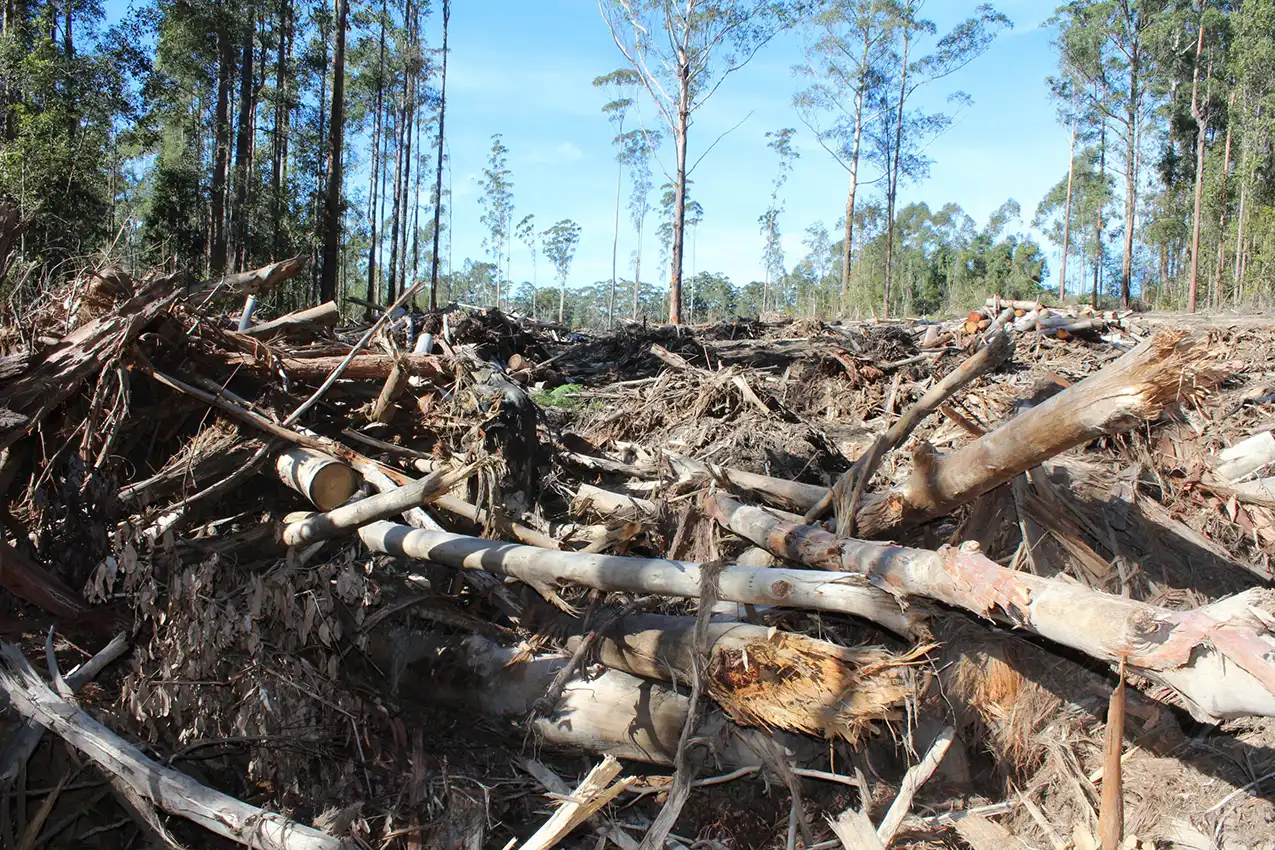
The state’s Statewide Landcover and Trees Study found 274,600 hectares of woody vegetation affected by clearing in 2023–24, down from 332,000 hectares the year before.10 The fall is real and should be acknowledged: overall clearing is now about 60 per cent below the 2018–19 level, and clearing of vegetation regulated under the state’s vegetation-management laws has fallen by about two-thirds over the same six years.10 Laws, enforcement and landholder decisions change outcomes.
The remainder is still enormous: some 2,750 square kilometres in a year, 43 per cent of it in catchments draining to the Great Barrier Reef, and most of it to expand pasture. Queensland, the Wilderness Society notes, bulldozes more bush than every other state combined.11
The composition matters as much as the total. Of the 274,600 hectares, about 207,300 — three-quarters — were in Category X: land mapped as previously lawfully cleared, which on most private tenures is exempt from the vegetation-management framework. Only about 67,200 hectares was regulated vegetation.10
Three-quarters of the destruction, in other words, required no approval because the law had decided in advance that it did not count. “Previously cleared” is a legal category, not an ecological one. Regrowth, paddock trees and the mosaics between remnants provide habitat, carbon storage and corridors; a koala does not consult the regulated vegetation map before it crosses a paddock.
New South Wales sends a related signal. Data released in July 2026 recorded 81,293 hectares of vegetation cleared in 2024, which the state government reports as a 16 per cent rise on 2023 after a 40 per cent rise the year before, with agriculture responsible for 88 per cent of it.12 Sixty per cent of all clearing, 49,146 hectares, was “unallocated”: detected by satellite but not matched to any authorisation. Most of that was non-woody vegetation, grassland and groundcover, which under NSW rules may not have needed approval at all; unallocated is a monitoring category, not a finding of illegality.13 The state government’s own release conceded the figure “remains significantly high”.12
The bulldozer runs on credit. In 2025 the Australian Conservation Foundation and a group of shareholders filed the country’s first nature-related shareholder resolutions at two major banks, asking NAB and ANZ to disclose their lending exposure to deforestation and adopt no-deforestation policies. At NAB the disclosure resolution drew 13.98 per cent of votes; at ANZ’s annual meeting in December, 22.7 per cent. At Commonwealth Bank’s meeting on 14 October 2026 a similar proposal fell at the first hurdle: more than 93 per cent of votes went against the constitutional amendment needed to put it to shareholders.14 None of this alleges wrongdoing by any bank. It records that the finance behind land clearing is now being asked to account for it, which is the question Article 4 of this series will take into the boardroom.
Across both states, the question is cumulative. If the law permits extensive clearing of habitat, at what scale does the sum of lawful acts become a failure of the law itself?
The word ecocide must be used with care here. No paddock, road or individual clearing approval comes near the exceptionally high threshold proposed for the crime. But a system that authorises incremental damage without accounting for the whole landscape is a system in which catastrophe arrives by accumulation, and in which no single actor is ever responsible for the result.
The koala park and the exemption that outlived its reason
There is good news on the NSW Mid North Coast, and it should be stated without hedging.
On 23 October 2026 the National Park Estate (Great Koala National Park Reservations) Bill 2026 passed the NSW Parliament. It transfers 178,000 hectares of state forest and other Crown land to the national parks estate, creating a connected protected landscape of more than 475,000 hectares between Kempsey and Grafton, home to an estimated 12,000 koalas and more than a hundred other threatened species.15 A carbon project approved by the Clean Energy Regulator helps pay for it; native timber supply from state forests falls by about a fifth; forestry workers are offered redundancy payments, retraining and a pathway into National Parks and Wildlife Service jobs.16 The park is expected to open before the end of the year.
It took more than a decade of campaigning, and it is proof that political choices can protect what remains. It is also a lesson in political time. Throughout those years the logging of forests of acknowledged conservation value continued, lawfully, while the koala’s national listing moved from vulnerable to endangered.
The lawfulness came from a particular Australian arrangement. Since the national environment law commenced in 2000, native forestry conducted under Regional Forest Agreements between the Commonwealth and the states has been exempt from its assessment and approval requirements, a carve-out no other land-use industry had. Under the reforms passed in November 2025, it ends on 1 July 2027, from which date forestry in the remaining agreement regions of New South Wales, Tasmania and Western Australia must meet the same National Environmental Standards as everyone else; Victoria’s five agreements were terminated at the end of 2024 when the state closed native-forest logging.17 New South Wales has begun a strategic assessment seeking a single twenty-year federal approval for public native, plantation and private native forestry before the deadline.18
Lawful forestry is not ecocide, and most logging, even where ecologically contentious, would not satisfy the demanding elements of the proposed crime. The relevant point is different. For a quarter of a century a statute decided that a whole industry’s impacts on threatened species did not require national scrutiny. Whether the new arrangements protect forests better than the old exemption will depend on what the standards demand and what the regulator enforces.
Macquarie Harbour: when parliament changed the law to keep an approval
On Tasmania’s west coast, a fish most Australians have never seen has become the clearest test of what Australian environmental law is for.
The Maugean skate is an ancient relative of the rays whose only surviving wild population lives in the stratified, tannin-dark waters of Macquarie Harbour. Estimates put the adult population at somewhere between 40 and 120.19 It has been listed as endangered since 2004. The Commonwealth’s own conservation advice identifies prolonged low dissolved oxygen, driven by the cumulative organic load of intensive salmon farming and compounded by altered river flows and warming, as the principal threat, and names salmon farming as the single catastrophic risk that could be remedied at once.20
The harbour’s salmon farms operate under a 2012 federal decision that their expansion could proceed “in a particular manner” without a full assessment. In 2023 three organisations asked the minister to reconsider that decision in the light of newer science. Instead, in March 2025, on the eve of a federal election, Parliament amended the national law to narrow the circumstances in which such decisions can be reconsidered — legislation the Prime Minister had promised the industry, which passed with Coalition support.21 On 14 August 2025 the minister, Murray Watt, used the amended law to confirm the 2012 decision. Salmon farming would continue, subject to the existing conditions, alongside federally funded oxygenation of the harbour and a captive breeding program.22
In February 2026 Watt declined a request to uplist the skate from endangered to critically endangered, citing the Threatened Species Scientific Committee’s advice that the species met one criterion for endangered and that data were insufficient to assess it under four others; the IUCN had reached the same conclusion in October 2025.23 The government points to $37.5 million committed to the harbour and the skate since 2021.23 University of Tasmania monitoring recorded a steep decline between 2014 and 2022 and higher numbers since,19 though the researchers caution that the estimates are uncertain, and the Bob Brown Foundation reads the latest monitoring report as showing continued decline.20 Salmon Tasmania says the decision provides certainty for more than 400 west-coast workers, that farming practices have changed, and that research suggests skate numbers have stabilised; it acknowledged the listing decision.24 Bob Brown called the listing decision disgraceful, and conservation groups call the 2025 amendment a law written for one industry. The Bob Brown Foundation challenged it in the Federal Court; the minister’s August decision overtook that case days before its hearing, and the foundation said it would bring fresh proceedings.24
Any claim that the skate is already doomed is unsupported. Any claim that it is safe is equally unsound.
What Macquarie Harbour shows is not a crime but a method. Faced with a scientific case that an approved activity might extinguish a species, the legal system did not resolve the question. It changed the rule that would have forced the question to be resolved. Every decision in the chain was lawful. That is precisely the situation the 2021 definition of ecocide was written to reach, and we return to it below.
The Reef: resilience is not permission
The Great Barrier Reef is Australia’s most famous ecosystem and the clearest demonstration of what national law cannot do alone.
The Australian Institute of Marine Science’s survey of 121 reefs, published in August 2026, carried unexpectedly good news. Average hard-coral cover rose in the northern region from 30.0 to 35.1 per cent and in the central region from 28.6 to 31.6 per cent between the 2025 and 2026 surveys; in the south it was stable at 26.4 per cent. A late-summer monsoon cooled the water and limited bleaching, and the impacts of the 2025 mass bleaching event proved limited.25
The institute was careful about what that meant. Six mass bleaching events have struck the Reef since 2016, and a regional one touched the north and centre again in early 2026. The fast-growing corals that drive recovery are the first to die in the next heatwave. Beneath the headline figure, the surveys recorded shifts in coral communities that total cover does not reveal. The Reef, AIMS said, remains under pressure from climate-driven disturbance, cyclones and crown-of-thorns outbreaks.25
A reef can recover from one assault without having unlimited capacity to recover from the next. The legal difficulty is that the assault has no single author. Ocean warming is the product of emissions by states, companies and billions of people across generations. No ecocide law could prosecute the climate. But cumulative causation does not dissolve responsibility everywhere. Particular decisions — to approve an especially large source of emissions with knowledge of the consequences, to permit sediment and nutrient runoff that compounds heat stress — can be identified, assessed and, if the elements are met, judged. The reforms now commencing will, for the first time, require some projects to disclose their direct emissions during assessment.26 What the law then does with that knowledge is the question.
Juukan Gorge: when permission was not protection
In May 2020 Rio Tinto destroyed two rock shelters at Juukan Gorge in the Pilbara that held evidence of human occupation across some 46,000 years and were of profound significance to the Puutu Kunti Kurrama and Pinikura peoples. The blasting was lawful, carried out under a Western Australian consent granted in 2013. A federal parliamentary inquiry found a system that had allowed the irreplaceable to be removed on schedule.27 The company apologised, three senior executives left, and nothing was rebuilt.
Juukan Gorge is not an ecocide case; its central harm was cultural, and the facts do not map onto an ecological crime. It belongs in this article for one reason. Legal permission is not the same thing as protection. An approval framework can authorise the loss of something scientifically, historically or culturally irreplaceable, and once it is lost there is no remedy in apology or money.
Ecocide law poses the environmental version of that problem. A permit should not settle every question about severe, long-term damage. But a credible law must say clearly when authorised conduct becomes independently criminal, rather than inviting retrospective punishment under vague standards. Here First Nations perspectives are not an acknowledgement at the front of an impact statement. Country is lived relationship, obligation and custodianship, and Indigenous peoples speak with many voices: some communities support particular developments, others oppose them. Meaningful authority requires free, informed participation and enforceable rights. Juukan Gorge is what their absence looks like.
An Australian company, a Brazilian river and a London courtroom
Article 2 ended at the Fundão tailings dam. On 5 November 2015 it collapsed at Mariana in Brazil, killing nineteen people, burying the village of Bento Rodrigues and sending mining waste down the length of the Rio Doce. The dam belonged to Samarco, owned in equal shares by the Brazilian miner Vale and by BHP, the largest miner on the Australian Securities Exchange.
Two courts have now ruled on the same collapse and arrived at different places. In September 2026 an appellate panel in Belo Horizonte convicted Samarco and three former managers in Brazil’s first criminal finding of guilt over the disaster, while leaving in place the acquittals of Vale and BHP on the ground that the evidence did not establish the owners’ direct criminal responsibility.28 In London, by contrast, the High Court found in November 2025 that BHP was liable under Brazilian law in a group action brought on behalf of more than 600,000 Brazilian claimants, the largest such action in English legal history. The judge found that by August 2014 BHP knew, or should have known, of serious structural problems at the dam, and that continuing to raise it when it was unsafe to do so was the direct cause of the failure.29 BHP was refused permission to appeal, first by the trial judge in January 2026 and then by the Court of Appeal in May. A trial on causation and damages is listed to hear evidence from April to December 2027, with closing submissions in March 2028.30
BHP has said it will continue to defend the action. It argues that the London claims duplicate a R$170 billion reparation agreement reached in Brazil, that about 240,000 of the claimants have already been compensated and signed releases, and that this will significantly reduce the size and value of the claims.29 The London finding is a civil one. No court anywhere has convicted BHP of a crime, and in Brazil it stands acquitted.
The relevance for Australia is uncomfortable and precise. A company headquartered in Melbourne, held through superannuation by millions of Australians, has been found by an English judge to have known, or to have been in a position to know, of a danger and to have let an unsafe dam be raised. If that finding holds through the damages phase, the question an ecocide law is designed to ask — who knew, who decided, and should the gravest foreseeable consequences be treated as a crime — will have been answered in part, in a civil court, under a foreign law, in a third country. No Australian court was ever asked. No Australian law required it to be.
The law Australia has, and the law it is building
Australia’s principal environmental statute, the Environment Protection and Biodiversity Conservation Act 1999, exists to protect matters of national environmental significance: threatened species and ecological communities, World Heritage, wetlands, and water resources affected by large coal and gas projects.
In 2020 an independent review led by Graeme Samuel found the Act ineffective at protecting the matters for which the Commonwealth is responsible and the environment in a state of continued, unsustainable decline.31 That was the law’s own commissioned verdict on itself.
The Act is not toothless on paper. It contains criminal offences for taking actions that significantly affect listed threatened species, ecological communities and other protected matters without approval, and Australia’s Criminal Code already contains the war crimes, including the Rome Statute offence of launching an attack in the knowledge that it will cause widespread, long-term and severe damage to the natural environment.32 What Australia lacks is a general offence for the gravest environmental destruction in peacetime: the difference between enforcing the conditions of a protection regime and defining an exceptional category of harm as criminal in itself.
After years of false starts, the reforms the Samuel Review called for passed Parliament on 28 November 2025 and received assent on 1 December, in a deal between the government and the Greens that secured the end of the forestry exemption and kept fossil-fuel projects out of a new fast-track approval pathway.33 The new architecture has been switched on in stages. A National Environmental Protection Agency was established on 1 July 2026, and by late August held powers to order work to stop, to audit and to pursue sharply higher penalties.34 The first four National Environmental Standards — on matters of national environmental significance, offsets, community engagement, and data and information — were made on 19 August 2026, and further provisions commenced on 24 August.35
But as this article is written in November 2026, those standards do not yet govern the assessment or approval of any individual project. The government says the new approval tests will commence on or before 1 December 2026, and a draft agreement accrediting New South Wales to assess projects under them is open for comment until 19 November.35 The next weeks will therefore test something more valuable than the rhetoric of reform: its operation.
The critiques already lodged are instructive. The Law Council of Australia pressed for greater precision in the draft standards and questioned how the offsets standard defines “net gain”.36 The Environmental Defenders Office found the second draft weaker than the first and the required net gain still undefined; the Australian Academy of Science asked for discretionary language to be removed.37 Industry bodies, for their part, want timely and predictable decisions, which is a legitimate interest: a chaotic approvals process imposes cost without improving outcomes.
Speed, though, is not protection. A faster system that reliably refuses unacceptable destruction would be genuine progress. A faster system that processes more of it would be something else.
The trouble with offsets
Offsets promise to solve an impossible equation. A developer clears habitat at one site and finances conservation or restoration at another; the loss is compensated, even exceeded. Sometimes that is true, where the residual impact genuinely cannot be avoided and the gain is measurable, additional and secured. The new federal offsets standard contains requirements of exactly that kind.38
The philosophical problem survives the drafting. Ecological places are not interchangeable units. A hollow-bearing tree cannot be manufactured; a centuries-old forest does not reappear because seedlings were planted 100 kilometres away; a breeding ground is not replaced in time to matter to the animals that needed it this season. The objection is not that restoration is useless. It is that it cannot be a universal permission slip.
A serious ecocide framework would do two things offsets cannot. It would mark an upper limit beyond which damage is not tradeable at any price. And it would strengthen the duty to avoid harm before mitigation, offsetting or compensation are considered at all. Without clear, enforceable standards and independent verification, net gain becomes an accounting aspiration rather than an outcome in a living landscape.
Would any of this be ecocide?
A credible investigation must resist the shortcut.
The definition proposed by the Independent Expert Panel in 2021, examined in Article 1, requires unlawful or wanton acts, committed with knowledge that there is a substantial likelihood of severe and either widespread or long-term damage to the environment. Wanton means reckless disregard for damage that would be clearly excessive in relation to the social and economic benefits anticipated.39 It is a proposal. It is not a crime available to any Australian prosecutor, and no Australian parliament has a bill before it to make it one: this investigation could find none introduced, though a working group of Australian lawyers has been drafting model provisions and a Greens senator called for the offence in his first speech in 2022.40
Applied honestly to the cases above, the definition bites in different places.
At Menindee the damage was immense, but the conduct is diffuse. Proving that an identifiable person took an act, with the required knowledge, inside a cumulative water-management system spanning decades would be extraordinarily difficult. An ecocide offence would not solve the EPA’s evidentiary problem; it would inherit it.
In Queensland and New South Wales the clearing figures prove no individual crime. Three-quarters of Queensland’s clearing is lawful by design, so the definition’s “unlawful” limb is largely closed, and its “wanton” limb — damage clearly excessive relative to benefit — would have to be assessed landholder by landholder. The law would reach only the gravest and most knowing cases, which is as it should be.
Macquarie Harbour is the hard case, and the most illuminating. The conduct is lawful; the “unlawful” limb fails. The damage, if the skate were lost, would be the extinction of a species: severe by any measure and permanent, which satisfies “long-term”. The knowledge is documented in the Commonwealth’s own conservation advice. The whole question would turn on wanton: whether continuing an activity identified as the single catastrophic and remediable threat to a species is a reckless disregard for damage clearly excessive in relation to the benefits, which are several hundred jobs and a regional industry. Reasonable people will weigh that differently. The point is that under existing Australian law the question is never asked, and in 2025 the law was amended so that it need not be.
For the Reef, the science of climate harm is compelling and the attribution of any particular injury to any particular decision is not. The definition would reach some decisions and not others, and would depend on the kind of emissions disclosure the new assessment rules are only now introducing.
Juukan Gorge is a heritage case, not an ecological one, and the definition does not fit it.
Mariana shows what a prosecution would require. The Brazilian court convicted the operator and its engineers and acquitted the owners for want of proof of direct responsibility. The London court, on the civil standard, found that the owner knew or should have known. An ecocide offence directed at corporate decision-makers would have to make a finding of that kind to the criminal standard. That is a high bar. It is the right bar.
These limits do not weaken the case for serious law. They define the work required to make it legitimate. The argument for ecocide legislation is not that every controversial development should be criminalised. It is that the gravest foreseeable destruction should not escape accountability merely because the existing statutes were never written to confront it.
Where the law stands: Australia, November 2026
The series test, set out in Article 1, is not whether the word “ecocide” appears in a statute but whether anyone could realistically be prosecuted under it. Stages follow the series vocabulary: proposal → advancing → adopted → in force.
| Jurisdiction / instrument | Stage | What it actually reaches |
|---|---|---|
| Commonwealth or any state: standalone ecocide offence | No proposal: no bill before any Australian parliament identified | Nothing. The 2021 panel definition is available only as a model39 |
| EPBC Act offence provisions (s 18A and related) | In force | Significant impacts on listed species, communities and other protected matters taken without approval; breach of approval conditions32 |
| Criminal Code div. 268 (war crimes) | In force | Attacks launched with knowledge of widespread, long-term and severe environmental damage; armed conflict only32 |
| EPBC reform package (assent 1 Dec 2025) | In force in stages; new approval tests on or before 1 Dec 2026 | National EPA from 1 July 2026; four standards made 19 Aug 2026, applying to project decisions from the final stage; RFA exemption ends 1 July 202735 |
| EPBC Reconsiderations amendment (28 Mar 2025) | In force | Narrows reconsideration of “particular manner” decisions; used to confirm Macquarie Harbour salmon farming on 14 Aug 202521 |
| NSW National Park Estate (Great Koala National Park Reservations) Act 2026 | Adopted 23 Oct 2026 | 178,000 ha reserved; end of native-forest logging within the park15 |
| Município de Mariana v BHP (England and Wales) | Civil liability found 14 Nov 2025; appeals refused Jan and May 2026; damages trial 2027–28 | Civil liability of an Australian parent under Brazilian law; no criminal finding anywhere30 |
| Rome Statute amendment (Vanuatu, Fiji, Samoa) | Proposal before the ASP Working Group on Amendments; ASP meets 30 Nov–7 Dec 2026 | Would create the international crime; Australia is a State Party, and its position is examined in Article 641 |
What strong Australian ecocide legislation would require
Australia should begin a public, expert-led process to consider a carefully defined ecocide offence, alongside — not instead of — the reform of its regulatory law. Criminal law in Australia is mostly the states’ domain; the Commonwealth’s path runs through its own constitutional powers and, if the Rome Statute is amended, through the obligation to implement the crime at home. Seven tests follow from the cases above.
First, a high and certain threshold. Serious criminal sanction belongs to exceptionally grave conduct, not ordinary regulatory breach or good-faith scientific disagreement; severity, scale, duration and the required knowledge must be specified precisely.
Second, responsibility must be personal and provable, reaching those who design, finance and knowingly authorise the most harmful decisions rather than the machine operator or the marginal landholder, with the presumption of innocence and a genuine opportunity to contest the science.
Third, independent investigation: satellite evidence, company records, ecological modelling and decision trails accessible to properly resourced regulators and prosecutors, and real protection for whistleblowers.
Fourth, recognition of cumulative and systemic harm without abandoning causation. Complex systems cannot be pretended simple; the answer is better evidentiary method, and prosecution only where the elements can be proved.
Fifth, First Nations authority: access to information, culturally safe participation, enforceable protection for Country and heritage, and standing in restoration and decision-making.
Sixth, prevention and recovery paired with sanction: no-go limits for the irreplaceable, strong threatened-species protection, offsets only where genuine, and enforceable restoration.
Seventh, outcomes rather than announcements: avoided destruction, improving ecosystem condition, prosecutions where warranted, and public confidence that the powerful are not exempt.
The point is not to build a spectacular offence that nobody can use. It is to change decisions before the damage occurs.
A country capable of choosing differently
It would be easy, and false, to tell Australia’s environmental story as uninterrupted disaster.
Queensland has cut clearing by 60 per cent in six years. New South Wales has just reserved 178,000 hectares of forest that were being logged. The Reef has shown that it can recover when given a season’s reprieve. A national regulator with stop-work powers exists where none did a year ago. The forestry exemption is ending. Brazil, as Article 2 showed, reduced Amazon deforestation to its lowest level in thirty-eight years because a government decided to; Australia has institutions, data and wealth that Brazil would envy.
Hope, in the sense this series uses it, is not optimism about outcomes. It is the record of what institutions have already done when they chose to act, set honestly against what they have not. The record also shows the limits. A new park does not absolve the clearing elsewhere. An improved reef survey does not neutralise the next marine heatwave. A stabilised skate population does not make the risk disappear. A statute’s commencement proves nothing about its enforcement.
Australia cannot plausibly claim that it does not understand what it is doing. It has the science, the satellites, the monitoring and the money. That knowledge creates an obligation.
The Barkandji did not need an international legal conference to understand what had happened to their river. The skate does not distinguish between an approved activity and a lethal one. A koala needs connected habitat, not a ministerial statement. Coral needs tolerable temperatures and time.
Ecocide law would not, on its own, solve any of the problems in this article. It cannot replace competent water management, strong planning law, serious climate policy, First Nations authority or the democratic choice to protect what remains. What it could establish is a principle now missing from Australia’s legal architecture: that certain exceptionally grave and foreseeable assaults on the living world cross a criminal line, whatever the political or economic weight of those responsible.
That would change the questions. No longer only: was the paperwork complete, was a permit granted, what compensation is available? But also: was this level of destruction ever an acceptable thing to do, who knew, who decided, and should the worst of it be a crime?
Australia has spent generations learning to measure what it is losing. It is time to show that it is prepared to prevent it.
Coming next: Article 4
The Boardroom and the Bulldozer: Who Is Personally Responsible for Ecocide?
The fourth investigation follows decisions away from the forests, rivers and coasts and into the meeting rooms, risk committees, engineering reports and investment structures where consequences are anticipated long before they are suffered. Mariana convicted an operator and acquitted its owners; London found that the owner knew or should have known. A cooperative with no members laundered ore into certified tin. A meat company’s financiers face money-laundering complaints in four countries. We ask what individual criminal accountability would require, what evidence investigators would need, and how a carefully drafted ecocide law could reach the people who decide without abandoning the presumption of innocence.
Notes and references
- Office of the NSW Chief Scientist & Engineer, Independent Review into the 2023 Fish Deaths in the Darling-Baaka River at Menindee: Final Report (Sydney: NSW Government, 29 September 2023; revised December 2023), https://www.chiefscientist.nsw.gov.au/__data/assets/pdf_file/0015/1671/Menindee_Report_Dec-2023.pdf; NSW Department of Primary Industries, DPI Fisheries Submission to the Independent Review into the February–March 2023 Fish Deaths (July 2023), https://www.chiefscientist.nsw.gov.au/__data/assets/pdf_file/0013/1606/DPI-Fisheries-Submission-to-Independent-Review-into-Menindee-Fish-Deaths-2023.pdf. The 20–30 million estimate is the NSW Government’s: see James Day, “State Government Begins Action on Chief Scientist’s Report into the Menindee Mass Fish Deaths,” PS News, 21 November 2023, https://psnews.com.au/?p=122973. ↩
- Office of the NSW Chief Scientist & Engineer, Independent Review (n. 1), Acknowledgement of the Traditional Owners (quoting William Brian “Badger” Bates to the Murray–Darling Basin Royal Commission), Findings and ch. 2.7, “Ecosystem Decline in the Lower Darling-Baaka”; NSW Government, NSW Government Response to the Independent Review (June 2024), https://www.chiefscientist.nsw.gov.au/__data/assets/pdf_file/0015/3246/response-OSCE-inquiry-menindee-fish-deaths-june-2024.pdf. ↩a ↩b
- NSW Environment Protection Authority, “EPA Investigation into Darling-Barka Fish Kill,” media release, 19 April 2023, https://www.epa.nsw.gov.au/news/media-releases/2023/epamedia230419-epa-investigation-into-darling-barka-fish-kill; NSW EPA, “Menindee Fish Deaths Follow Up: Darling-Baaka River Water Tests,” https://www.epa.nsw.gov.au/Working-together/Community-engagement/updates-on-issues/Menindee-fish-kill (accessed 7 November 2026): “We have concluded an investigation … No regulatory action will be taken at this time.” ↩
- “Up to 100,000 Dead Fish Found on Bank of Lake Menindee,” ABC News, 4 February 2026, https://www.abc.net.au/news/2026-02-04/fish-kill-on-sunset-strip-shores-near-menindee/106302904; Nature Conservation Council of NSW, “Another Mass Fish Kill at Menindee Lakes Highlights NSW Government’s Failure to Act on Darling/Baaka River,” 4 February 2026, https://www.nature.org.au/another_mass_fish_kill. ↩a ↩b
- “New Review Launched Following Latest Menindee Lakes Fish Kill,” Back Country Bulletin, 18 February 2026, https://backcountrybulletin.app/NewsStory/new-review-launched-following-latest-menindee-lakes-fish-kill/6994ffcf6ddfc4002dd8a4f4; Murray–Darling Basin Authority, Menindee Lakes Review: What We Heard Report (Canberra: MDBA, August 2026), https://www.mdba.gov.au/sites/default/files/publications/menindee-lakes-review-what-we-heard-report-august-2026.pdf. ↩
- “Locals Not Hopeful for Menindee Lakes Review as Water Levels Fall to Lowest Since 2021,” ABC News, 5 November 2026, https://www.abc.net.au/news/2026-11-05/menindee-lakes-review-locals-view-fish-kills/107255566. ↩
- Department of Climate Change, Energy, the Environment and Water (DCCEEW), “Threatened Species & Ecological Communities,” https://www.dcceew.gov.au/environment/biodiversity/threatened (accessed 7 November 2026). ↩
- Ian Cresswell, Terri Janke and Emma L. Johnston, Australia State of the Environment 2021: Overview (Canberra: DCCEEW, 2021), and “Biodiversity: Key Findings,” https://soe.dcceew.gov.au/biodiversity/key-findings; Dana M. Bergstrom et al., “Combating Ecosystem Collapse from the Tropics to the Antarctic,” Global Change Biology 27, no. 9 (2021): 1692–1703, https://doi.org/10.1111/gcb.15539. ↩
- DCCEEW, “State of the Environment Report,” https://www.dcceew.gov.au/environment/environment-information-australia/national-environmental-reporting/soe (accessed 7 November 2026). ↩
- Queensland Government, Department of Natural Resources and Mines, Manufacturing, and Regional and Rural Development, “SLATS Vegetation Management Analysis,” updated 5 August 2026, https://www.qld.gov.au/environment/land/management/vegetation/slats-analysis; Queensland Government, 2023–24 SLATS Report, updated 4 November 2026 (superseding the Clearing Report of 3 August 2026), https://www.qld.gov.au/environment/land/management/mapping/statewide-monitoring/slats/slats-reports/2023-24-slats-report. ↩a ↩b ↩c
- The Wilderness Society, “One-Year Dip Cannot Hide Queensland’s Ongoing Deforestation Crisis,” August 2026, https://wilderness.org.au/news-events/one-year-dip-cannot-hide-queenslands-ongoing-deforestation-crisis. ↩
- NSW Department of Climate Change, Energy, the Environment and Water, “20 Years of NSW Land Clearing Data Reveals Next Steps for Reform,” 21 July 2026, https://www.environment.nsw.gov.au/news/20-years-nsw-land-clearing-data-reveals-next-steps-reform; Australian Conservation Foundation, “Agriculture Continues to Drive Up NSW Land Clearing,” 21 July 2026, https://www.acf.org.au/news/agriculture-continues-to-drive-up-nsw-land-clearing; Chloe Sargeant, “Greens Demand Legislation Repeal after Data Reveals 16% Increase in Land Clearing in NSW,” City Hub, 21 July 2026, https://cityhub.com.au/greens-demand-legislation-repeal-after-data-reveals-16-increase-in-land-clearing-in-nsw/. ↩a ↩b
- NSW DCCEEW, “2024 NSW Vegetation Clearing Report,” updated 21 July 2026, https://www.environment.nsw.gov.au/topics/animals-and-plants/native-vegetation/landcover-science/2024-nsw-vegetation-clearing-report. ↩
- Australian Conservation Foundation, “Banks Continue to Bankroll Deforestation as ANZ and CommBank Face Nature Risk Shareholder Resolutions,” 2026, https://www.acf.org.au/news/banks-continue-to-bankroll-deforestation-as-anz-and-commbank-face-nature-risk-shareholder-resolutions; ACF, “Everything You Need to Know about Shareholder Resolutions,” 2026, https://www.acf.org.au/news/everything-you-need-to-know-about-shareholder-resolutions; “CBA Faces Shareholder Revolt over Deforestation Risk,” FS Sustainability, 2026, https://www.fssustainability.com.au/cba-faces-shareholder-revolt-over-deforestation-risk (ANZ vote of 22.7 per cent); “Big Bank Rejects Push to End Financing of Land Clearing,” Goulburn Post, 14 October 2026, https://www.goulburnpost.com.au/story/9368067/big-bank-rejects-push-to-end-financing-of-land-clearing/. ↩
- NSW Government, “Historic Day for Koalas as Landmark Legislation Passes NSW Parliament,” ministerial media release, 23 October 2026, https://www.environment.nsw.gov.au/news/historic-day-koalas-landmark-legislation-passes-nsw-parliament; Samuel O’Brien, “Great Koala National Park Established after More Than a Decade of Campaigning,” ABC News, 23 October 2026, https://www.abc.net.au/news/2026-10-23/great-koala-national-park-legislation-passed/107296314. ↩a ↩b
- “Landmark Decision for Great Koala National Park amid Fears for Timber Industry,” Port Macquarie News, 23 October 2026, https://www.portnews.com.au/story/9378998/great-koala-national-park-passed-how-nsw-timber-is-affected/; Alex Catalano, “Koala Conservation Legislation Passes Parliament,” Arbor Age, 26 October 2026, https://arborage.com.au/koala-conservation-legislation-passes-parliament. ↩
- Department of Agriculture, Fisheries and Forestry, “Regional Forest Agreements,” https://www.agriculture.gov.au/agriculture-land/forestry/policies/rfa (accessed 7 November 2026); DCCEEW, “Stronger Environmental Protection and Restoration,” https://www.dcceew.gov.au/environment/epbc/epbc-act-reform/stronger-environmental-protection-restoration (accessed 7 November 2026). ↩
- NSW Government, “Strategic Assessment of NSW Forestry Gets Underway,” ministerial media release, September 2026, https://www.nsw.gov.au/ministerial-releases/strategic-assessment-of-nsw-forestry-gets-underway; NSW Department of Primary Industries and Regional Development, “EPBC Act Strategic Assessment of Forestry Operations within NSW Regional Forest Agreement Regions,” https://www.dpird.nsw.gov.au/forestry/strategic-assessment (accessed 7 November 2026). ↩
- Ethan James and Callum Godde, “Salmon Farms Green Lit, but Conservation Fight Not Over,” Australian Associated Press, 14 August 2025, https://aapnews.aap.com.au/news/salmon-farms-green-lit-but-conservation-fight-not-over. ↩a ↩b
- Adam Holmes, “Maugean Skate Still Faces ‘Catastrophic’ Risk from Salmon Farming, Commonwealth Advice Says,” ABC News, 16 February 2026, https://www.abc.net.au/news/2026-02-16/maugean-skate-endangered-status-analysis/106348446; Australian Marine Conservation Society, “Science Clear, Action Missing: Skate Remains Endangered,” 13 February 2026, https://www.marineconservation.org.au/science-clear-action-missing-skate-remains-endangered/; Bob Brown Foundation, “New Report Shows Maugean Skate Still Declining in Macquarie Harbour,” 10 June 2026, https://bobbrown.org.au/new-report-shows-maugean-skate-still-declining-in-macquarie-harbour/. ↩a ↩b
- Environment Protection and Biodiversity Conservation Amendment (Reconsiderations) Act 2025 (Cth), commenced 28 March 2025; Phillipa C. McCormack, “Protecting Salmon Farming at the Expense of the Environment: Another Step Backwards for Australia’s Nature Laws,” The Conversation, March 2025, https://theconversation.com/protecting-salmon-farming-at-the-expense-of-the-environment-another-step-backwards-for-australias-nature-laws-252814. ↩a ↩b
- Murray Watt, “Decision Allows Salmon Farming to Continue in Macquarie Harbour,” media release, 14 August 2025, https://minister.dcceew.gov.au/watt/media-releases/decision-allows-salmon-farming-continue-macquarie-harbour; Adam Holmes, “Commonwealth Reaffirms Decision to Allow Salmon Farming Expansion in Tasmania’s Macquarie Harbour,” ABC News, 14 August 2025, https://www.abc.net.au/news/2025-08-14/macquarie-harbour-marine-farming-reaffirmed-commonwealth/105650836. ↩
- Murray Watt, “Media Statement: Decision on Maugean Skate Threatened Species Listing,” 13 February 2026, https://minister.dcceew.gov.au/watt/media-releases/media-statement-decision-maugean-skate-threatened-species-listing; “Maugean Skate’s Endangered Status Not Changing, Environment Minister Murray Watt Says,” ABC News, 13 February 2026, https://www.abc.net.au/news/2026-02-13/maugean-skate-endangered-listing-not-changing-murray-watt-says/106342278. ↩a ↩b
- Salmon Tasmania statements as reported in AAP (n. 19), ABC (n. 23) and “Is This the End of the Debate over Salmon Farming in Macquarie Harbour?,” ABC News, 15 August 2025, https://www.abc.net.au/news/2025-08-15/is-the-debate-over-salmon-farming-in-macquarie-harbour-settled/105655310; Bob Brown Foundation, “Maugean Skate Being Mugged by Watt,” 13 February 2026, https://bobbrown.org.au/maugean-skate-being-mugged-by-watt/; “New Legislation to Be Challenged after Minister’s Decision on Macquarie Harbour,” Tasmanian Times, August 2025, https://tasmaniantimes.com/2025/08/new-legislation-to-be-challenged-after-ministers-decision-on-macquarie-harbour/. ↩a ↩b
- Australian Institute of Marine Science, Long-Term Monitoring Program: Annual Summary Report of Coral Reef Condition 2025–2026 (Townsville: AIMS, 11 August 2026), https://www.aims.gov.au/monitoring-great-barrier-reef/gbr-condition-summary-2025-26, https://doi.org/10.25845/440g-d478. ↩a ↩b
- National Environmental Protection Agency, “Next Tranche of Environment Protection Reforms and National Environmental Standards,” 24 August 2026, https://www.nationalepa.gov.au/about/news/next-tranche-environment-protection-reforms-and-national-environmental-standards. ↩
- Joint Standing Committee on Northern Australia, A Way Forward: Final Report into the Destruction of Indigenous Heritage Sites at Juukan Gorge (Canberra: Parliament of Australia, October 2021), https://www.aph.gov.au/Parliamentary_Business/Committees/Joint/Former_Committees/Northern_Australia_46P/CavesatJuukanGorge/Report. ↩
- Both ENDS, “Unprecedented Criminal Conviction in the Mariana Disaster Case Breaks Mining Industry’s Cycle of Impunity,” 7 September 2026, https://www.bothends.org/en/Whats-new/News/Unprecedented-criminal-conviction-in-the-Mariana-disaster-case-breaks-mining-industrys-cycle-of-impunity/; “Samarco Convicted on Appeal over the Mariana Dam Collapse,” Rio Times, 6 September 2026, https://www.riotimesonline.com/samarco-mariana-dam-conviction-appeal-2026/. ↩
- High Court of Justice (Technology and Construction Court), Município de Mariana and others v BHP Group (UK) Ltd and BHP Group Ltd, judgment on liability, O’Farrell J, 14 November 2025; Sam Tobin, “BHP Liable for 2015 Brazil Dam Collapse, UK Court Rules in Mammoth Lawsuit,” Reuters, 14 November 2025, https://www.thestar.com.my/news/world/2025/11/14/bhp-liable-for-2015-brazil-dam-collapse-uk-court-rules-in-mammoth-lawsuit; “Big Win for Pogust Goodhead as UK’s High Court Rules BHP Liable for Brazil Dam Collapse,” Global Legal Post, 14 November 2025, https://www.globallegalpost.com/news/big-win-for-pogust-goodhead-as-uks-high-court-rules-bhp-liable-for-brazil-dam-collapse-1724774346 (BHP’s statement). ↩a ↩b
- Pogust Goodhead, “High Court Refuses BHP Permission to Appeal Landmark Mariana Liability Judgment,” 19 January 2026, https://pogustgoodhead.com/high-court-refuses-bhp-permission-to-appeal/; Reuters, “BHP Can’t Appeal UK Judgment over 2015 Brazil Dam Collapse,” Mining Weekly, 6 May 2026, https://www.miningweekly.com/article/bhp-cant-appeal-uk-judgment-over-2015-brazil-dam-collapse-2026-05-06; “Pogust Scores Appeal Victory over BHP in Brazilian Dam Case,” Non-Billable, May 2026, https://www.nonbillable.co.uk/news/pogust-scores-appeal-victory-over-bhp-hsf-brazilian-dam-case (trial evidence April–December 2027; closing submissions March 2028). ↩a ↩b
- Graeme Samuel, Independent Review of the EPBC Act: Final Report (Canberra: Department of Agriculture, Water and the Environment, October 2020), https://www.nationalepa.gov.au/epbc/our-role/reviews/epbc-review-2020. ↩
- Environment Protection and Biodiversity Conservation Act 1999 (Cth), ss 18A, 20A and related offence provisions, and s 142A (breach of approval conditions), Federal Register of Legislation, https://www.legislation.gov.au/C2004A00485/latest; Criminal Code Act 1995 (Cth), sch. 1, div. 268 (war crimes), including s 268.38, https://www.legislation.gov.au/C2004A04868/latest. ↩a ↩b ↩c
- Paul-Alain Hunt, “Australia Passes Landmark Law Overhauling Nature Protection,” Bloomberg, 27 November 2025, https://www.bloomberg.com/news/articles/2025-11-27/landmark-australia-environment-bill-passes-senate-set-to-be-law; Environmental Justice Australia, “The Detail: What’s in Australia’s New Environment Laws?,” 2026, https://envirojustice.org.au/the-detail-whats-in-australias-new-environment-laws/; Hall & Wilcox, “EPBC Act Reform: An Overdue Overhaul,” December 2025, https://hallandwilcox.com.au/news/epbc-act-reform-an-overdue-overhaul/. ↩
- “National EPA Gains Stop-Work Powers from Today,” Wood Central, 1 July 2026, https://woodcentral.com.au/national-epa-stop-work-powers-forestry/; DCCEEW, “More Efficient and Robust Project Assessments,” updated 24 August 2026, https://www.dcceew.gov.au/environment/epbc/epbc-act-reform/more-efficient-robust-epbc-act-project-assessments. ↩
- Murray Watt, “First National Environmental Standards Set amid Ongoing EPBC Reform,” media release, 20 August 2026, https://minister.dcceew.gov.au/watt/media-releases/first-national-environmental-standards-set-amid-ongoing-epbc-reform; DCCEEW, “Environment Protection Reforms,” https://www.dcceew.gov.au/environment/epbc/epbc-act-reform (accessed 7 November 2026; draft NSW assessment bilateral agreement open for comment until 19 November 2026). ↩a ↩b ↩c
- Law Council of Australia, “Addressing Key Issues in Draft National Environmental Standards,” 11 June 2026, https://lawcouncil.au/media/news/addressing-key-issues-in-draft-national-environmental-standards; Law Council of Australia, Revised Draft National Environmental Standard on Environmental Offsets, submission, 5 June 2026, https://lawcouncil.au/resources/submissions/revised-draft-national-environmental-standard-on-environmental-offsets. ↩
- Environmental Defenders Office, Submission on the Exposure Draft of the National Environmental Standard for Environmental Offsets, 9 June 2026, https://www.edo.org.au/wp-content/uploads/2026/06/260609-EDO-Submission-Exposure-Draft-Environmental-Offsets-Standard-and-Appendix-A.pdf; Australian Academy of Science, Submission: National Environmental Standards for Matters of National Environmental Significance and Environmental Offsets, April 2026, https://science.org.au/sites/default/files/2026-04/Academy-Submission-National-Environmental-Standards-MNES-Environmental-Offsets.pdf. ↩
- National Environmental Standard (Environmental Offsets) 2026 (Cth), made 19 August 2026; DCCEEW, “National Environmental Standards,” https://www.dcceew.gov.au/environment/epbc/epbc-act-reform/standards (accessed 7 November 2026). ↩
- Independent Expert Panel for the Legal Definition of Ecocide, “Legal Definition of Ecocide: Commentary and Core Text,” Stop Ecocide Foundation, June 2021, https://www.stopecocide.earth/legal-definition. ↩a ↩b
- Australian Earth Laws Alliance, “Ecocide Laws Australia,” https://www.earthlaws.org.au/aelc/ecocide/ (accessed 7 November 2026); Stop Ecocide International, “What Is Ecocide Law?,” timeline entry on Senator David Shoebridge’s first speech to the Senate, 2 August 2022, https://www.stopecocide.earth/ecocide-law. ↩
- International Criminal Court, Assembly of States Parties, Working Group on Amendments, reports ICC-ASP/23/26 and ICC-ASP/24/26 (cited in Article 1); the Assembly’s twenty-fifth session meets in The Hague from 30 November to 7 December 2026. ↩
Sources and legal statuses last checked 14 November 2026. The EPBC reforms are commencing in stages and the new approval tests had not begun when this article was written; the Mariana proceedings and the Menindee Lakes review are at the stages stated, the status of any fresh Macquarie Harbour proceedings could not be confirmed, and may have moved since. Readers should treat “proposal”, “advancing”, “adopted” and “in force” as distinct stages and check the primary sources linked above.
Follow the movement
This series was inspired by the ongoing international work of Stop Ecocide International, advancing recognition of severe environmental destruction as a serious crime. Follow updates, legal resources and campaigns at https://www.stopecocide.earth/. This is an independent editorial series; its interpretations are those of the author, and nothing in it should be taken as sponsored, endorsed or approved by Stop Ecocide International.
Editorial transparency
Research, source identification, structural development and drafting of this article were assisted by ChatGPT, an artificial intelligence system developed by OpenAI, with subsequent fact-checking, source verification and editorial revision assisted by Claude, an artificial intelligence system developed by Anthropic, both working under the direction of the author. The author retains responsibility for editorial decisions, interpretation, verification, accuracy and the final published text.
© 2026 Kevin Parker | kevinparker.com.au