
The Load-Bearing Virtue
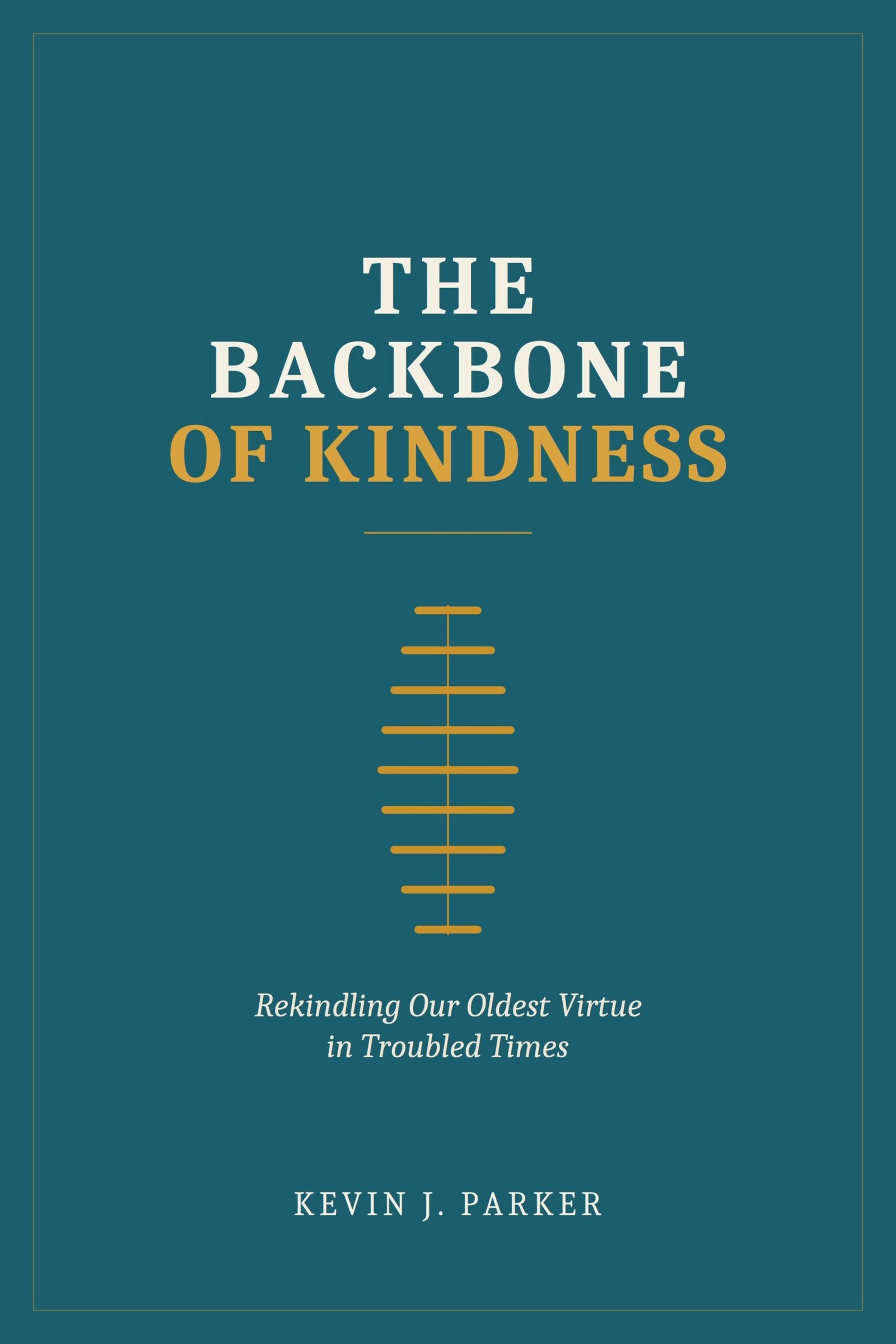
On the premise of The Backbone of Kindness
Kevin J. Parker
Order The Backbone of Kindness: Rekindling Our Oldest Virtue in Troubled Times from Amazon
There is a particular silence that has settled over public life. You can feel it in a queue, in a comment thread, at a family table where two people have quietly learned which subjects can no longer be raised. Something has shifted in the weather between us. Suspicion, which used to be a visitor, has taken up residence.
I spent fifty years in environmental and peace campaigns, and for most of that time I assumed the central problem was one of information and will—that if enough people understood what was at stake, and enough pressure was applied in the right places, the systems would move. I no longer think the difficulty sits there. What is missing in most of the failures I have watched is something more fundamental than resources or intelligence. It is the underlying structure of care: the assumption, once ordinary, that the person across the table is real, that their circumstances have weight, and that this weight places some claim on us.
That assumption is the subject of this book. And the first thing to say about it is that it has been badly misnamed.
The costly confusion
In the popular imagination, kindness has been domesticated. It has been reduced to a virtue of the gentle, the agreeable, the compliant—associated with greeting cards and motivational posters, with small courtesies performed by pleasant people in unthreatening circumstances. It is polite. It is easy. And because it is easy, it can be dismissed as trivial precisely when it is most needed.
But that is not kindness. That is niceness, and the two are different things.
Niceness is a social lubricant. It smooths interaction, avoids friction, and asks nothing difficult of anyone. Niceness says what people wish to hear; kindness sometimes says what they need to hear. Niceness is comfortable, and kindness is often uncomfortable, because it requires engagement with reality—with the actual condition of the person in front of you, rather than the version that would be most convenient.
The distinction is stark, and it is the hinge on which everything in this book turns. A kind friend will tell you that your drinking is destroying your family. A nice friend will pour you another glass. One is care that costs something; the other is courtesy that costs nothing.
Once that confusion is cleared away, kindness stops looking like a soft option and starts looking like what it is: a demanding discipline of attention. To be kind is to see—to register the presence and the weight of another human being. Not to glance, not to scan, not to assess for relevance or utility, but to recognise that another person’s reality matters as much as our own. Everything else follows from that seeing. Before we can offer help, or comfort, or justice, or companionship, we must first recognise that the other person is there.
This sounds simple. It is remarkably hard, and it is getting harder. We live inside architectures of distraction built to prevent exactly this kind of seeing. The attention economy profits from restlessness rather than presence. The algorithm rewards reaction over depth, speed over patience. And in an age of chronic, low-grade alarm—pandemic, precarity, ecological emergency, the destabilisation of democratic norms—openness to others can feel like a luxury, or worse, a liability.
That is the first illusion the book sets out to dismantle. Kindness is a necessity, and the hardest of them. It is the demanding option, the discipline you hold to precisely when times turn against you, and abandon at your peril when they do. It is the fire you protect when the wind rises.
A structural claim
The claim at the centre of the book is a large one, and it is structural rather than sentimental. It has nothing to do with self-improvement or personal branding.
Kindness is the backbone of human coexistence. It is the structure that holds everything else upright—the spine on which the serious business of economics, politics, technology and power all depends, rather than a decoration applied once that business has been attended to. A society may be wealthy, technologically sophisticated and militarily formidable and remain brittle, if it cannot protect dignity, reduce humiliation, and sustain humane relations between its members. On this reading kindness is a standard by which cultures, systems and futures can be judged.
The metaphor is anatomical and I mean it precisely. The spine does not generate force. It transmits it. It does not announce itself or require recognition. It is simply there, and its work becomes visible only when it fails. A damaged spine costs the body not elegance but the capacity to stand and act at all. This is what a civilisation loses when it allows kindness to fail.
The claim is also better supported than the cynics allow. We are, in the developmental psychologist Michael Tomasello’s phrase, ultra-social creatures, built from the ground up for shared attention and cooperative life. Kindness is a flowering of capacities that nature provided, rather than an achievement wrested from a hostile nature. The societies that survive across centuries are the most cooperative, not the most ruthless. And the great traditions converge on this from utterly different soils—the Confucian understanding of rén as what happens between two people, the Buddhist discipline of mettā, the Hebrew hesed, the Islamic iḥsān, the Stoic circles of concern, the southern African insistence of Ubuntu that a person is a person through other people. These teachings differ. They arrive, independently, at the same place.
Which is why the book insists on the point its subtitle carries: kindness is strength, not weakness. The courage required to be genuinely gentle is one of its recurring themes.
Widening circles
The architecture of the book is concentric. It begins in the inner ground of the self, where kindness takes root through attention and self-knowledge—drawing on Simone Weil, Iris Murdoch and the Stoics rather than the therapeutic register I have been careful never to adopt. From there the argument widens: into the intimate world of love, family and friendship; into the civic life of strangers and neighbours; into the harder question of whether a society can be kind without being fair. It widens again into fractured communities, into the conduct of nations and whether states can be kind, and into a planetary age that confronts us with compassion fatigue and the limits of moral attention across distance. In its final movement it extends beyond the human altogether, to the living world, where reverence itself is reframed as a form of kindness.
At every scale the same structural reading applies. Kindness lives in conditions, culture and institutions as much as in individual virtue. It looks like the libraries and community centres and public spaces that seem, to the efficient eye, like luxuries, and that turn out to determine which neighbourhoods survive a crisis. It looks like benches placed in public squares so people can linger rather than only pass through. It looks like restorative justice, and prison systems that treat those who have done serious harm as people whose humanity remains intact—a choice that looks to critics like weakness and produces outcomes the punitive model cannot. It looks like leaders who speak of the people in their care with regard rather than contempt, and who understand that in doing so they are performing a cultural function every bit as consequential as their policy decisions.
None of this guarantees kindness. Institutions built with the best intentions can be captured by the worst impulses. But conditions raise or lower the probability. They make kindness the path of least resistance or the path of most. Over a civilisational timescale, the conditions are the thing.
What this book will not do
It offers no programme, no method, no set of steps. There is no instruction here for optimising a life, and no promise that any of this is easy or that the outcome is assured.
What it offers instead is an invitation to see differently: to treat kindness not as one virtue among many but as the precondition for all the others, and not as a retreat from the real world but as the most radical available form of engagement with it. I do not write as an exemplar. This book arises from need rather than from certainty.
The question it finally puts is a public one. Weather is not destiny. The question is not whether we can change the climate of the world, but whether we can change the climate between us—and what would follow if kindness were treated as a design principle for civilisation rather than an afterthought.
The Backbone of Kindness: Rekindling Our Oldest Virtue in Troubled Times is published by Sane Earth an is available on Amazon.