
Green Cities Series | Article 02
How the French capital turned against the car, rewrote its streets, and discovered that a green city is not a mood but a struggle
| Paris has become one of the emblematic urban transformations of the climate era. In the space of two decades, the city has cut car traffic sharply, built out a vast cycling network, expanded pedestrian space, tightened planning rules, accelerated building renovation, and tied climate policy to air, heat, and public health. Yet Paris is not a finished model. It remains dense, mineral, unequal in exposure, politically contested, and still thin in green infrastructure compared with many European peers. What makes Paris important is not that it has solved the problem of the green city, but that it has forced the argument into the street. |
Opening scene
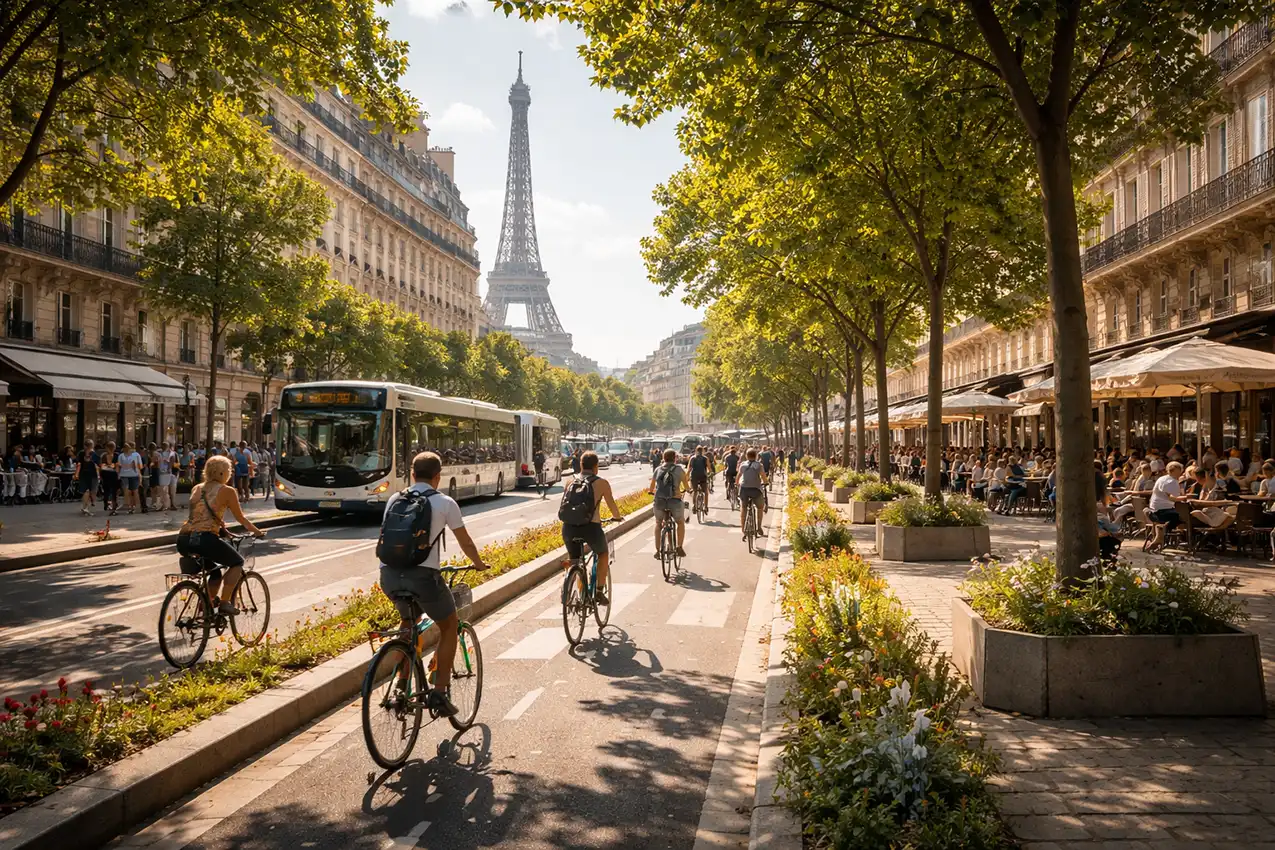
On Rue de Rivoli, one of the old imperial axes of the city, the change is now impossible to miss. Where traffic once claimed the centre of the argument, bicycles stream past in disciplined waves, buses slide through, pedestrians linger longer, and the old hierarchy of movement has been visibly demoted. The transformation is not total, and not always elegant, but it is legible. Paris has taken one of the great boulevards of European urbanism and begun to say, in paint, bollards, kerb lines and law, that the age of automatic automotive dominance is over.
That matters because Paris was never simply a pretty city. It was also, for a long time, a city that asked its residents to endure the ordinary violences of twentieth-century urban modernity: dirty air, hot stone, crowded roads, noise, and the daily insult of public space bent around the private vehicle. The city’s present greening drive is not cosmetic landscaping laid over a stable inheritance. It is a belated attempt to reprogram the metabolism of one of the densest, most visited, most symbolically burdened cities in the world.
The city before the turn
Paris begins with a paradox. It is dense enough to be, in theory, one of the easier major cities to decarbonise: compact, walkable, transit-rich, and historically mixed in use. Yet that same density also makes it acutely vulnerable to heat, pressure on public space, and the ecological deficits of a highly artificialised urban fabric. In its 2025 climate-neutrality documentation, the city describes itself as “dense, constrained, and heavily artificialized,” with roughly 21,067 residents per square kilometre. It also acknowledges vulnerability to the urban heat-island effect as a central fact of Parisian climate policy.
The old Paris of stone façades and grand boulevards remains physically beautiful, but beauty has its own environmental trap. A city of mineral surfaces stores heat. A city with too little open ground struggles to plant deeply, cool broadly, and absorb water generously. A city cut by monumental roads and later ringed by the périphérique inherited not only splendour but a machine-age spatial logic in which movement by car acquired a status far beyond its ecological intelligence. What Paris is now attempting is less the creation of a green city from scratch than the ecological correction of a historically elegant but climatically stressed one.
That correction did not begin yesterday. Paris’s current cycling plan explicitly presents itself as “Act 2,” following earlier work from 2015–2020 and, more broadly, a cycling turn that city documents say began two decades ago. The point is important. Paris’s reputation for rapid change is partly deserved, but the deeper truth is cumulative: years of street redesign, parking removal, traffic restraint, and political persistence have laid the groundwork for what now looks, from outside, like sudden conversion.
The pressures
No serious account of Paris can ignore air. Airparif’s 2025 assessment of the period 2012–2022 found a 40% reduction in average Parisian exposure to nitrogen dioxide and a 28% reduction in exposure to PM2.5, with road-traffic carbon dioxide emissions down 35% over the same period. Those are not trivial numbers. They suggest that the city’s transport and pollution policies have delivered real public-health gains rather than merely photogenic streetscapes.
Yet the same sources also show why Paris could not stop where it was. The city’s own climate strategy places adaptation near the centre of the next phase, noting that the climate crisis amplifies existing inequalities and that working-class neighbourhoods are often the most exposed to heatwaves, air pollution, and energy poverty. In other words, Paris’s green turn is not only about carbon. It is about the geography of bodily stress. The question is not simply whether Paris can lower emissions, but whether it can become more breathable and more tolerable for those who do not inhabit its most protected quarters.
Traffic, too, remained a stubborn pressure even after years of reform. The city’s broader policy ecosystem—from low-emission rules to parking restrictions to pedestrianisation—grew from a basic recognition that Paris could not continue to assign scarce land to metal storage and through-traffic while claiming to be serious about climate, health, or civic dignity. Reuters reported in 2025 that city-hall data showed car traffic had more than halved since the turn of the century. That is an extraordinary shift. But it also reveals how dominant the car had once become in a city now mythologised for its café terraces and flânerie.
What the city is doing
The most visible arm of Paris’s transformation is mobility. The current 2021–2026 cycling plan has a budget of more than €250 million, building on an earlier €150 million plan, and the city says Paris already had more than 1,000 kilometres of cycling lanes by 2021, including temporary “coronapistes” that were then retained. The aim is not simply more bike paint, but a complete network, secure parking, and safer routes that make cycling an ordinary tool of metropolitan life rather than a niche preference.
This has been matched by a deliberate war on excess car privilege. In March 2025, Paris voters backed the pedestrianisation and greening of 500 additional streets, a move that will remove 10,000 more parking spaces on top of the 10,000 already removed since 2020. The result will bring the total number of these pedestrianised “green lungs” to nearly 700 streets, a little over one-tenth of the capital’s streets. The symbolism is blunt: the city is converting land once reserved for parking and movement into land for shade, walking, planting, and neighbourhood use.
Paris has also tightened its grip on the city centre itself. As of late 2024, a limited traffic zone was introduced across the first four arrondissements, covering about 5.5 square kilometres, with through-traffic banned except for a range of exempted users. This is not yet the end of cars in central Paris, and “destination traffic” still leaves room for ambiguity, but the measure matters because it treats the historic core less as a corridor and more as a place. The old assumption—that central streets exist primarily to be crossed by vehicles headed elsewhere—has been formally challenged.
Even the périphérique, the city’s great loop of fumes and urgency, has entered the new order. The ring road’s speed limit was reduced to 50 km/h in late 2024, and in 2025 the city trialled a dedicated lane for car-sharing, public transport and certain other vehicles during peak periods. Critics saw harassment of motorists; city officials framed it as a health measure on one of Europe’s busiest urban motorways. Either way, the périphérique is no longer sacrosanct. That may prove one of the most important cultural changes of all.
But Paris’s green turn is not just about transport. Its new bioclimatic local urban plan and associated environmental guidance try to force environmental performance into the legal grammar of construction and renovation. The guide for the PLU bioclimatique emphasises bioclimatic design, summer comfort, carbon, renewable energy, façades, roofs, revegetation, and—in a strikingly practical detail—the obligation to connect certain projects to the heating network. This is where Paris becomes more interesting than a streetscape story. It is attempting to move from urban mood to urban code.
The climate plan goes further. Paris aims to strengthen its private renovation subsidy scheme, Eco-rénovons Paris+, to reach a pace of 40,000 homes renovated per year by 2030, while maintaining the renovation of 5,000 social-housing units annually, targeting energy-demand reductions and changes in heating systems. It also proposes a three-year property-tax exemption for renovating homeowners. In a city of old buildings, patrimonial constraints, and thermal fragility, this matters enormously. Paris cannot green itself by new construction alone. It must rework the existing city.
Energy and waste are also part of the same system. The city’s climate-neutrality plan targets at least 75% renewable or recovered energy in the district-heating network by 2030, while the waste strategy aims for a 20% reduction in waste generated between 2010 and 2030, alongside repair, reuse and circular-economy infrastructure such as ressourceries. These are less glamorous than a bike lane on Rivoli, but they are closer to the hidden engine room of urban decarbonisation.
Then there is water, the old embarrassment of the Seine. In 2025, Paris opened three public bathing sites in the river, with daily monitoring of current, weather and water quality. This followed vast investment and infrastructure work accelerated by the Olympics. To swim in the Seine again was always going to be staged as a civic miracle, and perhaps it is. But it is also a reminder that a greener city has to repair its hydrology, not merely its image.
What is working—and for whom
The evidence of improvement is substantial enough that Paris can no longer be dismissed as an exercise in urban theatre. Airparif’s 2012–2022 study attributes improved air quality to three main factors: cleaner vehicles, reduced road traffic, and measures tackling pollution from other sectors such as heating and industry. It found especially strong improvements for residents living near major roadways, where reductions in NO₂ and PM2.5 exposure were even greater than the city average. This is important. Paris’s anti-car turn has not merely pleased cyclists; it has materially altered pollution exposure in some of the places once hit hardest.
Transport behaviour has changed as well. The Urban Institute, drawing on Paris and regional data, reported that car traffic on city streets fell by 50% between 2002 and 2022, while use of major cycling routes increased by 166% between 2018 and 2022. That scale of behavioural shift suggests that infrastructure and regulation can in fact move culture, even in a large and historically car-accommodating metropolis. Paris is not Amsterdam, and perhaps never will be. But it has shown that the supposedly immovable habits of urban transport are more political than natural.
There is also striking real-world evidence from the Olympic period. Airparif found that traffic reductions during the 2024 Games cut vehicle volumes in Paris by an average of 18% and produced pronounced NO₂ declines along major roads, including reductions of up to 33% along the Seine under the strongest restrictions. That does not prove every permanent traffic intervention is automatically wise. It does show, however, with almost laboratory clarity, that fewer vehicles mean cleaner roadside air. Cities still pretending otherwise are arguing against their own measurements.
Paris is also beginning to think harder about heat. The city’s adaptation targets include placing 100% of Parisians within a seven-minute walk of a cool island by 2030, reaching 40% greening of the territory by 2050, and delivering 10 square metres of green space per inhabitant by 2040. Tree planting is part of this, but so are oasis schoolyards, shade, fountains, planted streets, and local cooling networks of refuge. In a warming Europe, this may prove as important as the transport story. A city that moves cleanly but still cooks in summer has not yet learned to breathe.
Contradictions, failures, and greenwashing risks
And yet Paris should not be romanticised. The same Reuters report that celebrated the 2025 vote also noted that green infrastructure still covers only 26% of the city’s area, compared with a 41% average for European capitals. That is a revealing statistic. Paris is greener in rhetoric and street politics than in physical ecological endowment. The city has moved fast on traffic, but it still has too little vegetal depth. Its climate future will not be secured by transport reform alone.
Enforcement is another weakness. Le Monde reported in 2025 that several flagship traffic-restriction measures, including the limited traffic zone in the centre, suffered from weak controls and long educational phases without punishment. The danger is obvious: when a city announces tough ecological rules but hesitates to enforce them, it risks feeding cynicism on both sides—among motorists who assume the policy is hollow, and among supporters who begin to suspect that spectacle is outrunning administration.
The politics are not trivial either. Turnout in the 2025 street-pedestrianisation referendum was just 4.06%, despite a comfortable yes majority. Critics have also argued that Parisian reforms can burden suburban commuters who rely on access to the capital and who do not enjoy the same density of alternatives in all parts of the wider region. Some transit improvements have indeed been focused beyond the city proper, but metropolitan coordination remains a structural challenge. Paris can remake its core faster than it can resolve the social geography of Greater Paris.
Even the Seine, that great environmental redemption story, remains conditional. The city’s own guidance makes clear that swimming depends on daily water-quality checks, current and weather, while reporting after the 2025 reopening showed closures after heavy rain and continuing debate over monitoring and contamination risk. This does not negate the achievement. It simply returns Paris to reality. In the climate era, urban ecological repair is rarely a final triumph. It is maintenance under pressure.
The future vision
The future Paris is trying to build is unusually explicit. By 2030 the city aims for a 50% reduction in local greenhouse-gas emissions compared with 2004 and a 40% reduction in its wider carbon footprint; by 2050 it wants zero local emissions, an 80% reduction in carbon footprint, and 100% renewable energy consumption. In transport, it wants to keep reducing inner-city road traffic, convert more parking into sidewalks and vegetation, expand bike infrastructure, decarbonise municipal fleets, improve logistics, and widen access to cleaner mobility. In buildings, it wants mass renovation. In public space, it wants more shade, more planted ground, and more ways of surviving heat with dignity.
The most interesting thing about this agenda is not that every target will be met. Some probably will not. The interesting thing is that Paris has begun to describe the city as a bioclimatic problem rather than a purely economic or aesthetic one. That conceptual shift matters. It means roads can be judged by lungs, buildings by summer comfort, parking by opportunity cost, and trees by cooling service rather than decoration. It means a boulevard is not just an axis of movement but a thermal landscape. That is the language of a city slowly learning ecological literacy.
Conclusion
Paris is not the green city. No such singular city exists. It is, instead, one of the clearest demonstrations that a wealthy, dense, globally symbolic metropolis can still choose to become less dominated by the car, less resigned to pollution, and more serious about climate adaptation than it once was. That is not nothing. In an era of municipal greenwashing, Paris has at least moved enough asphalt, money, law and political capital to make the claim testable.
But Paris is also a warning. It shows how difficult it is to add ecological depth to a city that remains stony, unequal, overvisited, and pressed by heat. It shows how fragile river repair can be, how essential enforcement is, and how easily urban reform can harden into a culture war if the wider metropolis is left out. Above all, it shows that the green city is not a finished object one day unveiled. It is a permanent renegotiation of space, comfort, access, and restraint. Paris has entered that negotiation in earnest. That is why it matters.
Endnotes
1. City of Paris, “A new cycling plan for a 100% bikeable city,” updated September 2024, for the scale, funding and ambition of the current cycling strategy. https://www.paris.fr/en/pages/a-new-cycling-plan-for-a-100-bikeable-city-28350
2. Airparif, “How has air quality improved in Paris between 2012 and 2022?” August 2025, for quantified changes in NO2, PM2.5 and road-traffic CO2 exposure. https://www.airparif.fr/sites/default/files/document_publication/PR%20-%20Paris%202012-2022.pdf
3. City of Paris / NetZeroCities, 2030 Climate Neutrality Action Plan, April 2025, for density, emissions targets, heat adaptation goals, renovation targets, district heating and waste policy. https://netzerocities.app/_content/files/knowledge/4671/ccc_paris.pdf
4. Apur, “Guidelines for greened public spaces in Paris” and “Tree cover planted in Parisian public space,” for tree cover, planting conditions and the practical limits of greening a dense historic city. https://www.apur.org/en/climate-environment/planting/guidelines-greened-public-spaces-paris
5. Reuters, March 2025, for the referendum on 500 additional pedestrianised streets, parking-space removal, long-run decline in car traffic, and Paris’s low share of green infrastructure relative to other European capitals. https://www.reuters.com/world/europe/paris-residents-vote-favour-making-500-more-streets-pedestrian-2025-03-23/
6. Le Monde and The Guardian, 2024–2025, for the limited traffic zone, enforcement problems, périphérique reforms and the political backlash surrounding anti-car measures. https://www.lemonde.fr/en/opinion/article/2025/04/08/paris-has-a-restrictive-car-traffic-policy-but-it-doesn-t-really-enforce-it_6739966_23.html
7. City of Paris and Associated Press reporting on the Seine reopening, for the return of public bathing and the continuing dependence on daily water-quality conditions. https://www.paris.fr/en/pages/swimming-on-the-seine-all-the-questions-you-need-to-know-31738
Source Note
This article relies primarily on official Paris planning and climate documents, Airparif air-quality studies, Apur urban-analysis material, and recent reporting from Reuters, Le Monde, The Guardian and AP to capture both measurable progress and current political tensions. Official sources are strongest on targets and programmes; independent reporting is essential for enforcement gaps, backlash and the limits of the Paris narrative.