
The global hospitality sector is facing an existential reckoning. As international tourist arrivals climb toward 1.4 billion annually, the industry’s massive carbon footprint and its strain on local resources have moved from the periphery to the centre of the climate conversation. Yet, a vanguard of properties is attempting to prove that “luxury” and “sustainability” are no longer oxymorons. From the humid urban core of Singapore to the remote atolls of French Polynesia, a new model of regenerative hospitality is emerging—one that aims not just to reduce damage, but to actively heal the ecosystems it occupies.
The ‘Hotel-in-a-Garden’
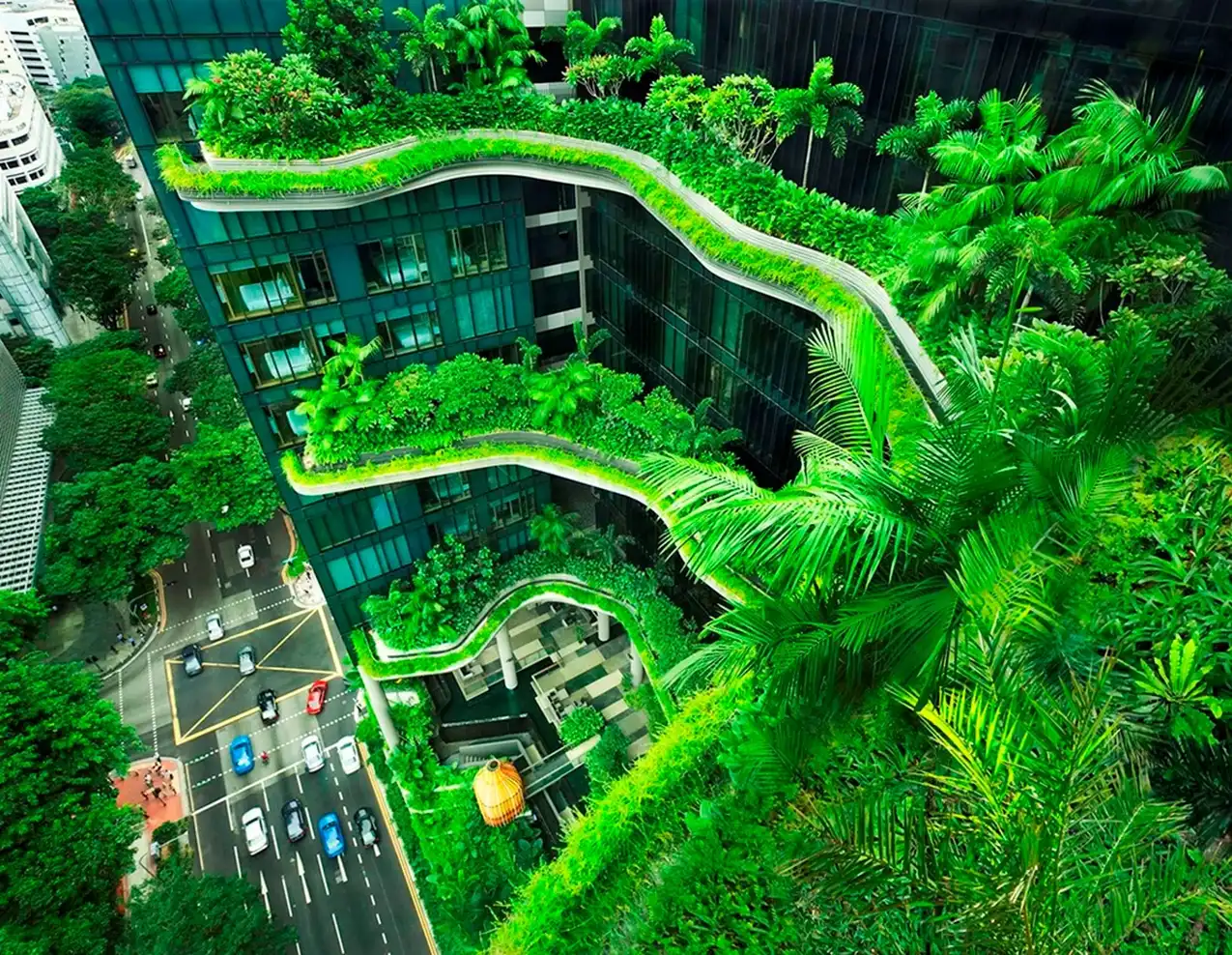
In the heart of Singapore’s dense business district, the PARKROYAL COLLECTION Pickering stands as a radical rejection of the sterile glass-and-steel skyscraper. Designed by WOHA, the building features 15,000 square metres of sky gardens, planter terraces, and cascading waterfalls—effectively doubling the green space of the original site.
This is more than an aesthetic flourish. The “vertical ecosystem” acts as a structural chassis that cools the building through shading and transpiration, significantly mitigating the urban heat island effect. Inside, the building’s operations are equally rigorous. Over half of the guest corridors are naturally ventilated, while a sophisticated rainwater harvesting system uses AI-powered, weather-based sensors to irrigate the vast greenery. The property even employs a food waste digester that converts kitchen scraps into greywater, diverting organic waste from landfills entirely .
Cooling from the Abyss
While the Pickering tackles urban density, The Brando in French Polynesia deals with the fragility of a remote atoll. Marlon Brando’s vision for a carbon-neutral sanctuary has been realised through some of the world’s most advanced engineering—most notably its Sea Water Air Conditioning (SWAC) system.
The system draws seawater from a depth of over 900 metres, where temperatures hover around 5°C. This “cold” is transferred via a titanium heat exchanger to a freshwater loop that cools the entire resort . The result is an energy reduction of 90% compared to traditional air conditioning. Combined with 4,700 solar panels and a backup generator running on coconut oil, the resort has achieved the world’s first campus-wide LEED Platinum certification.
The Circular Revolution
In the Maldives, Soneva Fushi has been refining the art of “responsible luxury” since 1995. The resort has been carbon neutral since 2012, funded in part by a 2% environmental levy on guest revenue. Its “Eco Centro” waste-to-wealth facility recycles approximately 80% of all waste produced on the island, including a glass studio that transforms discarded bottles into art and building materials.
Soneva’s impact extends beneath the waves. The property operates one of the largest coral nurseries in the world, using Mineral Accretion Technology (MAT)—an electrified reef system that can accelerate coral growth by 300%. In early 2024, the resort further expanded its solar capacity to 5.2MWp, now meeting 40% of its total energy needs and saving two million litres of diesel annually.
Retrofitting the Past
Sustainability isn’t always about new builds; it’s increasingly about the “adaptive reuse” of existing structures. In New Haven, Connecticut, Hotel Marcel has transformed a 1960s brutalist office building—once the headquarters for Pirelli Tire—into the first net-zero energy hotel in the United States.
The hotel meets rigorous EnerPHit (Passive House) standards, using triple-pane, argon-filled windows and a super-insulated envelope to reduce heating and cooling loads by 80%. It is entirely fossil-fuel-free, utilizing induction cooking and Power-over-Ethernet (PoE) technology to control lighting and shades, which alone has reduced lighting energy use by 30% . A massive rooftop solar array and a 1,012 kWh battery microgrid allow the building to operate independently of the utility grid during outages .
The Rise of the ‘Deep Green’ Certification
As “greenwashing” becomes a pervasive risk, travellers are increasingly looking toward rigorous third-party audits. Properties like Six Senses Zighy Bay in Oman and Alila Villas Uluwatu in Indonesia have sought out GSTC (Global Sustainable Tourism Council) and EarthCheck certifications to verify their claims .
At Six Senses, the focus is on “plastic freedom,” with the brand recently sharing an 82-point playbook for removing single-use plastics from hotel operations. Meanwhile, ITC Grand Chola in India has demonstrated that scale is no barrier to efficiency; the 1.6 million-square-foot property is one of the few in the world to be certified LEED Zero Carbon and LEED Zero Water.
A New Standard for 2050
The success of these ten pioneers—ranging from Singita Mara River Tented Camp in Tanzania to 1 Hotels Melbourne in Australia—suggests a shifting baseline for the industry . By integrating biodiversity restoration and community support into the business model, these properties are moving beyond the “do no harm” ethos of the early 2000s.
As carbon taxes rise and climate-conscious consumers demand transparency, the technologies pioneered at The Brando or Hotel Marcel are likely to become the regulatory standard rather than the exception. The future of high-end travel may well depend on whether the rest of the industry can follow their lead in turning the holiday into a regenerative force for the planet.