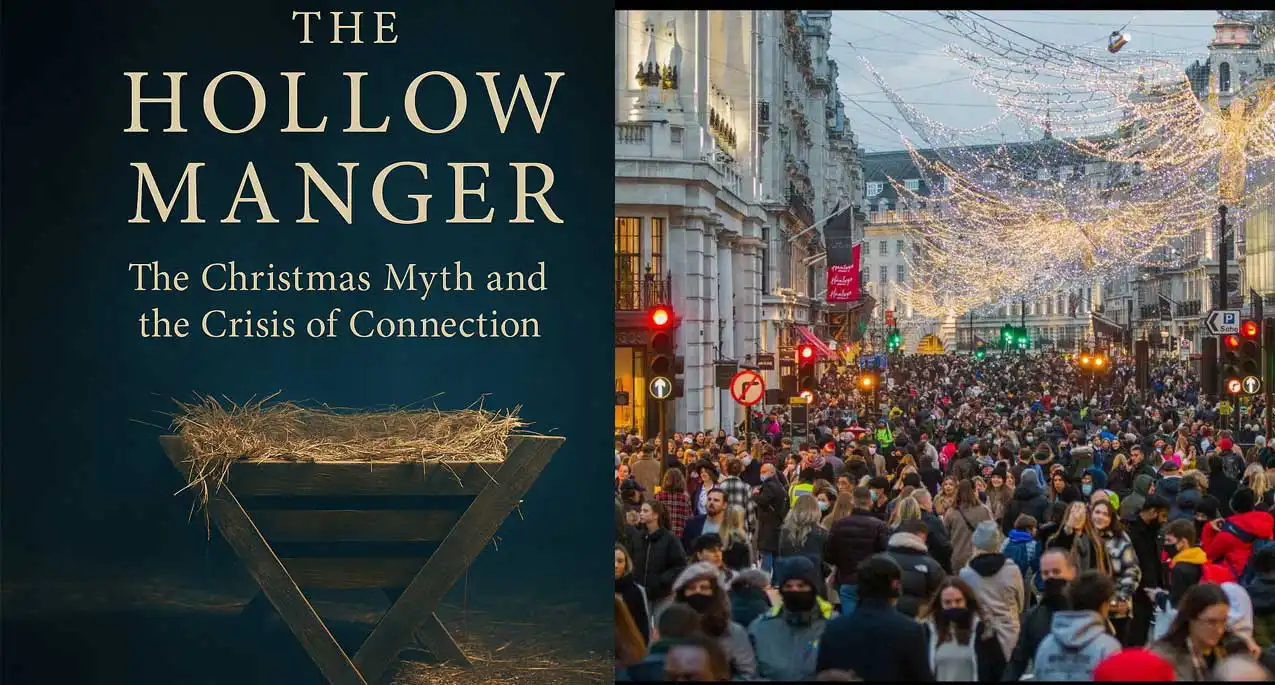

Some might see this as a bit of Bah! Humbug! article and in truth I did think twice about publishing it, after all Christmas brings my own family and millions worldwide great joy, and, we have enough harsh analysis without me piling more burning tinsel on the fire. Still, the central message of Christmas, hope, love, peace and compassion has been more than tarnished by crass commercialism and corporate cynicism. So, the following is offered in as a contribution to help us see beyond attempts to turn a time of family and community celebration into a cash bonanza of banality. That said, if I hear Mariah Carey’s “All I Want for Xmas is You” once more………. You might be interested in a companion article Beyond Santa: World Religions and Traditions other than Christmas – Seasons greeting – Kevin Parker – Publisher –
I. The Season of Paradox
The lights of Oxford Street (pictured) were illuminated in October this year, a premature phosphorescence that signalled not the joy of the season, but the anxiety of the ledger. In the cathedrals of consumption—the great department stores of London, New York, and Paris—the air has grown thick with the scent of synthetic pine and the frantic, palpable energy of the “Golden Quarter.” This three-month window, stretching from the dying warmth of October through the frenzied peaks of Black Friday to the silence of Boxing Day, is the epoch upon which the survival of the modern retail sector hangs. Yet, beneath the veneer of manufactured jubilation and the looped, hypnotic playlists of holiday standards, a profound and visceral unease has settled over the Western world.
We are living through an era of aggressive fragmentation. The social contract, once thought to be a durable weave of civic obligation and mutual care, is fraying under the tension of economic inequality and cultural polarisation. Political discourse has metastasised into a series of digital skirmishes, where algorithms reward outrage and silence nuance. Simultaneously, the drums of war have been beating with a terrifying rhythm in Ukraine, Gaza, Myanmar, Sudan, Nigeria, Iraq. 2025 has also seen an escalation of fighting in the Eastern DRC, a brief conflict between the nuclear powers of India and Pakistan in May, tensions between Thailand and Cambodia, and a significant expansion of the broader Middle East crisis. Collectively, their vibrations felt even amidst the distraction of the holiday shopping season. It is in this dissonant atmosphere—where the bells of Bethlehem compete with the sirens of air raids—that Christmas arrives, not merely as a holiday, but as a battleground of meaning.
It is a festival at war with itself, torn violently between its identity as a titan of global capitalism and its origins as a radical theological claim about the nature of God and humanity. The “true Christian message”—often reduced in the public imagination to a saccharine platitude suitable for greeting cards—is, in reality, a disruptive proposition: that the Creator of the universe entered the grime of history as a vulnerable refugee, bypassing the structures of imperial power to dwell among the dispossessed.
To understand how we might salvage this message for a world in crisis, we must first excavate the myths that obscure it. We must peel back the sedimented layers of Victorian invention, corporate appropriation, and historical revisionism to find what truly lies in the manger. It is a journey that requires us to move from the solar cults of Rome to the editorial rooms of 19th-century New York, from the bloodied trenches of the American Civil War to the high-tech, high-injury fulfilment centres of Amazon. It is a story of how a feast of the Incarnation became a festival of consumption, and whether, amidst the wrapping paper and the rhetoric, the “Prince of Peace” can still speak to a world addicted to conflict.
The stakes could not be higher. As we stand on the precipice of a new year, the commercial machinery of Christmas threatens to hollow out the very spiritual resources we need to survive the coming epoch. The commodification of the holiday has not only obscured its history; it has domesticated its power, turning a revolution of love into a transaction of goods. This essay seeks to document that transformation, to separate the historical verity from the profitable legend, and to ask if the original scandal of Christmas can pierce the armour of our cynicism.
II. The Economic Engine: The Golden Quarter and the Grinding of the World
To comprehend the modern Christmas, one must look away from the altar and towards the balance sheet. The holiday is no longer merely a liturgical season; it is the structural pillar of the Western consumer economy. This transformation did not happen by accident. It was policy—a deliberate alignment of industrial capacity, retail strategy, and cultural engineering designed to maximise the extraction of value during the darkest months of the year.
The Tyranny of the “Golden Quarter”
The retail industry operates on a precipice. For many businesses, the months of October, November, and December—known colloquially as the “Golden Quarter”—represent the difference between solvency and bankruptcy. In the United Kingdom and the United States, retailers generate a disproportionate percentage of their annual revenue during this period, often relying on the festive surge to offset losses incurred during the “tepid” months of the year.¹
However, the 2024 season revealed the fragility of this dependence. Retailers entered the quarter on “shaky ground,” battered by high inflation and persistent weak consumer confidence.² In the UK, retail insolvencies rose by 25% year-on-year in August, a grim harbinger for the holiday season.³ We will see if this is an emerging trend when we get the 2025 figures in the new year. Nonetheless, the desperation to secure sales in this hostile environment has accelerated the phenomenon of “Christmas Creep”—the merchandising practice of introducing holiday-themed goods earlier and earlier each year.
What was once a creeping trend has become a galloping necessity. Christmas decorations now appear in Costco warehouses in August; holiday candy lands on shelves in September. This is not merely an annoyance for the purist; it is a calculated “arms race” among retailers.⁴ As Wharton marketing professor Stephen Hoch observes, the competition means “nobody wants to be second,” forcing the shopping season to metastasise into the autumn months.⁵
Table 1: The Golden Quarter Economic Landscape (2024 Outlook)
| Metric | Trend/Value | Implication |
| US Avg. Spend | $1,063 (Nominal) | Up 7.9% from 2023, but flat/negative when adjusted for inflation.⁶ |
| UK Retail Insolvency | +25% (Year-on-Year) | Significant risk of bankruptcy for mid-sized retailers post-Christmas.⁷ |
| Consumer Sentiment | “Mixed” to “Pessimistic” | Shoppers are prioritising essentials; discretionary spend is tightening.⁸ |
| Debt Dependence | Rising | 8.1% increase in household credit card balances in Q3 2024.⁹ |
| Discount Dependency | High | 48% of consumers consciously cutting discretionary spend until Black Friday.¹⁰ |
The data reveals a disturbing reality: while nominal spending may appear robust, it is fuelled by inflation and debt rather than genuine prosperity. The “cheer” of the season is being financed on credit, creating a bubble of consumption that will inevitably burst in the grim fiscal light of January.
The Human Cost: Amazon and the Bodies in the Machine
Behind the click of a “Buy Now” button lies a vast, opaque logistics network that extracts a heavy toll on the human body. The miracle of next-day delivery is powered by a gruelling “peak season” for warehouse workers, a period where the demands of the algorithm override the limits of human physiology.
Senator Bernie Sanders, in his capacity as Chairman of the Senate Committee on Health, Education, Labor, and Pensions (HELP), released an interim report in 2024 that shed light on these “extremely unsafe conditions.”¹¹ The findings were visceral. During Prime Day and the holiday peak, injury rates at Amazon warehouses skyrocket. In 2019, Amazon’s rate of recordable injuries was over 10 per 100 workers—more than double the industry average.¹²
This is not a matter of clumsiness; it is a matter of speed. The system is designed to push workers to “impossible speeds,” requiring them to twist, bend, and lift heavy packages with a frequency that destroys the musculoskeletal system.¹³ OSHA investigations in 2023 at facilities in Aurora (Colorado), Nampa (Idaho), and Castleton (New York) confirmed that workers were exposed to high risks of lower back injuries due to the sheer pace of work required to meet holiday deadlines.¹⁴
The “peak season” is, in effect, a harvest of bodies. The seasonal workers hired to manage the Christmas rush—often lured by promises of competitive wages—enter a meat grinder. While Amazon touts that one-third of its holiday hires return each year, presenting this as evidence of job satisfaction, the high turnover and injury rates suggest a darker reality: a workforce treated as a disposable component in the machine of festive delivery.¹⁵
The Enshittification of the Planet: A Legacy of Waste
If the human cost of the commercial Christmas is hidden within the walls of fulfilment centres, the environmental cost is brazenly visible in our bins. The festival of consumption is also a festival of waste, a period of ecological devastation that stands in direct contradiction to the stewardship implied by the doctrine of Creation.
In the UK alone, the additional waste generated during the Christmas period exceeds 3 million tonnes.¹⁶ The scale of this disposability is difficult to conceptualise, but the statistics are damning.
Table 2: The Environmental Toll of the Festive Season (UK/US Data)
| Category | Statistic | Context |
| Wrapping Paper | 227,000 miles (UK) | Enough to wrap the island of Guernsey; mostly non-recyclable due to glitter/plastic.¹⁷ |
| Food Waste | 5 million dinners (UK) | Includes 2 million kg of cheese and 74 million mince pies discarded.¹⁸ |
| Glass Waste | 13,350 tonnes (UK) | A spike in alcohol consumption leads to massive glass disposal.¹⁹ |
| Food Waste (US) | 316 million lbs (Thanksgiving) | Valued at $556 million; generates emissions equivalent to 169,000 cars driving for a year.²⁰ |
| Christmas Trees | 30 million live trees (US) | While recyclable, millions end up in landfill; artificial trees take centuries to degrade.²¹ |
| Packaging | 125,000 tonnes plastic (UK) | Generated from advent calendars, gift boxes, and toy packaging.²² |
This orgy of waste is the material consequence of a spiritual malaise. We attempt to express love and connection through the purchase of goods that are designed to be transient. The wrapping paper is torn and discarded in seconds; the plastic toys are often broken or forgotten by February. We are converting the finite resources of the planet into landfill at an accelerated rate, all in the name of a holiday that ostensibly celebrates the birth of a child who owned nothing.
III. The Excavation of Date: Sol Invictus and the Calculation Theory
To understand how we arrived at this crisis of consumption, we must first understand the origins of the festival itself. For decades, the dominant narrative in popular history—recited with confident authority by secularists, documentary filmmakers, and internet commentators alike—has been that Christmas is a “stolen” holiday.
The story goes that the early Church, desperate to co-opt the pagan masses of the Roman Empire, cynically overlaid the birth of Christ onto the pre-existing festival of Saturnalia or the birthday of Sol Invictus (the Unconquered Sun). It is a seductive theory, suggesting that the date of December 25 is an act of ecclesiastical plagiarism, a marketing strategy to ease the transition from polytheism to monotheism.
However, a rigorous examination of the historical record suggests that this “Pagan Hypothesis” is largely a myth. The origins of the date are far more complex, rooted not in appropriation, but in a distinct form of ancient Christian computation.
The Myth of Sol Invictus
The assertion that Christmas was stolen from the cult of the Sun relies heavily on the belief that December 25 was a pagan feast of major importance before it was a Christian one. Recent scholarship has cast significant doubt on this consensus.
Historian Steven Hijmans, a leading authority on Roman solar iconography, argues that there is “no documentary evidence” that the pagans celebrated Sol Invictus on December 25 prior to the time of the Emperor Julian the Apostate in the mid-4th century.³³ By this time, Christians were likely already observing the Nativity on that date. The primary source linking the sun god to December 25 is the Chronography of 354, a Roman almanac that lists N·INVICTI (Birth of the Unconquered) alongside a Christian calendar listing the birth of Christ.
Hijmans notes a critical anomaly: in the Chronography, pagan festivals are typically marked by chariot races in multiples of twelve. The entry for December 25 lists 30 races—a number that does not fit the pattern for a major solar deity.³⁴ This suggests that the pagan observance on this date may have been minor, or perhaps even a pagan reaction to the emerging Christian feast, rather than the other way around.³⁵ The idea that Aurelian instituted a massive festival on December 25 in 274 AD is a modern assumption, not a fact supported by ancient texts.³⁶
The Calculation Theory: Integral Age
If the Church did not steal the date from the pagans, how did they arrive at December 25? The answer lies in the “Calculation Theory,” first proposed by the French historian Louis Duchesne in 1889 and later refined by Thomas Talley.³⁷
The early Church Fathers were obsessed with the symmetry of time. They believed in the concept of “integral age”—the idea that great prophets died on the same day they were conceived or born.³⁸ Drawing from Jewish tradition, early Christians calculated that Jesus was crucified on March 25 (dating the 14th of Nisan in the Julian calendar).
If Jesus died on March 25, the theory of integral age dictated that he must have been conceived on that same date. Thus, March 25 became the Feast of the Annunciation. The calculation is then one of simple biology: count forward nine months from the conception, and one arrives, with mathematical inevitability, at December 25.³⁹
Table 3: The Calculation of Christmas
| Event | Date Calculation | Theological Basis |
| Crucifixion | March 25 (14 Nisan) | Historical calculation of Passover during Christ’s death. |
| Conception | March 25 | “Integral Age” theory: prophets die on the anniversary of their conception/birth. |
| Birth | December 25 | Conception + 9 Months (Gestation period). |
| Solstice | December 21-25 | Viewed as providential confirmation, not the origin. |
This theory explains why the date was chosen without needing to invoke a pagan conspiracy. The fact that this date coincided with the winter solstice—the moment when the sun begins its ascent—was viewed by Fathers like St. Augustine and St. Ambrose not as the reason for the choice, but as a cosmic ratification of it.⁴⁰ As Ambrose wrote, Christ is the “true sun,” who outshines the fallen gods. The solar imagery was a post hoc theological reflection, not the ante hoc motivation.
Saturnalia and the Spirit of Misrule
While the date appears to be Christian in origin, the manner of celebration undoubtedly absorbed the DNA of the Roman Saturnalia. Held from December 17 to 23, Saturnalia was a festival of inversion: masters served slaves, gambling was permitted, and social norms were suspended.⁴¹
The medieval Christmas retained this rowdy, public character. It was not the domestic, child-centred holiday we know today. It was a time of “misrule,” where bands of young men—often the poor—would roam the streets, demanding food and drink from the wealthy, essentially threatening a trick if they did not receive a treat. It was a carnival of social release, visceral and chaotic. The domestication of this wild festival into a “family holiday” would require a new mythology, one that would be forged not in Rome, but in Manhattan.
IV. The Fabrication of the Saint: From Myra to Manhattan
If the date of Christmas is a product of 4th-century theology, the character of the modern Christmas is a product of 19th-century American literature and political satire. The figure of Santa Claus, often assumed to be an ancient piece of folklore, is in fact a relatively modern construct, assembled piece by piece by a small circle of New York elites who wished to tame the rowdy street celebrations of the working class.
The Genealogy of Santa Claus
The evolution of Santa Claus is a case study in cultural mutation. It begins with St. Nicholas of Myra, a 4th-century Greek bishop in modern-day Turkey. Nicholas was known for his orthodoxy (he famously opposed Arius at the Council of Nicaea) and his secret gift-giving, specifically providing dowries for three impoverished sisters to save them from prostitution.⁴²
This figure morphed into the Dutch Sinterklaas, a solemn, ecclesiastical figure who rode a white horse and judged the behaviour of children. But the jump from Sinterklaas to Santa Claus was not a natural evolution; it was a literary invention.
Table 4: The Evolution of the Icon
| Era | Figure | Characteristics | Source/Influencer |
| 4th Century | St. Nicholas | Greek Bishop, defender of orthodoxy, secret almsgiver. | Historical / Hagiography |
| 17th Century | Sinterklaas | Solemn, ecclesiastical, rides a horse, judgemental. | Dutch Tradition |
| 1809 | “St. Nicholas” | Pipe-smoking Dutch burgher, flies in a wagon. | Washington Irving (Knickerbocker) |
| 1823 | St. Nick | Jolly elf, sleigh, reindeer, “bowl full of jelly.” | Clement C. Moore (A Visit…) |
| 1863 | Santa Claus | Red suit, North Pole, political unionist. | Thomas Nast (Harper’s Weekly) |
| 1890 | Store Santa | Interactive, commercial, physically present. | James Edgar (Department Store) |
The Knickerbocker Myth and Clement Clarke Moore
The transformation began in 1809 with Washington Irving. In his satirical Knickerbocker’s History of New York, Irving reinvented Nicholas as a pipe-smoking Dutch burgher who flew over the city in a wagon.⁴³ Irving, along with John Pintard of the New-York Historical Society, was consciously engaging in the “invention of tradition,” seeking to create a benign, unifying symbol for a city fractured by class conflict.⁴⁴
The image was refined in 1823 with the publication of “A Visit from St. Nicholas” (commonly known as “The Night Before Christmas”), attributed to Clement Clarke Moore. Moore, a professor of biblical languages, stripped Nicholas of his episcopal robes and gave him a sleigh, reindeer, and a “belly that shook like a bowl full of jelly.”⁴⁵ Crucially, Moore moved the time of gift-giving from the chaotic public street to the private, safe domestic sphere of Christmas Eve, effectively neutering the threat of the lower classes invading the homes of the rich.
Thomas Nast and the Civil War Santa
The visual iconography of Santa Claus—the red suit, the white beard, the North Pole residence—was cemented by the political cartoonist Thomas Nast. A fierce abolitionist and supporter of the Union during the American Civil War, Nast first drew Santa Claus in 1863 for Harper’s Weekly.
In his illustration “Santa Claus in Camp,” Nast depicted Santa distributing gifts to Union soldiers, wearing a jacket patterned with stars and trousers striped like the American flag.⁴⁶ He holds a puppet of Confederate President Jefferson Davis with a rope around its neck. This is a critical, often overlooked detail: the modern Santa was born as a piece of Union propaganda. Nast continued to draw Santa for decades, fattening him up and establishing his residence at the North Pole—a location chosen because it was politically neutral territory, free from the sectional divisions of the United States.⁴⁷
The Commercialization of the Myth: James Edgar
By the late 19th century, the myth was ready for monetization. In 1890, James Edgar, a department store owner in Brockton, Massachusetts, had a revelation. Inspired by Nast’s drawings, he travelled to Boston to have a custom Santa suit tailored. He began wandering the aisles of his store dressed as the character.⁴⁸
The response was electric. Children flocked by train from as far as New York and Providence to see him. Edgar had invented the “Department Store Santa,” fusing the mythic figure of generosity directly to the mechanism of retail sales.⁴⁹ The “gift,” once a symbol of social inversion or charitable almsgiving, became a mandatory exchange of manufactured goods, blessed by the high priest of the department store.
It is a persistent modern myth that Coca-Cola “invented” Santa Claus in the 1930s. While Haddon Sundblom’s paintings for Coca-Cola certainly standardised the image of the “Coke Santa”—rosy-cheeked and grandfatherly—he was refining an image that Nast and Edgar had established fifty years prior.⁵⁰ Coca-Cola did not create the myth; they merely monetised it with unparalleled efficiency.
V. The Political Battlefield: The Weaponisation of Christmas
Just as the commercial sector colonised the holiday for profit, the political sector has colonised it for power. The “War on Christmas”—that perennial cable news melodrama—is not a recent invention of Fox News. It is a century-old cultural conflict that reflects deep anxieties about national identity, immigration, and secularism.
A Genealogy of Outrage
The modern “War on Christmas” narrative suggests that a secular liberal elite is attempting to erase the holiday. However, the history of anti-Christmas sentiment is far more nuanced. In the 17th century, it was the Puritans—the most zealous Christians of their age—who banned Christmas in Massachusetts, viewing it as a “popish” abomination filled with pagan excess.⁵¹
The modern version of the “War,” however, has its roots in the anti-semitism of the 1920s. In 1921, Henry Ford published a series of articles in The International Jew claiming that “Jewish opposition to Christmas” was an attempt to undermine American culture.⁵² He cited efforts to silence carolers as evidence of a conspiracy.
By the 1950s, the enemy had shifted to Communism. The John Birch Society released pamphlets warning that the “Reds” were trying to “take Christ out of Christmas” to weaken the nation’s religious pillars.⁵³
The Modern Crusade: O’Reilly and Brimelow
The contemporary iteration of this battle was engineered by Peter Brimelow, a former editor at Forbes and National Review who later founded the white nationalist website VDARE. In the late 1990s, Brimelow began cataloguing instances of “Christmas erasure,” such as the use of “Happy Holidays” by department stores or the renaming of holiday parties.⁵⁴
This narrative was amplified to a deafening volume by Bill O’Reilly on Fox News in the mid-2000s. O’Reilly framed the use of inclusive language as a direct assault on Christian America, mobilizing millions of viewers to boycott retailers like Target and Walmart.⁵⁵
Table 5: Timeline of the “War on Christmas”
| Period | Antagonist | Narrative | Key Proponent |
| 1659-1681 | The Holiday Itself | Christmas is “Popish” and pagan. | Puritans (Massachusetts Bay Colony) |
| 1920s | “Jewish Influence” | Jews are suppressing Christian culture. | Henry Ford (The International Jew) |
| 1950s | Communists | Reds are removing Christ to weaken the US. | John Birch Society |
| 1999-Present | Secular/Liberal Elite | “Happy Holidays” is an erasure of faith. | Peter Brimelow / Bill O’Reilly |
The irony of this “war” is profound. The defenders of “Christmas” are often fighting for the right to have the word displayed in the temples of consumerism—department stores and coffee chains. They are fighting for the brand of Christmas, while the substance—the radical humility of the Incarnation—is often lost in the noise. As one commentator noted, “Capitalism is an accomplice in the cultural slaying of Christmas,” yet the culture warriors give capitalism a pass, focusing their rage on the greeting card aisle rather than the ledger.⁵⁶
VI. The Theology of the Ruins: Incarnation in a Fragmented Age
If the shopping mall and the cable news studio represent the co-option of Christmas, the reality of 2024 offers a stark corrective. In the places where the Christian story began, and in the lands where it has flourished for a millennium, the holiday is being stripped of its sentimentality and returned to its raw, disruptive origins.
The Silence of Bethlehem
In the West Bank, the city of Bethlehem—the very site of the Incarnation cancelled its festivities for the 2 years running in 2023 and 2024. In solidarity with the suffering of Gaza, which was facing bombardment, displacement, and starvation, the municipal authorities and local churches chose to forego the giant tree and the lights in Manger Square.⁵⁷
The economic impact was devastating; Bethlehem’s economy relies on Christmas tourism for 70% of its annual revenue. Unemployment has surged to 65%.⁵⁸ Yet, the decision to cancel was a profound theological statement. “The real celebration will be on the day this war stops,” said one resident of Gaza, sheltering in a church that has become a refuge for the displaced.⁵⁹
This silence was a closer approximation of the Nativity than the cacophony of Times Square. Jesus was born under occupation, into a family that would soon become refugees fleeing state violence (the Massacre of the Innocents by Herod). The empty Manger Square revealed the uncomfortable truth that the Incarnation happened in the midst of empire and blood, not tinsel and snow.
In a good turn of events, celebrations have recommenced in 2025. According to the BBC reporting that after the “recent ceasefire, the holy city decided that this year the festivities would return as symbolised by the lighting of its traditional, giant Christmas tree in front of the historic Nativity Church.”
“It’s been a bad two years of silence; no Christmas, no jobs, no work,” says Bethlehem Mayor Maher Canawati. “We’re all living here from tourism and tourism was down to zero.”
Hopefully, the true spirit of Christmas will shine through as we move forward.
The Failed Truce of Ukraine
In Ukraine, the Orthodox Christmas (celebrated in January by many) has become a focal point of the conflict with Russia. In 2023, Vladimir Putin ordered a 36-hour ceasefire for Orthodox Christmas, a move dismissed by Kyiv as “hypocrisy” and a tactical trap designed to allow Russian forces to regroup.⁶⁰
Patriarch Kirill of Moscow, who has provided spiritual cover for the invasion, called for a truce, yet his appeal was widely seen as a cynical instrumentalisation of faith.⁶¹ Here, the “Christian message” is weaponised. The shared faith of two nations has not bridged the divide; instead, the liturgy itself has become a theatre of war. The refusal of the truce illustrates the limits of religious symbolism when it is decoupled from justice. A ceasefire without withdrawal, a Christmas without repentance, is merely a pause in the slaughter, not a peace.
The Theology of Consumption vs. The Theology of Incarnation
Why has the commercialisation of Christmas proved so irresistible, even as the world burns? The theologian William Cavanaugh, in his seminal work Being Consumed, argues that we misunderstand consumerism if we view it merely as “greed.”⁶² Greed implies an attachment to things; the consumerist, however, is characterised by detachment. We buy, we use, and we discard, constantly seeking the next novelty. The consumer market is a parody of the spiritual quest, promising infinite satisfaction but delivering only finite goods that quickly lose their lustre.
Christmas has become the high holy day of this religion. It frames us as “religious subjects” of capitalism, training us to express love through the purchase of mass-produced commodities.⁶³ The antidote to this is not merely “buying less,” but recovering the Eucharistic nature of the holiday. In the Christian tradition, the Incarnation is the moment where God becomes matter—flesh and blood. This sanctifies the material world, not as something to be consumed and discarded, but as something to be cherished and shared.
The Crisis of Loneliness
The bitter irony of the “season of connection” is that it often exacerbates our isolation. We are spending more, yet we are lonelier. Sociological data indicates that the holidays are a peak time for social isolation and mental health crises. In the UK, a quarter of young adults report having no close friends, a feeling magnified by the “Hallmark” images of perfect families broadcast during the season.⁶⁴
For the elderly and the poor, Christmas is not a time of abundance but of acute exclusion. The “cost of living crisis” and rising rents have displaced communities, severing the social networks that once provided a safety net.⁶⁵ The pressure to perform happiness, to present a tableau of domestic bliss, creates a “psychological tax” on those who cannot afford the price of entry.
VII. Conclusion: The Radical Possibility
The myths of Christmas—the solar origins, the Coca-Cola Santa, the Victorian idyll—are comforting fictions. They allow us to wrap the holiday in nostalgia and keep it at a safe distance. But the history of the date reveals a Church that was intellectually robust, claiming time itself for its Lord. The history of Santa Claus reveals how easily our icons can be co-opted by state power and market forces.
Today, as the “Golden Quarter” teeters on the brink of economic instability and the “War on Christmas” plays out on cable news, the real battle is for the soul of the season. The fragmentation of our world—the loneliness of the elderly, the rage of the partisan, the despair of the refugee—cannot be healed by a 25% discount on electronics.
The true Christian message for a fragmented world is terrifyingly simple: God is with us (Emmanuel). Not with the powerful in their palaces, but with the vulnerable in the rubble. If there is hope to be found this December, it will not be under a tree, but in the difficult, messy work of recognizing the face of God in the stranger, the enemy, and the poor.
As former Archbishop of Canterbury Rowan Williams noted, Jesus “comes to make humanity itself new, to create fresh possibilities for being at peace.”⁶⁶ This peace is not the absence of conflict but the presence of justice. It is the peace of the silent Manger Square in Bethlehem, waiting for the war to end. It is the peace of the Amazon worker demanding dignity. It is the peace of the table where the lonely are fed. It is a call to step out of the cathedral of consumption and into the stable of reality.
Notes
- “Golden Quarter Gets Off to a Dull Start,” BDO UK, October 2025, https://www.bdo.co.uk/en-gb/news/2025/golden-quarter-gets-off-to-a-dull-start-as-inflation-haunts-shoppers.
- “Consumer Holiday Spending 2024,” The Conference Board, 2024, https://www.conference-board.org/press/consumer-holiday-spending-2024.
- “Fall Back in Insolvencies as Retailers Look to Golden Quarter,” RSM UK, October 2025, https://www.rsmuk.com/news/fall-back-in-insolvencies-as-retailers-look-to-golden-quarter-for-boost.
- “Christmas Creep: The Shopping Season is Longer,” Knowledge at Wharton, 2024, https://knowledge.wharton.upenn.edu/article/christmas-creep-the-shopping-season-is-longer-but-is-it-better/.
- Ibid.
- “Consumer Holiday Spending 2024,” The Conference Board.
- “Fall Back in Insolvencies,” RSM UK.
- “The State of the US Consumer,” McKinsey & Company, 2024, https://www.mckinsey.com/industries/consumer-packaged-goods/our-insights/the-state-of-the-us-consumer.
- “Race, Jobs, and the Economy,” NCRC, January 2025, https://ncrc.org/race-jobs-economy-january-2025/.
- “Golden Quarter Q4 Spend Trends,” Barclays, February 2025, https://home.barclays/insights/2025/02/golden-quarter-q4-spend-trends/.
- “Interim Report on Amazon Warehouse Safety,” US Senate HELP Committee, 2024, https://www.help.senate.gov/help-committee-amazon-interim-report.
- Ibid.
- “US Department of Labor Citations,” OSHA, February 1, 2023, https://www.dol.gov/newsroom/releases/osha/osha20230201-0.
- Ibid.
- “One-third of Amazon Holiday Hires Return,” Amazon News, November 21, 2024, https://www.aboutamazon.com/news/workplace/amazon-holiday-pay-seasonal-workers.
- “Christmas Packaging Facts,” GWP Group, 2024, https://www.gwp.co.uk/guides/christmas-packaging-facts/.
- “Sustainable Festivities,” Defra Environment Blog, December 13, 2024, https://defraenvironment.blog.gov.uk/2024/12/13/sustainable-festivities-how-you-can-reduce-your-waste-this-christmas/.
- Ibid.
- “Christmas Packaging Facts,” GWP Group.
- “Give the Gift of the Planet,” NEEF, 2024, https://www.neefusa.org/story/sustainability/give-gift-planet-reducing-holiday-waste.
- Ibid.
- “Christmas Waste Statistics,” Waste Direct, 2024, https://wastedirect.co.uk/blog/christmas-waste-statistics/.
- Steven Hijmans, “Sol Invictus, the Winter Solstice, and the Origins of Christmas,” Mouseion 3, no. 3 (2003): 377–98.
- “Was There No Festival of Sol on 25 December Before 320 AD?” Roger Pearse, December 24, 2019, https://www.roger-pearse.com/weblog/2019/12/24/was-there-no-festival-of-sol-on-25-december-before-320-ad/.
- Hijmans, “Sol Invictus,” 380.
- “Origins of the Christmas Date,” Church History 81, no. 4 (December 2012): 903–11.
- Louis Duchesne, Origines du culte chrétien (Paris: Thorin, 1889), 275–79.
- Thomas J. Talley, Origins of the Liturgical Year (New York: Pueblo, 1986), 91–92.
- “The Great Myths 2: Christmas, Mithras and Paganism,” History for Atheists, December 2016, https://historyforatheists.com/2016/12/the-great-myths-2-christmas-mithras-and-paganism/.
- “How December 25 Became Christmas,” Biblical Archaeology Society, December 11, 2024, https://www.biblicalarchaeology.org/daily/people-cultures-in-the-bible/jesus-historical-jesus/how-december-25-became-christmas/.
- “Christmas Day and the Pagan Sol Invictus,” BioLogos, 2024, https://discourse.biologos.org/t/christmas-day-and-the-pagan-sol-invictus/37400.
- “St. Nicholas: The Real Story,” St. Nicholas Center, 2024, https://www.stnicholascenter.org/who-is-st-nicholas.
- Washington Irving, A History of New York (New York: Inskeep & Bradford, 1809).
- “The New York City Origins of Santa Claus,” New-York Historical Society, December 2024, https://www.nyhistory.org/blogs/the-new-york-city-origins-of-santa-claus.
- Clement Clarke Moore, “A Visit from St. Nicholas,” Troy Sentinel, December 23, 1823.
- “Thomas Nast and the Making of the American Santa Claus,” Delaware Art Museum, 2024, https://delart.org/thomas-nast-and-the-making-of-the-american-santa-claus/.
- “A Civil War Cartoonist Created the Modern Image of Santa Claus,” Smithsonian Magazine, December 20, 2018, https://www.smithsonianmag.com/history/civil-war-cartoonist-created-modern-image-santa-claus-union-propaganda-180971074/.
- “James Edgar Invents the Department Store Santa,” New England Historical Society, 2024, https://newenglandhistoricalsociety.com/james-edgar-invents-the-department-store-santa-on-a-whim-in-1890/.
- “James Edgar (Entrepreneur),” Wikipedia, 2024, https://en.wikipedia.org/wiki/James_Edgar_(entrepreneur.
- “Coca-Cola Did Not Create Santa,” Fake History Hunter, December 3, 2021, https://fakehistoryhunter.net/2021/12/03/coca-cola-did-not-create-santa/.
- “Christmas Controversies,” Wikipedia, 2024, https://en.wikipedia.org/wiki/Christmas_controversies.
- “The War on Christmas,” Time, 2024, https://time.com/archive/6913825/the-war-on-christmas/.
- Ibid.
- “War on Christmas History,” Newsweek, 2024, https://www.newsweek.com/war-christmas-history-1554700.
- Ibid.
- “Is Capitalism to Blame for Christmas Consumerism?” Institute for Faith, Work & Economics, 2024, https://tifwe.org/is-capitalism-to-blame-for-christmas-consumerism/.
- “Bethlehem Cancels Christmas Amid Gaza War,” Al Jazeera, December 24, 2023, https://www.aljazeera.com/news/2023/12/24/what-are-palestines-unique-christmas-rituals-disrupted-by-israels-war.
- “Christmas Festivities Return to Bethlehem,” Times of Israel, 2024, https://www.timesofisrael.com/christmas-festivities-return-to-bethlehem-after-2-years-of-war-in-gaza/.
- “Christians in Gaza Shelter in Church,” YouTube (Al Jazeera), 2024, https://www.youtube.com/watch?v=xovix-0aQF8.
- “Putin Orders 36-Hour Truce,” The Guardian, January 5, 2023, https://www.theguardian.com/world/2023/jan/05/putin-orders-36-hour-truce-in-ukraine-for-orthodox-christmas.
- “Kremlin Notes in the Patriarch’s Christmas Appeal,” Public Orthodoxy, January 6, 2023, https://publicorthodoxy.org/2023/01/06/kremlin-notes-in-the-patriarchs-christmas-appeal/.
- William Cavanaugh, Being Consumed: Economics and Christian Desire (Grand Rapids: Eerdmans, 2008).
- Shelby Burroughs, “Consumer Capitalist Christmas,” Augustana Digital Commons (2019): 2, https://digitalcommons.augustana.edu/cgi/viewcontent.cgi?article=1010&context=relgstudent.
- “Christmas and Loneliness,” BMindful Psychology, 2024, https://www.bmindfulpsychology.co.uk/post/christmas-and-loneliness.
- “Social Inequalities Worsen During Christmas,” Nonprofit Xarxanet, 2024, https://nonprofit.xarxanet.org/opinion/social-inequalities-worsen-during-christmas.
- “The Wisdom of Christmas,” In A Spacious Place, December 26, 2012, https://inaspaciousplace.wordpress.com/2012/12/26/the-wisdom-of-christmas/.
- · “What are Palestine’s Unique Christmas Rituals Disrupted by Israel’s War,” Al Jazeera, December 24, 2023.
- · “Christmas Festivities Return to Bethlehem After 2 Years of War in Gaza,” Times of Israel, 2024.
- · “Christians in Gaza Shelter in Church,” Al Jazeera, 2024.
- · Pjotr Sauer, “Putin Orders 36-Hour Truce in Ukraine for Orthodox Christmas,” The Guardian, January 5, 2023.
- · “Kremlin Notes in the Patriarch’s Christmas Appeal,” Public Orthodoxy, January 6, 2023.
- · William Cavanaugh, Being Consumed: Economics and Christian Desire (Grand Rapids: Eerdmans, 2008).
- · Shelby Burroughs, “Consumer Capitalist Christmas: How Participation in Christmas Frames Us as Religious Subjects,” Augustana Digital Commons (2019).
- · “Christmas and Loneliness,” BMindful Psychology, 2024.