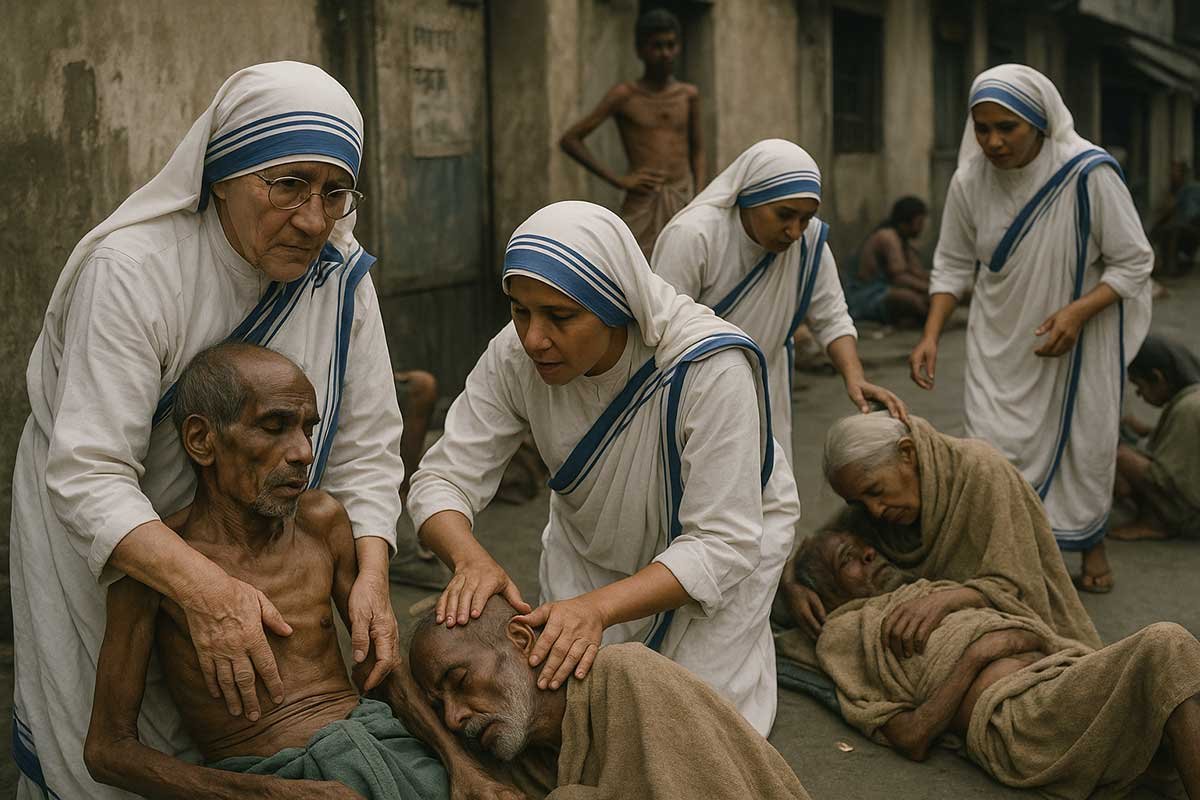

Mother Teresa, born Agnes Gonxha Bojaxhiu, emerged as one of the 20th century’s most recognized humanitarian figures, dedicating her life to serving the “poorest of the poor” in Calcutta, India, and beyond. Her profound commitment led to the establishment of the Missionaries of Charity, a religious order that expanded globally, earning her widespread acclaim, including the Nobel Peace Prize. This essay will retrace Mother Teresa’s history from her early life and initial religious calling to her transformative work in India, the global expansion of her mission, and her complex legacy, encompassing both celebrated contributions and significant critiques. Mother Teresa’s life exemplifies a profound commitment to compassionate service rooted in her faith, yet her enduring legacy is marked by a tension between global admiration for her humanitarian efforts and persistent controversies regarding her methods, theological perspectives, and organizational practices, necessitating a nuanced historical examination.
I. Early Life and the Genesis of a Mission
Birth and Early Influences
Agnes Gonxha Bojaxhiu was born on August 26, 1910, in Uskup, Ottoman Empire, a city now known as Skopje, North Macedonia. Her family was of Albanian descent, and her early life was shaped by the political turmoil of the Balkans in the early 20th century. The violence that tore through the region, including the death of her father—an advocate for Albanian independence—when she was only eight, profoundly influenced her formative years. Under the guidance of her deeply religious mother, she gravitated towards a life of faith within the Catholic Church.1 By the age of twelve, she felt a strong divine calling, a conviction that she was destined to be a missionary, spreading the love of Christ to distant lands.1
Joining the Sisters of Loreto and Arrival in India
Driven by this missionary zeal, Agnes, at eighteen, left her family home in Skopje in September 1928 to join the Institute of the Blessed Virgin Mary, commonly known as the Sisters of Loreto, in Ireland.1 Her intention was to learn English, the primary language of instruction for the Loreto Sisters’ missions in India. This departure marked a permanent separation from her mother and sister, whom she would never see again.4 During her time in Ireland, she received the name Sister Mary Teresa, a tribute to St. Thérèse of Lisieux, a 19th-century Carmelite nun.2 After a few months of training in Dublin, she embarked on her journey to India, arriving in Calcutta on January 6, 1929.1 Her novitiate began in Darjeeling, nestled in the lower Himalayas, where she immersed herself in learning Bengali and taught at St. Teresa’s School. She took her initial vows as a nun on May 24, 1931, and her solemn vows on May 14, 1937, while teaching at the Loreto convent school in Entally, eastern Calcutta. It was at this point, following Loreto custom, that she adopted the title ‘Mother’.1
Years as a Teacher in Calcutta
From 1931 to 1948, Mother Teresa dedicated herself to teaching at St. Mary’s High School in Calcutta. She served at the school for nearly two decades, eventually being appointed its headmistress in 1944.1 St. Mary’s, established in 1841, was one of six Loreto schools in Calcutta, known for educating a diverse student body that included orphans, children from affluent families, and foreign residents. The sisters ensured no distinction was made between students based on their wealth, origin, or religion, fostering an inclusive environment.5 Mother Teresa taught history and geography, becoming fluent in Bengali and later Hindi. She found immense satisfaction and comfort in the happiness and gratitude of her young students, many of whom affectionately called her “Ma,” a term she cherished.5 Her companions noted her unwavering charity, unselfishness, courage, capacity for hard work, and natural organizational abilities.3
The “Call within a Call”
Despite her enjoyment of teaching, Mother Teresa became increasingly troubled by the pervasive suffering and extreme poverty she observed beyond the convent walls in Calcutta.1 The devastating Bengal famine of 1943 brought widespread misery and death to the city, and the communal violence of August 1946, known as Direct Action Day, further intensified the Hindu-Muslim conflict, deepening her distress.4 These external societal crises acted as a catalyst for a profound reorientation of her life’s purpose. The visceral experience of poverty and violence transformed her abstract religious commitment into concrete action, demonstrating that profound social distress can indeed trigger significant individual and institutional humanitarian responses.
On September 10, 1946, during a train journey from Calcutta to Darjeeling for her annual retreat, Mother Teresa experienced a pivotal moment she later described as “the call within the call”.4 She felt a divine revelation of Jesus’s pain at the indifference and contempt shown towards the poor. This spiritual experience was an explicit command: “I was to leave the convent and help the poor while living among them. It was an order… ‘Come, be my light. I cannot go alone'”.4 In 1948, she received permission from her superiors to leave the convent school and dedicate herself entirely to working among the most impoverished residents of Calcutta’s slums.1
Transition to the Slums
On August 17, 1948, Mother Teresa marked her transition by replacing her traditional Loreto habit with a simple, white cotton sari with a blue border, a symbolic act of identifying with the people she intended to serve.3 She also adopted Indian citizenship, a deliberate act of integration that signaled her commitment to the nation and its people.4 This strategic adaptation, both visual and legal, likely facilitated her acceptance and effectiveness within the local community, helping to break down barriers often faced by foreign missionaries.
She spent several months in Patna, receiving basic medical training at Holy Family Hospital before venturing into the slums.3 Her initial year was fraught with immense difficulty. With no established funds, she relied entirely on “Divine Providence,” begging for food and supplies.1 During these early months, she experienced significant doubt, loneliness, and the temptation to return to the comfort and security of convent life.4 This internal struggle, a profound personal challenge, underscores the human vulnerability inherent in pioneering humanitarian work, demonstrating that even figures of immense faith can face deep personal trials. She began her work by founding an open-air school for slum children in Motijhil, Calcutta.1
The following table provides a chronological overview of key milestones in Mother Teresa’s life and the foundational development of the Missionaries of Charity:
Table 1: Key Milestones in Mother Teresa’s Life and the Missionaries of Charity
| Year | Event/Milestone | Brief Description |
| 1910 | Born Agnes Gonxha Bojaxhiu | Birth in Uskup, Ottoman Empire (now Skopje, North Macedonia).1 |
| 1928 | Joined Sisters of Loreto | Left home at 18 to join the Loreto Sisters in Ireland.1 |
| 1929 | Arrived in India | Began novitiate in Darjeeling, India.4 |
| 1931 | Took initial vows | First religious vows as a nun.1 |
| 1937 | Took solemn vows, became “Mother Teresa” | Final profession of vows while teaching at Loreto convent.3 |
| 1944 | Appointed headmistress of St. Mary’s School | Became principal of the school where she taught.3 |
| 1946 | Experienced “Call within a Call” | Profound spiritual experience on a train to Darjeeling, prompting new mission.4 |
| 1948 | Left Loreto convent, began work in slums | Received permission to work directly with the poorest in Calcutta.1 |
| 1950 | Founded Missionaries of Charity | Established her own order with permission from the Holy See.1 |
| 1952 | Opened Nirmal Hriday (Home for the Dying) | First hospice for the terminally ill in Calcutta.4 |
| 1957 | Built Shanti Nagar (leper colony) | Established a colony for leprosy patients outside Calcutta.9 |
| 1963 | Missionaries of Charity Brothers founded | Expansion of the religious family to include male members.3 |
| 1965 | Missionaries of Charity became International Religious Family | Papal decree from Pope Paul VI allowed global expansion.1 |
| 1976 | Contemplative Sisters branch founded | Establishment of a contemplative branch of the Sisters.3 |
| 1979 | Contemplative Brothers branch founded | Establishment of a contemplative branch of the Brothers.3 |
| 1984 | Missionaries of Charity Fathers founded | Establishment of the priestly branch of the family.3 |
| 1997 | Died in Calcutta | Passed away at the age of 87.2 |
| 2003 | Beatified by Pope John Paul II | First step towards canonization, recognized as “Blessed”.2 |
| 2016 | Canonized by Pope Francis | Declared a Saint by the Catholic Church.11 |
II. Founding and Evolution of the Missionaries of Charity
Formal Establishment of the Order
The pivotal moment for Mother Teresa’s mission arrived on October 7, 1950, when she received official permission from the Holy See to establish her own religious order, “The Missionaries of Charity”.1 The primary objective of this new congregation was explicitly defined: “to love and care for those persons nobody was prepared to look after”.1 From its inception, the order was dedicated to serving “the poorest of the poor” within the sprawling slums of Calcutta.4
Foundational Principles and Vows
The Missionaries of Charity distinguished themselves through a unique set of vows. In addition to the traditional religious vows of chastity, poverty, and obedience, members undertook a unique fourth vow: to provide “wholehearted free service to the poorest of the poor”.4 This was not merely an additional commitment but a strategic principle that defined the Missionaries of Charity’s radical approach. It mandated that members live among and serve the poor voluntarily, ensuring deep immersion and solidarity with their beneficiaries.9 This profound identification with the marginalized likely attracted highly dedicated volunteers and fostered significant public trust.
To embody this commitment, missionaries were required to live in extreme poverty themselves, possessing only the most basic necessities: a white habit, a pair of sandals, a metal bucket for washing, a crucifix and rosary, and a thin mattress for a bed.9 This austere lifestyle ensured they lived like those they served, reinforcing their authenticity. Mother Teresa also instructed the young missionaries to beg for food and supplies, a practice that demonstrated their complete dependence on divine providence and the generosity of donors.4 Their initial priority was begging for the poor, often going door-to-door to secure food for starving children.9 This approach, far from being a mere necessity, was a powerful symbolic act that reinforced their solidarity with the poor and built trust with local communities and individual benefactors.
Early Growth and Challenges in Calcutta
Mother Teresa’s efforts quickly attracted voluntary helpers. Her former students were among the first to join her, with Subhasini Das, later known as Sister Agnes, becoming her first postulant on March 19.1 Financial support, though initially absent, soon began to materialize, enabling the expansion of her work.1
The context of their mission was the densely populated city of Calcutta, a place teeming with humanity, often overcrowded and spilling into streets and alleys, characterized as a “cesspool of human misery and degradation”.5 This dire situation was exacerbated by the 1947 partition of India, which led to widespread unrest and the influx of over two million destitute refugees from East Pakistan (now Bangladesh) into Calcutta, overwhelming the already strained slums.9 This overwhelming humanitarian crisis created an immense and visible need that directly fueled the rapid growth and expansion of the Missionaries of Charity. The sheer scale of suffering provided both the impetus and the justification for their institutional development. Despite the immense challenges, including some nuns succumbing to cholera, the flow of volunteers remained steadfast.5
Initial Initiatives in Calcutta
In 1952, Mother Teresa, with the assistance of Calcutta officials, opened her first hospice. She transformed an abandoned Hindu temple into the Kalighat Home for the Dying, providing free care for the poor. She renamed it Nirmal Hriday, meaning “Home of the Pure Heart”.4 This facility was specifically intended for individuals with terminal illnesses who were often rejected by local hospitals and left to die on the streets, offering them a place to die with dignity.12
The Missionaries of Charity articulated their aim as caring for “the hungry, the naked, the homeless, the crippled, the blind, the lepers, all those people who feel unwanted, unloved, uncared for throughout society, people that have become a burden to the society and are shunned by everyone”.4 Their earliest efforts extended beyond the hospice to include opening schools, medical dispensaries, and food distribution centers.13 In 1957, the missionaries established Shanti Nagar, a leper colony or “Town of Peace,” located near Asansol, outside Calcutta. Here, they provided free treatment to over 13,000 leprosy victims.9 Additionally, Shishu Bhavan, a children’s home, was set up, which also offered free basic medical treatment and medicines to thousands of sick adults each month.10 These initiatives demonstrate a responsive and adaptive service model, directly addressing the most pressing and neglected needs of Calcutta’s population.
III. Mother Teresa’s Work in India: A Tapestry of Care
Holistic Approach to Suffering
The Missionaries of Charity adopted a comprehensive approach, aiming to address both the “physical and spiritual needs of the poor”.3 Their mission was broad, encompassing care for “the hungry, the naked, the homeless, the crippled, the blind, the lepers, all those people who feel unwanted, unloved, uncared for throughout society”.4 A central tenet of Mother Teresa’s philosophy was the emphasis on providing dignity and comfort, particularly to the dying. She strived to ensure that individuals could “die with dignity” 13, treating them with kindness, compassion, and empathy, rather than pity.14 This focus on providing dignity to the dying and unwanted, rather than solely medical treatment, reveals a fundamental philosophical underpinning of her work. It prioritized spiritual and emotional comfort over purely clinical outcomes, which was particularly impactful in a context where such individuals were often left to die on the streets. This highlights a qualitative aspect of care that went beyond conventional metrics.
Mother Teresa’s daily routine underscored this holistic commitment. Each day began with communion with Jesus in the Eucharist, after which she would venture out, rosary in hand, to find and serve Him in “the unwanted, the unloved, the uncared for”.3
Specific Facilities and Services
The Missionaries of Charity established several key facilities to address the diverse needs of Calcutta’s impoverished population:
- Nirmal Hriday (Home for the Pure of Heart): Opened in 1952, this hospice was a sanctuary for the terminally ill, many of whom had been rejected by local hospitals. By converting an abandoned Hindu temple, Mother Teresa created a space where these individuals could receive compassionate care in their final days.4
- Shanti Nagar (Town of Peace): Established in 1957, this colony for people with leprosy, located near Asansol, India, provided free treatment to over 13,000 leprosy victims, offering them a community and specialized care.9
- Shishu Bhavan: These children’s homes were created for orphans and abandoned children, and also extended free basic medical treatment and medicines to thousands of sick adults monthly.10
- Other Initiatives: Beyond these major facilities, the order also established open-air schools, medical dispensaries, and food distribution centers to meet immediate needs.1 Their adaptability was further demonstrated by their response to humanitarian crises, such as setting up homes in Bangladesh for refugees fleeing violence in the 1970s.12
Expansion within India
Mother Teresa’s dedicated efforts and the visible impact of her work quickly garnered the attention of Indian officials, including the prime minister.4 This recognition facilitated the expansion of the Missionaries of Charity throughout India, with new houses and centers being established across the country during the 1960s.8 The overwhelming humanitarian crisis in post-partition Calcutta, marked by famine, violence, and a massive influx of refugees, created an immense and visible need that directly fueled the rapid growth and expansion of the Missionaries of Charity. The scale of suffering provided both the impetus and the justification for their institutional development, demonstrating a symbiotic relationship between local need and organizational growth.
Resource Mobilization
From its very beginning, the Missionaries of Charity operated without conventional financial backing, with Mother Teresa depending entirely on “Divine Providence”.1 However, her unwavering commitment soon attracted voluntary helpers and financial support, which allowed her to broaden the scope of her work.1 The sisters were trained to beg for food and supplies, a practice that underscored their complete dependence on the generosity of donors.9 This practice of begging, rather than relying solely on large institutional grants, was not merely a necessity due to lack of funds but also a powerful symbolic act. It reinforced their solidarity with the poor by mirroring their experience and built trust with local communities and individual benefactors. Over time, nurses, doctors, and other volunteers joined their ranks, and the missionaries began to attract increasing private donations and support from the government.9
IV. Global Outreach and International Acclaim
International Expansion of the Missionaries of Charity
The Missionaries of Charity’s mission, initially focused on Calcutta, soon transcended national borders. In 1965, Pope Paul VI issued a decree that transformed the Society into an International Religious Family, paving the way for its global expansion.1 The first international center was established in the United States in 1971, located in New York City.14 From there, the order spread rapidly, reaching every corner of the world where the poor were in need, including countries in Africa, Latin America, and even behind the Iron Curtain in Communist nations and the Soviet Union.6
By the time of Mother Teresa’s death in 1997, the Missionaries of Charity had grown exponentially, comprising nearly 4,000 sisters operating in 610 foundations across 123 countries.2 By the early 21st century, the order continued its growth, with approximately 5,000 sisters active in over 130 countries.13 The “Family of the Missionaries of Charity” also expanded to include several branches: the Active Brothers (founded in 1963), the Contemplative Sisters (1976), the Contemplative Brothers (1979), and the Missionaries of Charity Fathers (1984).3 Beyond those with religious vocations, Mother Teresa also formed lay groups such as the Co-Workers of Mother Teresa and the Sick and Suffering Co-Workers. These groups comprised individuals of diverse faiths and nationalities who shared her spirit of prayer, simplicity, sacrifice, and dedication to humble works of love.3
Growing International Recognition and Media Attention
As the Missionaries of Charity expanded their reach, Mother Teresa’s work began to capture international attention. Secular Western media first took notice in 1969, when a television documentary highlighted her simple yet persistent efforts in the face of overwhelming poverty.2 This marked a turning point, as an increasingly interested media began to closely follow her activities.3 Her growing prominence led to her being featured on the cover of
TIME magazine in 1975, where she was hailed as one of the world’s “living saints”.14 Her global stature was further affirmed on October 26, 1985, when UN Secretary-General Pérez de Cuéllar introduced her to the United Nations General Assembly as “the most powerful woman in the world”.6 This amplification of her message through media and global recognition transformed her from a local figure into a global icon, which in turn significantly facilitated the rapid international expansion of the Missionaries of Charity.
Major Awards and Honors
Mother Teresa’s humanitarian work garnered numerous prestigious awards and honors from around the globe. These accolades began with the Indian Padmashri Award in 1962.3 Later that year, on August 31, 1962, she received the Ramon Magsaysay Award in the Philippines, often referred to as the “Nobel Prize of Asia,” for her outstanding contributions and selfless service.4
Table 2: Major Awards and Honors Received by Mother Teresa
| Year | Award Name | Awarding Body/Country | Brief Significance/Reason |
| 1962 | Padma Shri Award | President of India | One of India’s highest civilian honors.16 |
| 1962 | Ramon Magsaysay Award | Philippines | Often called the “Nobel Prize of Asia,” for selfless service.16 |
| 1969 | Jawaharlal Nehru Award | India | For her promotion of international peace and understanding.14 |
| 1971 | Pope John XXIII Peace Prize | Pope Paul VI | Recognized her work for peace.14 |
| 1971 | John F. Kennedy International Award | International | Acknowledged her global humanitarian efforts.16 |
| 1973 | Templeton Prize | International | First recipient, for efforts to help homeless and neglected children.16 |
| 1977 | Honorary PhD in Theology | University of Cambridge, England | Academic recognition of her spiritual and humanitarian work.16 |
| 1978 | Balzan Foundation Award | International | For humanity and peace among peoples.16 |
| 1979 | Nobel Peace Prize | Norwegian Nobel Committee | For her work to overcome poverty and distress, a threat to peace.12 |
| 1980 | Bharat Ratna | Government of India | India’s highest civilian award for humanitarian work.16 |
| 1980 | Medal of Merits of Skopje | City of Skopje, North Macedonia | Recognition from her birthplace.16 |
| 1983 | Order of Merit | Queen Elizabeth II | British honor for exceptional service.16 |
| 1985 | Presidential Medal of Freedom | US President Ronald Reagan | Highest civilian award in the United States.16 |
| 1996 | Honorary Citizen of the USA | United States | Granted honorary citizenship.16 |
| 1997 | United States Congressional Gold Medal | United States Congress | Highest civilian award bestowed by the U.S. Congress.16 |
The pinnacle of her international recognition came on December 10, 1979, when she was awarded the Nobel Peace Prize.2 The Norwegian Nobel Committee cited her “work undertaken in the struggle to overcome poverty and distress in the world, which also constitute a threat to peace”.19 The committee specifically acknowledged her efforts in “bringing help to suffering humanity,” particularly for children and refugees, and highlighted the “spirit that has inspired her activities” and her “respect for the individual human being, for his or her dignity and innate value”.19
Mother Teresa accepted the prize “in the name of the poor,” famously stating, “The prize is the recognition of the poor World. Jesus said, ‘I am hungry, I am naked, I am homeless.’ By serving the poor, I am serving him”.12 She used her acceptance speech not for personal glorification but as a powerful platform to highlight the plight of the poor, emphasizing love, compassion, and the inherent dignity of all people.12 Notably, she also used this global stage to express her strong, conservative views, controversially stating, “The greatest destroyer of peace is the cry of the innocent unborn child”.6 This consistent use of her growing fame and award platforms for advocacy, rather than self-celebration, demonstrates a calculated and consistent messaging strategy.
The following year, on January 25, 1980, the Indian government bestowed upon her the Bharat Ratna, India’s highest civilian award, in recognition of her profound humanitarian work.16 While receiving widespread international recognition from diverse political and religious figures, Mother Teresa simultaneously sparked controversy with her strong, often conservative, views on social issues. This highlights an enduring tension between her universally lauded humanitarian efforts and her specific ideological stances.
V. Legacy: Canonization, Contributions, and Critiques
Path to Sainthood
Mother Teresa’s earthly life concluded on September 5, 1997, in Calcutta.2 Less than two years after her passing, Pope John Paul II, recognizing her widespread reputation for holiness and numerous reported favors, granted special permission to expedite the opening of her Cause of Canonization.14 She was beatified on October 19, 2003, by Pope John Paul II, a significant step towards sainthood.2 This beatification followed the Vatican’s recognition of a miracle: an Indian woman attributed her recovery from a cancerous tumor to Mother Teresa’s intercession.14 However, this miracle was met with dispute by the patient’s doctor, who asserted that her recovery was due to medical treatment with drugs.22
Despite such contentions, Pope Francis officially canonized her as a Saint in Rome on September 4, 2016.11 This canonization followed the Holy See’s recognition of a second miracle, involving a Brazilian man’s recovery from a life-threatening brain infection after his family prayed to Mother Teresa.14 The speed of her canonization, occurring just 19 years after her death, was notably fast for modern times.14 On September 6, 2017, she was further honored by being named a co-patron of the Roman Catholic Archdiocese of Calcutta, alongside St. Francis Xavier.4 The swift beatification and canonization process, despite ongoing controversies and disputed miracles, suggests a powerful institutional effort by the Catholic Church to shape Mother Teresa’s public narrative and legacy, illustrating the interplay between religious authority, popular perception, and historical interpretation.
Enduring Impact and Contributions
By the time of her death, the Missionaries of Charity had grown into a formidable force for good, comprising nearly 4,000 sisters in 610 foundations spread across 123 countries.2 This expansion continued into the early 21st century, with approximately 5,000 sisters active in over 130 countries.13 Her work continues to alleviate humanitarian crises and human suffering globally.8
Mother Teresa remains an inspirational figure for many, embodying the “joy of loving, the greatness and dignity of every human person, the value of little things done faithfully and with love, and the surpassing worth of friendship with God”.11 Her life and work have inspired countless books, documentaries, and films, ensuring her story continues to resonate across generations.4 In a testament to her global influence, the United Nations General Assembly designated September 5th, the anniversary of her death, as the International Day of Charity.8
Controversies and Diverse Perspectives
Despite widespread admiration, Mother Teresa’s legacy is marked by significant controversies and diverse viewpoints that persist even after her canonization.
Medical Care Quality
Critics, including Indian author and physician Aroup Chatterjee and British journalists Christopher Hitchens and Tariq Ali (who produced the documentary Hell’s Angel), accused her of providing substandard medical care and, in some interpretations, of glorifying suffering rather than actively alleviating it.22 Allegations included unhygienic practices, such as reusing needles washed under tap water, storing expired medicines, and a general lack of proper medical equipment and trained volunteers in her facilities.23 Dr. Robin Fox’s article in
The Lancet noted the absence of strong analgesics in her homes, though he also acknowledged the Missionaries of Charity’s compassionate care, hygiene, and their crucial role in accepting patients rejected by other hospitals.24
Defenders argue that her facilities were primarily hospices for the dying, not hospitals, operating in the extremely impoverished and resource-scarce environment of post-colonial Calcutta.24 They point to the limited availability of trained palliative care professionals and strict government restrictions on opioid distribution as factors limiting pain management options.24 The core focus, they assert, was to provide comfort and dignity to those who would otherwise die alone on the streets.24 The accusation of hypocrisy regarding her own medical treatment, suggesting she preferred “California clinics,” is refuted by close associates who stated she resisted advanced medical interventions and was described as “the worst patient I ever had” due to her aversion to resting and resistance to treatment.21 This highlights a fundamental tension in her legacy: while her practical humanitarian efforts were widely celebrated, her underlying ideological and theological stances often clashed with modern secular and public health principles, leading to persistent debate.
Financial Transparency
A significant point of contention has been the alleged lack of financial transparency within the Missionaries of Charity. Critics claimed a substantial disparity between the millions of dollars reportedly received in donations and the very rudimentary nature of the facilities, with the order consistently refusing to publish any audit.21 A 1991 report in the German magazine
Stern estimated that only seven percent of the millions she received were used for direct charity.23 While no explicit proof of fund mismanagement has been widely confirmed, the persistent lack of transparency continues to fuel skepticism.26
Theological Approach and Social Issues
Mother Teresa faced criticism for her theological approach, particularly the alleged glorification of suffering. A controversial quote attributed to her states, “There is something beautiful in seeing the poor accept their lot, to suffer it like Christ’s Passion”.21 However, Sister Mary Prema Peierick, a defender, clarified that Mother Teresa “never wanted a person to suffer for suffering’s sake” and actively sought to alleviate it.24
Critics, including Mihir Bose and Christopher Hitchens, argued that she showed little interest in addressing the systemic root causes of poverty, focusing instead on “rescuing the souls” of the poor and effectively serving as an “ally of the status quo.” They contended that this approach differentiated her from others, including those of religious faith, who actively sought systemic societal change.21
Furthermore, Mother Teresa held strong, conservative views against divorce, contraception, and abortion.4 She publicly advocated for “natural family planning” as a solution for women not ready for children.23 Her speech at the Nobel Peace Prize ceremony notably included the statement, “The greatest destroyer of peace is the cry of the innocent unborn child,” underscoring her unwavering anti-abortion stance.6
Allegations of Proselytization and Questionable Associations
Accusations arose that dying Hindu or Muslim patients in her care were covertly baptized without their informed consent. Critics like Mohan Bhagwat claimed an “ulterior motive” of conversion, while Murray Kempton argued that patients were not provided the necessary information to make informed decisions about conversion.13
Mother Teresa was also criticized for accepting donations from and associating with questionable public figures. This included Jean-Claude Duvalier, Haiti’s dictator, whose rule she publicly praised, and Charles Keating, a central figure in the 1980s savings and loan crisis, for whom she provided a character statement and plea for leniency.21 Christopher Hitchens also criticized her for accepting the Presidential Medal of Freedom from President Ronald Reagan, whom he alleged had “armed and paid the death squads of Central America”.25
The “Dark Night of the Soul”
Perhaps one of the most profound revelations about Mother Teresa’s personal life emerged after her death. Her private correspondence, published in Come Be My Light (2007), revealed a deep, painful, and enduring feeling of being separated from God, an “ever-increasing longing for His love,” which began around 1949 and persisted for nearly 50 years until her death.3 This spiritual dryness, known as the “dark night of the soul,” was a profound sense of God’s absence that bewildered even her closest companions, as she never publicly alluded to it.27
Critics, such as Christopher Hitchens, interpreted these revelations as evidence that she had “ceased to believe” or was a “faux-saint” whose outward service was merely an attempt to “still the misery within”.21 However, Catholic interpretations, drawing on the mystical traditions of St. John of the Cross and her namesake, St. Thérèse de Lisieux, view this experience as a spiritual purgation. It is seen as a profound act of faith and a sharing in Christ’s suffering, allowing her to identify more deeply with the suffering of the poor and to experience God’s absence as they did.27 Her spiritual director, Father Langford, affirmed that this period revealed “the hidden depth of Mother Teresa’s faith,” demonstrating that profound spiritual struggles can coexist with and even deepen a life of outward service, offering a more human and relatable dimension to her sanctity.28
Conclusion
Mother Teresa’s life was a testament to unwavering devotion and radical service to the most marginalized members of society. From her humble beginnings in Skopje to her transformative work in the slums of Calcutta and the subsequent global expansion of the Missionaries of Charity, she profoundly impacted millions through her philosophy of dignity and compassionate care. Her recognition with the Nobel Peace Prize and subsequent canonization cemented her status as a global humanitarian icon.
However, her enduring legacy is not without its complexities and nuances. Debates surrounding the quality of medical care provided in her hospices, persistent questions about financial transparency, and her unyielding conservative stances on social issues like abortion and contraception present a multifaceted portrait. These critiques highlight an enduring tension between the pragmatic, immediate relief her efforts provided and the underlying ideological and theological principles that guided her work, which often clashed with modern secular and public health perspectives. Furthermore, the posthumous revelation of her decades-long “dark night of the soul” adds a deeply human and paradoxical dimension to her spiritual journey, challenging simplistic interpretations of her faith and revealing a profound internal struggle that coexisted with her outward acts of charity.
Ultimately, Mother Teresa remains a figure of immense inspiration and enduring contention. Her life compels reflection on the nature of compassion, the practical and ethical challenges of alleviating suffering on a global scale, and the intricate interplay between faith, action, and public perception. Her work continues through the Missionaries of Charity, a testament to the lasting impact of a woman who, despite her human frailties and the critiques she faced, dedicated her life to serving “Jesus in the poorest of the poor.”
Bibliography
- Active Minds. “Mother Teresa.” Accessed October 26, 2023. https://activeminds.com/topics/Mother_Teresa.html. 2
- All That’s Interesting. “Was Mother Teresa A Saint Or A Fraud?” Accessed October 26, 2023. https://allthatsinteresting.com/mother-teresa-saint. 23
- Brafton. “How To Write a Journalistic Article Like a Pro.” Accessed October 26, 2023. https://www.brafton.com/blog/content-writing/how-to-write-a-journalistic-article/. 29
- EasyBib. “Chicago Style Footnotes and Bibliography Examples.” Accessed October 26, 2023. https://www.easybib.com/guides/citation-guides/chicago-turabian/footnotes/. 30
- EBSCO. “Mother Teresa Founds the Missionaries of Charity.” Accessed October 26, 2023. https://www.ebsco.com/research-starters/religion-and-philosophy/mother-teresa-founds-missionaries-charity. 9
- EBSCO. “Mother Teresa Is Awarded the Nobel Peace Prize.” Accessed October 26, 2023. https://www.ebsco.com/research-starters/history/mother-teresa-awarded-nobel-peace-prize. 12
- EWTN. “Mary’s Light in Mother Teresa’s Dark Night.” Accessed October 26, 2023. https://www.ewtn.com/catholicism/library/marys-light-in-mother-teresas-dark-night-5989. 28
- Franciscan Media. “Mother Teresa: A Saint Who Conquered Darkness.” Accessed October 26, 2023. https://www.franciscanmedia.org/st-anthony-messenger/mother-teresa-a-saint-who-conquered-darkness/. 27
- Global Chamber. “International Day of Charity.” Accessed October 26, 2023. https://www.globalchamber.org/events/2026/09/05/holiday/international-day-of-charity/. 8
- HandWiki. “Criticism of Mother Teresa.” Accessed October 26, 2023. https://handwiki.org/wiki/Religion:Criticism_of_Mother_Teresa. 22
- History Collection. “Mother Teresa: 8 Reasons To Believe She Was No Saint.” Accessed October 26, 2023. https://historycollection.com/mother-teresa-8-reasons-believe-no-saint/. 25
- History.com. “Mother Teresa.” Accessed October 26, 2023. https://www.history.com/articles/mother-theresa. 14
- Inshorts. “Mother Teresa was given Bharat Ratna on this day.” Accessed October 26, 2023. https://inshorts.com/en/news/mother-teresa-awarded-bharat-ratna-on-this-day-1453714754257. 20
- Library, University of Leeds. “Clear, concise and formal | Language and style.” Accessed October 26, 2023. https://library.leeds.ac.uk/info/14011/writing/221/language-and-style. 31
- Mary Johnson. “How the Missionaries of Charity began.” Accessed October 26, 2023. https://www.maryjohnson.co/more-about-the-mcs. 7
- Memorial House of Mother Teresa. “Prizes.” Accessed October 26, 2023. https://memorialhouseofmotherteresa.com/mother-teresa/prizes/. 16
- Missionaries of Charity Brothers. “History.” Accessed October 26, 2023. https://www.mcbrothers.org/history.html. 10
- Montclair Catholics. “St. Teresa of Calcutta Biography.” Accessed October 26, 2023. https://www.montclaircatholics.org/st-teresa-of-calcutta-biography/. 15
- Mother Teresa Charites. “Mother Teresa – Life and Living.” Accessed October 26, 2023. https://www.motherteresacharities.org/mother-teresa-Life-and-living.php. 5
- Mother Teresa.org. “Mother Teresa.” Accessed October 26, 2023. https://www.motherteresa.org/. 11
- Nobel Prize. “Mother Teresa – Biographical.” Accessed October 26, 2023. https://www.nobelprize.org/prizes/peace/1979/teresa/biographical/. 1
- Nobel Prize. “Press Release.” Accessed October 26, 2023. https://www.nobelprize.org/prizes/peace/1979/press-release/. 19
- Omnesmag. “The context of Mother Teresa’s mission in Calcutta.” Accessed October 26, 2023. https://www.omnesmag.com/en/focus/context-mother-teresas-mission-in-calcutta/. 24
- Reddit. “Was Mother Teresa a fraud?” Accessed October 26, 2023. https://www.reddit.com/r/skeptic/comments/1i4vu35/was_mother_teresa_a_fraud/. 26
- Saint Teresa Catholic. “Mother Teresa.” Accessed October 26, 2023. https://saintteresacatholic.org/mother-teresa. 3
- Scribbr. “Chicago style footnotes.” Accessed October 26, 2023. https://www.scribbr.com/chicago-style/footnotes/. 32
- Slate. “The Fanatic, Fraudulent Mother Teresa.” Accessed October 26, 2023. https://slate.com/news-and-politics/2003/10/the-fanatic-fraudulent-mother-teresa.html. 21
- Testbook. “In which year was Mother Teresa honored with Bharat Ratna Award?” Accessed October 26, 2023. https://testbook.com/question-answer/in-which-year-was-mother-teresa-honored-with-bhara–609a7460e1feb8d51c585295. 18
- Vatican News. “S. Mother Theresa of Calcutta.” Accessed October 26, 2023. https://www.vaticannews.va/en/saints/09/05/s–mother-theresa-of-calcutta.html. 6
- Wikipedia. “Mother Teresa.” Accessed October 26, 2023. https://en.wikipedia.org/wiki/Mother_Teresa. 4
- Wikipedia. “Ramon Magsaysay Award.” Accessed October 26, 2023. https://en.wikipedia.org/wiki/Ramon_Magsaysay_Award. 17
- Britannica. “Missionaries of Charity.” Accessed October 26, 2023. https://www.britannica.com/topic/Missionaries-of-Charity. 13
- BeOmniscient. “How to write like a journalist.” Accessed October 26, 2023. https://beomniscient.com/blog/how-to-write-like-a-journalist/. 33
- BestEditProof. “4 Common Types of Academic Writing.” Accessed October 26, 2023. https://besteditproof.com/en/academy/4-common-types-of-academic-writing. 34