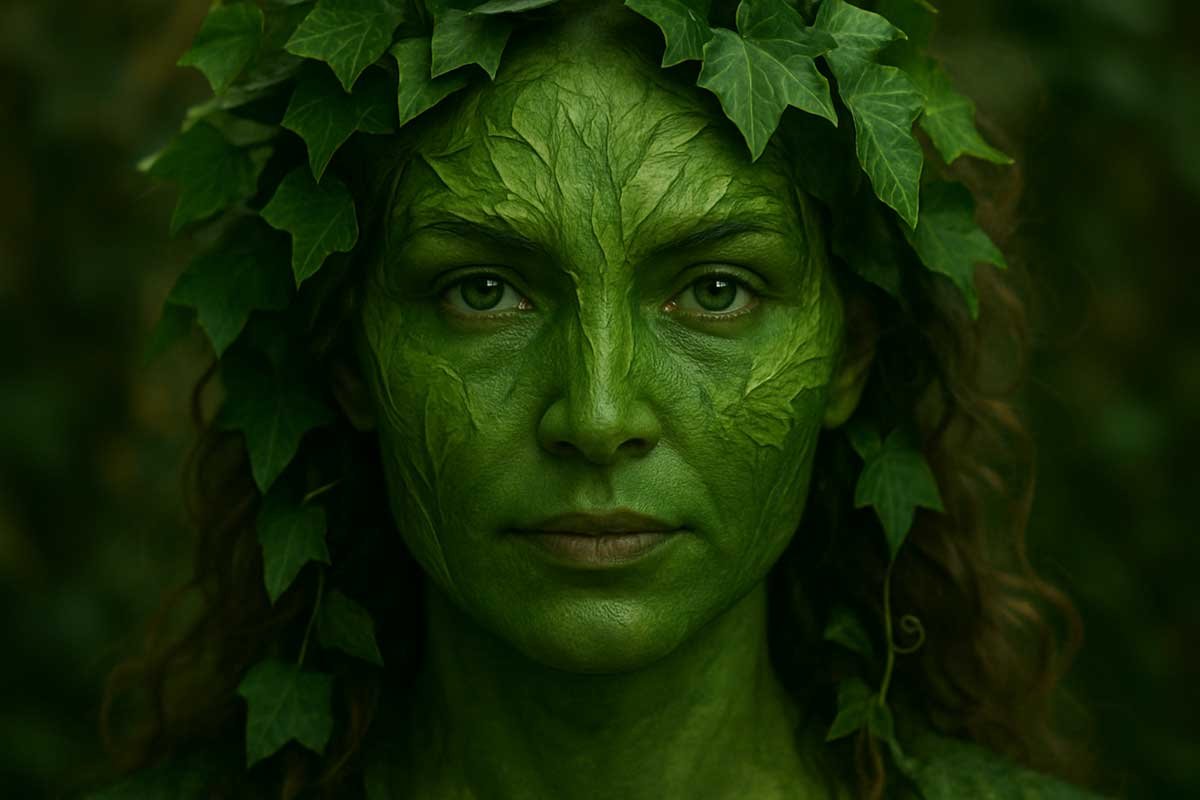

The Face Emerging from Foliage
(editors note. You can download this essay via a link at the end- KJP)
The Green Woman exists. Despite centuries of scholarly and patriarchal oversight, recent research has definitively documented female counterparts to the Green Man throughout history, from Roman frescoes to medieval church carvings, appearing as early as the 1st century BCE. Dutch researchers Ko and Joke Lankester’s groundbreaking 20-year study revealed that Green Women have adorned sacred spaces alongside their male counterparts, yet remained consistently overlooked by scholars who assumed all foliate heads were masculine.¹ This discovery fundamentally reframes our understanding of nature-gender symbolism in Western culture while resonating with rich traditions of feminine nature deities found globally.
The implications extend far beyond art history. As environmental crises intensify, contemporary movements increasingly draw upon feminine nature archetypes—from Extinction Rebellion’s haunting Red Rebel Brigade to indigenous water protectors at Standing Rock. These modern expressions build upon deep philosophical foundations established by ecofeminist thinkers like Vandana Shiva and Carolyn Merchant, who identified profound connections between the domination of women and nature.² Yet critical perspectives from intersectional, decolonial, and queer ecology scholars warn against essentializing these connections, calling instead for nuanced approaches that honor diversity while challenging systems of oppression.
Uncovering the Hidden Green Woman in Medieval Europe
The most significant revelation comes from the Lankesters’ meticulous documentation of Green Women in European church architecture. In Canterbury Cathedral, a 14th-century roof boss long misidentified as another Green Man actually depicts a Green Woman, her head wreathed in leaves and flowers but lacking the characteristic mouth-sprouting vegetation of male figures.³ At Chartres Cathedral, three Green Women emerge from oak leaves on the northern porch, deliberately positioned as counterparts to three Green Men on the southern entrance. These architectural choices suggest medieval craftspeople understood nature’s regenerative power as fundamentally dual-gendered.
The Roman Villa Farnesina contains perhaps the earliest Green Woman representation, dating to 19 BCE. Here, a female figure emerges from vegetation to rule “the other world” where boundaries between divine, human, and natural realms dissolve.⁴ By 118 CE, a Green Woman identified as Medusa watched over Emperor Hadrian’s temple in Ephesus, her snake-hair transformed into vegetal forms. These examples predate many Green Man representations, challenging assumptions about the primacy of masculine nature symbolism.
Barcelona Cathedral’s misericord from 1394-1399 depicts an embracing Green Man and Green Woman emerging together from vegetation, crowned with grape or ivy leaves. This representation of the sacred marriage between masculine and feminine nature principles appears throughout medieval art, though female figures remain far rarer than their male counterparts.⁵ The Lankesters attribute this disparity partly to patriarchal scholarship that assumed all ambiguous foliate heads were male, and partly to Christian authorities’ greater comfort with domesticated feminine imagery like the Virgin Mary compared to wild feminine archetypes that challenged patriarchal control.
Global Traditions of Feminine Nature Deities
While European Green Women remained hidden in plain sight, cultures worldwide openly celebrated feminine nature deities. Celtic traditions honored Brigid, the triple goddess of fire, poetry, and healing, whose sacred wells and metalworking forge connected creative and regenerative powers.⁶ The goddess Danu, though rarely mentioned directly in texts, represented the primordial earth mother from whom the Tuatha Dé Danann (“People of the Goddess Danu”) descended.⁷ Trees held particular feminine significance: elder housed protective “Elder Tree Mothers,” rowan belonged to Brigid, and hawthorn marked gateways to the Otherworld.⁸
Greek and Roman pantheons featured extensive feminine nature hierarchies. Demeter and Persephone’s annual cycle explained seasonal changes through a mother-daughter narrative of loss and reunion.⁹ Beyond major goddesses, thousands of nymphs animated the natural world—dryads inhabiting trees, naiads dwelling in freshwater, oreads claiming mountains. Each represented not abstract nature but specific, localized ecological relationships.¹⁰
Hindu cosmology presents Prakriti as the primordial feminine principle underlying all matter, balanced by Purusha’s masculine consciousness.¹¹ Aranyani, the elusive forest goddess mentioned in the Rigveda, dwells in quiet jungle glades, providing food “though she tills no lands.”¹² These goddesses embody nature not as resource but as sacred presence deserving reverence.
Indigenous American traditions center powerful earth mothers. The Hopi’s Spider Grandmother assisted the Sun in creating life, molding humans from clay and guiding them through cosmic transformations.¹³ The Lakota’s White Buffalo Calf Woman brought the sacred pipe and ceremonies connecting human and spirit worlds.¹⁴ These figures function not as distant deities but as active teachers and protectors within living cosmologies.
African earth goddesses like the Igbo’s Ala and the Ashanti’s Asase Ya govern morality alongside fertility.¹⁵ Ala can “swallow a person into the underground” when angered by injustice, while Asase Ya appears as both beautiful young woman (fertile earth) and wise crone (barren earth receiving the dead).¹⁶ These goddesses demand ethical behavior toward both land and community, enforcing consequences for violations.
Ecofeminist Philosophy Connects Domination Systems
The theoretical framework linking women’s oppression to environmental destruction emerged prominently through Carolyn Merchant’s The Death of Nature (1980). Merchant traced how the Scientific Revolution’s shift from organic to mechanistic worldviews enabled exploitation of both women and nature by reconceptualizing the earth from living organism to inert machine.¹⁷ Her historical analysis revealed that pre-modern Europeans understood nature as a nurturing but also potentially vengeful feminine presence whose exploitation carried moral consequences.
Vandana Shiva advanced this analysis by documenting how colonialism and development projects specifically targeted women’s ecological knowledge. Her concept of “maldevelopment” describes Western development models that create poverty for Third World women while destroying subsistence economies.¹⁸ Shiva doesn’t advocate return to an idealized past but rather recognition that “in nature’s economy the currency is not money, it is life.”¹⁹ Her work demonstrates how women, particularly in the Global South, maintain seed diversity, water conservation, and forest protection despite—not because of—development interventions.
Val Plumwood’s philosophical rigor identified systematic dualisms—culture/nature, mind/body, male/female—that create “logics of colonization.”²⁰ These conceptual structures position one side as radically separate from and superior to the other, justifying domination. Her critique extends beyond gender to examine how Western thought constructs “the other as radically separate and inferior, the background to the self as foreground.”²¹
Donna Haraway disrupts these dualisms entirely through her concept of “naturecultures”—the recognition that nature and culture co-evolve and cannot be meaningfully separated.²² Her vision of “making kin” across species boundaries offers sympoiesis (making-with) rather than autopoiesis (self-making) as a model for ecological relationships.²³ This framework moves beyond anthropocentrism while maintaining feminist analysis of power relations.
Indigenous feminist scholars like Robin Wall Kimmerer demonstrate how traditional ecological knowledge operates through reciprocal rather than extractive relationships. Her “grammar of animacy” recognizes plants and animals as teachers rather than resources.²⁴ Kimmerer braids indigenous wisdom with botanical science, showing how “becoming indigenous to a place means living as if your children’s future mattered.”²⁵
Contemporary Movements Embody Earth Resistance
Modern environmental movements increasingly deploy feminine nature symbolism for urgent activism. Extinction Rebellion’s Red Rebel Brigade, created in 2019, features silent performers in flowing red robes representing “the blood of all species.”²⁶ Their haunting processions cut through protest noise to embody prophetic grief for planetary destruction. The Brigade’s primarily feminine aesthetic—though open to all genders—deliberately invokes ancient traditions of women as environmental prophets and protectors.²⁷
The original Chipko movement of 1970s India saw women literally embracing trees to prevent logging, with leaders like Gaura Devi organizing human shields against deforestation.²⁸ Women tied rakhi (sacred threads) around trees, declaring them protected brothers. This movement originated the term “tree hugger” while demonstrating how women’s subsistence needs for fuel, fodder, and water positioned them as forests’ most committed defenders.²⁹
Contemporary artists reimagine plant-women hybrids for ecological urgency. Ana Mendieta’s earth-body works merged her physical form with landscapes through her Silueta series (1973-1980), creating feminine absences in nature that evoked both violence and regeneration.³⁰ Her statement that “my art is grounded in the belief of one universal energy which runs through everything” preceded current new materialist philosophy by decades.³¹
The neo-pagan Goddess movement, particularly through teachers like Starhawk, has revived earth-based spirituality as environmental activism.³² Her concept of “power-with” rather than “power-over” provides models for non-hierarchical organizing.³³ Contemporary pagans explicitly invoke the “Green Woman” as the May Queen’s evolution, representing earth’s regenerative powers in female form.³⁴
Critical Perspectives Demand Intersectional Approaches
While feminine nature connections inspire powerful activism, critical scholars warn against essentializing these relationships. Victoria Davion distinguished between “ecofeminine” approaches that celebrate biological women’s “natural” environmental connection and genuinely feminist ecofeminism that analyzes power structures.³⁵ Biological determinism, even when positively framed, limits women to reproductive and nurturing roles while ignoring how race, class, and sexuality shape environmental experiences.
Indigenous scholars particularly critique white Western ecofeminism’s appropriation of indigenous knowledge while maintaining colonial structures.³⁶ Leanne Betasamosake Simpson observes that Western academia extracts Traditional Ecological Knowledge (TEK) from its context of indigenous sovereignty and political decolonization.³⁷ Indigenous women’s environmental movements—from Standing Rock water protectors to Chipko tree-huggers—operate from specific cosmovisions rather than universal “feminine” connections to nature.
Intersectional ecofeminism, developed by scholars like Rachel Bagby and bell hooks, reveals how environmental hazards disproportionately affect women of color while white-dominated environmental movements ignore environmental racism.³⁸ As hooks argues, “whiteness and white supremacy culture have driven us towards the current climate crisis” yet mainstream environmentalism fails to address these root causes.³⁹
Queer ecology, articulated by Catriona Mortimer-Sandilands and others, challenges heteronormative assumptions underlying much environmental thought.⁴⁰ National parks designed around nuclear family camping, wilderness areas that excluded queer communities, and reproductive futurism that frames non-reproductive sexualities as “unnatural” all demonstrate how environmental spaces enforce normative sexualities. Queer ecology proposes alternative kinship models and non-binary approaches to nature that don’t replicate oppressive structures.⁴¹
Decolonial perspectives from Global South scholars reveal how Western ecofeminism can perpetuate epistemic violence by treating indigenous and Third World women as objects of study rather than knowledge producers.⁴² María Lugones’ decolonial feminism moves beyond analyzing structural injustices to fostering decoloniality in practice, supporting indigenous resurgence and plural ontologies that don’t rely on Western nature/culture binaries.⁴³
Toward an Inclusive Green Woman Archetype
Creating a contemporary Green Woman concept requires navigating between powerful archetypal symbolism and critical awareness of diversity and power. The figure cannot simply mirror the Green Man with feminine features but must embody resistance to all forms of domination while celebrating regenerative possibilities. She emerges not from essential feminine nature but from chosen alliances with earth’s creative and destructive powers.
A meaningful Green Woman archetype would recognize multiple manifestations across cultures without appropriating specific traditions. She appears as May Queen and Corn Mother, forest guardian and water protector, scientist and activist, embracing both ancient wisdom and future possibilities. Rather than representing universal “feminine” traits, she embodies qualities needed for planetary survival: reciprocity over extraction, regeneration over growth, kinship over dominion.
Contemporary artists and activists already manifest diverse Green Women. She rises in the Red Rebels’ silent witness, the water protectors’ prayer resistance, the solarpunk makers’ vegetal architecture. She speaks through indigenous grandmothers protecting seed sovereignty and young climate activists demanding livable futures. Her power lies not in biological essence but in chosen alliance with earth’s continuance.
This multiplicity suggests the Green Woman functions best not as single archetype but as invitation to imagine and embody earth-protective possibilities across all identities. She reminds us that human survival depends on recognizing our kinship with the more-than-human world—not through essential connection but through deliberate choice to nurture rather than destroy, to generate rather than extract, to protect rather than plunder.
The Politics of Reclaiming Earth Guardianship
The rediscovery and reimagining of Green Woman figures carries profound political implications for environmental movements. Unlike the relatively depoliticized Green Man of garden centers and pub signs, the Green Woman emerges explicitly connected to resistance against interconnected oppressions. Her appearance signals not decorative nature romanticism but active opposition to systems destroying both human communities and ecosystems.
Strategic deployment of Green Woman imagery—avoiding essentialism while honoring real connections between gender and environmental justice—offers powerful organizing symbols. When indigenous water protectors invoke earth mother teachings, when Indian women embrace trees their lives depend upon, when artists merge bodies with landscapes, they demonstrate that environmental destruction particularly impacts those already marginalized by existing power structures.⁴⁴ The Green Woman makes visible these connections while inspiring collective resistance.
Yet she must remain open to multiple interpretations and embodiments. A truly transformative Green Woman archetype creates space for indigenous sovereignty, decolonial resurgence, queer ecological kinships, and disabled environmental justice alongside traditional goddess spirituality. She appears wherever humans choose to defend earth’s integrity, regardless of gender identity or expression. Her multiplicities reflect biodiversity itself—strength through variation rather than uniformity.
Contemporary movements increasingly recognize that effective environmental action requires addressing systemic oppressions. The Green Woman embodies this understanding, representing not pristine nature separate from human concerns but the messy entanglements of ecological and social justice. She rises from toxic waste sites in communities of color, from clear-cut forests on indigenous lands, from flooded island nations facing climate chaos. Her call to action addresses not abstract “humanity” but specific responsibilities based on differential power and impact.
This political Green Woman offers hope through collective action rather than individual purity. She acknowledges that “we become-with each other or not at all,” as Haraway writes.⁴⁵ Her regenerative power emerges through solidarity across difference, through recognition that liberation cannot be partial. In reclaiming and reimagining the Green Woman, contemporary movements assert that earth’s protection requires not return to an idealized past but creation of radically different futures where both human and more-than-human beings can flourish.
Conclusion: Rooting the Future in Feminine Wisdom
The Green Woman’s emergence from historical obscurity into contemporary consciousness marks a crucial moment in humanity’s relationship with the living earth. Her rediscovery in medieval churches reveals how patriarchal scholarship erased feminine nature symbolism even when carved in stone. Yet her persistence across cultures—from Celtic tree mothers to Hindu forest goddesses, from African earth deities to Indigenous grandmothers—demonstrates the universality of recognizing nature’s feminine aspects while honoring their specific cultural manifestations.
As climate chaos accelerates and biodiversity collapses, the Green Woman offers essential resources for transformation. Not as essential feminine connection to nature—that path leads to limitation and appropriation—but as chosen alliance with earth’s regenerative powers available to all who commit to planetary healing. She teaches that effective resistance requires addressing interconnected oppressions, that environmental and social justice cannot be separated, that transformation demands both inner work and outer action.
The Green Woman invites us to imagine ourselves differently: not as masters of nature but as participants in ongoing creation, not as isolated individuals but as nodes in networks of kinship extending across species boundaries. Her foliate face reminds us that we too can leaf and bloom, that human nature is always already more-than-human, that our survival depends on remembering we are earth temporarily crystallized into conscious form.
Moving forward, the Green Woman serves not as fixed symbol but as generative principle—inspiring diverse manifestations of earth-protective power across all identities and communities. She rises wherever people choose partnership over domination, wherever movements integrate healing with resistance, wherever humans recognize their kinship with the more-than-human world. In reclaiming and reimagining the Green Woman, we reclaim possibilities for futures where both human and earth communities can flourish. Her promise lies not in return to an idealized past but in conscious co-creation of radically different tomorrows rooted in justice, reciprocity, and reverence for life’s continuing creativity.
Download a copy of The Green Woman: From Hidden History to Ecological Archetype with my compliments – Kevin Parker Publisher
You might also be interested in The Green Man: From Medieval Margins to Ecological Icon
Notes
¹ Ko Lankester and Joke Lankester, “The Green Woman: Parallel to the Green Man,” Folklore 112, no. 2 (2001): 12-27.
² Carolyn Merchant, The Death of Nature: Women, Ecology, and the Scientific Revolution (San Francisco: Harper & Row, 1980), 164-190; Vandana Shiva, Staying Alive: Women, Ecology and Development (London: Zed Books, 1988), 38-42.
³ Lankester and Lankester, “Green Woman,” 18-19.
⁴ Jeremy Harte, The Green Man (Andover: Pitkin Guides, 2001), 23.
⁵ Kathleen Basford, The Green Man (Cambridge: D.S. Brewer, 1978), 45-47.
⁶ Miranda Green, Celtic Goddesses: Warriors, Virgins and Mothers (London: British Museum Press, 1995), 195-197.
⁷ Proinsias Mac Cana, Celtic Mythology (London: Hamlyn, 1970), 85-86.
⁸ Francine Nicholson, “The Sacred Trees of Celtic Tradition,” in Celtic Tree Wisdom, ed. Jane Gifford (London: Rider, 1999), 45-67.
⁹ Jenny Strauss Clay, “The Homeric Hymn to Demeter,” in The Politics of Olympus: Form and Meaning in the Major Homeric Hymns (Princeton: Princeton University Press, 1989), 202-266.
¹⁰ Jennifer Larson, Greek Nymphs: Myth, Cult, Lore (Oxford: Oxford University Press, 2001), 3-8.
¹¹ Kapila Vatsyayan, Prakriti: The Integral Vision (New Delhi: Indira Gandhi National Centre for the Arts, 1995), 12-15.
¹² Stephanie W. Jamison and Joel P. Brereton, trans., The Rigveda: The Earliest Religious Poetry of India (Oxford: Oxford University Press, 2014), 1461-1462.
¹³ Frank Waters, Book of the Hopi (New York: Viking Press, 1963), 3-5.
¹⁴ Joseph Marshall III, The Lakota Way: Stories and Lessons for Living (New York: Penguin Compass, 2002), 191-209.
¹⁵ John S. Mbiti, African Religions and Philosophy, 2nd ed. (Oxford: Heinemann, 1989), 48-49.
¹⁶ J. Omosade Awolalu, Yoruba Beliefs and Sacrificial Rites (London: Longman, 1979), 29-30.
¹⁷ Merchant, Death of Nature, 127-128.
¹⁸ Shiva, Staying Alive, 14-15.
¹⁹ Vandana Shiva, Earth Democracy: Justice, Sustainability, and Peace (Cambridge, MA: South End Press, 2005), 11.
²⁰ Val Plumwood, Feminism and the Mastery of Nature (London: Routledge, 1993), 41-68.
²¹ Plumwood, Feminism and Mastery, 42.
²² Donna Haraway, The Companion Species Manifesto: Dogs, People, and Significant Otherness (Chicago: Prickly Paradigm Press, 2003), 6-7.
²³ Donna Haraway, Staying with the Trouble: Making Kin in the Chthulucene (Durham: Duke University Press, 2016), 58-98.
²⁴ Robin Wall Kimmerer, Braiding Sweetgrass: Indigenous Wisdom, Scientific Knowledge, and the Plant World (Minneapolis: Milkweed Editions, 2013), 48-59.
²⁵ Kimmerer, Braiding Sweetgrass, 9.
²⁶ Clare Farrell et al., This Is Not a Drill: An Extinction Rebellion Handbook (London: Penguin, 2019), 187-189.
²⁷ Anna Behrmann, “The Artists of Extinction Rebellion: ‘Our Bold Imagery Is Helping to Change the Conversations Around Climate Change,'” The i, November 26, 2019, https://annabehrmann.com/2019/11/26/the-artists-of-extinction-rebellion-our-bold-imagery-is-helping-to-change-the-conversations-around-climate-change-i-paper/.
²⁸ Vandana Shiva and J. Bandyopadhyay, “The Evolution, Structure, and Impact of the Chipko Movement,” Mountain Research and Development 6, no. 2 (1986): 133-142.
²⁹ Thomas Weber, Hugging the Trees: The Story of the Chipko Movement (New Delhi: Viking, 1988), 89-102.
³⁰ Olga Viso, Ana Mendieta: Earth Body, Sculpture and Performance 1972-1985 (Washington, DC: Hirshhorn Museum, 2004), 35-49.
³¹ Ana Mendieta, quoted in Mary Jane Jacob, Ana Mendieta: The “Silueta” Series, 1973-1980 (New York: Galerie Lelong, 1991), 3.
³² Starhawk, The Spiral Dance: A Rebirth of the Ancient Religion of the Great Goddess, 20th anniversary ed. (San Francisco: HarperSanFrancisco, 1999), 26-28.
³³ Starhawk, Truth or Dare: Encounters with Power, Authority, and Mystery (San Francisco: Harper & Row, 1987), 8-20.
³⁴ Ronald Hutton, The Stations of the Sun: A History of the Ritual Year in Britain (Oxford: Oxford University Press, 1996), 242-243.
³⁵ Victoria Davion, “Is Ecofeminism Feminist?” in Ecological Feminism, ed. Karen J. Warren (London: Routledge, 1994), 8-28.
³⁶ Andy Smith, “Ecofeminism Through an Anticolonial Framework,” in Ecofeminism: Women, Culture, Nature, ed. Karen J. Warren (Bloomington: Indiana University Press, 1997), 21-37.
³⁷ Leanne Betasamosake Simpson, As We Have Always Done: Indigenous Freedom through Radical Resistance (Minneapolis: University of Minnesota Press, 2017), 154-155.
³⁸ Rachel Bagby, “Daughters of Growing Things,” in Reweaving the World: The Emergence of Ecofeminism, ed. Irene Diamond and Gloria Feman Orenstein (San Francisco: Sierra Club Books, 1990), 231-248.
³⁹ bell hooks, “Earthbound: On Solid Ground,” in Sisters of the Earth: Women’s Prose and Poetry About Nature, ed. Lorraine Anderson (New York: Vintage, 2003), 346-347.
⁴⁰ Catriona Mortimer-Sandilands and Bruce Erickson, eds., Queer Ecologies: Sex, Nature, Politics, Desire (Bloomington: Indiana University Press, 2010), 1-47.
⁴¹ Mortimer-Sandilands and Erickson, Queer Ecologies, 31.
⁴² Silvia Rivera Cusicanqui, “Ch’ixinakax utxiwa: A Reflection on the Practices and Discourses of Decolonization,” South Atlantic Quarterly 111, no. 1 (2012): 95-109.
⁴³ María Lugones, “Toward a Decolonial Feminism,” Hypatia 25, no. 4 (2010): 742-759.
⁴⁴ Winona LaDuke, All Our Relations: Native Struggles for Land and Life (Cambridge, MA: South End Press, 1999), 2-5.
⁴⁵ Haraway, Staying with the Trouble, 4.
Bibliography
Awolalu, J. Omosade. Yoruba Beliefs and Sacrificial Rites. London: Longman, 1979.
Bagby, Rachel. “Daughters of Growing Things.” In Reweaving the World: The Emergence of Ecofeminism, edited by Irene Diamond and Gloria Feman Orenstein, 231-248. San Francisco: Sierra Club Books, 1990.
Basford, Kathleen. The Green Man. Cambridge: D.S. Brewer, 1978.
Behrmann, Anna. “The Artists of Extinction Rebellion: ‘Our Bold Imagery Is Helping to Change the Conversations Around Climate Change.'” The i, November 26, 2019. https://annabehrmann.com/2019/11/26/the-artists-of-extinction-rebellion-our-bold-imagery-is-helping-to-change-the-conversations-around-climate-change-i-paper/.
Clay, Jenny Strauss. “The Homeric Hymn to Demeter.” In The Politics of Olympus: Form and Meaning in the Major Homeric Hymns, 202-266. Princeton: Princeton University Press, 1989.
Cusicanqui, Silvia Rivera. “Ch’ixinakax utxiwa: A Reflection on the Practices and Discourses of Decolonization.” South Atlantic Quarterly 111, no. 1 (2012): 95-109.
Davion, Victoria. “Is Ecofeminism Feminist?” In Ecological Feminism, edited by Karen J. Warren, 8-28. London: Routledge, 1994.
Farrell, Clare, et al. This Is Not a Drill: An Extinction Rebellion Handbook. London: Penguin, 2019.
Green, Miranda. Celtic Goddesses: Warriors, Virgins and Mothers. London: British Museum Press, 1995.
Haraway, Donna. The Companion Species Manifesto: Dogs, People, and Significant Otherness. Chicago: Prickly Paradigm Press, 2003.
———. Staying with the Trouble: Making Kin in the Chthulucene. Durham: Duke University Press, 2016.
Harte, Jeremy. The Green Man. Andover: Pitkin Guides, 2001.
hooks, bell. “Earthbound: On Solid Ground.” In Sisters of the Earth: Women’s Prose and Poetry About Nature, edited by Lorraine Anderson, 346-347. New York: Vintage, 2003.
Hutton, Ronald. The Stations of the Sun: A History of the Ritual Year in Britain. Oxford: Oxford University Press, 1996.
Jacob, Mary Jane. Ana Mendieta: The “Silueta” Series, 1973-1980. New York: Galerie Lelong, 1991.
Jamison, Stephanie W., and Joel P. Brereton, trans. The Rigveda: The Earliest Religious Poetry of India. Oxford: Oxford University Press, 2014.
Kimmerer, Robin Wall. Braiding Sweetgrass: Indigenous Wisdom, Scientific Knowledge, and the Plant World. Minneapolis: Milkweed Editions, 2013.
LaDuke, Winona. All Our Relations: Native Struggles for Land and Life. Cambridge, MA: South End Press, 1999.
Lankester, Ko, and Joke Lankester. “The Green Woman: Parallel to the Green Man.” Folklore 112, no. 2 (2001): 12-27.
Larson, Jennifer. Greek Nymphs: Myth, Cult, Lore. Oxford: Oxford University Press, 2001.
Lugones, María. “Toward a Decolonial Feminism.” Hypatia 25, no. 4 (2010): 742-759.
Mac Cana, Proinsias. Celtic Mythology. London: Hamlyn, 1970.
Marshall, Joseph, III. The Lakota Way: Stories and Lessons for Living. New York: Penguin Compass, 2002.
Mbiti, John S. African Religions and Philosophy. 2nd ed. Oxford: Heinemann, 1989.
Merchant, Carolyn. The Death of Nature: Women, Ecology, and the Scientific Revolution. San Francisco: Harper & Row, 1980.
Mortimer-Sandilands, Catriona, and Bruce Erickson, eds. Queer Ecologies: Sex, Nature, Politics, Desire. Bloomington: Indiana University Press, 2010.
Nicholson, Francine. “The Sacred Trees of Celtic Tradition.” In Celtic Tree Wisdom, edited by Jane Gifford, 45-67. London: Rider, 1999.
Plumwood, Val. Feminism and the Mastery of Nature. London: Routledge, 1993.
Shiva, Vandana. Earth Democracy: Justice, Sustainability, and Peace. Cambridge, MA: South End Press, 2005.
———. Staying Alive: Women, Ecology and Development. London: Zed Books, 1988.
Shiva, Vandana, and J. Bandyopadhyay. “The Evolution, Structure, and Impact of the Chipko Movement.” Mountain Research and Development 6, no. 2 (1986): 133-142.
Simpson, Leanne Betasamosake. As We Have Always Done: Indigenous Freedom through Radical Resistance. Minneapolis: University of Minnesota Press, 2017.
Smith, Andy. “Ecofeminism Through an Anticolonial Framework.” In Ecofeminism: Women, Culture, Nature, edited by Karen J. Warren, 21-37. Bloomington: Indiana University Press, 1997.
Starhawk. The Spiral Dance: A Rebirth of the Ancient Religion of the Great Goddess. 20th anniversary ed. San Francisco: HarperSanFrancisco, 1999.
———. Truth or Dare: Encounters with Power, Authority, and Mystery. San Francisco: Harper & Row, 1987.
Vatsyayan, Kapila. Prakriti: The Integral Vision. New Delhi: Indira Gandhi National Centre for the Arts, 1995.
Viso, Olga. Ana Mendieta: Earth Body, Sculpture and Performance 1972-1985. Washington, DC: Hirshhorn Museum, 2004.
Waters, Frank. Book of the Hopi. New York: Viking Press, 1963.
Weber, Thomas. Hugging the Trees: The Story of the Chipko Movement. New Delhi: Viking, 1988.