HomeNews2.5 Million Trees Planted...

2.5 Million Trees Planted in Minnesota by The Nature Conservancy

TNC has planted more than 13 million trees in Minnesota since 2005 to benefit people and nature.

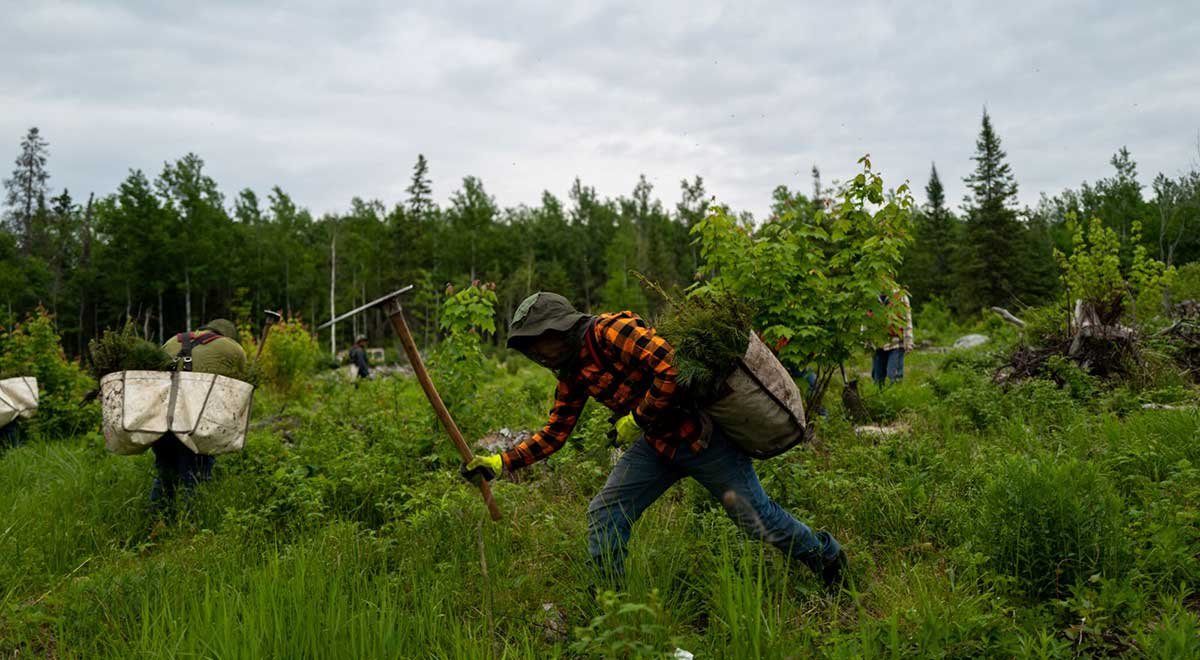
MINNEAPOLIS, Minn. – The Nature Conservancy (TNC) announced it planted 2.5 million trees in northern Minnesota this year in partnership with the U.S. Forest ServiceMinnesota Department of Natural Resources and three county land departments. This is a record number for the organization, and the second consecutive year the program has planted more than 2 million tree seedlings.

The tree seedlings were planted on public lands—across 5,810 acres of national forest, state forest, state park and county-managed forest lands—and covered six counties, including Cook, Lake, Saint Louis, Itasca, Cass and Carlton County.

The planting areas included 1.8 miles along scenic Highway 61 and 41 miles of stream, river and lakeshore that connect to Lake Superior. It also included 1,740 acres of moose habitat enhancement, completed in partnership with the Ruffed Grouse Society and Minnesota Moose Habitat Collaborative—whose tribal representation is critical in maintaining habitat for this species of cultural importance to Indigenous communities.

“Our Northwoods are an essential part of our state,” said Ann Mulholland, TNC’s director in Minnesota, North Dakota and South Dakota. “They absorb and store carbon from the atmosphere, filter our water, support our economy, offer wildlife habitat and give us places to hike, hunt and relax. We’re planting trees to improve the diversity and resilience of our Northwoods for generations to come.”

Warming temperatures, pressure from development, and pests like spruce budworm are rapidly changing Minnesota’s forests. As the forests become more fragmented and less diverse, they grow increasingly vulnerable to disease and wildfire. In response to this spring’s devastating wildfires, the team also planted 5,100 trees on 11 acres that were burned in the Camp House wildfire.

TNC uses science-based methods to carefully select and plant trees that will thrive in future climate conditions and enhance the health of the forest. This year, the team planted 14 different native and climate-hardy tree species, including white pine, white spruce, red pine, jack pine, red oak and yellow birch.

“Diversity is the superpower of our forests. Like a diverse stock portfolio, we want a diverse mix of tree species to ensure that enough survive different stresses like drought, pests and warmer temperatures,” said Jim Manolis, TNC’s director of forest strategy and stewardship in Minnesota.

Tree planting at this scale requires an enormous amount of planning, collaboration and effort. The team orders tree seedlings two years in advance and coordinates with agencies and partners to ensure the trees are planted on time during the six-week spring planting season.

“Strong partnerships with the DNR, Forest Service and local counties are the reason we have been able to plant more than 13 million trees across northern Minnesota since 2005,” said Manolis.

This accomplishment was only possible with the hard work of 65 seasonal guest workers who specialize in tree planting and tending. Non-immigrant guest workers from Latin America plant more than 85% of the trees planted in the U.S. each year on temporary visas. An important pillar of TNC’s program is ensuring these highly skilled workers are well compensated, cared for and appreciated while helping TNC achieve its forestry goals.

Learn more about TNC’s work to protect Minnesota’s forests at nature.org/mnforests

The Nature Conservancy is a global conservation organization dedicated to conserving the lands and waters on which all life depends. Guided by science, we create innovative, on-the-ground solutions to our world’s toughest challenges so that nature and people can thrive together. We are tackling climate change, conserving lands, waters and oceans at an unprecedented scale, providing food and water sustainably and helping make cities more resilient. The Nature Conservancy is working to make a lasting difference around the world in 81 countries and territories (40 by direct conservation impact and 41 through partners) through a collaborative approach that engages local communities, governments, the private sector, and other partners. To learn more, visit nature.org or follow @nature_press on X.

Latest Posts

More from Author

The Life and Legacy of Martin Luther King

Martin Luther-King was a profound influence on my peace activism and...

Labor–Greens Deal: A New Era for Australia’s Environment Laws

CANBERRA — For a quarter of a century, the silence of...

Nature Positive November 2025: Inside Australia’s Historic Environmental Law Overhaul

Executive Summary In November 2025, the Australian Parliament enacted a transformative suite...

Read Now

The Algorithm Will See You Now: Your Doctor’s AI Assistant Can’t Read Handwriting But Might Save Your Life

The first drug ever discovered entirely by artificial intelligence is working its way through human trials as I write this (November, 2025), a molecule dreamed up by silicon that may soon flow through human veins. Its name is rentosertib—a word that sounds like something out of a...

The Life and Legacy of Martin Luther King

Martin Luther-King was a profound influence on my peace activism and I still stand in-awe of his courage, his faith, vision and passion. A blessing on this most extraordinary human. I believe that I got into two jobs, one as State Co-Ordinator of People For Nuclear Disarmament...

Labor–Greens Deal: A New Era for Australia’s Environment Laws

CANBERRA — For a quarter of a century, the silence of the Australian bush—broken only by the crash of falling timber and the quiet disappearance of species—was matched by a deafness in the halls of Parliament. The Environment Protection and Biodiversity Conservation Act 1999 (EPBC), a legislative...

Nature Positive November 2025: Inside Australia’s Historic Environmental Law Overhaul

Executive Summary In November 2025, the Australian Parliament enacted a transformative suite of environmental legislation, fundamentally reshaping the Commonwealth’s approach to biodiversity conservation, project assessment, and regulatory enforcement. This report provides an analysis of the Environment Protection Reform Bill 2025, the National Environment Protection Agency Bill 2025, and...

Artificial Intelligence: Prospects, Progress, and Perils by 2035

Abstract Artificial intelligence (AI) stands at a pivotal juncture, poised for a decade of unprecedented evolution. This report reflects on AI's projected trajectory by 2035, exploring the profound roles and functions it is anticipated to fulfill across industries, from augmenting human capabilities in the workforce and revolutionizing healthcare...

Slow Living: Temporal Resistance in an Accelerated Age

Slow living resists speed-driven society, blending sustainability, urban design, and mindfulness to reclaim time, balance, and ecological harmony.

The Silent General: The Algorithm of War and the Need for Boundaries

AI warfare: autonomous weapons, cyber attacks, and algorithmic targeting transform modern conflict. What moral boundaries must we establish before war becomes fully automated?

Amazonia and South American Wilderness

1. Historical Baseline Pre-1750 Wilderness Extent South America contained 1.7 billion acres of wilderness in 1500—95% of the continent's land area.¹ The Amazon basin alone encompassed 1.4 billion acres of continuous rainforest, Earth's most biodiverse terrestrial ecosystem. This was not pristine wilderness but a cultural landscape shaped by...

Montessori Education: History, Philosophy, and Current Status

When Revolutionary Observation Transforms Pedagogy In January 1907, something extraordinary unfolded in Rome's impoverished San Lorenzo district—a physician's experimental classroom for sixty slum children would revolutionize global education. Within months, these economically disadvantaged five-year-olds were reading, writing, and demonstrating sustained concentration that drew international visitors. By 2022, this...

North America Wilderness: From Tundra to Desert

1. Historical Baseline Pre-1750 Wilderness Extent North America contained 3.9 billion acres of wilderness when Europeans first arrived—98% of the continent's land area.¹ From Arctic tundra to Sonoran desert, from Atlantic forests to Pacific rainforests, the continent supported Earth's most diverse temperate ecosystems. This wasn't empty wilderness but homeland...

The Enduring Majesty: Exploring the World of Birds

Listen to our five-minute summary of the article below before you fly-in! Birds, with their vibrant plumage, melodious songs, and breathtaking aerial acrobatics, have captivated human imagination across millennia. From the smallest hummingbirds to the towering ostriches, these feathered marvels inhabit nearly every corner of our planet, showcasing...

The Deceptive Bite: Unmasking Ultra-Processed Foods

The Quiet Takeover of the Global Diet The modern global diet is undergoing a quiet, pervasive transformation, one driven not by nutritional science or consumer need, but by engineered profitability. Public attention, recently highlighted by media reports concerning the dangers of processed foods, is beginning to align with...
error: Content unavailable for cut and paste at this time