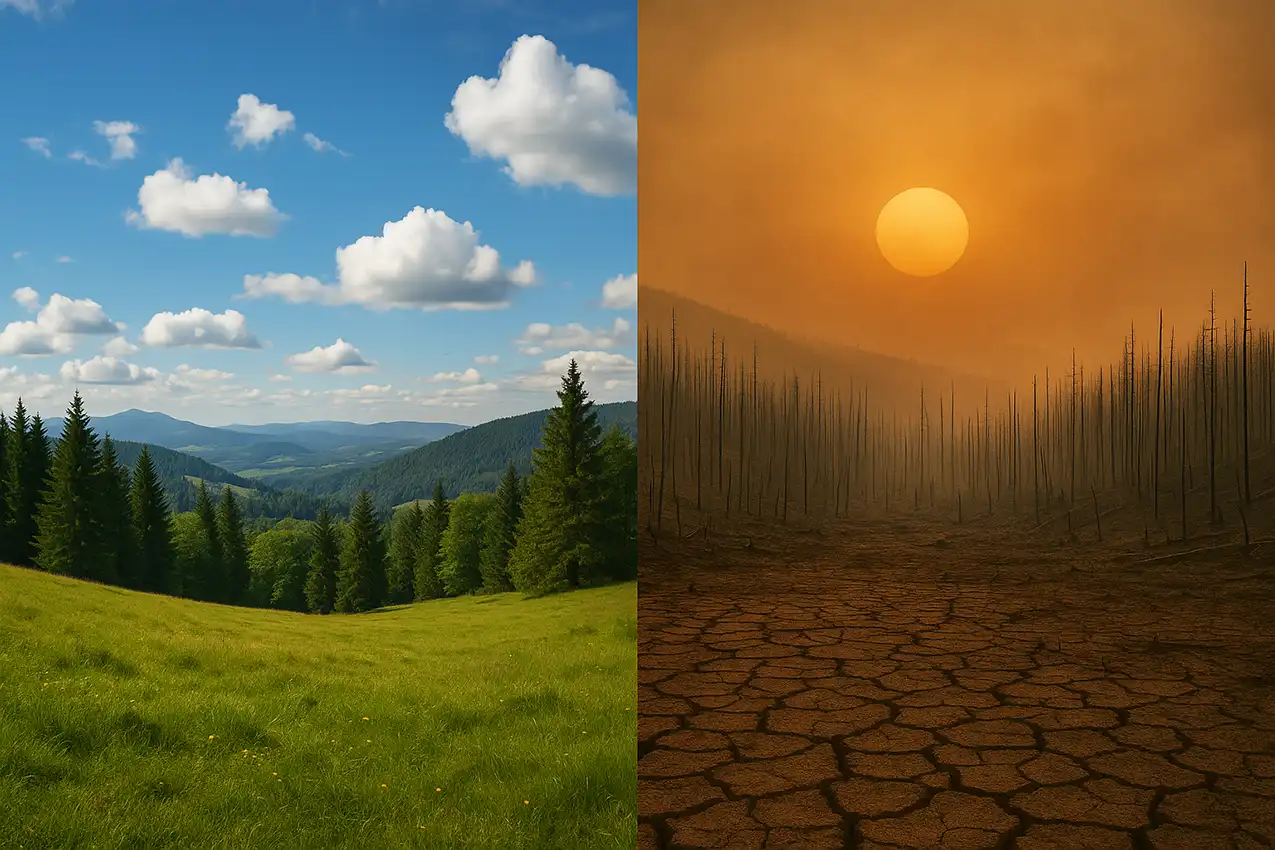

We are living in an age when the accumulation of heat, carbon and expectation already outpaces the narratives we used just a few years ago. Across the planet the signs of systemic change are unmistakable: accelerating warming, shifting weather regimes, mounting human vulnerability—and yet, the policy and political responses still lag far behind. In this reflection, I pull together the latest science, the global politics, the human stakes and emerging tools (including artificial intelligence) that may yet influence what unfolds in the next decade. – Kevin Parker Site Publisher
The science: warming, thresholds and cascading risks
Our planet is already warmer than the centuries that came before. The recent paper Indicators of Global Climate Change 2024-2025 reports that the observed global surface temperature best estimate of warming is 1.52 °C above the 1850-1900 baseline, while human-induced warming is estimated at approximately 1.36 °C. ESSD In short: we have already consumed a large slice of the “safe” warming budget.
The Intergovernmental Panel on Climate Change (IPCC) Synthesis and earlier Assessment Reports remind us that staying below the 1.5 °C threshold — a key target of the Paris Agreement — remains technically “possible” but only if the world makes deep and rapid cuts in emissions. IPCC+1 Meanwhile the Panel has noted that warming of 1.5 °C vs 2 °C materially changes the risk profile for ecosystems, sea level rise, extreme weather, and societal tipping points. IPCC
Yet we are observing more than simple incremental change: the Earth system is responding non-linearly in many cases. For example, the risk of one-in-ten-year droughts, or extreme heatwaves, is shifting towards once in five or three years; sections of the cryosphere (ice sheets, permafrost) show signs of accelerating response. The IPCC states that limiting warming to 1.5 °C rather than 2 °C would reduce risks substantially, but also that past emissions alone commit us to further sea-level rise and other “locked-in” changes. IPCC
In short: the baseline is changing. What was once “rare” may now be “normal”. And that matters for human systems and ecosystems alike.
Impacts on people and nature
The consequences of warming are already wide-ranging. On the human side, heatwaves, droughts, flooding and storms increasingly impose cascading burdens on health, infrastructure, livelihoods and migration. The Germanwatch Climate Risk Index 2025 tallies the human and economic toll of extreme weather events over time, showing sharp acceleration. Germanwatch
For example, in 2024 an estimated 61 % of global land area experienced extreme drought—nearly three times the average for the 1950s. Health Policy Watch In the first half of 2025, the U.S. alone suffered 14 separate billion-dollar (USD) weather disasters totalling some USD 101 billion in damages. The Guardian On the natural side, ecosystems are under intense stress: coral reefs threatened by ocean warming and acidification, glaciers melting, sea-level rise accelerating, and many species facing habitat contraction. The IPCC underscores that bio-diversity loss and ecosystem functioning are intimately tied to the climate challenge. World Resources Institute
Moreover, “hydro-climate whiplash” is becoming more frequent: rapid swings between extreme wet and extreme dry conditions increasingly destabilize agriculture, water catchments and disaster-planning systems. As one recent article put it:
“Almost everywhere on the planet has experienced between 31 % and 66 % more whiplash events since the mid-20th century.” The Guardian
For vulnerable populations in low-income nations, the compound nature of climate risk is especially acute: heat plus poverty, drought plus weak infrastructure, storms plus dislocation. The ethical dimension is plain: those least responsible often suffer first and worst.
Emerging weather patterns: fire, drought, storms and volatility
Given the warming context, the patterns of weather we see now are shifting in character and magnitude. Wildfire seasons are lengthening and intensifying. According to one global report:
“Climate change is driving extreme wildfires events worldwide.” The University of Melbourne
In regions from California to the Mediterranean, dry vegetation, higher temperatures, earlier melt of snow‐pack, and shifting wind regimes are combining to create fire risks far above historical norms. For instance, Southern Europe in 2025 was scorched by heatwaves and large wildfire zones, driven by conditions rarely seen before. Le Monde.fr Droughts are likewise more severe and prolonged, and flash floods are more intense, as the warmer atmosphere holds more moisture and releases it violently in storms.
Storms and tropical cyclones are also changing. While attribution remains complex, the consensus is that heavier rainfall per storm, slower moving storms (hence extended exposure) and heightened sea level (hence greater storm surge) are consistent with the warming world. Combined with drought and fire, the system is becoming more volatile — what some call the “new normal” of cascading, compound extreme events rather than isolated anomalies.
In other words: the weather is no longer just “wilder” — it is reshuffling how we think about risk, infrastructure, planning and adaptation.
Mitigation strategies and the global emissions landscape
At the heart of the problem is greenhouse‐gas emissions, historically and currently. The global community has set out pathways to bend the emissions curve and eventually reach net zero, but the gap between pledged commitments and actual emissions remains large. The IPCC noted that global emissions must peak before 2025 at the latest, and be nearly halved by 2030 to retain a plausible chance of staying under 1.5 °C. hub.climate-governance.org+1
Recent data show troubling trends. For example, the International Energy Agency (IEA) 2025 Global Energy Review reports that emissions from natural gas rose by about 2.5 % in 2024, coal emissions also rose, driven in large part by China, India and other emerging markets. IEA A report by the United Nations Environment Programme (UNEP) finds that new Nationally Determined Contributions (NDCs) “barely move the needle” in terms of closing the emissions gap. Carbon Brief
Which countries matter most? According to the latest EDGAR dataset, the largest GHG emitters in 2024 were China, the United States, India, the EU27, Russia and Indonesia — together accounting for approximately 61.8 % of global emissions. edgar.jrc.ec.europa.eu
Major players and their tendencies:
- China: remains the largest single emitter today. It has pledged to peak CO₂ emissions around 2030, and to reduce carbon intensity, but coal consumption remains high. climatechangeauthority.gov.au+1
- United States: historically the largest cumulative emitter; its recent policy swings complicate its trajectory, though several states and private actors push ahead on clean energy.
- India: growing rapidly in emissions (largest absolute increase recently) yet per capita remains low; balancing development and emissions reduction is politically fraught. edgar.jrc.ec.europa.eu+1
- European Union: comparatively better policy frameworks, but still off the mark in terms of adequate ambition and implementation. The Climate Change Performance Index places many G20 nations in the “low or very low” category for policy. ccpi.org
Mitigation tools in play include: rapid deployment of renewables (solar, wind), energy efficiency, electrification of transport, industrial decarbonisation (e.g., hydrogen, carbon capture), land-use change (afforestation, rewilding) and behavioural/consumption change. Negative emissions technologies and carbon removal are increasingly discussed, though often still immature. MDPI At the same time, adaptation strategies (flood defences, fire management, resilient agriculture) are critical given the lag between emissions and climate response.
Political posture remains uneven: surprisingly ambitious in some quarters, hesitant or contradictory in others. That disconnect means that the era ahead will be defined by not only climate physics and technology but geopolitics, economics, justice and choices of which path humanity takes.
The role of emerging AI technologies in the climate fight
One of the most intriguing frontiers is the intersection of artificial intelligence (AI) and climate action. Far from mere hype, recent peer-reviewed work suggests AI can support decarbonisation and resilience — though with caveats. For instance, a 2025 Nature commentary reviewed five key areas in which AI helps build an effective low-carbon transition. Nature A 2024 review emphasised that AI technologies can optimise energy systems, monitor carbon capture, and support climate risk prediction. sciencedirect.com
Concrete examples:
- AI-driven forecasting helps identify where, when and how best to deploy renewable generation, store energy, and stabilise grids. World Economic Forum
- AI tools detecting waste streams and improving recycling lead to lower methane emissions from landfills and better resource efficiency. World Economic Forum
- AI is helping map climate risk at finer resolutions, enabling early-warning systems for floods, droughts and heatwaves — thereby allowing communities to respond faster. Earth.org
But there are important caveats: AI itself requires energy, water, and resources; data centres and heavy compute have a carbon footprint. SAP Moreover, uneven access to AI, algorithmic bias, and governance gaps raise questions of equity and fairness. SCIRP
In sum: AI is not a silver bullet, but it is increasingly a key amplifier of climate action — both mitigation and adaptation. Over the next decade we may see increasingly sophisticated AI-powered climate-services platforms: for example, real-time climate risk dashboards, digital twins of cities modelling heat/wildfire/flood scenarios, supply-chain decarbonisation via AI, and carbon-removal monitoring via remote sensing plus machine-learning. If well governed, AI could help bridge part of the implementation gap. If unmanaged, it risks becoming another carbon-intensive industry or reinforcing inequities.
Looking ahead: most likely scenarios for the next decade
What might the world experience between now and 2035? While no forecast is certain, three broad scenario clusters seem plausible:
Scenario A – “Late-but-Rising”
Emissions continue to climb for several years, peak perhaps around 2028-2030, but due to stronger policy and technology deployment decline begins thereafter. Warming surpasses 1.5 °C, perhaps reaching 1.7-2.0 °C by 2035. Extreme weather becomes increasingly routine; adaptation remains patchy; carbon removal begins to scale but is not sufficient.
Scenario B – “Rapid Turn”
A global economy accelerates the energy transition: renewables, storage, efficiency and low-carbon industries surge; major emitters commit to deeper cuts; AI, digitalization and new business models help. Emissions peak earlier (2025-27) and begin falling significantly; warming might stay in the 1.5-1.7 °C range by 2035. However, adaptation still remains essential and risks remain elevated.
Scenario C – “Delayed and Disordered”
Emissions continue or even increase, mitigation stalls, adaptation fails, climate impacts accelerate. Warming heads toward 2.5-3.0 °C by mid-century. Feedbacks and tipping points (e.g., Arctic sea-ice loss, permafrost melt) become more probable. Society faces large adaptation burdens, displacement, food and water stress.
Based on current data — rising emissions, weak policy momentum in many large emitters, the shrinking carbon budget (some analyses suggest only two to three years left of the 1.5 °C budget) Financial Times+1 — the most likely unfolding seems a mid-range path between A and B: a rise to perhaps ~1.7 °C by 2035, with adaptation challenges mounting, and a race to implement tools (including AI, renewables and carbon removal) in time to avoid the worst.
Critically, decisions made in the next 3-5 years will disproportionately determine whether we lean towards Scenario B or slide into the more hazardous version of Scenario C. The era of gradual change is likely over; we are now in the era of rapid response or rapid regret.
In that sense, the lyric line might come from the planet itself: “we are catching up to our past decisions.” We will not just ask what we could have done — we will face what we must do.
The moral and political dimension
Underlying all of this is a question of equity, justice and political will. The IPCC emphasises that many of the impacts of warming fall disproportionately on the poor and vulnerable. IPCC The global north bears much of the cumulative legacy emissions, while the global south often shoulders the brunt of the initial impacts. This asymmetry complicates trust, cooperation and finance flows.
Politically, mitigation has become a suite of domestic and global dilemmas: how to balance economic growth and emissions reduction, how to share the burden, how to finance adaptation, and how to innovate ethically (in AI, geo-engineering, carbon removal). Private sector and non-state actors matter more than ever — but so does governmental coordination and regulation.
In the next decade we may see: carbon border adjustment mechanisms, more climate litigation, insurance sector shocks, large-scale infrastructure loss, climate-migration pressures, and intensifying demands for “just transition” programmes. At the same time, there may be breakthroughs in clean technology, grid-scale storage, mass deployment of nature-based solutions, and AI-enabled optimisation of energy systems.
From an investigative journalist’s lens: the story is no longer only about “if” warming happens, but about “how” society responds — where the turning points will be, which actors pivot, which regions adapt or fail, and what narratives win out (innovation-hope vs. tragedy-story). We are now in a phase where history may bifurcate.
Conclusion
The climate story in 2025 is no longer a distant future projection — it is unfolding right now. The science is clear: we’re already in a warmer world, and the risks are accelerating. The impacts are real: droughts, fires, storms, floods and societal stresses are all rising. The mitigation tools are available but under-utilised; the political will is inconsistent; the carbon budget is shrinking rapidly. The emergence of AI and other technologies offers new leverage, but also new risks.
Ultimately, the next decade will be defined not by our intentions but by our actions. Will the world treat the 2020s as a transformative decade — one of deep decarbonisation, robust adaptation, inclusive justice and technological leverage? Or will the momentum falter, tipping us into a more severe warming trajectory with correspondingly harsher impacts?
As one commentator recently warned, “the remaining carbon budgets are declining rapidly and the main reason is the world’s failure to curb global CO₂ emissions.” Financial Times+1 The words are stern, but the message is also hopeful: every fraction of a degree matters, every innovation counts, every policy delay enlarges the risk.
For readers, for citizens, for communities: this is a moment to watch carefully, to hold leaders to account, to ask what futures are being built, and to ask what role each of us plays. The planet doesn’t wait. The turning has already begun.
End notes
- Intergovernmental Panel on Climate Change (IPCC), Global Warming of 1.5 °C: Summary for Policymakers (2018). IPCC
- IPCC, Reports (August 2021–March 2023). IPCC+1
- “Indicators of Global Climate Change 2024–2025: annual update of key water, carbon, cryosphere and extreme events indicators,” Earth System Science Data (2025). ESSD
- United Nations Framework Convention on Climate Change (UNFCCC) Secretariat, “AI and Climate Action: Opportunities, Risks and Challenges for Developing Countries,” July 11 2025. UNFCCC
- Olawade DB. “Artificial intelligence potential for net-zero sustainability,” Sustainable Earth (2024). sciencedirect.com
- Stern N. “Green and intelligent: the role of AI in the climate transition,” Nature Sustainability (2025). Nature
- “Global Energy Review 2025: CO₂ Emissions,” International Energy Agency (2025). IEA
- “GHG emissions of all world countries – 2025 Report,” EDGAR (2025). edgar.jrc.ec.europa.eu
- “New country climate plans ‘barely move needle’ on expected warming,” UNEP via Carbon Brief (2025). Carbon Brief
- “Climate-climate whiplash events increasing exponentially around world,” The Guardian, Jan 15 2025. The Guardian