

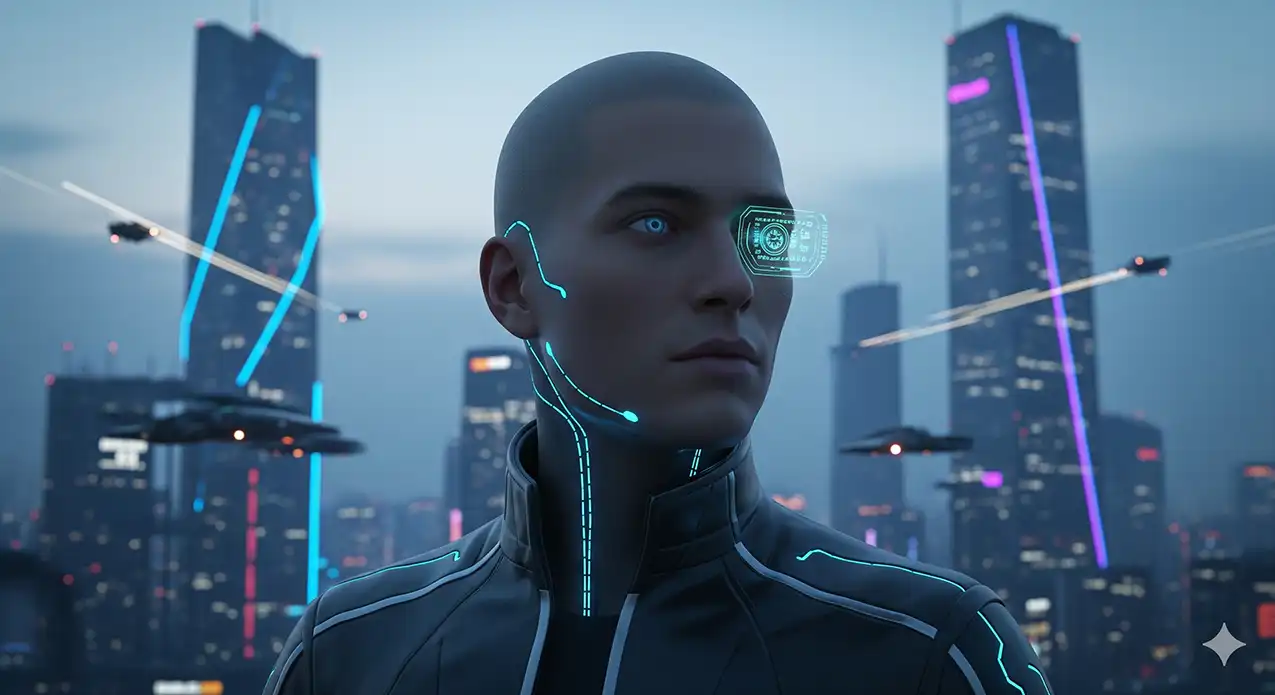
The cyberpunk futures we once relegated to dog-eared paperbacks and neon-soaked anime are no longer speculative fiction. They are the mundane reality of our Monday mornings. We have not just arrived at the intersection of human and machine; we have paved over it, built a Starbucks on the corner, and are now streaming data directly into our cortexes. The “blend” is no longer a question of if, but of how deep the integration goes before the definition of “human” dissolves entirely. Our cybernetic evolution is well underway.
The Wetware Revolution
The medical sector has been the quiet vanguard of this revolution. It started with pacemakers and cochlear implants—crude, single-purpose fixes. Today, we are witnessing the birth of the “platform human.” Companies like Neuralink are not merely repairing severed spinal cords; they are building I/O ports for the brain. We have moved from restoration to optimization. Brain-Computer Interfaces (BCIs) are currently allowing paralyzed patients to control cursors with thought alone, a precursor to the “telepathic” exchange of data between individuals.[1]
But the street finds its own uses for things. Beyond the sterile labs of Silicon Valley, a subculture of “grinders” and biohackers is democratizing evolution in garages and tattoo parlours. They implant RFID chips to unlock doors with a wave of a hand and bury magnets in their fingertips to “feel” electromagnetic fields—a sixth sense gifted not by nature, but by neodymium.[2] It is cosmetic surgery repurposed as functional upgrade; the facelift replaced by the sensory lift.
Hardened Shells and Digital Eyes
Physical enhancement has shed its clumsy, robotic gait. In warehouses and on battlefields, the exoskeleton is becoming standard issue. These are not the clanking mechs of Hollywood, but sleek, powered braces that allow a logistics worker to lift hundreds of pounds without fatigue, turning the human body into a highly efficient industrial servo. The military application is obvious and terrifying: the “super soldier” is less about Captain America and more about reduced metabolic cost and heightened situational awareness.
Vision, too, is being overlaid. Smart contact lenses, like those pioneered by Mojo Vision, promise to paint our reality with data—turn-by-turn navigation, biometric readouts, and facial recognition hovering ghost-like over the retina.[3] The implications for policing are stark. A beat cop with facial recognition baked into their eyewear is no longer just an officer; they are a walking Panopticon.
The Corporate Cyborg
We must widen our aperture to include the non-biological actors in this drama. You asked if the LLC (Limited Liability Company) is part of the model. Absolutely. In fact, the corporation was the first artificial intelligence—a legal entity with rights, capable of owning property, suing, and existing beyond the lifespan of its biological components.
Today, this concept is evolving into the DAO (Decentralized Autonomous Organization). These are entities run not by boards of directors, but by smart contracts on a blockchain. They are algorithmic corporations—autonomous, code-based legal persons that can hold assets and execute decisions without human intervention.[4] If a human with a chip is a cyborg, what is a corporation with no humans? It is a new species of economic actor, and it is already trading on our markets.
The Extended Mind
Our environments have become exocortices. The “smart home” is not just a convenience; it is a cognitive extension. When your house anticipates your heating needs, orders your groceries, and manages your security, it is functioning as a lobe of your brain, externalized in brick and silicon. The smart car is not a vehicle; it is a mobile room of this external brain, interacting with the smart city grid. We are becoming arachnids at the centre of a vast, digital web of our own spinning.
Philosophical Frameworks: Beyond Humanism
How do we categorize this? “Enhanced Humanism” feels too nostalgic. We are treading into the territory of Metahumanism or Posthumanism. The philosopher Donna Haraway, in her seminal Cyborg Manifesto, argued that the dichotomy between human and machine is an illusion.[5] She was right. The boundary is permeable.
Traditional Humanism centres the biological “Man” as the measure of all things. Posthumanism decentres us, acknowledging that we are merely one node in a network of biological, technological, and ecological systems. We need a framework of “Morphological Freedom”—the right to modify one’s body and mind—balanced against a robust concept of “Cognitive Liberty”, the right to shield our mental processes from external manipulation.
The View from 2030
Looking toward 2030, the scenarios bifurcate. In the utopian view, we achieve a symbiosis where AI handles the drudgery, and bio-enhancements eliminate disease and frailty. We see the rise of the “Centaur”—human intuition paired with AI processing power—dominating the economy.
The dystopian alternative is a fractured caste system. The “Gene-Rich” and “Tech-Augmented” elites tower over the “Naturals.” We could see the rise of autonomous cybercrime, where AI agents (acting as rogue LLCs) execute identity theft and ransom attacks at machine speed, untouched by human laws.[6]
Safeguards and the Law
The legislative environment is woefully behind. We are regulating 21st-century tech with 20th-century laws. We have no clear legal distinction for a human whose memory is stored in the cloud. If you hack my brain implant, is it assault or computer misuse?
We need a Digital Bill of Rights that explicitly covers:
- Neural Privacy: Your neural data is yours alone.
- Right to Disconnect: The ability to go “offline” without losing personhood.
- Algorithmic Transparency: The right to know if you are interacting with a human or a machine.
The blend is here. We are all cyborgs now, tethered to our devices, reliant on our networks, and increasingly modified by our medicine. The task now is not to resist the merger, but to ensure that in the process of becoming something more, we do not become something less.
Endnotes
[1] N. A. L. P. A. N. (2025). “Brain–Computer Interface.” Wikipedia. Accessed November 24, 2025. https://en.wikipedia.org/wiki/Brain%E2%80%93computer_interface.
[2] “CyberPunk Yourself – Body Modification, Augmentation, And Grinders.” Hackaday. October 12, 2015. https://hackaday.com/2015/10/12/cyberpunk-yourself-body-modification-augmentation-and-grinders/.
[3] “Smart Contact Lenses: Blending Vision and Augmented Reality.” Analytics Insight. January 25, 2025. https://www.analyticsinsight.net/tech-news/smart-contact-lenses-blending-vision-and-augmented-reality.
[4] Reyes, Carla L. “Autonomous Corporate Personhood.” Washington Law Review 96, no. 4 (2021). https://digitalcommons.law.uw.edu/wlr/vol96/iss4/7/.
[5] Haraway, Donna. “A Cyborg Manifesto: Science, Technology, and Socialist-Feminism in the Late Twentieth Century,” in Simians, Cyborgs and Women: The Reinvention of Nature (New York; Routledge, 1991), 149-181.
[6] “AI 2030: The Coming Era of Autonomous Cyber Crime.” Check Point Blog. October 24, 2025. https://blog.checkpoint.com/executive-insights/ai-2030-the-coming-era-of-autonomous-cyber-crime/.


