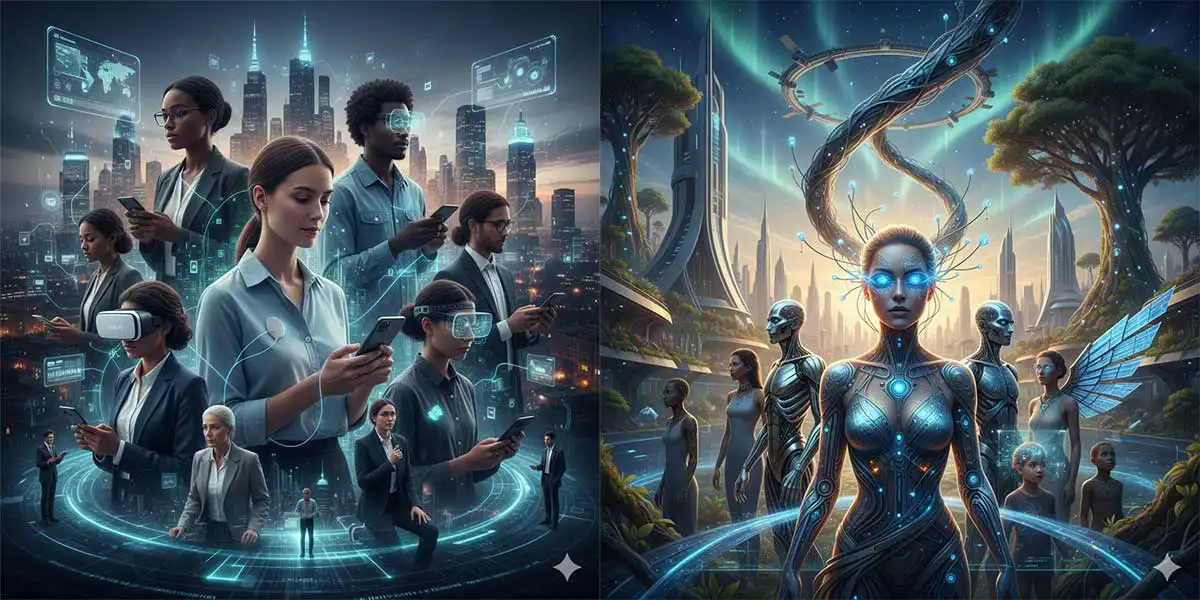

The big idea
Transhumanism is a bet that humanity can take charge of its own evolution. It is both a philosophy and a movement, resting on the conviction that our biological form is not the summit of possibility but a provisional stage. The idea is simple but sweeping: by leveraging technology—biotechnology, artificial intelligence, brain-computer interfaces, robotics, and beyond—we can overcome our most basic limitations. Ageing, disease, even death may not be eternal givens. Instead, they might be problems with solutions.
The biologist Julian Huxley gave the movement its name in 1957, when he argued that humanity could “remain man, but transcend himself, realizing new possibilities of and for his human nature.”¹ For Huxley, transhumanism was not a rejection of humanity but an expansion of it, a project to enhance life rather than flee from it. What was a provocative speculation in the mid-twentieth century is now becoming a live agenda in laboratories, clinics, and companies around the world.
At its core, transhumanism envisions three major avenues of enhancement: radical longevity, amplified intelligence, and engineered well-being. Each is alluring; each raises ethical, political, and spiritual dilemmas. What will it mean to be human when we are no longer confined by the traditional limits of biology? What happens when technology moves faster than our moral imagination?
Already among us
The most important point to grasp is that transhumanism is not a far-off fantasy. It is already woven into the fabric of our daily lives.
Consider how thoroughly we outsource memory, navigation, and even decision-making to our phones and the cloud. This is cognitive prosthesis in all but name. Cochlear implants restore hearing to thousands. Cardiac pacemakers have extended lives for decades. Prosthetic limbs—some controlled directly by nerve signals—are not only functional but aesthetically expressive. These are incremental but profound shifts: the line between healing and enhancing is already blurred.
In 2023, a paralyzed woman in California regained her voice after 18 years thanks to a brain implant that transmitted her thoughts to an avatar and synthesized her speech through artificial intelligence.² The breakthrough was not just medical; it was existential. Her sense of agency was restored, her identity given a new medium of expression. Two years later, a stroke patient was able to control a robotic arm by thought, as his brain’s learning and the machine’s learning converged.³ This “blending of learning between humans and AI,” as one researcher described it, is transhumanism in microcosm: a fusion of flesh and code that creates a new hybrid capacity.
Biotechnology is reshaping fate at the genomic level. In 2023, the U.S. Food and Drug Administration approved the first CRISPR-based therapy for sickle-cell disease, rewriting DNA in living patients.⁴ For those who have long suffered excruciating pain crises, the therapy is nothing less than liberation. The difference between therapy and enhancement is largely a matter of framing: today we treat disease, tomorrow we may amplify strength, memory, or mood.
Meanwhile, 3D printing is evolving from plastics to biology. Harvard engineers have demonstrated printable vasculature, a prerequisite for manufacturing tissues and organs at scale.⁵ Imagine an era when waiting lists for kidney or heart transplants vanish—not because supply has caught up, but because scarcity itself has been abolished. If organs can be printed to order, medicine will no longer only repair bodies; it will reconfigure them.
The human–AI crossover
If biology is the canvas of transhumanism, artificial intelligence is its brush. The most radical transhumanist visions involve not just repairing the human but intertwining it with machine intelligence.
Ray Kurzweil, one of the most famous prophets of this future, predicts that by the mid-2040s, humans will “expand intelligence a millionfold” by directly linking our brains to computational networks.⁶ This is the so-called singularity: a moment when biological and artificial intelligence merge, producing forms of thought we can scarcely imagine.
It is easy to dismiss Kurzweil’s timelines as hyperbolic, but the trajectory is clear. Brain-computer interfaces already rely on machine-learning models that decode neural signals. The machine adapts to the human, and the human adapts to the machine. With each interaction, a hybrid mind takes shape. What begins as a prosthetic for the disabled could become an enhancement for the able-bodied: faster recall, richer perception, new forms of communication. Mind-to-mind transmission may become as normal to the next generation as text messaging is to us.
This raises a profound question: if parts of my consciousness reside in silicon, where does “I” end and the “machine” begin? Is an augmented mind still fully my own? And if an AI assistant becomes so integrated into my thought that I can no longer distinguish its contributions from mine, how should we understand authorship, responsibility, or even identity?
The three “supers”
Transhumanist goals can be distilled into three pillars: superlongevity, superintelligence, and superhappiness.
Superlongevity is the quest to radically extend healthy lifespan. Proponents argue that ageing is not a natural destiny but a disease process that can be slowed or halted. If death can be deferred for decades, why not centuries? Skeptics counter that this risks overpopulation, social stagnation, and deep inequities. Yet the moral force of preventing suffering is powerful. As one researcher put it, “If we can cure cancer, we should; why not ageing?” The difference is scale, not principle.
Superintelligence is the drive to elevate human cognition. This could mean genetic editing for intelligence, neuroprosthetics that expand working memory, or direct brain-to-cloud connections. The potential is exhilarating: breakthroughs in science, wiser political decisions, new art forms. The dangers are just as sharp: an unbridgeable gulf between enhanced and unenhanced, and an unsettling redefinition of personhood if hybrid minds blur boundaries.
Superhappiness is perhaps the most controversial. Philosopher David Pearce argues that the elimination of suffering is a moral imperative and that we should use biotechnology to re-engineer the neural substrates of pain and despair.⁷ Relief from depression or chronic pain is one thing; engineering a world of engineered bliss is another. Critics fear a pharmacological dystopia where authenticity and struggle are erased. Yet the line between humane treatment and troubling enhancement is never as clear as it seems.
The ethics, briefly and bluntly
Transhumanism’s promise is tangled with peril. The ethical landscape is crowded with dilemmas.
Human nature is one. Critics worry that transhumanism reduces people to mechanisms, eroding the mystery and dignity of human life. A 2025 book described mainstream transhumanism as a “dangerous scam” that treats the person as mere matter to be optimized.⁸ Defenders reply that humanity has always changed itself, from literacy to vaccines, and that refusing to use technology is no more “natural” than using it.
Justice is another. If enhancements follow the path of smartphones—expensive at first, cheap later—the ethical challenge is to accelerate access and avoid entrenching inequality. If we fail, we may create a caste society of the enhanced and the obsolete. Yuval Noah Harari has warned of “data colonies” where the many are managed by a cognitively superior elite.⁹ This is not simply speculative; it is a political risk.
Consent is crucial. Adult self-enhancement is one thing; genetic editing of embryos is another. Fixing lethal mutations is difficult to oppose, but editing for cosmetic or cognitive traits raises profound concerns about autonomy, diversity, and unintended consequences.
Security looms large. A neural interface that connects thought to the internet invites new crimes. Neuroprivacy and cognitive liberty may need to be enshrined as rights alongside bodily autonomy and freedom of expression. If minds become hackable, then freedom itself is at stake.
The role of 3D printing
Few technologies capture transhumanism’s promise better than 3D printing. Already, custom prosthetics are produced cheaply and fitted precisely to the user. Bioprinting goes further: cartilage patches, skin grafts, and even rudimentary organs have been printed in research settings. Harvard’s breakthrough in printing vascular networks in 2024 marked a crucial step.⁵ Without blood supply, tissues die; with it, the door to organ fabrication opens.
The implications are staggering. No more waiting lists. No more organ trafficking. A future where surgery is less about repair and more about replacement. And if enhancement is possible—lungs with greater capacity, muscles with improved endurance—then “better than well” becomes a default expectation.
Already normal
It may feel futuristic, but in many respects transhumanism is already ordinary. Wearable fitness trackers monitor our physiology in real time. Virtual reality alters perception. AI tutors personalize learning. These are incremental enhancements that make the next leap seem plausible, even natural.
Philosopher Stefan Lorenz Sorgner argues that we have always been cyborgs: humans with tools, data, and culture woven into our identity.¹⁰ The 21st century makes the metaphor literal. The slope toward deeper integration is slippery by design; each step offers enough benefit to make the next one desirable.
What a transhumanist world might feel like
If transhumanism became the social default, daily life would feel radically different, yet strangely continuous. A 120-year-old might launch a new career rather than retire. Neural laces could add layers of recall and translation to thought itself. Bioprinted organs could be scheduled like dental appointments. AI companions might blur the boundary between partner and tool. Mind-to-mind communication could normalize intimacy beyond words.
The law would evolve: damage to an implant would be treated as bodily harm. Education would shift from memorization to creativity and judgment. Religion would adapt, as it always has, debating whether transcendence is spiritual, technological, or both. Dystopias remain possible—authoritarian regimes mandating neuralware, black markets for dangerous enhancements—but the potential gains in health, knowledge, and empathy are difficult to dismiss.
The frameworks we need
Three principles can guide the way.
First, techno-progressivism: innovation should be tied to justice and democratic oversight. We should not fetishize the new but ask who benefits and how equitably.
Second, cognitive rights: enshrine protections for mental privacy, identity continuity, and freedom from coercion—whether to adopt or to refuse enhancement.
Third, prudence without paralysis: rejecting transhumanism outright is neither feasible nor wise. But moving fast and breaking things, as Silicon Valley once preached, is reckless. The middle path is to move wisely, fix things first, and anticipate consequences.
The wager
Transhumanism is not destiny, but it is momentum. The tools are here. The decisions are ours. Julian Huxley asked us to imagine a species that chooses to transcend itself.¹ The wager is that we can do so without losing what makes us human. The challenge is that we must decide what that means—before the technology decides for us.
Notes
- Julian Huxley, Transhumanism (1957), quoted in “Julian Huxley – Wikiquote,” accessed October 2, 2025, https://en.wikiquote.org/wiki/Julian_Huxley.
- University of California, San Francisco, “How Artificial Intelligence Gave a Paralyzed Woman Her Voice Back,” August 23, 2023, https://www.ucsf.edu/news/2023/08/425986/how-artificial-intelligence-gave-paralyzed-woman-her-voice-back.
- University of California, San Francisco, “How a Paralyzed Man Moved a Robotic Arm with His Thoughts,” March 12, 2025, https://www.ucsf.edu/news/2025/03/429561/how-paralyzed-man-moved-robotic-arm-his-thoughts.
- TIME, “Peter Marks,” 2024, https://time.com/6962909/peter-marks/; Medscape, “Gene-Edited Cells Alleviate Pain Crisis in Sickle Cell Disease,” September 2025, https://www.medscape.com/viewarticle/gene-edited-cells-alleviate-pain-crisis-sickle-cell-disease-2025a1000os9.
- Harvard John A. Paulson School of Engineering and Applied Sciences (SEAS), “3D-Printed Blood Vessels Bring Artificial Organs Closer to Reality,” August 2024, https://seas.harvard.edu/news/2024/08/3d-printed-blood-vessels-bring-artificial-organs-closer-reality.
- John Naughton, “AI Scientist Ray Kurzweil: ‘We Are Going to Expand Intelligence a Millionfold by 2045,’” The Guardian, June 29, 2024, https://www.theguardian.com/technology/article/2024/jun/29/ray-kurzweil-google-ai-the-singularity-is-nearer; WIRED, “If Ray Kurzweil Is Right (Again), You’ll Meet His Immortal Soul in the Cloud,” June 2024, https://www.wired.com/story/big-interview-ray-kurzweil.
- Sentience Research, “The Imperative to Abolish Suffering: An Interview with David Pearce,” 2019, https://sentience-research.org/the-imperative-to-abolish-suffering-an-interview-with-david-pearce/.
- Ricardo Mejía Fernández, Integral Transhumanism (2025), overview in Spanish Transhumanist Association, https://www.transhumanistas.com/.
- World Economic Forum, “Read Yuval Harari’s Blistering Warning to Davos in Full,” January 2020, https://www.weforum.org/stories/2020/01/yuval-hararis-warning-davos-speech-future-predications/.
- Stefan Lorenz Sorgner, We Have Always Been Cyborgs: Digital Data, Gene Technologies, and an Ethics of Transhumanism (Bristol: Polity, 2022). See review in NanoEthics (2022), https://link.springer.com/article/10.1007/s11569-022-00414-1.
Bibliography
Harvard John A. Paulson School of Engineering and Applied Sciences (SEAS). “3D-Printed Blood Vessels Bring Artificial Organs Closer to Reality.” August 2024. https://seas.harvard.edu/news/2024/08/3d-printed-blood-vessels-bring-artificial-organs-closer-reality.
Huxley, Julian. “Transhumanism.” 1957. Quoted in “Julian Huxley – Wikiquote.” Accessed October 2, 2025. https://en.wikiquote.org/wiki/Julian_Huxley.
Medscape. “Gene-Edited Cells Alleviate Pain Crisis in Sickle Cell Disease.” September 2025. https://www.medscape.com/viewarticle/gene-edited-cells-alleviate-pain-crisis-sickle-cell-disease-2025a1000os9.
Naughton, John. “AI Scientist Ray Kurzweil: ‘We Are Going to Expand Intelligence a Millionfold by 2045.’” The Guardian, June 29, 2024. https://www.theguardian.com/technology/article/2024/jun/29/ray-kurzweil-google-ai-the-singularity-is-nearer.
Sorgner, Stefan Lorenz. We Have Always Been Cyborgs: Digital Data, Gene Technologies, and an Ethics of Transhumanism. Bristol: Polity, 2022. Review in NanoEthics (2022). https://link.springer.com/article/10.1007/s11569-022-00414-1.
TIME. “Peter Marks.” 2024. https://time.com/6962909/peter-marks/.
University of California, San Francisco. “How a Paralyzed Man Moved a Robotic Arm with His Thoughts.” March 12, 2025. https://www.ucsf.edu/news/2025/03/429561/how-paralyzed-man-moved-robotic-arm-his-thoughts.
———. “How Artificial Intelligence Gave a Paralyzed Woman Her Voice Back.” August 23, 2023. https://www.ucsf.edu/news/2023/08/425986/how-artificial-intelligence-gave-paralyzed-woman-her-voice-back.
World Economic Forum. “Read Yuval Harari’s Blistering Warning to Davos in Full.” January 2020. https://www.weforum.org/stories/2020/01/yuval-hararis-warning-davos-speech-future-predications/.WIRED. “If Ray Kurzweil Is Right (Again), You’ll Meet His Immortal Soul in the Cloud.” June 2024. https://www.wired.com/story/big-interview-ray-kurzweil.