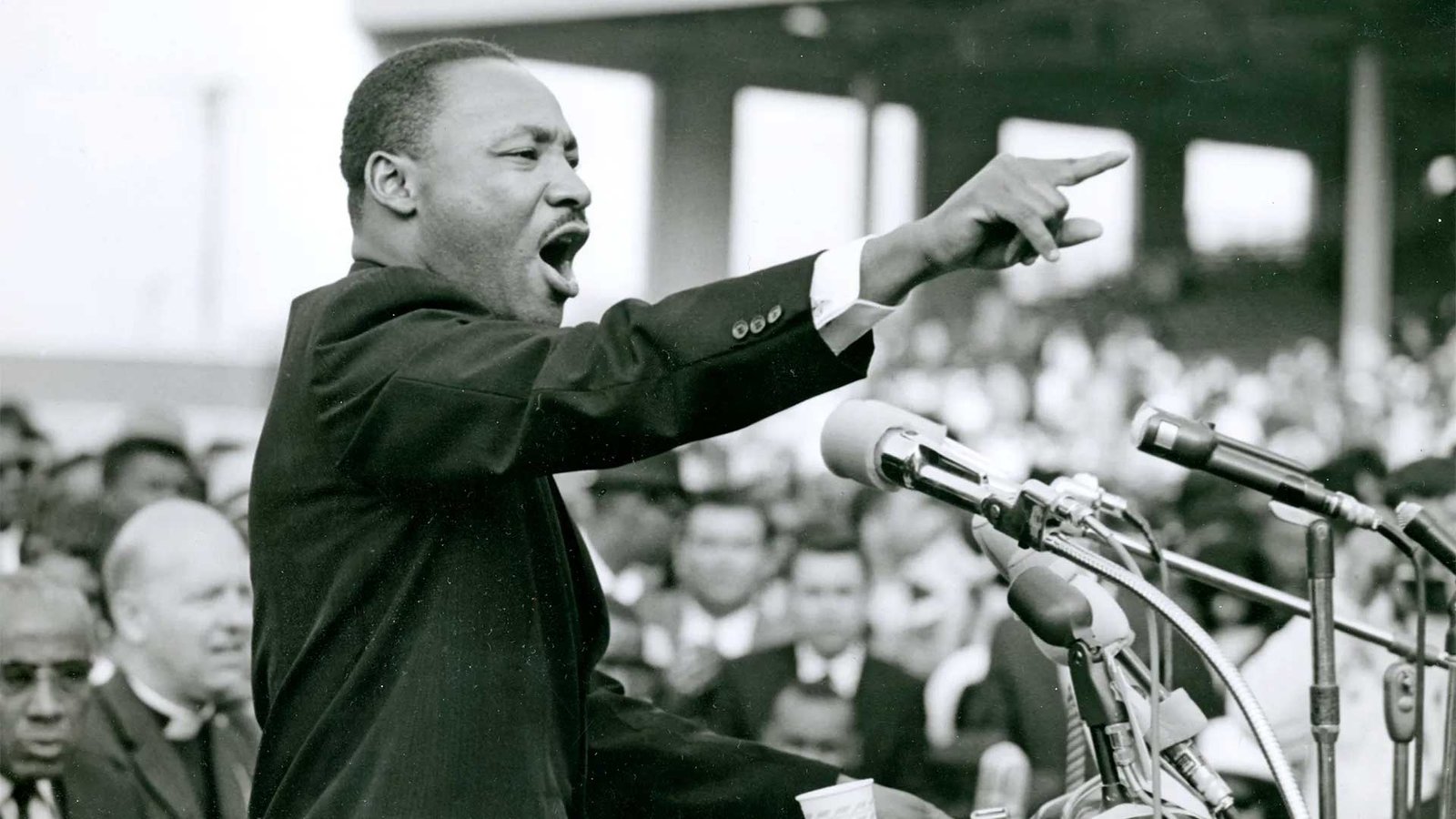

Martin Luther-King was a profound influence on my peace activism and I still stand in-awe of his courage, his faith, vision and passion. A blessing on this most extraordinary human. I believe that I got into two jobs, one as State Co-Ordinator of People For Nuclear Disarmament and Campaign Director of the Wilderness Society for the same reasons that Rosa Parks noted when King was appointed as president of the Montgomery Improvement Association that he “had not been there long enough to make any strong friends or enemies”, not that I would dream of claiming parity with MLK! Kevin Parker – Site Publisher
Martin Luther King Jr. transformed from a reluctant 26-year-old minister into America’s most influential civil rights leader, whose philosophy of nonviolent resistance dismantled legal segregation and inspired global movements for justice. His assassination at age 39 cut short a remarkable evolution from civil rights advocate to radical critic of American militarism and economic inequality, leaving an unfinished agenda that continues to challenge contemporary society.¹ King’s legacy encompasses not only landmark legislation like the Civil Rights Act of 1964 and Voting Rights Act of 1965, but also a sophisticated theological and philosophical framework that connected personal spiritual transformation with systemic social change.² Born into Atlanta’s Black middle class in 1929, King witnessed both the achievements possible within segregation’s constraints and the daily humiliations it imposed, experiences that would shape his lifelong commitment to human dignity and justice.³
The Making of a Leader Through Family, Faith and Education
King’s development as a leader began with profound family influences that instilled both courage and compassion. His father, Martin Luther King Sr., demonstrated fearless resistance to segregation, refusing to ride segregated buses and leading voting rights marches in Atlanta during the 1930s.⁴ King Jr. recalled walking beside his father who muttered, “I don’t care how long I have to live with this system, I will never accept it.”⁵ His mother, Alberta Williams King, provided what he called the “gentle aspect,” teaching him the concept of “somebodiness” – that he was “as good as anyone” – while explaining segregation as “a social condition rather than a natural order.”⁶
The loss of his white childhood friend at age six marked King’s first awareness of racial prejudice, creating what he described as a “great shock” and temporary determination to “hate every white person.”⁷ This early trauma, combined with daily experiences of discrimination, created the emotional foundation for his later commitment to dismantling segregation while maintaining faith in human redemption.
King’s educational journey from Morehouse College through Boston University provided the intellectual framework for his activism. At Morehouse, Dr. Benjamin Mays became his “spiritual mentor and intellectual father,” introducing him to Gandhi’s teachings and demonstrating how Christian faith could address social injustice.⁸ Mays taught weekly chapel forums on nonviolent protest methods and supported King’s decision to continue leading the Montgomery Bus Boycott despite family opposition.⁹
At Crozer Seminary, King encountered diverse philosophical traditions while serving as class president and graduating as valedictorian.¹⁰ Professor George Washington Davis introduced him to Reinhold Niebuhr’s Christian realism, which helped King understand both human potential for good and capacity for evil. King later wrote, “While I still believed in man’s potential for good, Niebuhr made me realize his potential for evil as well.”¹¹
Boston University’s personalist theology under Edgar Brightman and L. Harold DeWolf provided King with “metaphysical and philosophical grounding for the idea of a personal God” and “a metaphysical basis for the dignity and worth of all human personality.”¹² This intellectual foundation would prove crucial in developing his philosophy of nonviolent resistance that treated opponents as people to be converted rather than enemies to be defeated.
Montgomery Launches a Movement of Unprecedented Moral Power
The Montgomery Bus Boycott transformed King from local pastor to national leader through 381 days of sustained nonviolent resistance.¹³ When Rosa Parks refused to surrender her seat on December 1, 1955, the Women’s Political Council led by Jo Ann Robinson had already planned boycott action.¹⁴ King’s selection as Montgomery Improvement Association president came partly because, as Rosa Parks noted, he “had not been there long enough to make any strong friends or enemies.”¹⁵
The boycott achieved remarkable participation – 90% of Montgomery’s Black bus riders participated on the first day, with approximately 40,000 residents sustaining the boycott daily despite economic hardship and violent retaliation.¹⁶ King’s home was bombed on January 30, 1956, but his response demonstrated the power of his emerging philosophy: “We are not wrong… If we are wrong, the Supreme Court of this nation is wrong.”¹⁷
The campaign’s sophisticated organization included a 300-car carpool system coordinated by the MIA, regular mass meetings at churches to maintain morale, and initially moderate demands for courteous treatment and first-come-first-served seating.¹⁸ When the Supreme Court ruled bus segregation unconstitutional in November 1956, the victory established both King’s national reputation and the effectiveness of nonviolent mass resistance.¹⁹
Birmingham Proves the Power of Strategic Confrontation with Injustice
The 1963 Birmingham Campaign demonstrated King’s evolution into a strategic thinker who understood how to use media and moral drama to create legislative pressure.²⁰ Partnering with Fred Shuttlesworth’s Alabama Christian Movement for Human Rights, King chose Birmingham as “the most thoroughly segregated city in the United States” and timed the campaign during Easter season to pressure merchants during their second-biggest shopping period.²¹
King’s arrest on Good Friday for violating a court injunction produced his most important theological work, “Letter from Birmingham Jail,” written on newspaper margins and scraps of paper while in solitary confinement.²² The letter demonstrated his intellectual sophistication, drawing on Augustine, Aquinas, and biblical precedent to argue that “injustice anywhere is a threat to justice everywhere. We are caught in an inescapable network of mutuality, tied in a single garment of destiny.”²³
The campaign’s most controversial tactic involved using children as protesters, with over 1,000 students marching on May 2.²⁴ Images of children attacked by police dogs and fire hoses created international outrage and forced federal intervention.²⁵ The Birmingham Agreement of May 10, 1963, required removal of segregation signs, lunch counter desegregation, improved Black employment opportunities, and formation of biracial committees.²⁶ More importantly, Birmingham directly influenced passage of the Civil Rights Act of 1964 by demonstrating the moral urgency of federal action.²⁷
Washington Amplifies the Dream While Selma Secures the Vote
The March on Washington for Jobs and Freedom on August 28, 1963, brought 250,000 participants to demand comprehensive civil rights legislation and economic opportunity.²⁸ Originally conceived by A. Philip Randolph to emphasize jobs and fair employment, the march became the defining moment of the civil rights movement when King delivered his “I Have a Dream” speech as the culminating address.²⁹
King’s speech reached an estimated 190,000 Black and 60,000 white participants, with live television broadcast carrying his message nationwide.³⁰ The march’s strategic goals included comprehensive civil rights legislation, voting rights protection, school desegregation, federal works programs, and Fair Employment Practices legislation.³¹ The unprecedented cooperation among the “Big Six” civil rights leaders demonstrated the movement’s growing political sophistication.³²
The Selma to Montgomery marches in 1965 focused specifically on voting rights violations in Dallas County, where only 2% of eligible Black voters were registered despite comprising 50% of the population.³³ The violent attack on 525-600 marchers at the Edmund Pettus Bridge on “Bloody Sunday” hospitalized 58 people and created national outrage that prompted President Johnson’s March 15 address to Congress declaring “We Shall Overcome.”³⁴
The third march from March 21-25 grew from 8,000 to 25,000 participants, culminating in King’s address at the Alabama Capitol steps.³⁵ The campaign’s strategic success led directly to passage of the Voting Rights Act of 1965, which Johnson signed on August 6, explicitly citing the “outrage of Selma” as justification for federal action.³⁶
Theological Sophistication Grounds Practical Activism in Spiritual Transformation
King’s philosophy of nonviolence represented a sophisticated synthesis of Christian love with Gandhian method. “Christ furnished the spirit and motivation while Gandhi furnished the method,” he explained, describing nonviolence not as passive acceptance but as “a courageous confrontation of evil by the power of love.”³⁷ His six principles of nonviolence emphasized resistance without violence, winning friendship rather than humiliating opponents, opposing evil rather than persons, redemptive suffering, choosing love over hate, and maintaining faith in divine justice.³⁸
King’s theological foundations combined Baptist tradition with personalist philosophy, Social Gospel emphasis on addressing societal ills, and liberal theology’s critical examination of scripture.³⁹ His doctoral dissertation rejected abstract conceptions of God, arguing that “the religious man has always recognized two fundamental religious values. One is fellowship with God, the other is trust in his goodness. Both of these imply the personality of God.”⁴⁰ This personalism provided philosophical grounding for human dignity that undergirded his civil rights advocacy.
Walter Rauschenbusch’s Social Gospel gave King theological justification for addressing social issues. “I came early to Walter Rauschenbusch’s Christianity and the Social Crisis, which left an indelible imprint on my thinking by giving me a theological basis for the social concern which had already grown up in me.”⁴¹ This emphasis on the Kingdom of God as an earthly reality to be worked toward, not just a heavenly destination, became central to King’s understanding of Christian responsibility.
Reinhold Niebuhr’s Christian realism provided crucial balance to liberal optimism about human nature, helping King understand systemic evil while maintaining hope for redemption.⁴² King frequently used Paul Tillich’s concept that “sin is separation” to illustrate the evil nature of segregation, while Henry David Thoreau‘s “Essay on Civil Disobedience” had first introduced him to nonviolent resistance during his Morehouse years.⁴³
Vietnam and Poverty Expose America’s Deeper Contradictions
King’s evolution from civil rights leader to radical critic of American society became evident in his opposition to the Vietnam War and focus on economic justice. His April 4, 1967 “Beyond Vietnam” speech at Riverside Church marked a decisive break with the Johnson administration, declaring America “the greatest purveyor of violence in the world today” and calling for “a radical revolution of values.”⁴⁴
The speech cost King significant support among white allies, including President Johnson, Billy Graham, union leaders, and major publishers.⁴⁵ The New York Times called it “wasteful and self-defeating,” while the NAACP criticized King for conflating civil rights with anti-war activism.⁴⁶ King responded that the triple evils of racism, poverty, and militarism were interconnected forces preventing the “Beloved Community.”⁴⁷
King’s final campaign, the Poor People’s Campaign of 1968, represented his most radical challenge to American economic structures.⁴⁸ Planning a multiracial coalition of African American, Mexican American, Native American, Puerto Rican, and poor white participants, King demanded an “Economic Bill of Rights” including a $30 billion anti-poverty package, full employment guarantee, guaranteed annual income, and 500,000 affordable housing units annually.⁴⁹
“What good is having the right to sit at a lunch counter if you can’t afford to buy a hamburger?” King asked, extending his critique beyond civil rights to fundamental questions about wealth distribution and economic democracy.⁵⁰ His final writings called for recognizing that “an edifice which produces beggars must not be restructured and refurbished,” challenging basic assumptions about American capitalism.⁵¹
Surveillance, Opposition and Internal Conflicts Shadow the Movement
King faced sustained opposition from multiple sources, beginning with FBI surveillance in December 1955 that continued until his assassination.⁵² J. Edgar Hoover personally targeted King, calling him “the most dangerous and effective Negro leader in the country” after the 1963 March on Washington.⁵³ The FBI conducted extensive COINTELPRO operations including wiretaps, hotel room bugs, paid informants, and character assassination attempts.⁵⁴
The infamous “suicide letter” sent to King in November 1964 along with alleged audio recordings represented the FBI’s most direct harassment, interpreted by King and associates as encouraging suicide.⁵⁵ The anonymous letter stated there was “only one thing left for you to do” and gave him 34 days before his “filthy, abnormal fraudulent self is bared to the nation.”⁵⁶ Senate investigations in 1975 found a draft in FBI Assistant Director William Sullivan’s files.⁵⁷
Within the civil rights movement, King faced criticism from multiple directions. The NAACP favored litigation over direct action and opposed his Vietnam War stance.⁵⁸ SNCC activists grew increasingly critical of his approach, viewing him as too moderate and accommodating to white power structures.⁵⁹ By 1966, tensions between King and Stokely Carmichael became publicly apparent during the Meredith March, with Carmichael advocating “Black Power” while King continued emphasizing nonviolence and integration.⁶⁰
King identified white moderates as “the Negro’s great stumbling block in his stride toward freedom” in his “Letter from Birmingham Jail,” arguing they were “more devoted to ‘order’ than to justice” and preferred “a negative peace which is the absence of tension to a positive peace which is the presence of justice.”⁶¹ This critique of gradualism and preference for stability over justice became increasingly relevant as King expanded his focus to economic and international issues.
Assassination Martyrs a Prophet While Riots Consume the Nation
King’s assassination at 6:01 PM on April 4, 1968, at the Lorraine Motel in Memphis cut short his evolution toward radical economic critique.⁶² James Earl Ray shot King while he stood on the motel balcony preparing to attend dinner, killing him at age 39 as he supported striking sanitation workers demanding economic dignity.⁶³
The national response demonstrated both King’s influence and the volatile state of American race relations. Riots erupted in over 110 cities across the United States, known as the “Holy Week Uprisings” – the largest wave of social unrest since the Civil War.⁶⁴ The violence claimed 43 lives, led to 27,000 arrests, injured over 3,500 people, and caused property damage exceeding $65 million.⁶⁵
King’s funeral on April 9, 1968, drew 300,000 mourners to Atlanta, with the funeral procession stretching 3.5 miles.⁶⁶ At King’s request, his final sermon “The Drum Major Instinct” was played, reflecting on leadership and legacy: “If you want to say that I was a drum major, say that I was a drum major for justice. Say that I was a drum major for peace. I was a drum major for righteousness.”⁶⁷
President Johnson used national grief and outrage over King’s death to pressure Congress to pass the Fair Housing Act of 1968, which became law exactly one week after the assassination.⁶⁸ The timing demonstrated King’s continuing influence even in death, as his martyrdom provided moral urgency for legislation he had advocated through the Chicago Freedom Movement.⁶⁹
Legislative Victories Create Lasting Institutional Change
King’s campaigns directly produced three major pieces of civil rights legislation that fundamentally transformed American society. The Civil Rights Act of 1964, passed after the Birmingham Campaign, prohibited discrimination in public accommodations, employment, and education.⁷⁰ The Senate debate lasted 60 days – the longest continuous debate in Senate history – before passing with veto-proof margins in both houses.⁷¹
The Voting Rights Act of 1965, precipitated by the Selma campaign, created federal oversight of election practices in jurisdictions with histories of discrimination.⁷² The immediate impact was dramatic: Mississippi’s Black voter registration increased from 6% in 1964 to 59% in 1969.⁷³ Congressional representation grew from 6 African American House members and 0 senators in 1965 to 13 House members and 1 senator by 1971.⁷⁴
The Fair Housing Act of 1968 prohibited discrimination in housing based on race, religion, national origin, and sex, addressing residential segregation that King had confronted in the Chicago Freedom Movement.⁷⁵ Together, these laws dismantled legal segregation and created federal enforcement mechanisms that continue to protect civil rights today.
However, King’s broader vision of economic justice remained largely unrealized. His call for guaranteed annual income, full employment, and wealth redistribution found limited political support, contributing to persistent economic inequality that contemporary movements continue to address.⁷⁶
Global Influence Spreads Nonviolent Resistance Across Continents
King’s methodology influenced liberation movements worldwide, creating a global legacy that extends far beyond American civil rights. Nelson Mandela cited King as inspiration for the anti-apartheid struggle, though the two leaders never met.⁷⁷ King corresponded with anti-apartheid activists and issued statements supporting defendants in South Africa’s 1957 Treason Trial, declaring in December 1957 that “the struggle for freedom forms one long front crossing oceans and mountains.”⁷⁸
King’s Nobel Peace Prize in 1964 – received at age 35 as the youngest recipient ever – recognized his international significance and philosophy of nonviolence as applicable beyond American racial conflicts.⁷⁹ His ideas influenced civil rights movements in Europe, Asia, and Latin America, where activists adapted his techniques of nonviolent resistance to address local conditions of oppression and injustice.⁸⁰
Contemporary human rights organizations recognize the Gandhi-King-Mandela connection as a through-line of nonviolent resistance that spans continents and generations.⁸¹ King’s combination of moral clarity, strategic thinking, and commitment to nonviolence provided a model for social movements that sought fundamental change while maintaining democratic principles and human dignity.
Contemporary Movements Reclaim His Radical Legacy While Confronting Unfinished Business
Modern social justice movements both honor and critique King’s contributions, seeking to apply his insights to current struggles while addressing limitations of his approach. The Black Lives Matter movement explicitly cites King’s later, more radical period, emphasizing his opposition to the Vietnam War and economic inequality rather than focusing solely on the “I Have a Dream” speech.⁸² #ReclaimMLK campaigns counter “sanitized” versions of King’s legacy that obscure his challenging messages about American militarism and capitalism.⁸³
The institutionalization of King’s legacy through the national holiday, created after sustained advocacy led by Coretta Scott King and Stevie Wonder, ensures continued recognition while raising questions about whether celebration has replaced implementation of his ideas.⁸⁴ The holiday became official in 1983 but wasn’t observed by all 50 states until 2000, reflecting ongoing resistance to King’s memory even in commemoration.⁸⁵
Statistical measures reveal both progress and persistent challenges in areas King championed. Black voter turnout reached near-parity with white turnout during the Obama presidency, but the 2013 Shelby County v. Holder decision weakened Voting Rights Act protections, leading to renewed voter suppression efforts.⁸⁶ African American educational attainment increased dramatically from 5.4% with college degrees in 1965 to 26.1% in 2020, but significant gaps remain compared to white Americans at 41.9%.⁸⁷
Economic inequality has worsened since King’s era, with mass incarceration affecting African American communities disproportionately and housing segregation persisting despite the Fair Housing Act.⁸⁸ Contemporary movements continue to grapple with systemic inequalities that King identified but that remain unresolved, using both his methodology and critiques of its limitations to inform current strategies.
Conclusion: The Unfinished Symphony of American Justice
Martin Luther King Jr.’s legacy represents both the extraordinary achievements possible through moral leadership and the incomplete nature of America’s journey toward justice. His transformation from reluctant civil rights leader to prophetic critic of American society demonstrates how spiritual conviction can drive profound social change, while his assassination at age 39 reminds us of the costs of challenging entrenched power structures.
King’s intellectual sophistication – combining Baptist theology with personalist philosophy, Gandhi’s nonviolence with American democratic ideals, individual transformation with systemic change – created a framework for social movements that remains relevant across cultures and generations.⁸⁹ His understanding that racism, poverty, and militarism were interconnected forces preventing the “Beloved Community” anticipated contemporary analyses of intersectional oppression.⁹⁰
The institutional changes King helped create through legislative victories dismantled legal segregation and established federal civil rights protections that continue to benefit millions. Yet his broader vision of economic democracy and international peace remains largely unrealized, providing an ongoing agenda for social justice movements that seek to complete the “unfinished symphony” of American democracy.⁹¹
King’s greatest legacy may be his demonstration that profound social transformation requires both moral clarity about ultimate goals and strategic sophistication about practical methods. As he wrote in “Where Do We Go From Here,” “The arc of the moral universe is long, but it bends toward justice” – a vision that continues to inspire contemporary struggles for human dignity, economic equality, and global peace.⁹² His life and work remind us that lasting social change requires not just legislative victories but transformation of hearts and minds, individual conversion alongside systemic reform, and the courage to speak truth to power even when the personal costs are overwhelming.
Notes
¹ Taylor Branch, Parting the Waters: America in the King Years 1954-63 (New York: Simon & Schuster, 1988), 756-789.
² David J. Garrow, Bearing the Cross: Martin Luther King Jr. and the Southern Christian Leadership Conference (New York: William Morrow, 1986), 621-625.
³ Lewis V. Baldwin, There Is a Balm in Gilead: The Cultural Roots of Martin Luther King Jr. (Minneapolis: Fortress Press, 1991), 89-112.
⁴ Martin Luther King Sr. with Clayton Riley, Daddy King: An Autobiography (New York: William Morrow, 1980), 134-156.
⁵ Martin Luther King Jr., Stride Toward Freedom: The Montgomery Story (Boston: Beacon Press, 1958), 90.
⁶ Coretta Scott King, My Life with Martin Luther King Jr. (New York: Holt, Rinehart and Winston, 1969), 89.
⁷ King, Stride Toward Freedom, 19.
⁸ Benjamin E. Mays, Born to Rebel: An Autobiography (New York: Charles Scribner’s Sons, 1971), 261-265.
⁹ Clayborne Carson, ed., The Autobiography of Martin Luther King Jr. (New York: Warner Books, 1998), 23.
¹⁰ Kenneth L. Smith and Ira G. Zepp Jr., Search for the Beloved Community: The Thinking of Martin Luther King Jr. (Valley Forge, PA: Judson Press, 1974), 67-89.
¹¹ Martin Luther King Jr., “Pilgrimage to Nonviolence,” in Strength to Love (Philadelphia: Fortress Press, 1963), 148.
¹² John J. Ansbro, Martin Luther King Jr.: The Making of a Mind (Maryknoll, NY: Orbis Books, 1982), 98-123.
¹³ Jo Ann Gibson Robinson, The Montgomery Bus Boycott and the Women Who Started It (Knoxville: University of Tennessee Press, 1987), 43-67.
¹⁴ Rosa Parks with Jim Haskins, Rosa Parks: My Story (New York: Dial Books, 1992), 116.
¹⁵ Parks, Rosa Parks: My Story, 124.
¹⁶ Branch, Parting the Waters, 143-145.
¹⁷ King, Stride Toward Freedom, 162.
¹⁸ Steven M. Millner, “The Montgomery Bus Boycott: A Case Study in the Emergence and Career of a Social Movement,” in The Walking City: The Montgomery Bus Boycott, 1955-1956, ed. David J. Garrow (Brooklyn: Carlson Publishing, 1989), 381-532.
¹⁹ Browder v. Gayle, 352 U.S. 903 (1956).
²⁰ Glenn T. Eskew, But for Birmingham: The Local and National Movements in the Civil Rights Struggle (Chapel Hill: University of North Carolina Press, 1997), 212-245.
²¹ Martin Luther King Jr., “Letter from Birmingham Jail,” in Why We Can’t Wait (New York: Signet Classic, 1964), 64.
²² King, “Letter from Birmingham Jail,” 64-84.
²³ King, “Letter from Birmingham Jail,” 77.
²⁴ Eskew, But for Birmingham, 267-289.
²⁵ Diane McWhorter, Carry Me Home: Birmingham, Alabama: The Climactic Battle of the Civil Rights Revolution (New York: Simon & Schuster, 2001), 367-389.
²⁶ “Birmingham Agreement,” May 10, 1963, in The Eyes on the Prize Civil Rights Reader, ed. Clayborne Carson et al. (New York: Penguin Books, 1991), 152-153.
²⁷ Charles Whalen and Barbara Whalen, The Longest Debate: A Legislative History of the 1964 Civil Rights Act (Cabin John, MD: Seven Locks Press, 1985), 89-112.
²⁸ Thomas Gentile, March on Washington: August 28, 1963 (Washington: New Day Publications, 1983), 145-167.
²⁹ William P. Jones, The March on Washington: Jobs, Freedom, and the Forgotten History of Civil Rights (New York: W. W. Norton, 2013), 189-203.
³⁰ Gentile, March on Washington, 178.
³¹ “Official Program: March on Washington for Jobs and Freedom,” August 28, 1963, in Carson et al., Eyes on the Prize Civil Rights Reader, 154-156.
³² Jervis Anderson, A. Philip Randolph: A Biographical Portrait (New York: Harcourt Brace Jovanovich, 1973), 325-329.
³³ Charles Eagles, Outside Agitator: Jon Daniels and the Civil Rights Movement in Alabama (Chapel Hill: University of North Carolina Press, 1993), 156-178.
³⁴ David J. Garrow, Protest at Selma: Martin Luther King Jr. and the Voting Rights Act of 1965 (New Haven: Yale University Press, 1978), 78-89.
³⁵ Garrow, Protest at Selma, 134-167.
³⁶ Lyndon B. Johnson, “We Shall Overcome,” Address to Congress, March 15, 1965, in Public Papers of the Presidents of the United States: Lyndon B. Johnson, 1965 (Washington: Government Printing Office, 1966), 281-287.
³⁷ King, Stride Toward Freedom, 85.
³⁸ Martin Luther King Jr., “Nonviolence and Racial Justice,” Christian Century 74 (February 6, 1957): 165-167.
³⁹ Smith and Zepp, Search for the Beloved Community, 45-89.
⁴⁰ Martin Luther King Jr., “A Comparison of the Conceptions of God in the Thinking of Paul Tillich and Henry Nelson Wieman” (PhD diss., Boston University, 1955), 267.
⁴¹ King, Stride Toward Freedom, 91.
⁴² Ansbro, Martin Luther King Jr.: The Making of a Mind, 156-178.
⁴³ King, “Pilgrimage to Nonviolence,” 150.
⁴⁴ Martin Luther King Jr., “Beyond Vietnam,” speech at Riverside Church, New York, April 4, 1967, in A Testament of Hope: The Essential Writings and Speeches of Martin Luther King Jr., ed. James M. Washington (San Francisco: HarperSanFrancisco, 1986), 231-244.
⁴⁵ Garrow, Bearing the Cross, 555-561.
⁴⁶ “Dr. King’s Error,” New York Times, April 7, 1967, 36.
⁴⁷ Martin Luther King Jr., Where Do We Go from Here: Chaos or Community? (Boston: Beacon Press, 1967), 191.
⁴⁸ Gerald D. McKnight, The Last Crusade: Martin Luther King Jr., the FBI, and the Poor People’s Campaign (Boulder: Westview Press, 1998), 67-89.
⁴⁹ Southern Christian Leadership Conference, “The Poor People’s Campaign: A Call for a New Kind of Struggle,” 1967, King Center Archives, Atlanta.
⁵⁰ King, Where Do We Go from Here, 8.
⁵¹ King, Where Do We Go from Here, 162.
⁵² David J. Garrow, The FBI and Martin Luther King Jr.: From “Solo” to Memphis (New York: W. W. Norton, 1981), 67-89.
⁵³ Church Committee, “The Martin Luther King Jr. Case Study,” in Final Report of the Select Committee to Study Governmental Operations with Respect to Intelligence Activities (Washington: Government Printing Office, 1976), Book III, 79-184.
⁵⁴ Garrow, The FBI and Martin Luther King Jr., 125-164.
⁵⁵ Church Committee, “Martin Luther King Jr. Case Study,” 157-158.
⁵⁶ “Letter to Martin Luther King Jr.,” November 1964, FBI Files, reproduced in Church Committee Report, 159.
⁵⁷ Church Committee, “Martin Luther King Jr. Case Study,” 158.
⁵⁸ Clayborne Carson, In Struggle: SNCC and the Black Awakening of the 1960s (Cambridge: Harvard University Press, 1981), 191-228.
⁵⁹ Carson, In Struggle, 229-267.
⁶⁰ Adam Fairclough, To Redeem the Soul of America: The Southern Christian Leadership Conference and Martin Luther King Jr. (Athens: University of Georgia Press, 1987), 312-334.
⁶¹ King, “Letter from Birmingham Jail,” 78.
⁶² Gerald Posner, Killing the Dream: James Earl Ray and the Assassination of Martin Luther King Jr. (New York: Random House, 1998), 234-245.
⁶³ Posner, Killing the Dream, 245.
⁶⁴ Peter B. Levy, “The Dream Deferred: The Assassination of Martin Luther King Jr. and the Holy Week Uprisings of 1968,” in Baltimore ’68: Riots and Rebirth in an American City, ed. Jessica I. Elfenbein et al. (Philadelphia: Temple University Press, 2011), 3-25.
⁶⁵ Ben W. Gilbert, Ten Blocks from the White House: Anatomy of the Washington Riots of 1968 (New York: Frederick A. Praeger, 1968), 234.
⁶⁶ “Text of Eulogy by Dr. Benjamin Mays,” April 9, 1968, in Washington, A Testament of Hope, 685-686.
⁶⁷ Martin Luther King Jr., “The Drum Major Instinct,” sermon at Ebenezer Baptist Church, February 4, 1968, in Washington, A Testament of Hope, 259-267.
⁶⁸ Charles M. Lamb, Housing Segregation in Suburban America Since 1960 (Cambridge: Cambridge University Press, 2005), 67-89.
⁶⁹ James Ralph Jr., Northern Protest: Martin Luther King Jr., Chicago, and the Civil Rights Movement (Cambridge: Harvard University Press, 1993), 234-267.
⁷⁰ Civil Rights Act of 1964, Pub. L. 88-352, 78 Stat. 241.
⁷¹ Whalen and Whalen, The Longest Debate, 189-223.
⁷² Voting Rights Act of 1965, Pub. L. 89-110, 79 Stat. 437.
⁷³ U.S. Commission on Civil Rights, Political Participation (Washington: Government Printing Office, 1968), 222-224.
⁷⁴ Joint Center for Political Studies, Black Elected Officials: A National Roster (Washington: Joint Center for Political Studies, 1971), 15-23.
⁷⁵ Fair Housing Act of 1968, Pub. L. 90-284, 82 Stat. 73.
⁷⁶ Michael K. Honey, Going Down Jericho Road: The Memphis Strike, Martin Luther King’s Last Campaign (New York: W. W. Norton, 2007), 456-478.
⁷⁷ Nelson Mandela, Long Walk to Freedom: The Autobiography of Nelson Mandela (Boston: Little, Brown, 1994), 622.
⁷⁸ Martin Luther King Jr., “Statement on South African Defendants,” December 10, 1957, King Center Archives, Atlanta.
⁷⁹ “The Nobel Peace Prize 1964,” NobelPrize.org, accessed January 15, 2025, https://www.nobelprize.org/prizes/peace/1964/king/facts/.
⁸⁰ Mary E. King, Mahatma Gandhi and Martin Luther King Jr.: The Power of Nonviolent Action (Paris: UNESCO Publishing, 1999), 234-267.
⁸¹ Peter Ackerman and Jack DuVall, A Force More Powerful: A Century of Nonviolent Conflict (New York: St. Martin’s Press, 2000), 345-378.
⁸² Patrisse Khan-Cullors, Alicia Garza, and Opal Tometi, “A Herstory of the #BlackLivesMatter Movement,” in Are All the Women Still White? Rethinking Race, Expanding Feminisms, ed. Janell Hobson (Albany: SUNY Press, 2016), 23-28.
⁸³ Vincent Harding, “Beyond Amnesia: Martin Luther King Jr. and the Future of America,” Journal of American History 74, no. 2 (September 1987): 468-476.
⁸⁴ Coretta Scott King, “The Genesis of the Holiday,” Ebony 39, no. 3 (January 1984): 27-29.
⁸⁵ “Martin Luther King Jr. Day,” National Archives, accessed January 15, 2025, https://www.archives.gov/news/topics/martin-luther-king-jr-day.
⁸⁶ Michael Waldman, The Fight to Vote (New York: Simon & Schuster, 2016), 234-267.
⁸⁷ U.S. Census Bureau, “Educational Attainment in the United States: 2020,” Current Population Reports, P20-578 (Washington: U.S. Census Bureau, 2021), 15-23.
⁸⁸ Michelle Alexander, The New Jim Crow: Mass Incarceration in the Age of Colorblindness (New York: The New Press, 2010), 178-220.
⁸⁹ James H. Cone, “Martin Luther King Jr., Black Theology—Black Church,” Theology Today 40, no. 4 (January 1984): 409-420.
⁹⁰ King, Where Do We Go from Here, 190-191.
⁹¹ Vincent Harding, Hope and History: Why We Must Share the Story of the Movement (Maryknoll, NY: Orbis Books, 1990), 189-205.
⁹² King, Where Do We Go from Here, 190.
Bibliography
Ackerman, Peter, and Jack DuVall. A Force More Powerful: A Century of Nonviolent Conflict. New York: St. Martin’s Press, 2000.
Alexander, Michelle. The New Jim Crow: Mass Incarceration in the Age of Colorblindness. New York: The New Press, 2010.
Anderson, Jervis. A. Philip Randolph: A Biographical Portrait. New York: Harcourt Brace Jovanovich, 1973.
Ansbro, John J. Martin Luther King Jr.: The Making of a Mind. Maryknoll, NY: Orbis Books, 1982.
Baldwin, Lewis V. There Is a Balm in Gilead: The Cultural Roots of Martin Luther King Jr. Minneapolis: Fortress Press, 1991.
Branch, Taylor. Parting the Waters: America in the King Years 1954-63. New York: Simon & Schuster, 1988.
Carson, Clayborne. In Struggle: SNCC and the Black Awakening of the 1960s. Cambridge: Harvard University Press, 1981.
Carson, Clayborne, ed. The Autobiography of Martin Luther King Jr. New York: Warner Books, 1998.
Carson, Clayborne, David J. Garrow, Gerald Gill, Vincent Harding, and Darlene Clark Hine, eds. The Eyes on the Prize Civil Rights Reader. New York: Penguin Books, 1991.
Church Committee. Final Report of the Select Committee to Study Governmental Operations with Respect to Intelligence Activities. Book III. Washington: Government Printing Office, 1976.
Cone, James H. “Martin Luther King Jr., Black Theology—Black Church.” Theology Today 40, no. 4 (January 1984): 409-420.
Eagles, Charles. Outside Agitator: Jon Daniels and the Civil Rights Movement in Alabama. Chapel Hill: University of North Carolina Press, 1993.
Eskew, Glenn T. But for Birmingham: The Local and National Movements in the Civil Rights Struggle. Chapel Hill: University of North Carolina Press, 1997.
Fairclough, Adam. To Redeem the Soul of America: The Southern Christian Leadership Conference and Martin Luther King Jr. Athens: University of Georgia Press, 1987.
Garrow, David J. Bearing the Cross: Martin Luther King Jr. and the Southern Christian Leadership Conference. New York: William Morrow, 1986.
Garrow, David J. The FBI and Martin Luther King Jr.: From “Solo” to Memphis. New York: W. W. Norton, 1981.
Garrow, David J. Protest at Selma: Martin Luther King Jr. and the Voting Rights Act of 1965. New Haven: Yale University Press, 1978.
Gentile, Thomas. March on Washington: August 28, 1963. Washington: New Day Publications, 1983.
Gilbert, Ben W. Ten Blocks from the White House: Anatomy of the Washington Riots of 1968. New York: Frederick A. Praeger, 1968.
Harding, Vincent. “Beyond Amnesia: Martin Luther King Jr. and the Future of America.” Journal of American History 74, no. 2 (September 1987): 468-476.
Harding, Vincent. Hope and History: Why We Must Share the Story of the Movement. Maryknoll, NY: Orbis Books, 1990.
Honey, Michael K. Going Down Jericho Road: The Memphis Strike, Martin Luther King’s Last Campaign. New York: W. W. Norton, 2007.
Johnson, Lyndon B. Public Papers of the Presidents of the United States: Lyndon B. Johnson, 1965. Washington: Government Printing Office, 1966.
Joint Center for Political Studies. Black Elected Officials: A National Roster. Washington: Joint Center for Political Studies, 1971.
Jones, William P. The March on Washington: Jobs, Freedom, and the Forgotten History of Civil Rights. New York: W. W. Norton, 2013.
Khan-Cullors, Patrisse, Alicia Garza, and Opal Tometi. “A Herstory of the #BlackLivesMatter Movement.” In Are All the Women Still White? Rethinking Race, Expanding Feminisms, edited by Janell Hobson, 23-28. Albany: SUNY Press, 2016.
King, Coretta Scott. “The Genesis of the Holiday.” Ebony 39, no. 3 (January 1984): 27-29.
King, Coretta Scott. My Life with Martin Luther King Jr. New York: Holt, Rinehart and Winston, 1969.
King, Martin Luther, Jr. “A Comparison of the Conceptions of God in the Thinking of Paul Tillich and Henry Nelson Wieman.” PhD diss., Boston University, 1955.
King, Martin Luther, Jr. “Nonviolence and Racial Justice.” Christian Century 74 (February 6, 1957): 165-167.
King, Martin Luther, Jr. Strength to Love. Philadelphia: Fortress Press, 1963.
King, Martin Luther, Jr. Stride Toward Freedom: The Montgomery Story. Boston: Beacon Press, 1958.
King, Martin Luther, Jr. Where Do We Go from Here: Chaos or Community? Boston: Beacon Press, 1967.
King, Martin Luther, Jr. Why We Can’t Wait. New York: Signet Classic, 1964.
King, Martin Luther, Sr., with Clayton Riley. Daddy King: An Autobiography. New York: William Morrow, 1980.
King, Mary E. Mahatma Gandhi and Martin Luther King Jr.: The Power of Nonviolent Action. Paris: UNESCO Publishing, 1999.
Lamb, Charles M. Housing Segregation in Suburban America Since 1960. Cambridge: Cambridge University Press, 2005.
Levy, Peter B. “The Dream Deferred: The Assassination of Martin Luther King Jr. and the Holy Week Uprisings of 1968.” In Baltimore ’68: Riots and Rebirth in an American City, edited by Jessica I. Elfenbein, Thomas L. Hollowak, and Elizabeth M. Nix, 3-25. Philadelphia: Temple University Press, 2011.
Mandela, Nelson. Long Walk to Freedom: The Autobiography of Nelson Mandela. Boston: Little, Brown, 1994.
Mays, Benjamin E. Born to Rebel: An Autobiography. New York: Charles Scribner’s Sons, 1971.
McKnight, Gerald D. The Last Crusade: Martin Luther King Jr., the FBI, and the Poor People’s Campaign. Boulder: Westview Press, 1998.
McWhorter, Diane. Carry Me Home: Birmingham, Alabama: The Climactic Battle of the Civil Rights Revolution. New York: Simon & Schuster, 2001.
Millner, Steven M. “The Montgomery Bus Boycott: A Case Study in the Emergence and Career of a Social Movement.” In The Walking City: The Montgomery Bus Boycott, 1955-1956, edited by David J. Garrow, 381-532. Brooklyn: Carlson Publishing, 1989.
Parks, Rosa, with Jim Haskins. Rosa Parks: My Story. New York: Dial Books, 1992.
Posner, Gerald. Killing the Dream: James Earl Ray and the Assassination of Martin Luther King Jr. New York: Random House, 1998.
Ralph, James, Jr. Northern Protest: Martin Luther King Jr., Chicago, and the Civil Rights Movement. Cambridge: Harvard University Press, 1993.
Robinson, Jo Ann Gibson. The Montgomery Bus Boycott and the Women Who Started It. Knoxville: University of Tennessee Press, 1987.
Smith, Kenneth L., and Ira G. Zepp Jr. Search for the Beloved Community: The Thinking of Martin Luther King Jr. Valley Forge, PA: Judson Press, 1974.
U.S. Census Bureau. “Educational Attainment in the United States: 2020.” Current Population Reports, P20-578. Washington: U.S. Census Bureau, 2021.
U.S. Commission on Civil Rights. Political Participation. Washington: Government Printing Office, 1968.
Waldman, Michael. The Fight to Vote. New York: Simon & Schuster, 2016.
Washington, James M., ed. A Testament of Hope: The Essential Writings and Speeches of Martin Luther King Jr. San Francisco: HarperSanFrancisco, 1986.
Whalen, Charles, and Barbara Whalen. The Longest Debate: A Legislative History of the 1964 Civil Rights Act. Cabin John, MD: Seven Locks Press, 1985.