
Audio discussion about this essay.
I. Introduction: The Grinder of Glass and Gods
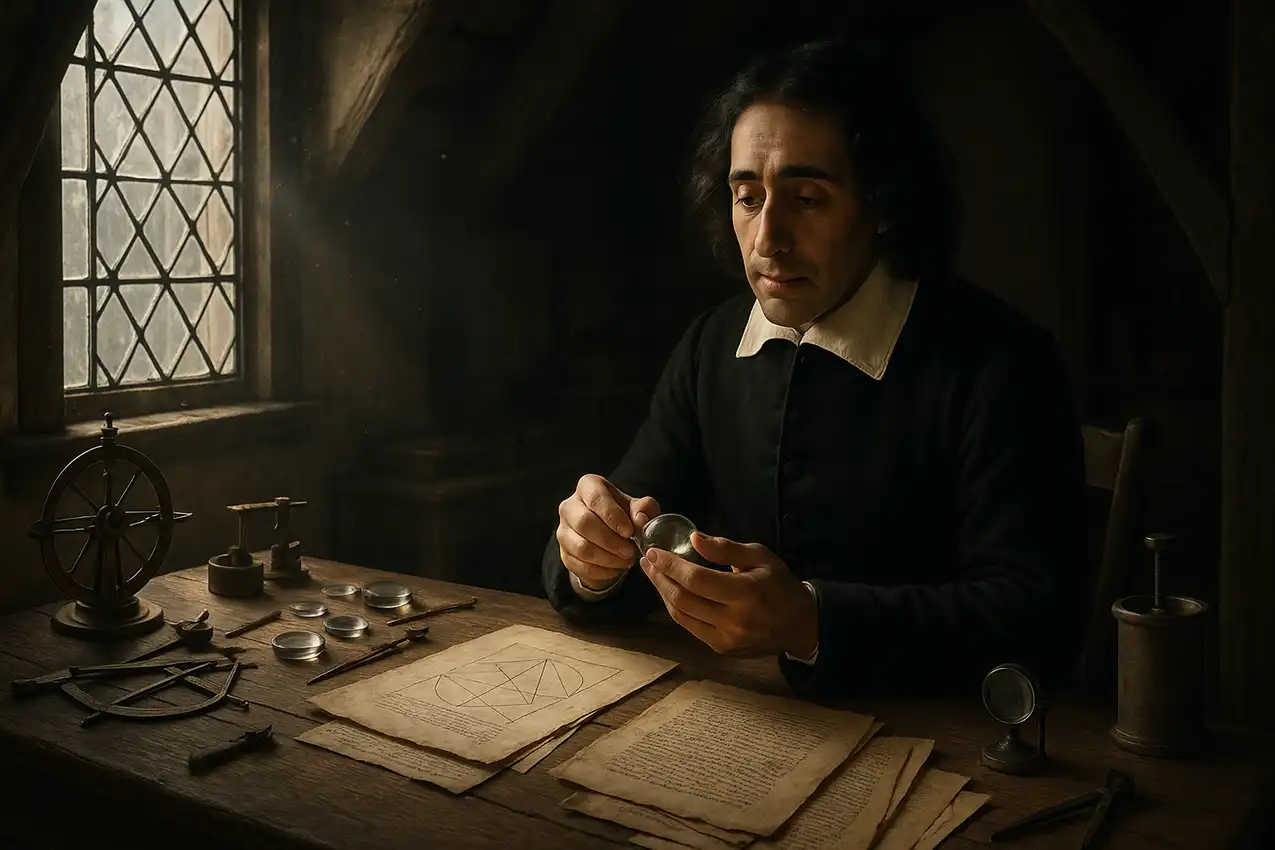
In the damp, salt-laden air of the seventeenth-century Dutch Republic, a revolution was being quietly polished into existence. It did not begin with the thunder of cannons or the fanfare of royal decrees. It began in the silent, dust-mote filled attic of a modest lodging in The Hague, where a solitary man laboured over the grinding of lenses.
This man, Bento de Spinoza to his Portuguese family, Baruch to the synagogue that cursed him, and Benedictus to the Republic of Letters, was engaged in a dual act of clarification. With his hands, he shaped glass to reveal the microscopic and the celestial, aiding the nascent scientific revolution in its quest to see the physical world more clearly.1 With his mind, he was grinding a far more dangerous optic: a philosophical system designed to strip away the murky superstitions of the age and reveal the crystalline structure of God, Nature, and the human soul.
Spinoza is a singular figure in the history of thought, a paradox wrapped in a humble cloak. He was a lens grinder who died of the very dust he created, yet his vision extended to the furthest reaches of eternity.2 He was arguably the most vilified man in Europe, denounced as an atheist and a monster, yet his life was a model of saintly frugality and benevolence. He was a man who possessed almost nothing, yet he bequeathed to the modern world its most precious intellectual treasures: the secular state, the freedom of speech, and a conception of the universe so unified and interconnected that it continues to haunt the frontiers of modern physics and deep ecology.3
His gift to society was not merely a set of arguments, but a radical reorientation of the human spirit. In a world tearing itself apart over definitions of the divine—Protestant against Catholic, Remonstrant against Counter-Remonstrant—Spinoza dared to suggest that the warring factions were fighting over a phantom. He proposed that God was not a king in heaven, judging the petty affairs of men, but Being itself: Deus sive Natura—God or Nature.5
This essay seeks to excavate the life and legacy of this quiet radical. We will traverse the canals of Jewish Amsterdam, the seminar rooms of the Radical Enlightenment, and the forests of modern ecological thought. We will examine the strengths of his monolithic thesis and the criticisms that have battered it for three centuries.
We will ask how a thinker excommunicated for “abominable heresies” in 1656 came to be revered by the Romantics as “God-intoxicated,” by Einstein as a spiritual guide, and by modern environmentalists as the prophet of the Anthropocene. To understand Spinoza is to look through the lens he ground for us: a lens that turns the chaos of the world into a geometric order, terrifying in its necessity, but beautiful in its truth.
II. The Marrano Crucible: A Sanctuary of Shadows
The Weight of Heritage
To understand the radical break Spinoza made with tradition, one must first grasp the density of the tradition he abandoned. Baruch Spinoza was born on November 24, 1632, in Amsterdam, the commercial heart of the Dutch Golden Age.6 But his roots lay in the blood-soaked soil of the Iberian Peninsula.
His parents, Miguel de Espinoza and Hana Debora, were Marranos—Portuguese Jews who had been forcibly converted to Catholicism but who had fled to the Netherlands to reclaim their ancestral faith. This community lived with a profound, inherited trauma. They were a people of secrets, accustomed to living double lives, whispering Hebrew prayers behind shuttered windows while outwardly bowing to the cross.
In Amsterdam, they found a “New Jerusalem,” a city of tolerance where they could build a synagogue and worship openly. Yet, precisely because their freedom was new and fragile, the community was rigid. They were terrified of scandal, terrified of provoking the Calvinist magistrates who tolerated their presence only as long as they remained quiet and profitable.3
The Prodigy of the Talmud Torah
Young Baruch was the shining hope of this community. He was a brilliant student at the Talmud Torah school, immersed in the intricate legalism of the Halakha and the soaring metaphysics of medieval Jewish philosophy. He studied the works of Maimonides and Gersonides, men who had tried to reconcile the Torah with Aristotelian reason.6
But Spinoza’s intellect was too caustic to be contained by medieval synthesis. He was a polyglot, fluent in Portuguese, Spanish, Hebrew, and Dutch. Crucially, he learned Latin—the language of the secular gentile world—from Franciscus van den Enden, a radical ex-Jesuit and freethinker who was eventually executed for plotting against Louis XIV.1
Under Van den Enden’s tutelage, Spinoza was exposed to the new mechanical philosophy of René Descartes, the plays of the classical world, and the dangerous currents of political republicanism. He began to see the contradictions in the texts he was meant to revere. He noticed that the Torah contained anachronisms suggesting it was not written entirely by Moses. He questioned the immortality of the soul, finding no evidence for it in the Hebrew Bible. He began to ask if God truly had a “will” or if that was merely a human projection.1
The Abominable Heresies
The drift became a rupture. Spinoza stopped attending the synagogue. He ceased paying his dues. When two fellow students asked him his true opinion on God, he allegedly replied that matter might be the body of God—a thought so blasphemous it struck at the very heart of the Creator-Creation distinction fundamental to Judaism.7
The elders of the community, the Parnassim, were horrified. They saw in Spinoza the shadow of Uriel da Costa, another heretic whose questioning had brought shame and turmoil to the community decades earlier. They tried to bribe Spinoza to conform, offering him a pension of 1,000 florins if he would just keep up appearances and stay quiet.
Spinoza refused. He was not interested in a double life. The Marrano habit of secrecy ended with him. He demanded the liberty to think and speak according to his own reason, not the dictates of tradition.
The Cherem: A Curse of Blackest Night
The response of the community was absolute and terrifying. On July 27, 1656, the 24-year-old Spinoza was subjected to the Cherem, the writ of excommunication. It remains the harshest ban ever issued by the Amsterdam Jewish community.
In the synagogue, before the open Ark, the cantor chanted the words that would sever Baruch Spinoza from his people forever:
“By decree of the angels and by the command of the holy men, we excommunicate, expel, curse and damn Baruch de Espinoza… Cursed be he by day and cursed be he by night; cursed be he when he lies down and cursed be he when he rises up. Cursed be he when he goes out and cursed be he when he comes in. The Lord will not spare him… We order that no one should communicate with him, not even in writing, nor accord him any favor nor stay with him under the same roof nor come within four cubits in his vicinity; nor shall he read any treatise composed or written by him”.7
This was a social death sentence. In the tight-knit world of 17th-century Amsterdam, to be cut off from the community was to be cast into a void. His family disowned him. His sister, to whom he later ceded his inheritance, turned her back on him.6
Spinoza’s reaction was characteristically stoic. He is reported to have said, “All the better; they do not force me to do anything that I would not have done of my own accord.” He packed his belongings and left the Jewish quarter, never to return. He changed his name from Baruch (Blessed) to Benedictus (Blessed), translating himself into the universal language of philosophy. He was now a citizen of nowhere, and everywhere.9
III. The Geometric God: Metaphysics of the One Substance
The Architecture of the Ethics
Exiled from the synagogue, Spinoza retreated to the margins of Dutch society—first to Rijnsburg, then Voorburg, and finally The Hague. He supported himself by grinding lenses, a trade that required immense patience and precision. It was in these quiet years that he composed his masterpiece, the Ethics (Ethica, ordine geometrico demonstrata).3
The book is a bizarre and beautiful object. It is written not in prose, but in the style of Euclid’s geometry. It begins with Definitions and Axioms, followed by Propositions, Demonstrations, Scholiums (notes), and Corollaries.
This geometric method was not an affectation. For Spinoza, the universe was not a messy, chaotic place governed by a moody God. It was a rational system, a necessary unfolding of truth. Just as the properties of a triangle follow necessarily from its definition, so too do the events of the world follow necessarily from the nature of God. He believed one could prove the nature of emotions with the same certainty as one proves the Pythagorean theorem.11
Monism: The Dangerous Unity
At the core of the Ethics is Spinoza’s most radical idea: Monism.
Most thinkers of his time, including his intellectual father Descartes, were dualists. They believed the universe was made of two things: Matter and Mind. Above them both was God, the Creator.
Spinoza shattered this hierarchy. He argued that “Substance” is that which exists in itself and is conceived through itself. If God is infinite, there cannot be another substance outside of Him, for that would limit Him. Therefore, there is only one Substance in the universe.5
That Substance is Deus sive Natura—God or Nature.
This is the bedrock of Spinozism. God is not a distinct entity who created the world and then stepped back to watch. God is the world. God is the active, generative force of the universe (Natura naturans) and the passive, created world (Natura naturata).3
Attributes and Modes: The Ocean and the Waves
If everything is One, how do we explain the diversity of the world? How do we explain rocks, trees, and people?
Spinoza introduces the concepts of Attributes and Modes.
Attributes are the ways in which the intellect perceives the essence of Substance. Spinoza argues that while God has infinite attributes, humans can perceive only two: Extension (physical matter) and Thought (mind, ideas).11
Modes are the specific, finite expressions of Substance. A rock is a mode. A human being is a mode. A thought is a mode.
Consider the metaphor of the ocean. The ocean is Substance—vast, deep, and singular. The waves on the surface are Modes. A wave is not separate from the ocean; it is the ocean, acting in a specific way for a brief moment. When the wave crashes, it does not leave the ocean; it returns to the whole. For Spinoza, we are all waves in the ocean of God.14
Solving the Mind-Body Problem
This monism allowed Spinoza to solve the great riddle of Cartesian philosophy: the Mind-Body connection. Descartes could never explain how a non-physical mind could move a physical body.
Spinoza’s answer is elegant and startling: They do not interact because they are not two different things. They are the same thing, perceived under two different attributes.10
The mind is simply the idea of the body. The body is the object of the mind.
When I decide to raise my arm, the physical motion (Extension) and the mental intention (Thought) happen simultaneously, not because one caused the other, but because they are the same event in Substance, expressed in two parallel languages. This concept, known as Parallelism, anticipates modern neuroscience’s view that mental states are inextricably linked to brain states.15
Determinism: The Clockwork of Necessity
The most chilling, yet liberating, aspect of Spinoza’s system is his strict determinism. If the universe is God, and God is perfect Reason, then everything that happens flows necessarily from the nature of God.
There is no contingency. Things could not have been otherwise.
Spinoza denies the existence of “free will” as it is commonly understood. We believe we are free, he famously wrote, only because we are conscious of our actions but ignorant of the causes that determine them. A stone thrown through the air, if it had consciousness, might believe it was flying because it wanted to. We are that stone.17
Critics called this “fatalism.” They argued it stripped life of meaning and moral responsibility. If I am determined to be a thief by the causal chain of the universe, how can I be blamed?
Spinoza’s defense is subtle. He distinguishes between “free will” (an illusion of uncaused choice) and “freedom” (autonomy). A thing is free when it acts according to the necessity of its own nature, rather than being compelled by external forces. The drunkard thinks he chooses the bottle freely, but he is a slave to his thirst (an external passion). The wise man, who understands his desires and acts according to reason, is truly free.18
IV. The Automaton of the Spirit: Psychology and the Affects
The Conatus: The Will to Endure
If we are merely modes of God, driven by necessity, what motivates us? Spinoza identifies a universal drive found in all things: the Conatus.
“Each thing,” he writes, “as far as it can by its own power, strives to persevere in its being”.19
In a rock, this is the resistance to being broken. In a human, it is the will to live, to assert oneself. When this striving is conscious, we call it Desire.
The Geometry of Emotion
Spinoza builds a complete psychology from this single drive. He argues that there are three primary affects (emotions):
- Desire: The essence of the human being (Conatus).
- Joy: The transition from a state of lesser perfection (power) to greater perfection.
- Sorrow (or Sadness): The transition from greater perfection to lesser perfection.20
All other emotions are combinations of these. Love is simply Joy accompanied by the idea of an external cause. Hate is Sorrow accompanied by the idea of an external cause. Hope is an inconstant Joy arising from the image of something future about whose outcome we are in doubt.20
This is a clinical, almost mechanical view of the human heart. Yet, it is profoundly empathetic. By understanding that people are driven by the mechanics of pain and pleasure, Spinoza argues we should not mock or judge them, but understand them. “I have laboured carefully,” he wrote, “not to mock, lament, or execrate human actions, but to understand them”.22
From Bondage to Freedom
Most humans live in a state Spinoza calls “Bondage.” We are enslaved by passive affects—emotions triggered by external things over which we have no control. We tie our happiness to fickle things: fame, wealth, the love of others. When these external supports collapse, we fall into despair.21
The path to freedom is the path of Reason. We cannot stop feeling emotions (we are biological organisms, after all), but we can transform them.
When we form a “clear and distinct idea” of a passive emotion—when we understand why we are jealous or angry, tracing the causal chain back to its source—the emotion ceases to be a passive suffering and becomes an active thought. We gain distance. We gain control.
The Intellectual Love of God
The summit of Spinoza’s ethics is Amor Dei Intellectualis—the Intellectual Love of God. This is not the emotional love of a believer for a father figure. It is the deep, abiding joy that comes from understanding the universe.
When we understand that everything is necessary, that the person who wronged us was compelled to do so by the infinite chain of causes, our anger dissolves into understanding. We see the world sub specie aeternitatis—under the aspect of eternity. This understanding brings a peace that “passes all understanding,” a blessedness that is not a reward for virtue, but is virtue itself.3
Modern neuroscientist Antonio Damasio has championed Spinoza as a precursor to modern biology. In his book Looking for Spinoza, Damasio argues that Spinoza correctly identified feelings as the mental readout of the body’s homeostatic state. The Conatus is the biological drive for survival/regulation, and the mind is the tool evolved to facilitate that striving.23
V. The Scandal of Scripture: The Theological-Political Treatise
The Dangerous Book
While Spinoza kept the Ethics in his desk, knowing it would likely get him killed, he felt compelled to intervene in the political crisis of his time. The Dutch Republic, though liberal, was tearing itself apart. The strict Calvinist clergy were demanding censorship and political power, threatening the tolerant Republican faction led by Jan de Witt.10
In 1670, Spinoza published the Tractatus Theologico-Politicus (TTP) anonymously. It was an intellectual bomb thrown into the marketplace.
Deconstructing the Bible
Spinoza was the father of modern biblical criticism. He approached the Bible not as a divine artifact, but as a historical text. He read it with the eye of a linguist and a historian.
He argued that the Prophets were not philosophers with superior intellects. They were men of vivid imagination, chosen to convey simple moral truths (obedience and charity) to an uneducated people. Their visions were shaped by their own prejudices and the culture of their time.25
Most controversially, Spinoza denied the possibility of miracles. Since God is Nature, and Nature acts according to eternal, unbreakable laws, a “miracle” (a violation of nature’s laws) would be a contradiction. It would be God acting against His own nature. Therefore, biblical miracles were either natural events misunderstood by primitive people or allegorical stories.26
This argument stripped the clergy of their power. If the Bible is a historical document, and miracles are impossible, then the priests have no special hotline to God. They are merely interpreters of a text, subject to the same errors as anyone else.
The Purpose of the State is Liberty
Politically, the TTP is a ringing defense of democracy and free speech. Spinoza counters the pessimism of Thomas Hobbes. Hobbes argued that to escape the brutal “state of nature,” humans must surrender all their rights to an absolute sovereign (the Leviathan) in exchange for security.27
Spinoza agrees that the state is necessary for security, but he argues that there is one right no human can surrender: the right to think.
“The ultimate design of government is not to rule, or restrain, by fear,” Spinoza wrote, “but contrariwise, to free every man from fear… In fact, the true aim of government is liberty”.28
He argued that a state that tries to control men’s minds is tyrannical and ultimately doomed to failure. It will only produce hypocrites. A stable state must allow “the freedom to philosophize”—to think and speak freely—so long as one obeys the laws of the state in action. This distinction between the private sphere of thought and the public sphere of action is the foundation of modern secular liberalism.30
The reaction was furious. The book was banned. It was described as “forged in hell by the apostate Jew working together with the devil.” Spinoza decided not to publish the Ethics during his lifetime, retreating further into the shadows.27
VI. The Spinoza Circle: Collaborators in the Underground
Spinoza was a solitary thinker, but he was not alone. He was the intellectual gravity well for a group of friends and correspondents known as the “Spinoza Circle.” These men were the conduits through which his radical ideas seeped into the bloodstream of Europe.
Lodewijk Meyer (1629–1681): A physician, playwright, and director of the Amsterdam theater. Meyer was Spinoza’s editor and closest intellectual confidant. He wrote the preface to Spinoza’s only work published under his own name (a commentary on Descartes) and likely helped edit the Ethics. Meyer was a bridge between Spinoza’s abstract metaphysics and the vibrant Dutch art scene.32
Henry Oldenburg (c. 1619–1677): The first secretary of the Royal Society in London. Oldenburg visited Spinoza in Rijnsburg and maintained a long correspondence with him. He was Spinoza’s link to the English scientific revolution, connecting the lens grinder to figures like Robert Boyle. Their letters debated the nature of fate and the physics of nitre, showing Spinoza’s deep engagement with the empirical sciences.32
Jarig Jelles (?–1683): A Mennonite merchant who recognized Spinoza’s genius early on. He provided Spinoza with a stipend, allowing the philosopher to quit his merchant business and focus on writing. Jelles represents the “Collegiant” connection—a group of dissenting Christians who, like Spinoza, rejected church hierarchy and dogma. Spinoza lived among them in Rijnsburg, finding in their simple piety a safe harbour.33
Adriaan Koerbagh (1633–1669): A cautionary tale. A brilliant jurist and friend of Spinoza, Koerbagh tried to publish a book in Dutch (the language of the common people, not the Latin of the elite) that openly ridiculed the Trinity and organized religion using Spinozist arguments. He was arrested, tortured, and died in prison. His fate was a grim reminder to Spinoza of the dangers of speaking too clearly.32
These men formed the vanguard of what historian Jonathan Israel calls the Radical Enlightenment. While “moderate” Enlighteners like Locke and Voltaire sought to compromise with monarchy and church, the Spinozists aimed for the root: the total secularization of society, the demolition of aristocracy, and the establishment of pure democracy.4
VII. The Romantic Resurrection: From “Dead Dog” to “God-Intoxicated”
The Pantheism Controversy
For a century after his death in 1677, Spinoza was a pariah. To call someone a “Spinozist” was the ultimate insult, equivalent to calling them an atheist and a libertine. He was dismissed as a “dead dog.”
The resurrection began in 1785 with the Pantheismusstreit (Pantheism Controversy) in Germany. Friedrich Heinrich Jacobi, a critic of rationalism, revealed that the great German dramatist Gotthold Ephraim Lessing had confessed on his deathbed: “There is no other philosophy than the philosophy of Spinoza”.35
This scandal forced the German intellectuals to re-read the forbidden texts. What they found shocked them. They didn’t find the cold atheist of legend. They found a man who saw God everywhere.
Goethe and the Poets
Johann Wolfgang von Goethe, the Shakespeare of Germany, fell under Spinoza’s spell. He wrote that the Ethics had a calming effect on his turbulent passions. “A Spinoza in poetry becomes Machiavelli in philosophy,” Goethe allegedly remarked, suggesting the transformative power of the system.36 For Goethe, Spinoza’s Deus sive Natura was the perfect theology for the artist: a God who is constantly creating, a nature that is alive and divine.37
The British Romantics followed suit. Samuel Taylor Coleridge, in his letters to Robert Southey, wrestled with Spinoza’s influence. He was captivated by the idea of the “One Life within us and abroad,” a pantheistic unity that permeates his poetry, such as The Eolian Harp.38
In a letter to Southey, Coleridge famously discussed his flirtation with Spinozism, moving from the materialism of Hartley to the “corporeality of thought” found in Spinoza.39 Though Coleridge eventually retreated to Trinitarian Christianity, unable to accept Spinoza’s denial of a personal God, the stamp of the “lens grinder’s God” remained on the Romantic soul.
William Wordsworth, too, absorbed this ethos. His “Tintern Abbey,” with its sense of “a motion and a spirit, that impels / All thinking things, all objects of all thought, / And rolls through all things,” is pure poetic Spinozism.41
Hegel’s Lion’s Den
Georg Wilhelm Friedrich Hegel, the giant of German Idealism, paid Spinoza the ultimate compliment and the ultimate critique. He famously told his students, “You are either a Spinozist or not a philosopher at all”.42
Hegel saw Spinoza’s Monism as the necessary beginning of all philosophy—the realization that the finite is an illusion and only the Infinite is real. However, he criticized Spinoza for “Acosmism”—not the denial of God (Atheism), but the denial of the world. Hegel argued that Spinoza’s Substance was like a “lion’s den” where all footsteps lead in, but none lead out. The individual is swallowed up by the Absolute, losing all subjectivity and dynamism.43
VIII. The Prophet of the Green Earth: Spinoza and Ecology
Deep Ecology and the Ecological Self
In the late 20th century, as the skies darkened with smog and the rivers choked with plastic, Spinoza found a new congregation: the Environmentalists.
In 1973, the Norwegian philosopher Arne Naess coined the term “Deep Ecology.” He distinguished it from “Shallow Ecology,” which seeks to protect the environment only for the sake of human utility (e.g., saving forests to ensure timber supply). Deep Ecology argues that nature has intrinsic value, independent of human needs.44
Naess explicitly cited Spinoza as the philosophical grandfather of this movement. He adapted Spinoza’s concept of Self-Realization.
For Spinoza, the more we understand our connection to the web of cause and effect, the more our “power of acting” increases. Naess argued that the modern “Self” is too narrow—it is the ego, the isolated consumer. We need to expand our Self to include the environment.
When we realize that we are modes of the single Substance, just like the mountain and the river, we realize that damaging the river is damaging ourselves. Self-preservation (Conatus) becomes Earth-preservation. This is the “Ecological Self”.46
Spinoza in the Anthropocene
In the current climate crisis, Spinoza’s voice is urgent. The modern industrial worldview treats nature as “dead matter,” a warehouse of resources to be exploited. This is the Cartesian view: mind is separate from matter.
Spinoza offers the antidote: Matter is vibrant, divine, and alive. We are not “a kingdom within a kingdom,” standing above nature. We are nature.
Contemporary environmental ethicists use Spinoza to argue against “Anthropocentrism.” If humans are just one mode among infinite modes, we have no divine right to dominate the others. Spinoza’s determinism also teaches us about the rigid laws of the climate system. We cannot negotiate with the carbon cycle. We can only understand it and align our behaviour with its necessity. Freedom, in the Anthropocene, is the recognition of ecological necessity.47
IX. Spinoza and the Physicist: The Creed of Science
The most famous Spinozist of the 20th century was not a philosopher, but a physicist. Albert Einstein was obsessed with Spinoza. He read the Ethics repeatedly.
When Rabbi Herbert S. Goldstein sent Einstein a telegram in 1929 asking, “Do you believe in God? Stop. Answer paid 50 words,” Einstein replied:
“I believe in Spinoza’s God who reveals himself in the orderly harmony of what exists, not in a God who concerns himself with fates and actions of human beings”.49
Einstein found in Spinoza a spiritual validation for his scientific work. Both men shared a “Cosmic Religion”—a feeling of awe at the rational beauty of the universe. Both were strict determinists. Einstein’s famous quip against Quantum Mechanics, “God does not play dice,” is a thoroughly Spinozistic sentiment. For both the lens grinder and the patent clerk, the universe was not a game of chance; it was a masterpiece of order.50
X. Strengths, Criticisms, and Defenses
Strengths of the Thesis
- Logical Coherence: Spinoza’s system is a fortress. If you accept his definition of Substance, the rest follows with irresistible logic. It is one of the most consistent philosophical systems ever devised.
- Naturalism: By removing the supernatural, Spinoza cleared the ground for modern science. He treated psychology, sociology, and physics as parts of a unified natural order.
- Therapeutic Power: His ethics offer a robust secular spirituality. The “Intellectual Love of God” provides a way to find peace and meaning without resorting to superstition.
- Foundation of Liberalism: His separation of church and state, and his defense of free speech, underpin modern Western democracy.
Criticisms
- Fatalism: The “Lazy Argument”—if everything is determined, why bother trying? If I am sick, and it is determined whether I recover or die, why call a doctor?
- Defense: Spinoza would answer that the doctor is part of the causal chain. Your desire to call the doctor is also determined. Fatalism implies the outcome is fixed regardless of causes; Determinism means the outcome is fixed by the causes. We are active participants in the chain.
- Acosmism/Loss of Individuality: If I am just a wave in the ocean, do I matter? Hegel’s critique that the individual vanishes in Spinoza’s Absolute.
- Defense: Spinozists argue that the modern obsession with the isolated “Ego” is the source of our misery. Recognizing our oneness with the Whole is not a loss, but an expansion. We gain the universe.
- The Cold God: A God who cannot love us back offers no comfort to the grieving parent. Spinoza is explicit: “He who loves God cannot endeavor that God should love him in return”.22
- Defense: Spinoza offers truth, not comfort. He argues that the comfort of religion is a false comfort, a “sanctuary of ignorance.” True dignity lies in facing reality as it is.
- The Category Mistake: Critics argue that renaming Nature as “God” is a linguistic trick. If it’s just the physical universe, why use religious language?
- Defense: Spinoza insists the universe is infinite and eternal, attributes traditionally reserved for divinity. He wants to re-sacralize the world, to make us treat nature with the reverence usually saved for a deity.
XI. Conclusion: The Gift of the Glass
Baruch Spinoza died on Sunday, February 21, 1677. He was 44 years old. The silica dust from his lenses had ravaged his lungs, likely causing silicosis or exacerbating hereditary tuberculosis.2 He died as he lived: quietly, stoically, without Last Rites.
He left behind a wardrobe of threadbare coats, some polishing equipment, and a desk containing the manuscript of the Ethics. His friends, the loyal members of his Circle, worked feverishly to publish his “Opera Posthuma” before the clergy could seize the papers. To protect themselves, they published the book with only the initials “B.D.S.” on the cover.51
Spinoza’s legacy is a testament to the endurance of truth. He was a man who possessed no weapons, commanded no armies, and held no pulpit. He had only his reason and his lenses. Yet, he defeated the censors.
His gift to society is the vision of a world made of light. He taught us that we are not strangers in the universe, but intimate parts of it. He taught us that the mind and the body are friends, not enemies. He taught us that the state exists to serve the citizen, not the other way around.
In an age of ecological collapse and epistemological chaos, the lens grinder of Amsterdam offers us a way to see clearly again. He invites us to look through his glass and see the world not as a collection of fragmented, warring parts, but as a single, shimmering, eternal substance—a world where God is the green of the forest, the logic of the equation, and the beat of the human heart. He asks us to stop hoping and fearing, and simply to understand.
Table 1: The Affects of Spinoza vs. Modern Psychology
| Spinozistic Concept | Definition in Ethics | Modern Psychological/Biological Parallel |
| Conatus | The striving to persevere in being. | Homeostasis (Damasio); Survival Instinct; Will to Power (Nietzsche). |
| Appetite | Conatus related to mind and body. | Drive Theory (Freud); Biological drives (Hunger, Thirst). |
| Joy (Laetitia) | Increase in power of acting. | Dopaminergic Reward System; Positive reinforcement; Flourishing. |
| Sorrow (Tristitia) | Decrease in power of acting. | Stress Response; Depression; Psychic entropy. |
| Bondage | Slavery to passive affects (external causes). | Addiction; Reactive behaviour; External Locus of Control. |
| Freedom | Action based on adequate ideas (internal nature). | Self-Regulation; Cognitive Behavioral Therapy (reframing causes). |
Table 2: The Evolution of Spinoza’s Reception
| Era | dominant View of Spinoza | Key Figures |
| 1677–1780 | The Atheist Monster | Pierre Bayle, Hume. Seen as a destroyer of religion and morality. “Spinozism” is a slur. |
| 1780–1830 | The God-Intoxicated Man | Goethe, Lessing, Coleridge, Hegel. Reinterpreted as a mystic of Nature. The father of Romanticism. |
| 1850–1900 | The Scientific Rationalist | Marx, Nietzsche. Admired for his materialism and determinism. Seen as a precursor to secularism. |
| 1920–1950 | The Cosmic Religious | Einstein. The patron saint of the ordered, knowable universe. |
| 1970–Present | The Deep Ecologist | Arne Naess, Deleuze, Damasio. The philosopher of the body, the brain, and the biosphere. |
Works cited
- Baruch Spinoza | Research Starters – EBSCO, , https://www.ebsco.com/research-starters/history/baruch-spinoza
- 5 Things You Never Knew About Spinoza – Edinburgh University Press Blog, , https://euppublishingblog.com/2018/11/11/5-things-you-never-knew-about-spinoza/
- Baruch Spinoza – Stanford Encyclopedia of Philosophy, , https://plato.stanford.edu/entries/spinoza/
- Radically Enlightened Jews – Jewish Review of Books, , https://jewishreviewofbooks.com/jewish-history/12560/radically-enlightened-jews%EF%BF%BC/
- Spinoza: Substance, Attributes, and Modes | History of Modern Philosophy Class Notes, , https://fiveable.me/history-modern-philosophy/unit-2/spinoza-substance-attributes-modes/study-guide/8ktWEO4MULEFeDHc
- Baruch Spinoza: The Philosopher’s Philosopher – PMC – PubMed Central – NIH, , https://pmc.ncbi.nlm.nih.gov/articles/PMC2882284/
- Why Spinoza Was Excommunicated | National Endowment for the Humanities, , https://www.neh.gov/article/why-spinoza-was-excommunicated
- , https://www.neh.gov/article/why-spinoza-was-excommunicated#:~:text=By%20decree%20of%20the%20angels,therein%3B%20cursing%20him%20with%20the
- Baruch Spinoza – Wikipedia, , https://en.wikipedia.org/wiki/Baruch_Spinoza
- Spinoza, Benedict De | Internet Encyclopedia of Philosophy, , https://iep.utm.edu/spinoza/
- Spinoza, Benedict de: Metaphysics | Internet Encyclopedia of Philosophy, , https://iep.utm.edu/spinoz-m/
- Spinoza’s Modal Metaphysics – Stanford Encyclopedia of Philosophy, , https://plato.stanford.edu/entries/spinoza-modal/
- Spinoza’s Theory of Attributes – Stanford Encyclopedia of Philosophy, , https://plato.stanford.edu/entries/spinoza-attributes/
- What does ‘mode’ mean in Spinoza’s Ethics? – Philosophy Stack Exchange, , https://philosophy.stackexchange.com/questions/69007/what-does-mode-mean-in-spinozas-ethics
- Representation and the mind-body problem in Spinoza / by Michael Della Rocca Hardcover – 1996 – 1st Edition – Biblio, , https://www.biblio.com/book/representation-mind-body-problem-spinoza-michael/d/1610767565
- Representation and the Mind-Body Problem in Spinoza – Michael Della Rocca, , https://global.oup.com/academic/product/representation-and-the-mind-body-problem-in-spinoza-9780195095623
- Deus, sive Natura: Substance and Determinism in Spinoza’s Ethics, , https://pubs.lib.umn.edu/index.php/aisthesis/article/download/50/35/180
- Spinoza on Free Will and Freedom | Internet Encyclopedia of Philosophy, , https://iep.utm.edu/spinoza-free-will-determinism/
- , https://pmc.ncbi.nlm.nih.gov/articles/PMC9450011/#:~:text=In%20his%20masterwork%20Ethics%2C%20Spinoza,%2C%20ethics%2C%20and%20political%20theory.&text=The%20doctrine%20of%20the%20conatus,natural%20thing%20for%20self%2Dpreservation.
- Spinoza’s Metaphysical Psychology (Chapter 6) – Cambridge University Press & Assessment, , https://www.cambridge.org/core/books/cambridge-companion-to-spinoza/spinozas-metaphysical-psychology/21C99D756BB9F9CE1DD26145ACDEB723
- Spinoza’s Psychological Theory – Stanford Encyclopedia of Philosophy, , https://plato.stanford.edu/entries/spinoza-psychological/
- Baruch Spinoza – Wikiquote, , https://en.wikiquote.org/wiki/Baruch_Spinoza
- Looking for Spinoza: Joy, Sorrow, and the Feeling Brain by António Damásio | Goodreads, , https://www.goodreads.com/book/show/162370.Looking_for_Spinoza
- Looking for Spinoza by Antonio Damasio: Detailed Summary – OtherLife.co, , https://www.otherlife.co/looking-for-spinoza/
- FRIENDS AND FOES l. Spinozas ‘Circle’ In the second chapter we saw how from the 1650s onwards, Dutch Carte – Brill, , https://brill.com/display/book/9789004247567/B9789004247567-s005.pdf
- Spinoza’s ‘Theological-Political Treatise’ – Cambridge University Press, , https://www.cambridge.org/core/books/spinozas-theologicalpolitical-treatise/F44C8F0EA7402357FDA89BA79FDF3A9E
- Tractatus Theologico-Politicus – Wikipedia, , https://en.wikipedia.org/wiki/Tractatus_Theologico-Politicus
- Tractatus Theologico-Politicus – Wikiquote, , https://en.wikiquote.org/wiki/Tractatus_Theologico-Politicus
- Theological-Political Treatise Quotes by Baruch Spinoza – Goodreads, , https://www.goodreads.com/work/quotes/1850355-tractatus-theologico-politicus
- Libertas philosophandi and Freedom of Mind in Spinoza’s Tractatus Theologico-politicus – Rollins Scholarship Onlin, , https://scholarship.rollins.edu/cgi/viewcontent.cgi?article=1164&context=as_facpub
- Spinoza’s Political Philosophy, , https://plato.stanford.edu/entries/spinoza-political/
- Our Knowledge of Spinoza’s Life and Works1, , https://www.meiji.ac.jp/cip/researcher/6t5h7p00000ixpa5-att/6t5h7p000010t6ec.pdf
- Baruch Spinoza – Correspondence – Early Modern Texts, , https://www.earlymoderntexts.com/assets/pdfs/spinoza1661.pdf
- Enlightenment Uncontested – H-Net Reviews, , https://www.h-net.org/reviews/showrev.php?id=13250
- Coleridge’s Philosophies (Chapter 14) – Cambridge University Press, , https://www.cambridge.org/core/books/new-cambridge-companion-to-coleridge/coleridges-philosophies/0992129F4DD17A54B28441E5A3A7D7B1
- spinoza – What’s the meaning of this aphorism by Goethe? – Philosophy Stack Exchange, , https://philosophy.stackexchange.com/questions/89714/whats-the-meaning-of-this-aphorism-by-goethe
- Goethe and Spinoza: A Reconsideration, , http://blogimages.seniorennet.be/bds/attach/113397.pdf
- The “one life” that “rolls through all things”: Nature, Philosophy, and Perception in Spinoza, Coleridge, and Wordsworth – Honors Program Distinction Projects, , https://distinction-projects.pages.roanoke.edu/the-one-life-that-rolls-through-all-things-nature-philosophy-and-perception-in-spinoza-coleridge-and-wordsworth/
- Coleridge’s Ecumenical Spinoza – Romanticism and Victorianism on the Net – Érudit, , https://www.erudit.org/fr/revues/ravon/2012-n61-ravon0834/1018604ar/
- July 5, 1801 to Robert Southey | The Letters of Samuel Taylor Coleridge, , https://stcletters.com/?p=699
- Spinoza with Wordsworth: substance and “the life of things” – NASSR Graduate Student Caucus (NGSC), , https://nassrgrads.hcommons.org/2016/04/18/spinoza-with-wordsworth-substance-and-the-life-of-things/
- Section Two: Period of the Thinking Understanding Chapter I. — The Metaphysics of the Understanding A 2. SPINOZA – Hegel’s History of Philosophy, , https://www.marxists.org/reference/archive/hegel/works/hp/hpspinoz.htm
- George di Giovanni Hegel and the Challenge of Spinoza. A Study in German Idealism, 1801-1831 Cambridge University Press, Cambri, , https://universa.padovauniversitypress.it/system/files/papers/diGiovanni_Hegel_Spinoza_Megli.pdf
- Deep Ecology and Nature: Naess, Spinoza, Schelling – The Trumpeter, , https://trumpeter.athabascau.ca/index.php/trumpet/article/download/1549/1783/6125
- Spinoza and Deep Ecology: Challenging Traditional Approaches to Environmentalism, , https://ndpr.nd.edu/reviews/spinoza-and-deep-ecology-challenging-traditional-approaches-to-environmentalism/
- How to face the climate crisis with Spinoza and self-knowledge | Aeon Essays, , https://aeon.co/essays/how-to-face-the-climate-crisis-with-spinoza-and-self-knowledge
- spinoza-and-ecology.pdf – Anthony Paul Smith, , https://anthonypaulsmith.net/wp-content/uploads/2018/07/spinoza-and-ecology.pdf
- Spinoza, Deep Ecology and Education Informed by a (Post)human Sensibility – PESA Agora, , https://pesaagora.com/access-archive-files/ACCESSAV39N1_081.pdf
- Can Einstein’s reasons for believing in Spinoza’s God be structured as a deductive or syllogistic argument? – Philosophy Stack Exchange, , https://philosophy.stackexchange.com/questions/118611/can-einsteins-reasons-for-believing-in-spinozas-god-be-structured-as-a-deducti
- What Did Einstein Believe About Spinoza’s God? – YouTube, , https://www.youtube.com/watch?v=p7f4uGWHwQM
- The Nature of Spinoza’s God – EvPhil Blog – Evolutionary Philosophy, , https://www.evphil.com/blog/the-nature-of-spinozas-god
- Arne Næss’s Deep Ecology: Reevaluating Our Place in Nature | Philosophy Break, , https://philosophybreak.com/articles/arne-naess-deep-ecology-reevaluating-our-place-in-nature/
- Emotions and Feelings in Antonio Damasio’s “Looking for Spinoza” – Psychology Writing, , https://psychologywriting.com/emotions-and-feelings-in-antonio-damasios-looking-for-spinoza/
- The Causes of Our Belief in Free Will: Spinoza on Necessary, “Innate,” yet False Cognition, , https://www.cambridge.org/core/books/spinozas-ethics/causes-of-our-belief-in-free-will-spinoza-on-necessary-innate-yet-false-cognition/E35867988107E0F7F24B5419624F352C
ENDNOTES
1 EBSCO. “Baruch Spinoza biography excommunication lens grinder friends.”
6 PMC. “Baruch Spinoza: The Polymath and the Cherem.”
9 Wikipedia. “Baruch Spinoza: Life and Excommunication.”
10 IEP. “Spinoza: Biography and Moves.”
3 Stanford Encyclopedia of Philosophy. “Spinoza: Biography and Ethics.”
32 Meiji University. “Spinoza circle of friends: Meyer and Oldenburg.”
25 Brill. “Lodewijk Meyer and the Spinoza Circle.”
33 Early Modern Texts. “Correspondence of Spinoza.”
5 Fiveable. “Spinoza: Deus sive Natura and Substance.”
17 UMN. “Spinoza: Monism and Determinism.”
12 Stanford Encyclopedia of Philosophy. “Spinoza: Modal Metaphysics.”
10 IEP. “Spinoza: God or Nature.”
51 EvPhil. “The Nature of Spinoza’s God.”
26 Cambridge Core. “Spinoza’s Theological-Political Treatise.”
27 Wikipedia. “Tractatus Theologico-Politicus: Political Theory.”
31 Stanford Encyclopedia of Philosophy. “Spinoza’s Political Philosophy.”
11 IEP. “Spinoza: Ethics Summary.”
13 Stanford Encyclopedia of Philosophy. “Spinoza: Attributes.”
14 Philosophy StackExchange. “Meaning of Mode in Spinoza.”
44 The Trumpeter. “Spinoza and Deep Ecology: Arne Naess.”
52 Philosophy Break. “Deep Ecology and Spinoza.”
46 Aeon. “Facing the Climate Crisis with Spinoza.”
45 NDPR. “Spinoza and Deep Ecology Review.”
23 Goodreads. “Looking for Spinoza: Antonio Damasio.”
24 Otherlife. “Damasio and Spinoza: Neurobiology of Feelings.”
53 Psychology Writing. “Emotions and Feelings in Damasio’s Looking for Spinoza.”
3 Stanford Encyclopedia of Philosophy. “Spinoza: Biography.”
19 PMC. “The Conatus Doctrine.”
20 Cambridge Companion. “Spinoza’s Metaphysical Psychology.”
21 Stanford Encyclopedia of Philosophy. “Spinoza: Psychological Theory.”
46 Aeon. “Spinoza and Self-Knowledge in Climate Crisis.”
47 Anthony Paul Smith. “Spinoza and Ecology beyond Ideology.”
48 PESA Agora. “Spinoza, Deep Ecology and Education.”
18 IEP. “Spinoza: Free Will and Determinism.”
54 Cambridge Core. “Spinoza on Free Will.”
18 IEP. “Spinoza: Fatalism and Response.”
3 Stanford Encyclopedia of Philosophy. “Spinoza: God or Nature.”
37 Seniorennet. “Spinoza and Goethe: Dynamic Pantheism.”
22 Wikiquote. “Baruch Spinoza Quotes.”
36 Philosophy StackExchange. “Goethe on Spinoza and Machiavelli.”
49 Philosophy StackExchange. “Einstein on Spinoza’s God.”
50 YouTube/Transcript. “Einstein’s Belief in Spinoza’s God.”
38 Roanoke College. “Coleridge and Spinoza.”
41 NASSR Grads. “Spinoza with Wordsworth.”
43 Padova University Press. “Hegel and the Challenge of Spinoza.”
42 Marxists.org. “Hegel’s History of Philosophy: Spinoza.”
30 Rollins Scholarship. “TTP and Freedom of Philosophizing.”
27 Wikipedia. “Tractatus Theologico-Politicus.”
31 Stanford Encyclopedia of Philosophy. “Spinoza’s Political Philosophy.”
28 Wikiquote. “TTP Quotes: Purpose of State is Liberty.”
29 Goodreads. “TTP Quotes.”
39 Erudit. “Coleridge, Southey, and Spinoza.”
35 Cambridge Companion. “Coleridge’s Philosophies.”
4 Jewish Review of Books. “Radical Enlightenment and Jews.”
34 H-Net Reviews. “Jonathan Israel: Radical Enlightenment.”
15 Biblio. “Michael Della Rocca: Representation.”
16 Oxford Academic. “Della Rocca: Representation and Mind-Body.”
7 NEH. “Why Spinoza Was Excommunicated.”
8 NEH. “Text of the Excommunication.”
2 EUP Blog. “Spinoza’s Death: Glass Dust and Lungs.”
40 STC Letters. “Coleridge Letter to Southey.”