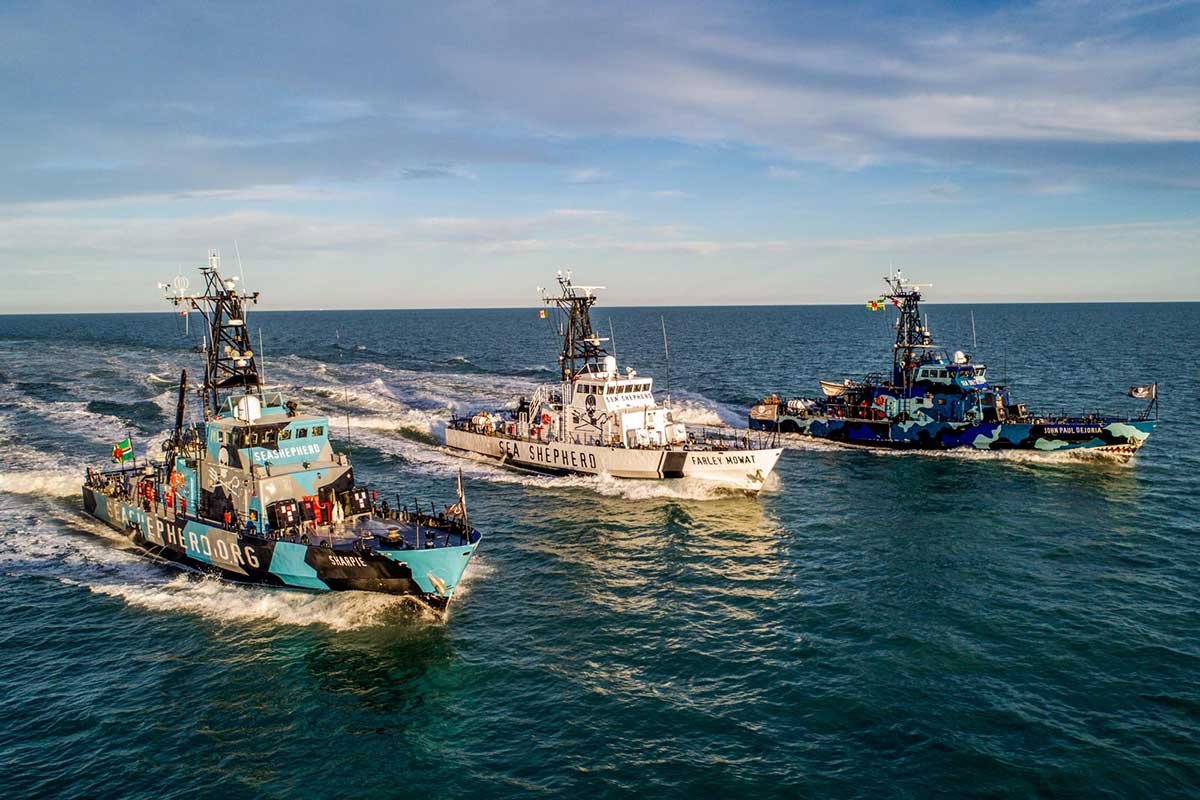

It is interesting to look closely at an organization that I have a soft spot for with a slightly cold journalistic eye. The Sea Shepherd project has, in my view, been one that has fundamentally altered opinions globally in favor of the essential conservation needed for threatened marine species. Still, it hasn’t been without controversy, and, in the interests of transparency, this article does not shy away from this. My own philosophy leans more into a Greenpeace perspective of pacifism and bearing witness yet I understand why in years past the Sea Shepherd mob felt driven to take drastic action. You can find out more about Sea Shepherd here and perhaps consider donating to their ongoing work. – Kevin Parker- Site Publisher
The Jolly Roger of Conservation
On the high seas, few symbols are as evocative or as paradoxical as the flag flown by the ships of the Sea Shepherd Conservation Society. It is a modified Jolly Roger, the skull and crossbones of historical piracy, but with a crucial difference: the skull is flanked by a shepherd’s crook and a trident, symbols of protection and intervention. A whale and a dolphin form the skull’s eye sockets, gazing out from the black flag.²⁴ This emblem perfectly encapsulates the central tension of the organization it represents: a self-appointed guardian of the oceans that has, for decades, employed the confrontational tactics of an outlaw. It is a symbol of conservation through aggression, of law enforcement without a state mandate, and of a radical environmentalism born from a deliberate break with the mainstream.
This essay will argue that the history of the Sea Shepherd Conservation Society (SSCS) is a compelling case study in the evolution of radical environmentalism. It traces the organization’s trajectory from its origins in confrontational vigilantism, born from a schism with the pacifist doctrine of Greenpeace, through a period of global notoriety fueled by media spectacle, to a strategic pivot towards quasi-state legitimacy through government partnerships. This evolution, however, ultimately created an ideological fracture so profound that it led to the ousting of its iconic founder, revealing the inherent contradictions in attempting to institutionalize a radical, personality-driven movement. To understand Sea Shepherd is to understand the complex interplay between ideology, tactics, law, and public perception that defines the cutting edge of environmental activism. This analysis will proceed chronologically and thematically, first examining the organization’s foundational principles, then detailing the signature campaigns that defined its confrontational era. It will subsequently analyze the strategic pivot toward state partnerships and the legal pressures that prompted it, before dissecting the 2022 internal schism that split the movement. Finally, the conclusion will synthesize these themes to evaluate Sea Shepherd’s contested but undeniable legacy in the global fight for marine conservation.
Part I: Forging a Doctrine of Aggressive Non-Violence
The entire operational history and ideological framework of the Sea Shepherd Conservation Society is rooted in its schismatic birth. It was not merely a new organization but a direct, philosophical repudiation of the world’s most prominent environmental group, Greenpeace. This foundational conflict over the meaning of “non-violence” and the nature of effective action created a new, more radical niche in environmentalism, one that Sea Shepherd would occupy and define for over four decades.
A Mutiny of Principle: The Greenpeace Schism
Paul Watson, the founder and long-time leader of Sea Shepherd, was an early and influential member of Greenpeace. He was present at its genesis, participating in the 1971 protest against American nuclear testing in Alaska that marked the organization’s first campaign.¹ While his status as a “co-founder” is a point of long-running and bitter dispute with Greenpeace, which has retroactively denied the claim, his role as a key early activist is not in question.¹, ² The ideological chasm between Watson and the Greenpeace leadership opened over the fundamental definition of “non-violence.” Greenpeace adhered to a strict interpretation inspired by pacifist traditions, focusing on “bearing witness” to environmental atrocities and using peaceful protest to generate public pressure.¹⁷ Watson, however, developed a philosophy he termed “aggressive non-violence,” which sanctioned direct physical intervention and the destruction of property used to harm wildlife, so long as no person was injured.³, ¹⁷
This philosophical divergence was crystallized by two seminal events. The first was a profound emotional experience during a 1975 Greenpeace campaign against a Soviet whaling fleet. Watson described locking eyes with a dying sperm whale that had been harpooned after trying to defend its calf. He has repeatedly cited this moment as a life-altering event that convinced him that passive witnessing was an inadequate response to such violence.¹, ²⁹ The second, and more direct, catalyst for the split occurred in 1977 during a campaign to protect harp seals. Watson, frustrated with what he saw as inaction, grabbed a sealer’s club and a pile of pelts and threw them into the ocean.³ ⁶ This was a direct violation of Greenpeace’s doctrine.
The fallout was swift. In 1977, the Greenpeace board of directors voted 11 to 1 to expel Watson; Watson himself cast the lone dissenting vote.², ⁴ Key Greenpeace figures like the late Bob Hunter, after whom a Sea Shepherd vessel would later be named, described Watson as a “mutineer” and a “great warrior brother” who was nonetheless possessed by “too powerful a drive, too unrelenting a desire to push himself front and centre.”⁴ The split was acrimonious and the feud has persisted for decades. Watson famously derided his former colleagues as the “Avon ladies of the environmental movement,” while Greenpeace has labeled him a “violent extremist” and refused to cooperate with his organization.¹, ², ⁴
The conflict was far more than a personality clash; it was a fundamental divergence on the strategy and tactics of activism. By leaving Greenpeace, Watson did not just start another environmental group; he deliberately created a competing ideological space. This new niche was defined in opposition to Greenpeace’s perceived passivity and corporate-friendly approach. From the outset, Watson positioned Sea Shepherd as the more authentic, more courageous, and less compromised alternative. In a 1978 radio interview, he accused Greenpeace and other organizations of using the emotionally charged anti-sealing campaigns primarily as a fundraising “profit maker,” a line of attack that framed his own nascent group as being motivated by pure conviction rather than financial gain.² This schism established a permanent binary in marine conservation activism that would shape the strategies, public perception, and fundraising appeals of both organizations for the rest of the century: the “respectable” insider versus the “radical” outsider.
The Law of the Outlaw: Enforcing Nature’s Mandate
Immediately after his expulsion from Greenpeace, Watson founded the Earth Force Society in Vancouver in 1977, which soon became the Sea Shepherd Conservation Society.⁹, ¹⁰, ¹¹ Its mission was clear and uncompromising: “to end the destruction of habitat and slaughter of wildlife in the world’s oceans in order to conserve and protect ecosystems and species” through the use of “innovative direct-action tactics.”¹⁰ From its very inception, Sea Shepherd positioned itself not as a protest group, but as an enforcement agency. Watson repeatedly stated that Sea Shepherd was a “self-appointed policing organization” or an “anti-poaching agency,” a rhetorical framing that would become central to its identity and legal strategy.⁹, ¹³, ¹⁹, ⁵⁰
This claim to enforcement authority was not merely aspirational; Watson sought to ground it in international law. Sea Shepherd consistently cited the 1982 United Nations World Charter for Nature as its legal justification. The Charter states that “each person has a duty to act in accordance with the provisions of the present Charter,” which the organization interpreted as granting non-state actors and individuals the authority—and indeed, the responsibility—to uphold international conservation laws, especially on the high seas where state enforcement is often absent.⁸, ¹⁹, ⁵⁵ This interpretation, while highly controversial and not widely accepted in international legal circles, provided a crucial veneer of legitimacy for its actions.
With a foundational philosophy in place, Watson secured funding from Cleveland Amory, head of the Fund for Animals, to purchase his first vessel in 1978: a British trawler he renamed the Sea Shepherd.⁹, ¹⁷ He wasted no time putting his doctrine into practice. In March 1979, the ship undertook its first campaign against the Canadian seal hunt.¹¹, ⁷² Then, in July of the same year, Sea Shepherd executed the action that would define its public image for years to come. It hunted down the notorious pirate whaling vessel Sierra—a ship estimated to have killed over 25,000 whales while flying flags of convenience to evade regulation—and rammed it in a Portuguese harbor, inflicting serious damage.¹, ⁶, ⁹ The Sierra was later sunk in Lisbon harbor in 1980 by what investigators determined were limpet mines; Sea Shepherd claimed responsibility.¹⁹ This act of aggressive intervention against an undisputed criminal operation made Sea Shepherd a media sensation and confirmed Watson’s theory that violent confrontation would attract global attention to his cause.¹
This strategy of “direct enforcement,” as some academic analyses have termed it, was a work of strategic brilliance.⁵¹, ⁵⁴ By framing its actions as law enforcement rather than protest, Sea Shepherd created a powerful rhetorical and legal shield. Its activists were not criminals breaking the law; they were heroes upholding a higher moral and international law that sovereign states were unwilling or unable to enforce. This approach relied heavily on what legal scholars call the “principle of unclean hands”: targets engaged in clearly illegal or morally reprehensible activities, like the operators of the Sierra, were unlikely to press charges or seek legal recourse because doing so would expose their own criminality to public scrutiny.⁵¹, ⁵⁴ Furthermore, by operating in the legally ambiguous spaces of the high seas and wrapping its actions in a complex web of international charters and conventions, the organization made prosecution by any single state politically complicated and potentially embarrassing. Sea Shepherd’s core strategy was thus to weaponize the gaps in international maritime law enforcement. It created a space where its doctrine of “aggressive non-violence” could operate with a degree of impunity that would have been impossible for a conventional protest group, making its sophisticated use of legal rhetoric as critical to its success as its physical tactics.
Part II: Theaters of Confrontation: Signature Campaigns
Having established its radical doctrine, Sea Shepherd spent the next three decades building a global reputation through a series of high-profile, confrontational campaigns. These actions were not merely protests; they were meticulously staged “theaters of confrontation” designed for mass media consumption. From the ice floes of Canada to the frigid waters of the Antarctic, Sea Shepherd perfected a model of combining direct physical intervention with powerful visual storytelling to mobilize public opinion and disrupt its targets.
War on the Ice Floes: The Canadian Seal Hunt
Sea Shepherd’s very first direct-action campaign, in March 1979, was aimed at the annual Canadian commercial seal hunt in the Gulf of St. Lawrence.⁹, ⁷⁷ In a tactic that would become a hallmark of its early activism, crew members went onto the ice and sprayed hundreds of harp seal pups with harmless, indelible red dye.⁷⁶ This action, which rendered the pups’ valuable white pelts commercially worthless, immediately led to arrests for violating Canada’s Seal Protection Act but also generated significant media attention.⁴⁴, ⁷⁷ This was the opening salvo in a multi-decade war on the ice.
The campaigns against the seal hunt continued intermittently for nearly 30 years, employing a variety of confrontational tactics. In 1983, the Sea Shepherd II blockaded the harbor of St. John’s, Newfoundland, preventing the sealing fleet from leaving for two weeks.⁶, ⁷² The vessel, fortified with barbed wire and a water cannon, then moved to the ice to harass and chase away sealing ships, leading to a one-day suspension of the hunt.⁷⁷ These actions resulted in the vessel being boarded by Canadian police using tear gas, the arrest of the crew, and the ship’s temporary confiscation. Watson was sentenced to prison but was later acquitted on appeal.⁶, ²⁰, ⁷¹, ⁷⁷ Other campaigns involved activists physically placing themselves between sealers and seals, documenting acts of cruelty, and enduring violent confrontations with sealers who attacked them with clubs and fists.²⁰, ⁷⁷
The Canadian seal hunt provided Sea Shepherd with a morally unambiguous target, which was perfectly suited to its strategy. As Watson himself admitted, the image of a helpless, white-coated baby seal being clubbed to death is an incredibly potent symbol, “an image which just goes right to the heart of animal lovers” and is easy to exploit for fundraising and public sympathy.¹⁹, ⁷¹ For a global audience, the issue was presented in stark, black-and-white terms: the brutal slaughter of charismatic infants for a non-essential luxury product, fur.⁶⁹ This simple, powerful narrative allowed Sea Shepherd to build a broad base of international support and cast its aggressive interventions as heroic acts of defense.
The ultimate success of these campaigns was not measured in the number of seals directly saved on the ice, but in the long-term political and economic consequences they helped generate. The constant international pressure, fueled by the shocking imagery provided by Sea Shepherd and other groups like the International Fund for Animal Welfare (IFAW), was instrumental in shifting public opinion.⁴², ⁷⁰ This culminated in the European Union’s 2009 ban on the import of products from the commercial seal hunt.⁴¹, ⁷⁹, ⁸⁰ This ban crippled the primary market for Canadian seal pelts, causing prices to plummet and demonstrating that direct action, sustained over decades, could achieve tangible, systemic change by destroying the economic foundation of a target industry.⁸¹ The seal hunt campaigns perfected the Sea Shepherd blueprint: combine dramatic, on-the-ground confrontation with emotionally charged media imagery to create international political pressure that results in devastating economic consequences for the perpetrators.
The Southern Ocean Whale Wars
While the seal hunt campaigns established its methods, it was Sea Shepherd’s war against the Japanese whaling fleet in the Southern Ocean that catapulted the organization to global fame. From 2002 to 2017, Sea Shepherd conducted eleven major campaigns in the Antarctic, directly confronting the Japanese fleet operating under the controversial guise of “scientific research” (JARPA II).²⁵, ²⁷, ³⁰ Japan’s activities took place within the Southern Ocean Whale Sanctuary, a region where the International Whaling Commission (IWC) had banned all commercial whaling, but a loophole in the IWC convention allowed for lethal “research.”⁵³, ⁵⁷ Sea Shepherd declared this to be a sham and took it upon itself to enforce the spirit of the sanctuary.⁵⁷
The tactics employed during these “Whale Wars” were diverse, relentless, and highly aggressive. Sea Shepherd vessels would spend months tracking the Japanese fleet across the vast, dangerous Antarctic waters. Once engaged, they would physically block the slipways of the Nisshin Maru factory ship to prevent dead whales from being loaded, and they would position their own smaller boats between the harpoon ships and fleeing whales.²⁴ They fouled propellers with reinforced ropes, rammed and disabled vessels, and threw projectiles onto the decks of the Japanese ships. These included bottles of butyric acid (“stink bombs”), a foul-smelling substance designed to contaminate the whale meat and make the working conditions on the flensing deck unbearable, and bags of cellulose powder to make the decks dangerously slippery.⁴, ⁶, ⁵⁰ The whalers responded in kind, using powerful water cannons and deploying Long-Range Acoustic Devices (LRADs). The confrontations were intense and dangerous, often resulting in collisions and injuries.⁵⁵
The key to this campaign’s global impact was its transformation into a media spectacle. From 2008 to 2015, the Animal Planet television series Whale Wars documented the high-seas escapades of the Sea Shepherd fleet.²⁴, ²⁹ The show was an international hit, bringing the organization unprecedented fame, a massive surge in donations, and a constant stream of idealistic volunteers eager to join the crew.²⁴, ⁵¹ This created a powerful, self-perpetuating engine for the conflict. The show generated the funds and personnel needed for more ambitious and technologically advanced campaigns, such as the acquisition of faster ships. The resulting escalation in conflict provided more dramatic content for the show, which in turn generated more support.
This symbiosis between activism and entertainment, however, had complex consequences. While it was undeniably successful in raising global awareness and disrupting the hunt, the dependency on media spectacle may have locked Sea Shepherd into a strategy of perpetual escalation. To maintain audience engagement and fundraising momentum, each season arguably required more dramatic and risky confrontations than the last. This dynamic likely contributed to the “eco-terrorist” and “pirate” labels that would later cause the organization significant legal trouble.⁵³, ⁵⁵ Furthermore, some analysts and Japanese sources have argued that the highly visible aggression was counterproductive within Japan itself. It allowed the Japanese government to reframe the whaling issue as a matter of national sovereignty and pride against foreign extremists, thereby hardening domestic support for a program that many Japanese citizens might otherwise have been indifferent to.⁵⁵, ⁵⁸
Nonetheless, the campaign achieved remarkable results. Sea Shepherd claims its interventions saved the lives of over 6,000 whales during this period.²⁵, ²⁸, ³², ⁷⁵ The constant harassment significantly increased the operational costs and dramatically reduced the efficiency of the Japanese fleet, which frequently failed to meet its self-imposed quotas.⁵⁴ The campaign culminated in Japan’s 2018 announcement that it would cease its whaling activities in the Southern Ocean. Sea Shepherd credited this victory to the combined pressure of its direct interventions, the enormous cost Japan incurred in deploying security to counter them, and the landmark 2014 ruling by the International Court of Justice (ICJ), which declared that Japan’s research program was not, in fact, for scientific purposes and was therefore illegal.²⁵, ⁵⁵, ⁵⁷ The Whale Wars era represents the zenith of Sea Shepherd’s original model, but it also reveals the model’s inherent limitations. The strategy’s reliance on media spectacle created a need for escalating conflict that was both legally unsustainable and potentially counterproductive to achieving political change within the target nation.
Case Study: The Sinking of the Ady Gil
No single incident encapsulates the high-risk, high-reward strategy of the Whale Wars era better than the loss of the vessel Ady Gil. The ship itself was a symbol of Sea Shepherd’s growing sophistication and fundraising prowess. Formerly the Earthrace, a futuristic, wave-piercing trimaran that held the world record for circumnavigating the globe in a powerboat, it was purchased with a $1 million donation from Hollywood lighting magnate Ady Gil and repainted black with radar-scattering paint.³, ³, ⁶⁶ Fast, stealthy, and visually stunning, it was the perfect vessel for a television show, designed to be fast enough to outrun the Japanese fleet.³, ³⁷
On January 6, 2010, during the campaign dubbed “Operation Waltzing Matilda,” the Ady Gil was engaged in harassing the Japanese fleet in the Southern Ocean when it collided with the Japanese security and harpoon vessel, the Shōnan Maru 2.³⁵, ⁷⁵ The collision sheared off the entire bow of the lightweight trimaran. The footage was shocking. Sea Shepherd immediately claimed the collision was a deliberate and unprovoked ramming, a “vicious attack” by the larger Japanese ship.³⁸ The Japanese government and the Institute of Cetacean Research countered that the Ady Gil had been maneuvering dangerously, cut directly in front of their vessel, and was responsible for the incident.³⁸
The heavily damaged Ady Gil was abandoned and, after a failed towing attempt, sank into the Antarctic waters, a total loss.³⁸ Miraculously, none of the six crew members were seriously injured. Tactically, the incident was a disaster—a multi-million dollar, state-of-the-art asset was destroyed. Strategically and mediatically, however, it was an overwhelming victory for Sea Shepherd. The dramatic footage of the sleek, black vessel being sliced in two became the defining image of the campaign, broadcast around the world. It galvanized public support, fueled outrage against Japanese whaling, and undoubtedly drove a massive influx of donations. The “truth” of the incident remains contested, a microcosm of the entire conflict, which was fought as much in the court of public opinion and through competing propaganda as it was on the water. The loss of the Ady Gil demonstrates the extreme risks inherent in Sea Shepherd’s tactics but also the immense media and fundraising rewards. It stands as the ultimate example of the organization’s willingness to sacrifice its own assets to create a powerful global narrative of heroic martyrdom and industrial villainy.
| Vessel Name | Years of Service (Approx.) | Original Purpose / Type | Key Campaigns | Fate / Significance |
| Sea Shepherd | 1978–1979 | Fishing Trawler | Canadian Seal Hunt (1979), Ramming of the Sierra (1979) | Scuttled in Portugal (1979) after the Sierra campaign to avoid seizure.⁹, ¹⁹ |
| Sea Shepherd II | 1980–1992 | Fishing Trawler | Dolphin defense (Iki Island), Faroe Islands whaling, Canadian Seal Hunt (1983) | Confiscated by Canada in 1983, later returned; eventually sold.⁷², ⁷⁷ |
| Farley Mowat | 1996–2008 | Fisheries Research Vessel | Galapagos patrols, Canadian Seal Hunt (2008) | Impounded by the Canadian government in 2008 and never recovered.⁹, ²¹ |
| Steve Irwin | 2007–2018 | Scottish Fisheries Patrol | Southern Ocean Whale Wars (multiple campaigns), Faroe Islands | Formerly the M/Y Robert Hunter. Named for Steve Irwin with his widow’s support. Retired in 2018.⁹, ²¹, ³⁷ |
| Bob Barker | 2009–2022 | Norwegian Whaling Catcher | Southern Ocean Whale Wars, African IUU Fishing Partnerships | Purchased with a $5M donation from Bob Barker. Ice-strengthened hull was crucial in Antarctica. Scrapped in 2022.⁹, ³⁶, ³⁷ |
| Ady Gil | 2009–2010 | Record-holding Powerboat (Trimaran) | Southern Ocean Whale Wars (“Operation Waltzing Matilda”) | Formerly the Earthrace. Sunk in 2010 after a collision with the Japanese vessel Shōnan Maru 2.³⁵, ³⁸ |
| Ocean Warrior | 2016–Present | Custom-built Patrol Vessel | Southern Ocean Whale Wars (“Operation Nemesis”), African IUU Fishing Partnerships | Faster than any Japanese whaling vessel, representing a new level of tactical capability.³², ⁴⁸ |
Part III: The Pivot: From Pariah to Partner
The high-water mark of the Whale Wars era, while bringing global fame, also brought crippling legal and political pressure. The very tactics that made Sea Shepherd a household name pushed it to the brink of being designated a criminal enterprise. Faced with an existential threat to its ability to operate, the organization underwent the most significant strategic transformation in its history, pivoting away from unilateral vigilantism and towards a new model of state-sanctioned legitimacy.
In the Crosshairs: Accusations of Piracy and Terrorism
As Sea Shepherd’s tactics grew more aggressive, so too did the efforts to stop them. The Japanese government, the primary target of the Antarctic campaigns, consistently labeled the organization “eco-terrorists” and issued international arrest warrants for Paul Watson, forcing him to become a fugitive for a period.⁵, ²⁹, ⁵⁹ This rhetoric was damaging, but the most significant blow came not from a political opponent but from the U.S. legal system.
In a landmark 2013 decision in the case of Institute of Cetacean Research v. Sea Shepherd Conservation Society, the United States Ninth Circuit Court of Appeals delivered a damning verdict. The court, upholding an injunction to prevent Sea Shepherd from attacking or endangering Japanese vessels, explicitly branded the activists as “pirates.” In a widely quoted passage, Chief Judge Alex Kozinski wrote, “You don’t need a peg leg or an eye patch. When you ram ships, hurl glass containers of acid, drag metal-reinforced ropes in the water to damage propellers and rudders, launch smoke bombs and flares with hooks, and point high-powered lasers at other ships, you are, without a doubt, a pirate, no matter how high-minded you believe your purpose to be.”⁵⁶, ⁵⁹, ᴮ³ This ruling was a turning point. It stripped away the veneer of legal ambiguity and moral authority that Sea Shepherd had carefully cultivated for decades. The organization’s actions were no longer a matter of contested interpretation of the UN World Charter for Nature; a major federal court in a key allied nation had made a definitive and delegitimizing judgment.
The legal pressure created an existential crisis. It threatened the organization’s non-profit status in the United States, exposed it to massive financial liabilities, and made it increasingly difficult to secure vessel insurance, enter ports, and operate freely. The “pirate” label was not just a public relations problem; it was a strategic dead end. This legal defeat forced a major organizational restructuring, causing the U.S. branch to formally separate from other global entities to shield the broader movement from the ruling’s consequences.ᴮ¹
The criticism was not limited to Japan and the U.S. courts. The International Whaling Commission denounced the group for jeopardizing maritime safety.⁵⁶ Even fellow environmental organizations, most notably Greenpeace, continued to publicly condemn Sea Shepherd’s tactics. Greenpeace argued that the confrontational approach was not only dangerous but also counterproductive, as it allowed Japan to easily paint all anti-whaling activists as violent extremists, thereby undermining more diplomatic efforts to end whaling from within.⁴, ⁵⁵ Furthermore, some indigenous communities in Canada and elsewhere criticized the anti-sealing campaigns, arguing that the activists failed to distinguish between industrial slaughter and their own sustainable, culturally significant hunts, thereby harming their traditions and livelihoods.⁵⁶, ⁵⁸ The cumulative weight of this legal, political, and peer condemnation made Sea Shepherd’s original model of unilateral confrontation untenable. The law, which Watson had once used as a shield, had become a sword turned against his own organization.
The New Frontline: Combating IUU Fishing in Partnership
In response to this mounting pressure, Sea Shepherd executed a brilliant strategic pivot. Beginning around 2016, under the operational leadership of then-Director of Campaigns Peter Hammarstedt, the organization dramatically shifted its focus away from the high-profile anti-whaling campaigns and toward a new mission: partnering with national governments to combat Illegal, Unreported, and Unregulated (IUU) fishing.¹², ²⁴, ⁴⁶ This new model represented a fundamental change in strategy, an evolution from a “vigilante group to a partner of government authorities.”¹²
The new approach involves Sea Shepherd providing its vessels, experienced crew, and fuel as “civilian offshore patrol vessels” (COPVs). These ships then host law enforcement agents—such as navy sailors or coast guard officers—from the partner nation.⁴⁶, ⁴⁹ Critically, the command structure is inverted from past campaigns: the partner government’s officers have the sole authority to board, inspect, and arrest vessels suspected of illegal activity. Sea Shepherd provides the platform and operational expertise; the sovereign state provides the legal authority.⁴⁹ This simple but profound shift instantly solved the legitimacy crisis created by the piracy ruling. Operating under the direct authority and flag of a sovereign state, Sea Shepherd’s actions were no longer legally questionable vigilantism; they were state-sanctioned law enforcement.¹², ⁵⁶
These partnerships have been concentrated in the Global South, particularly in African and Latin American nations that have rich marine ecosystems but lack the resources to adequately patrol their own Exclusive Economic Zones (EEZs).⁴⁶, ⁵⁷ Sea Shepherd has launched successful, long-term operations in collaboration with the governments of Gabon, Liberia, Tanzania, The Gambia, Benin, Namibia, Sierra Leone, and São Tomé and Príncipe, among others.⁴⁵, ⁴⁶, ⁴⁸ In Mexico, it works with the navy to protect the critically endangered vaquita porpoise from illegal gillnetting.²³ This strategic shift was even formalized as a commitment to the United Nations under the Sustainable Development Goals, further cementing the organization’s new-found legitimacy.⁴⁶, ⁴⁷
This “Pirate to Partner” evolution represents a maturation of the organization. It is arguably a more effective and sustainable model for creating change. Instead of engaging in dramatic but legally perilous confrontations with ambiguous outcomes, the partnership campaigns result in the direct, legally sound enforcement of conservation laws. They have led to the arrest and seizure of dozens of illegal fishing vessels, creating a powerful deterrent and helping to restore the rule of law in some of the world’s most vulnerable waters.ᴮ² This new strategy moves Sea Shepherd from a reactive, target-of-opportunity model (chasing whalers) to a proactive, systemic one (building long-term enforcement capacity). It directly addresses the “law enforcement vacuum” on the high seas in a way that unilateral action never could, representing a masterstroke of organizational adaptation that secured its survival while creating a more scalable and legitimate operational model.
| Partner Country / Region | Operation Name | Year Initiated (Approx.) | Key Outcomes & Significance |
| Gabon | Operation Albacore | 2016 | Patrols Africa’s largest network of marine protected areas. Has resulted in the arrest of numerous illegal trawlers for offenses like fishing without a license and shark finning.⁴⁷, ⁴⁸ |
| Liberia | Operation Sola Stella | 2017 | Patrols Liberia’s coastal waters, focusing on protecting the Inshore Exclusion Zone reserved for artisanal fishermen. Dozens of vessels arrested for violations.⁴⁷, ⁴⁹ |
| Tanzania | Operation Jodari | 2018 | Partnership with Tanzania and the regional Fish-i Africa task force to combat IUU fishing in the Western Indian Ocean, targeting illegal shark finning and use of prohibited gear.⁴⁸ |
| The Gambia | Operation Gambian Coastal Defense | 2019 | Partnership with The Gambia’s Ministry of Fisheries and Navy to protect waters vital to the livelihoods of over 200,000 local people. Multiple trawlers arrested for fishing in restricted zones.⁴⁸ |
| Namibia | Operation Vanguard | 2019 | Joint surveillance activities in Namibia’s EEZ to combat illegal trawling for horse mackerel, forcing suspect vessels out of the nation’s waters.⁴⁸ |
| Sierra Leone | Operation Sierra Leone Coastal Defense | 2021 | Partnership with Sierra Leone’s Ministry of Defense and Navy. The campaign launched with the arrest of five illegal trawlers in its first two days.⁴⁸ |
| Benin | Operation Guegou | 2019 | Joint patrols in the Gulf of Guinea to stop poaching in Benin’s waters, working with the navy and local law enforcement.⁴⁸ |
| Mexico | Operation Milagro | c. 2015 | Long-standing partnership with the Mexican Navy in the Upper Gulf of California to remove illegal gillnets that threaten the critically endangered vaquita porpoise.²³, ⁶³ |
Part IV: A House Divided: The 2022 Schism
Sea Shepherd’s strategic evolution from outlaw to partner, while a triumph of organizational adaptation, came at a profound internal cost. The pivot towards legitimacy and government collaboration placed the organization on a direct collision course with the uncompromising, confrontational ideology of its founder. This clash between the pragmatic institution and the revolutionary visionary culminated in a bitter 2022 schism that fractured the global movement and ousted Paul Watson from the organization he had created.
The Founder’s Exit: A “Hostile Takeover”
In July 2022, Paul Watson issued a public statement announcing that he had “ceased my employment and cut all ties with the Sea Shepherd Conservation Society (USA).”⁶², ᴮ⁴ While the announcement was sudden, the underlying conflict had been simmering for years. The rift began in earnest after the 2013 “piracy” ruling, which led to a restructuring and the installation of Pritam Singh, a wealthy real estate developer and major donor, as the head of the influential U.S. branch.ᴮ¹, ᴮ⁴ According to Watson, this marked the beginning of a gradual, deliberate marginalization process he described as a “hostile take-over.”⁶²
The core of the dispute was the organization’s new direction. Watson stated that the board of directors wanted to “disassociate with our traditional tactics and strategies” in favor of focusing on non-controversial research and government partnerships. He was told that his own history—and by extension, the foundational history of Sea Shepherd itself—was now viewed as an “obstacle for negotiations with governments and corporations.”⁶², ᴮ⁴ For Watson, this was an unacceptable betrayal of the organization’s soul. He saw the pivot not as a savvy strategic evolution but as a descent into a “mediocre, less controversial, less confrontational” version of the very mainstream environmentalism he had rebelled against in 1977.³ He informed the board he could not support the new direction and was told, “I was an employee and needed to do what I was told.”⁶²
From the perspective of the SSCS and Sea Shepherd Global boards, the situation was different. In their public statements, they framed Watson’s departure as the culmination of a long process, noting that he had already stepped back from day-to-day management in 2014 and that by 2019 his role had been reduced primarily to that of an archivist and historian.⁶³ They insisted that the organization remained committed to “direct action,” but their definition of the term had clearly evolved to include the government partnership campaigns and providing support for scientific research—a redefinition Watson rejected as disingenuous.⁶², ⁶³
This conflict is a classic case of the “founder’s dilemma.” The very traits that made Watson a successful revolutionary leader—his uncompromising vision, his confrontational charisma, and the powerful cult of personality he built around himself—became liabilities for the mature, institutionalized organization he had forged. The new leadership, facing the hard realities of international law, financial sustainability, and operational risk, made a rational decision to pivot towards a more stable and legally defensible model. This is a natural, often necessary, stage in the lifecycle of a successful social movement. For Watson, however, this institutionalization was anathema. His identity and the organization’s were inextricably fused. The move away from “aggressive non-violence” was not a strategic choice but an abandonment of sacred principle. The board saw him as an obstacle to the organization’s future; he saw them as gutting its very reason for being. The schism was not merely a power struggle but an inevitable ideological clash between the revolutionary founder and the pragmatic institution he had built.
Two Shepherds on the High Seas
The departure of Paul Watson did not just remove a figurehead; it fractured the global Sea Shepherd movement. Immediately following his ousting, Watson established a new entity, the Captain Paul Watson Foundation, which he positioned as the true heir to the original Sea Shepherd mission, later adding the name Sea Shepherd Origins.⁹, ¹², ⁶⁰
The global network of independent national chapters was forced to choose sides. In a significant show of loyalty to the founder and his philosophy, several key chapters—including those in France, the United Kingdom, and Brazil—broke away from the Sea Shepherd Global umbrella and pledged their allegiance to Watson’s new foundation.⁹, ¹², ᴮ¹ This created a formal split, resulting in two distinct movements operating under variations of the same iconic name.
The official Sea Shepherd entities, SSCS (USA) and Sea Shepherd Global, have continued to pursue the partnership model with vigor. They have expanded their fleet, acquiring new vessels like the MV Sharkwater, and have deepened their commitment to campaigns like Operation Milagro, working with the Mexican Navy to save the vaquita porpoise from extinction.⁶³, ⁶⁷ Meanwhile, Watson and his new foundation seek to continue the legacy of confrontational, non-compromising direct action, unencumbered by the diplomatic constraints of government partnerships. The separation was finalized when Watson was legally barred from using the Sea Shepherd name or logo, a move that cemented the divorce.⁶⁰ His long-standing legal troubles with international law enforcement, however, saw a positive resolution when Interpol cancelled its Red Notice against him.⁶¹
This schism has created two Shepherds on the high seas, each competing for the same legacy, donor base, and public identity. One entity, the official Sea Shepherd, represents the future of institutionalized, “legitimate” activism—effective, collaborative, and professional, but less overtly radical. The other, Watson’s foundation, represents the “pure” ideology of the founder—uncompromising, confrontational, and proudly defiant. The future of this fractured brand remains uncertain. Can the official Sea Shepherd maintain its powerful brand identity and fundraising appeal without its charismatic, controversial founder? Can Watson’s new venture recapture the momentum, resources, and global platform of the organization he spent a lifetime building? The Sea Shepherd story is no longer a single narrative but a contested legacy being written in real-time. The outcome will serve as a powerful indicator for the future of environmentalism itself: will it be dominated by pragmatic, state-sanctioned partners, or is there still space in the world for radical, uncompromising outsiders to make waves?
Conclusion: The Contested Legacy of Direct Action
The history of the Sea Shepherd Conservation Society is a turbulent saga of rebellion, confrontation, and transformation. Born from an ideological mutiny against the pacifism of Greenpeace, it charted a new, aggressive course in marine conservation. Under the leadership of Paul Watson, the organization perfected a potent formula of “aggressive non-violence,” media spectacle, and a sophisticated manipulation of the gaps in international law. This strategy propelled a small, determined group to the forefront of the global environmental stage, allowing it to challenge powerful industries and sovereign nations on the high seas in a way no group had before.
The successes of this model are tangible and undeniable. Sea Shepherd’s decades-long campaigns were instrumental in creating the political and economic pressure that led to the EU ban on commercial seal products and the ultimate cessation of Japanese whaling in the Southern Ocean Whale Sanctuary.²⁵, ⁷⁹ Its ships and crews directly saved thousands of whales and seals from slaughter.⁵⁷ In its more recent evolution, the pivot to government partnerships has proven to be a remarkably effective model for tangible enforcement, leading to the arrest of dozens of illegal fishing vessels and providing critical support to developing nations that lack the resources to police their own waters.ᴮ² Inarguably, Sea Shepherd has successfully and repeatedly filled a law enforcement vacuum where the international community was either unable or unwilling to act.⁵⁷
Yet, this record of success is shadowed by significant and valid criticisms. The organization’s aggressive tactics led to it being branded as a “pirate” organization by a U.S. federal court and “eco-terrorists” by its targets, damaging its legitimacy and creating immense legal risk.⁵⁶, ⁵⁹ Its confrontational approach alienated potential allies, including other environmental groups and indigenous communities who felt their nuanced realities were trampled by the organization’s black-and-white worldview.⁴, ⁵⁸ There is also credible reason to believe that in some cases, particularly with Japanese whaling, its high-profile aggression may have been counterproductive, hardening the resolve of its opponents and transforming a domestic policy issue into a defense of national pride.⁵⁵
The organization’s legacy, therefore, is inherently complex and contested. It proved that radical, direct action could achieve what diplomacy and passive protest could not. It pioneered a model of media-savvy activism that has been profoundly influential. Yet, its own history demonstrates the immense challenge of sustaining radicalism within an institutional framework. The strategic pivot from pariah to partner, while a necessary move for survival and arguably more effective in its outcomes, ultimately required the sacrifice of its founding ideology and its founder.
The ultimate question Sea Shepherd’s story poses is not whether direct action works, but what form it must take to remain both relevant and legitimate in a world of increasingly complex ecological and political crises. The organization’s ongoing internal and external battles ensure that its narrative, like the oceans it has fought so fiercely to protect, remains in constant, turbulent motion.
Notes
¹ S.S.1, The Canadian Encyclopedia, s.v. “Paul Watson,” accessed October 26, 2023.
² S.S.2, “Paul Watson,” Wikipedia, last modified October 23, 2023.
³ S.S.3, “Captain Paul Watson: The Vegan Eco-Warrior, Master of Direct Action,” Vegan FTA, September 6, 2023.
⁴ S.S.4, “Paul Watson,” Greenpeace International, accessed October 26, 2023.
⁵ S.S.5, “Paul Watson, the ‘Whale Freak’ Who Became an Eco-Warrior,” The Greenside of Pink, updated 2024.
⁶ S.S.6, “The Good, the Bad, and the Ugly of the Sea Shepherd,” Heart of Illinois Group Newsletter (Sierra Club, Jan/Feb 2008).
⁷ S.S.17, Gerry Nagtzaam, “Paul Watson and the Future of the Sea Shepherd Conservation Society,” The Arts Journal 3, no. 1 (2014).
⁸ S.S.8, “Sea Shepherd Conservation Society (SSCS),” EBSCO Research Starters, accessed October 26, 2023.
⁹ S.S.9, “Sea Shepherd Conservation Society,” Wikipedia, last modified October 25, 2023.
¹⁰ S.S.10, “Sea Shepherd Conservation Society,” Social Movements Lab, Trinity College, accessed October 26, 2023.
¹¹ S.S.11, “Since 1977,” Sea Shepherd Conservation Society, accessed October 26, 2023.
¹² S.S.12, Malen Nousari, “From Pirate to Partner: Sea Shepherd’s Evolution in Maritime Conservation and the Pursuit of High Seas Legitimacy,” University of Miami International and Comparative Law Review 31, no. 2 (2024).
¹³ S.S.13, “Sea Shepherd’s Approach: Direct Action for Ocean Conservation,” Sea Shepherd Conservation Society, March 18, 2025.
¹⁴ S.S.14, “Direct Action Crew,” Sea Shepherd Conservation Society, accessed October 26, 2023.
¹⁵ S.S.15, Andy Oliver, “The Sea Shepherd – ‘Defend the Oceans’ with Sean Azzopardi’s Graphic Biography,” Broken Frontier, June 1, 2021.
¹⁶ S.S.16, Gerry Nagtzaam, “Ramming Speed! The Sea’s Shepherd Conservation Society and the Law of the Sea,” Monash University, 2008.
¹⁷ S.S.17, Gerry Nagtzaam, “Paul Watson and the Future of the Sea Shepherd Conservation Society.”
¹⁸ S.S.18, Gerry Nagtzaam, “Vessels of Rage: The Sea Shepherd Conservation Society and the International Law of the Sea,” William & Mary Environmental Law and Policy Review 38, no. 3 (2014).
¹⁹ S.S.19, “Sea Shepherd’s Violent History,” Institute of Cetacean Research, n.d.
²⁰ S.S.20, “Sea Shepherd Conservation Society operations,” Wikipedia, last modified September 28, 2023.
²¹ S.S.21, “Sea Shepherd History,” Sea Shepherd Global, accessed October 26, 2023.
²² S.S.22, “Who We Are,” Sea Shepherd Global, accessed October 26, 2023.
²³ S.S.23, “Home,” Sea Shepherd Conservation Society, accessed October 26, 2023.
²⁴ S.S.24, Christopher Solomon, “Sea Shepherd’s New War,” Outside, September 7, 2023.
²⁵ S.S.25, “Victory in Antarctica: Japan’s Whaling Ends in the Southern Ocean,” Sea Shepherd Global, December 26, 2018.
²⁶ S.S.26, “Our History of Protection,” Sea Shepherd Conservation Society, July 10, 2024.
²⁷ S.S.27, “Whale Defense Campaign,” Sea Shepherd Global, accessed October 26, 2023.
²⁸ S.S.28, “The End of Japan’s Antarctic Whaling,” YouTube video, 1:59, posted by Sea Shepherd Global, December 26, 2018.
²⁹ S.S.29, Jessica Hoek, “A Reprieve for the Whales: An In-Depth Analysis of the Effectiveness of International Law and the Sea Shepherd Conservation Society in the Fight to End Japanese Whaling,” Stanford Journal of Animal Law & Policy 3 (2010): 160-184.
³⁰ S.S.30, “Operation Nemesis,” Sea Shepherd Scandinavia, accessed October 26, 2023.
³¹ S.S.31, “Past Antarctic Whale Defense Campaigns,” Sea Shepherd Scandinavia, accessed October 26, 2023.
³² S.S.32, “Operation Nemesis: Sea Shepherd’s 11th Antarctic Whale Defense Campaign,” YouTube video, 2:15, posted by Sea Shepherd Global, November 29, 2016.
³³ S.S.33, “Sea Shepherd Conservation Society operations.”
³⁴ S.S.34, “Operation Nemesis,” Sea Shepherd Global, accessed October 26, 2023.
³⁵ S.S.35, “MY Ady Gil,” Wikipedia, last modified September 18, 2023.
³⁶ S.S.36, “MY Bob Barker,” Wikipedia, last modified October 11, 2023.
³⁷ S.S.37, “The Fleet,” Sea Shepherd Conservation Society (Weebly site), accessed October 26, 2023.
³⁸ S.S.38, “Sea Shepherd Vessel Rammed, Sinking,” Rewilding, January 8, 2010.
³⁹ S.S.39, “Ady Gil’s Desperate Attempt to Stop the Factory Ship | Whale Wars,” YouTube video, 2:54, posted by DMAX, October 2, 2020.
⁴⁰ S.S.40, “Home,” Sea Shepherd Global, accessed October 26, 2023.
⁴¹ S.S.41, “The Canadian Seal Hunt,” Sea Shepherd Conservation Society, May 7, 2012.
⁴² S.S.42, “Ending the Commercial Seal Hunt – Canada,” International Fund for Animal Welfare (IFAW), accessed October 26, 2023.
⁴³ S.S.43, “Seal hunting,” Wikipedia, last modified October 16, 2023.
⁴⁴ S.S.44, “Sea Shepherd Seal Defense – 1979,” YouTube video, 1:00, posted by Paul Watson, March 12, 2008.
⁴⁵ S.S.45, “Our Campaigns,” Sea Shepherd Scandinavia, accessed October 26, 2023.
⁴⁶ S.S.46, “Illegal Fishing Campaigns,” Sea Shepherd Global, accessed October 26, 2023.
⁴⁷ S.S.47, “Partnership with African Coastal States to Eradicate IUU Fishing,” UN Department of Economic and Social Affairs, accessed October 26, 2023.
⁴⁸ S.S.48, “Sea Shepherd’s Current Partnerships,” Sea Shepherd Global, accessed October 26, 2023.
⁴⁹ S.S.49, “Combatting illegal fishing in Liberia, West Africa,” Sea Shepherd Scandinavia, accessed October 26, 2023.
⁵⁰ S.S.50, Kaj Halse, “A Thorn in Their Side: The Sea Shepherd Conservation Society and the Strategy of Direct Enforcement” (MPhil diss., University of Cambridge, 2014).
⁵¹ S.S.51, Kaj Halse, “Direct Enforcement on the High Seas: The Strategy of the Sea Shepherd Conservation Society,” ResearchGate, January 2014.
⁵² S.S.52, “Science at Sea: How Sea Shepherd Uses Research to Protect the Ocean,” Sea Shepherd Conservation Society, April 8, 2025.
⁵³ S.S.53, Jessica Hoek, “A Reprieve for the Whales.”
⁵⁴ S.S.54, Kaj Halse, “A Thorn in Their Side.”
⁵⁵ S.S.55, “Sea Shepherd Conservation Society,” Wikipedia.
⁵⁶ S.S.56, Malen Nousari, “From Pirate to Partner.”
⁵⁷ S.S.57, “Why We Fight,” Sea Shepherd Global, accessed October 26, 2023.
⁵⁸ S.S.58, “What are the thoughts of the scientific community on Sea Shepherd?,” Reddit, r/marinebiology, 2022.
⁵⁹ S.S.59, Christopher Solomon, “Sea Shepherd’s New War.”
⁶⁰ S.S.60, “Paul Watson,” Wikipedia.
⁶¹ S.S.61, “Interpol Cancels Paul Watson Red Notice,” Sea Shepherd Conservation Society, July 22, 2025.
⁶² S.S.62, “Standing up for direct action: Paul Watson v. Sea Shepherds,” Freedom News, September 29, 2022.
⁶³ S.S.63, “In reference to Paul Watson’s resignation from Sea Shepherd Conservation Society on July 27th, 2022,” Sea Shepherd Conservation Society, July 31, 2022.
⁶⁴ S.S.64, “Paul Watson resigns from Sea Shepards USA,” gCaptain Forum, August 3, 2022.
⁶⁵ S.S.65, “Sea Shepherd Conservation Society,” Wikipedia.
⁶⁶ S.S.66, “Sea Shepherd History,” Sea Shepherd Global.
⁶⁷ S.S.67, “Home,” Sea Shepherd Conservation Society.
⁶⁸ S.S.68, “Scapegoats,” Theater of the Sea, accessed October 26, 2023.
⁶⁹ S.S.69, “Canadian Seal Hunt,” Humane World, accessed October 26, 2023.
⁷⁰ S.S.70, “Stand Fast for Seals,” YouTube video, 1:29, posted by Sea Shepherd, April 20, 2017.
⁷¹ S.S.71, “Sea Shepherd’s Violent History,” Institute of Cetacean Research.
⁷² S.S.72, “Since 1977,” Sea Shepherd Conservation Society.
⁷³ S.S.73, Jessica Hoek, “A Reprieve for the Whales.”
⁷⁴ S.S.74, “Our History of Protection,” Sea Shepherd Conservation Society.
⁷⁵ S.S.75, “Whale Defense Campaigns: A History,” Sea Shepherd Global, accessed October 26, 2023.
⁷⁶ S.S.76, “TIL Eight ‘Sea Shepherd’ activists were arrested in 1979…,” Reddit, r/todayilearned, 2018.
⁷⁷ S.S.77, “Sea Shepherd Conservation Society operations.”
⁷⁸ S.S.78, “The Canadian Blood Festival Resumes,” Britannica, accessed October 26, 2023.
⁷⁹ S.S.79, “Sea Shepherd’s Farley Mowat Seized by Canadian Government,” YouTube video, 1:49, posted by Journeyman Pictures, April 16, 2008.
⁸⁰ S.S.80, “Why We Fight,” Sea Shepherd Global.
⁸¹ S.S.81, “Fast and Furious Star Joins Sea Shepherd to Show Impact of Climate Change on Baby Seals,” EcoWatch, March 30, 2017.
ᴮ¹ 1, “Standing up for direct action: Paul Watson v. Sea Shepherds,” Freedom News, September 29, 2022.
ᴮ² 2, “Sea Shepherd Global’s partnerships with African governments to combat IUU fishing,” Research Synthesis.
ᴮ³ 3, “Legal challenges and criticisms faced by Sea Shepherd,” Research Synthesis.
ᴮ⁴ 1, “Reasons and statements regarding Paul Watson’s departure from Sea Shepherd in 2022,” Research Synthesis.
Bibliography
“Ady Gil’s Desperate Attempt to Stop the Factory Ship | Whale Wars.” YouTube video, 2:54. Posted by DMAX, October 2, 2020.
“The Canadian Blood Festival Resumes.” Britannica. Accessed October 26, 2023.
“The Canadian Seal Hunt.” Sea Shepherd Conservation Society. May 7, 2012.
“Canadian Seal Hunt.” Humane World. Accessed October 26, 2023.
“Captain Paul Watson: The Vegan Eco-Warrior, Master of Direct Action.” Vegan FTA. September 6, 2023.
“Combatting illegal fishing in Liberia, West Africa.” Sea Shepherd Scandinavia. Accessed October 26, 2023.
“Direct Action Crew.” Sea Shepherd Conservation Society. Accessed October 26, 2023.
“The End of Japan’s Antarctic Whaling.” YouTube video, 1:59. Posted by Sea Shepherd Global, December 26, 2018.
“Ending the Commercial Seal Hunt – Canada.” International Fund for Animal Welfare (IFAW). Accessed October 26, 2023.
“Fast and Furious Star Joins Sea Shepherd to Show Impact of Climate Change on Baby Seals.” EcoWatch. March 30, 2017.
“The Fleet.” Sea Shepherd Conservation Society. Weebly site. Accessed October 26, 2023.
“The Good, the Bad, and the Ugly of the Sea Shepherd.” Heart of Illinois Group Newsletter. Sierra Club, Jan/Feb 2008.
Halse, Kaj. “A Thorn in Their Side: The Sea Shepherd Conservation Society and the Strategy of Direct Enforcement.” MPhil diss., University of Cambridge, 2014.
———. “Direct Enforcement on the High Seas: The Strategy of the Sea Shepherd Conservation Society.” ResearchGate. January 2014.
Hoek, Jessica. “A Reprieve for the Whales: An In-Depth Analysis of the Effectiveness of International Law and the Sea Shepherd Conservation Society in the Fight to End Japanese Whaling.” Stanford Journal of Animal Law & Policy 3 (2010): 160-184.
“Home.” Sea Shepherd Conservation Society. Accessed October 26, 2023.
“Home.” Sea Shepherd Global. Accessed October 26, 2023.
“Illegal Fishing Campaigns.” Sea Shepherd Global. Accessed October 26, 2023.
“In reference to Paul Watson’s resignation from Sea Shepherd Conservation Society on July 27th, 2022.” Sea Shepherd Conservation Society. July 31, 2022.
Institute of Cetacean Research. “Sea Shepherd’s Violent History.” n.d.
“Interpol Cancels Paul Watson Red Notice.” Sea Shepherd Conservation Society. July 22, 2025.
“Legal challenges and criticisms faced by Sea Shepherd.” Research Synthesis.
“MY Ady Gil.” Wikipedia. Last modified September 18, 2023.
“MY Bob Barker.” Wikipedia. Last modified October 11, 2023.
Nagtzaam, Gerry. “Paul Watson and the Future of the Sea Shepherd Conservation Society.” The Arts Journal 3, no. 1 (2014).
———. “Ramming Speed! The Sea’s Shepherd Conservation Society and the Law of the Sea.” Monash University, 2008.
———. “Vessels of Rage: The Sea Shepherd Conservation Society and the International Law of the Sea.” William & Mary Environmental Law and Policy Review 38, no. 3 (2014).
Nousari, Malen. “From Pirate to Partner: Sea Shepherd’s Evolution in Maritime Conservation and the Pursuit of High Seas Legitimacy.” University of Miami International and Comparative Law Review 31, no. 2 (2024).
Oliver, Andy. “The Sea Shepherd – ‘Defend the Oceans’ with Sean Azzopardi’s Graphic Biography.” Broken Frontier. June 1, 2021.
“Operation Nemesis.” Sea Shepherd Global. Accessed October 26, 2023.
“Operation Nemesis.” Sea Shepherd Scandinavia. Accessed October 26, 2023.
“Operation Nemesis: Sea Shepherd’s 11th Antarctic Whale Defense Campaign.” YouTube video, 2:15. Posted by Sea Shepherd Global, November 29, 2016.
“Our Campaigns.” Sea Shepherd Scandinavia. Accessed October 26, 2023.
“Our History of Protection.” Sea Shepherd Conservation Society. July 10, 2024.
“Partnership with African Coastal States to Eradicate IUU Fishing.” UN Department of Economic and Social Affairs. Accessed October 26, 2023.
“Past Antarctic Whale Defense Campaigns.” Sea Shepherd Scandinavia. Accessed October 26, 2023.
“Paul Watson.” The Canadian Encyclopedia. Accessed October 26, 2023.
“Paul Watson.” Greenpeace International. Accessed October 26, 2023.
“Paul Watson.” Wikipedia. Last modified October 23, 2023.
“Paul Watson resigns from Sea Shepards USA.” gCaptain Forum. August 3, 2022.
“Paul Watson, the ‘Whale Freak’ Who Became an Eco-Warrior.” The Greenside of Pink. Updated 2024.
“Reasons and statements regarding Paul Watson’s departure from Sea Shepherd in 2022.” Research Synthesis.
“Scapegoats.” Theater of the Sea. Accessed October 26, 2023.
“Science at Sea: How Sea Shepherd Uses Research to Protect the Ocean.” Sea Shepherd Conservation Society. April 8, 2025.
“Sea Shepherd Conservation Society (SSCS).” EBSCO Research Starters. Accessed October 26, 2023.
“Sea Shepherd Conservation Society.” Social Movements Lab, Trinity College. Accessed October 26, 2023.
“Sea Shepherd Conservation Society.” Wikipedia. Last modified October 25, 2023.
“Sea Shepherd Conservation Society operations.” Wikipedia. Last modified September 28, 2023.
“Sea Shepherd Global’s partnerships with African governments to combat IUU fishing.” Research Synthesis.
“Sea Shepherd History.” Sea Shepherd Global. Accessed October 26, 2023.
“Sea Shepherd Seal Defense – 1979.” YouTube video, 1:00. Posted by Paul Watson, March 12, 2008.
“Sea Shepherd’s Approach: Direct Action for Ocean Conservation.” Sea Shepherd Conservation Society. March 18, 2025.
“Sea Shepherd’s Current Partnerships.” Sea Shepherd Global. Accessed October 26, 2023.
“Sea Shepherd’s Farley Mowat Seized by Canadian Government.” YouTube video, 1:49. Posted by Journeyman Pictures, April 16, 2008.
“Sea Shepherd Vessel Rammed, Sinking.” Rewilding. January 8, 2010.
“Seal hunting.” Wikipedia. Last modified October 16, 2023.
“Since 1977.” Sea Shepherd Conservation Society. Accessed October 26, 2023.
Solomon, Christopher. “Sea Shepherd’s New War.” Outside. September 7, 2023.
“Stand Fast for Seals.” YouTube video, 1:29. Posted by Sea Shepherd, April 20, 2017.
“Standing up for direct action: Paul Watson v. Sea Shepherds.” Freedom News. September 29, 2022.
“TIL Eight ‘Sea Shepherd’ activists were arrested in 1979 for violating the Seal Protection Act, for spraying a thousand seal pups with permanent red dye; rendering their pelts useless for hunters.” Reddit, r/todayilearned. 2018.
“Victory in Antarctica: Japan’s Whaling Ends in the Southern Ocean.” Sea Shepherd Global. December 26, 2018.
“Whale Defense Campaign.” Sea Shepherd Global. Accessed October 26, 2023.
“Whale Defense Campaigns: A History.” Sea Shepherd Global. Accessed October 26, 2023.
“What are the thoughts of the scientific community on Sea Shepherd?” Reddit, r/marinebiology. 2022.
“Who We Are.” Sea Shepherd Global. Accessed October 26, 2023.
“Why We Fight.” Sea Shepherd Global. Accessed October 26, 2023.