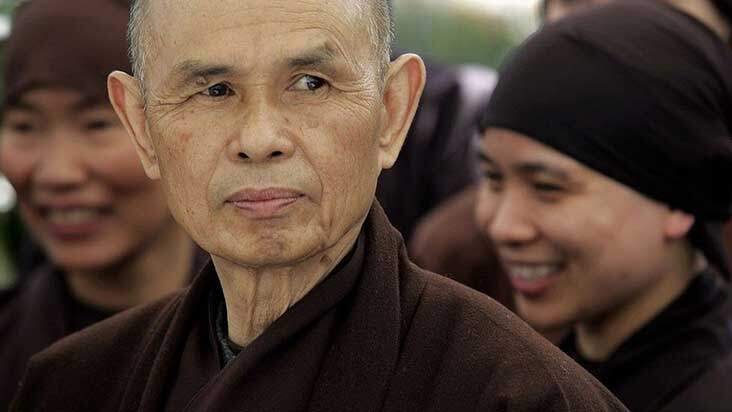

The highly respected Thich Nhat Hanh, a Vietnamese Zen master, teacher, and peace activist who passed away in January 2022 at the age of 95, left an indelible mark on the world. Known affectionately to his followers as “Thây” (teacher), he was a spiritual leader whose influence extended far beyond Buddhist circles, touching millions with his gentle wisdom and radical call for a mindfulness that engages directly with the world. He was the founder of the Engaged Buddhism movement, a path that calls practitioners to use the insights from meditation to actively address social injustices, political conflict, and environmental crises. More than just a philosophy, Thây’s teachings offered a concrete, accessible method for finding peace not in some distant future, but in the heart of the present moment.
A Life Forged in War and Dedicated to Peace
To understand Thich Nhat Hanh’s teachings is to understand his life. Born Nguyen Xuan Bao in 1926 in central Vietnam, he entered a monastery at the age of 16. His formative years as a young monk were set against the backdrop of the French colonial war and later, the devastating conflict in Vietnam. He witnessed firsthand the immense suffering caused by violence and division, which profoundly shaped his spiritual path. While many Buddhist traditions emphasised withdrawal from the world for contemplative practice, Thây saw an urgent need to bring the fruits of meditation—clarity, compassion, and non-violence—directly into the theatre of conflict.
In the early 1960s, he co-founded the School of Youth for Social Service in Saigon, a grassroots relief organization of monks, nuns, and laypeople who went into the countryside to build schools, establish medical clinics, and rebuild villages ravaged by war. This was the birth of “Engaged Buddhism.” His peace activism, which called for a cessation of hostilities from all sides, made him an enemy of both the North and South Vietnamese governments, leading to his exile in 1966. It was during a trip to the U.S. that he met Dr. Martin Luther King Jr., whom he persuaded to speak out against the Vietnam War. Deeply moved, Dr. King nominated Thây for the Nobel Peace Prize in 1967, calling him “an apostle of peace and nonviolence.” Thich Nhat Hanh would never be permitted to return to his homeland to live, instead founding the Plum Village monastery in France in 1982, which became the heart of a global community.
The Practice: Mindfulness is Not Just for the Cushion
At the core of Thich Nhat Hanh’s methodology is the radical simplicity of mindfulness—the energy of being aware and awake to the present moment. Unlike more esoteric traditions, he did not reserve this practice for silent retreats. Instead, he taught that any act, no matter how mundane, could be a vehicle for meditation.
“The miracle is not to walk on water,” he famously taught. “The miracle is to walk on the green Earth in the present moment.” (Hanh, The Miracle of Mindfulness, 1975).
Guidance for Practice:
- Mindful Breathing: The anchor of all practice. Simply follow your in-breath and out-breath. As you breathe in, you can say to yourself, “Breathing in, I know I am breathing in.” As you breathe out, “Breathing out, I know I am breathing out.” This simple exercise calms the body and mind and returns you to the here and now.
- Walking Meditation: Instead of rushing from one place to another, coordinate your steps with your breath. Take one step for your in-breath, one or two for your out-breath. Feel the contact of your feet on the ground. You are not walking to a destination; you are the walking. You have arrived with every step.
- Mindful Consumption: Pay full attention to the act of eating or drinking. Before a meal, pause and look at your food, recognizing the sun, the rain, the earth, the farmer, and the grocer who all contributed to bringing this nourishment to your plate. This cultivates gratitude and an awareness of “interbeing”—Thây’s term for the interconnectedness of all things.
The Five Mindfulness Trainings: An Ethical Compass for Modern Life
Thich Nhat Hanh reformulated the traditional Buddhist precepts into the Five Mindfulness Trainings, presenting them not as rigid commandments, but as aspirational guides for a life of wisdom and compassion. They represent the ethical foundation of Engaged Buddhism.
1. Reverence for Life
“Aware of the suffering caused by the destruction of life, I am committed to cultivating the insight of interbeing and compassion and learning ways to protect the lives of people, animals, plants, and minerals. I am determined not to kill, not to let others kill, and not to support any act of killing in the world, in my thinking, or in my way of life…”
This training extends beyond a simple vow not to kill. It is a profound commitment to protecting all life, rooted in the understanding that we are interconnected with everything. It calls for an active environmental consciousness and a recognition that violence begins in dualistic thinking—the idea of a separate “self” versus an “other.”
2. True Happiness
“Many people think excitement is happiness…. But when you are excited you are not peaceful. True happiness is based on peace.”
This training addresses the suffering caused by theft, exploitation, and social injustice. It reminds us that chasing wealth, fame, and possessions as sources of happiness is a recipe for suffering. True happiness arises from contentment and generosity. It is about recognizing the abundance we already possess in the present moment and committing to social justice so that all may have the chance to live securely. The training encourages us to cultivate generosity in our thinking, speaking, and acting.
3. True Love
“Aware of the suffering caused by sexual misconduct, I am committed to cultivating responsibility and learning ways to protect the safety and integrity of individuals, couples, families, and society… I am determined not to engage in sexual relations without true love and a deep, long-term commitment…”
Thây taught that true love is composed of four elements: loving-kindness (maitrıˉ), compassion (karuṇaˉ), joy (muditaˉ), and equanimity or inclusiveness (upekṣaˉ). This training guides us to use our sexual energy responsibly, grounded in genuine love and long-term commitment rather than craving. It is a powerful call to protect children from abuse and to foster relationships built on mutual respect, trust, and deep understanding, thereby preventing the suffering caused by misconduct.
4. Loving Speech and Deep Listening
“Aware of the suffering caused by unmindful speech and the inability to listen to others, I am committed to cultivating loving speech and deep listening in order to bring joy and happiness to others and relieve others of their suffering… I am determined to speak truthfully, with words that inspire self-confidence, joy, and hope.”
This is a profound communication practice. Deep listening involves giving someone our full, compassionate attention without judgment, allowing them to empty their heart and feel heard. This act alone can be incredibly healing. Loving speech involves using words that are truthful, kind, and constructive. Thây taught that even when we must convey difficult truths, we can do so with a foundation of compassion.
Guidance for Practice:
- Before speaking, pause and ask: Is what I’m about to say true? Is it kind? Is it beneficial? Is this the right time to say it?
- When listening, practice suspending your own agenda and internal commentary. Simply be present for the other person.
5. Nourishment and Healing
“Aware of the suffering caused by unmindful consumption, I am committed to cultivating good health, both physical and mental, for myself, my family, and my society by practicing mindful eating, drinking, and consuming…”
This training asks us to look deeply at what we consume, not only with our mouths but also with our eyes, ears, and consciousness. This includes food, but also media, conversations, and the ideas we take in. We are encouraged to avoid “toxins” like violent films, divisive news, and gossip that poison our minds and spirits. Instead, we are guided to consume things that nourish peace, well-being, and compassion in ourselves and the world.
Comparison with Other Buddhist Practices
While sharing the foundational tenets of Buddhism—the Four Noble Truths, the Eightfold Path, and the goal of ending suffering—Thich Nhat Hanh’s approach has several distinct characteristics:
- Accessibility and Language: Thây masterfully translated profound and complex Buddhist psychology into simple, poetic, and accessible language. He avoided jargon-heavy discourse, preferring gentle metaphors like “watering the seeds” of happiness or “coming home to oneself.” This contrasts with some Theravada or Tibetan traditions that require a deeper study of Pali or Sanskrit terminology and intricate philosophical systems.
- Emphasis on Social Engagement: His creation of “Engaged Buddhism” is arguably his most significant departure. While all Buddhist traditions value compassion, some historically prioritised monastic seclusion and personal enlightenment. Thây insisted that the ultimate test of one’s practice is how it manifests in society. True enlightenment cannot exist separate from the world’s suffering. As scholar and practitioner Jon Kabat-Zinn notes, “He has been a master at… building sangha on a global scale and of bringing the dharma into the marketplace and having it be relevant to the suffering of our times.” (Kabat-Zinn, 2017).
- Secular Application: While deeply rooted in Zen tradition, Thây’s framing of mindfulness has a universal, secular appeal. His techniques of mindful breathing and walking can be practiced by anyone, regardless of their religious beliefs, making his teachings a cornerstone of the modern secular mindfulness movement.
The Major Contribution and Enduring Memory
Thich Nhat Hanh’s major contribution was this brilliant synthesis: he wedded the deepest contemplative insights of Zen with a practical, actionable path for peace and social justice. He took mindfulness off the cushion and put it into our homes, our workplaces, and our communities. His concept of interbeing—the idea that nothing can exist by itself, that everything is interconnected—provided a powerful spiritual and ecological framework for understanding our place in the universe.
We will remember this gentle monk not as a distant, otherworldly figure, but as a teacher who walked his talk. We remember him for showing us that peace is not an abstract ideal but a daily, moment-to-moment practice available through our own breath. His legacy lives on in the global network of Plum Village centers, in the millions who have been soothed by his books and guided meditations, and in the simple, revolutionary act of stopping, breathing, and smiling at the miracle of being alive. He taught us that to change the world, we must first come home to ourselves.
Bibliography
Hanh, Thich Nhat. The Miracle of Mindfulness: An Introduction to the Practice of Meditation. Boston: Beacon Press, 1975.
Hanh, Thich Nhat. Peace Is Every Step: The Path of Mindfulness in Everyday Life. New York: Bantam Books, 1991.
Kabat-Zinn, Jon. “The Father of Mindfulness.” Lion’s Roar, September 13, 2017. https://www.lionsroar.com/the-father-of-mindfulness/.
Plum Village. “The Fourth Mindfulness Training: Deep Listening and Loving Speech.” Accessed July 17, 2025. https://plumvillage.app/the-fourth-mindfulness-training-deep-listening-and-loving-speech/.
Thich Nhat Hanh Foundation. “The Five Mindfulness Trainings: A Path of Happiness.” Accessed July 17, 2025. https://thichnhathanhfoundation.org/the-path-of-happiness.