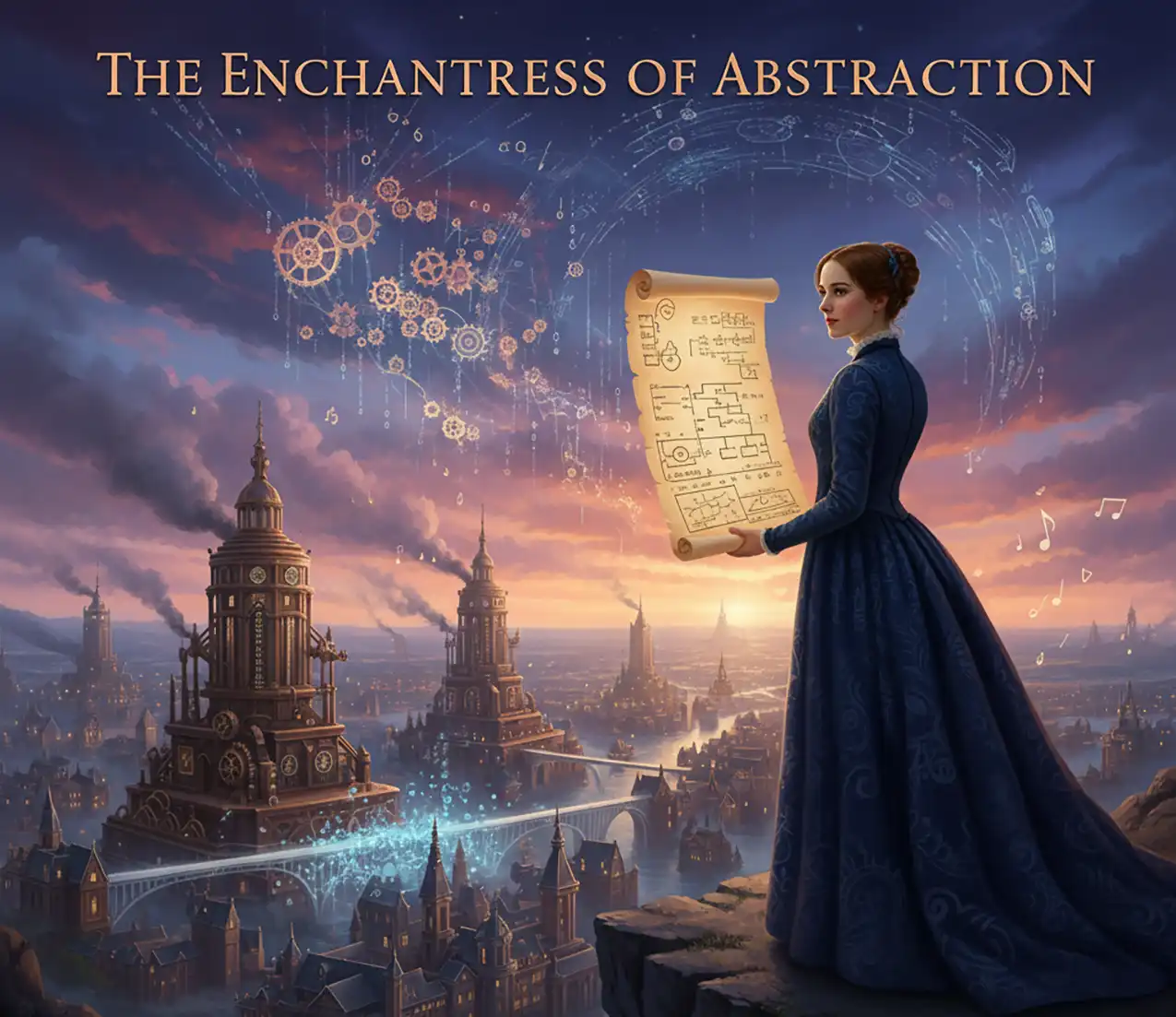

The Convergence of Poetry and Logic
The history of science is frequently punctuated by figures who exist at the confluence of opposing forces—individuals whose intellects bridge the chasm between the empirical and the imaginative. Among these, few cast a longer or more complex shadow than Augusta Ada King, Countess of Lovelace. Born into the wreckage of a celebrated Romantic marriage and educated under the strictures of Industrial Revolution rationalism, Lovelace embodied a peculiar synthesis of her parents’ contradictory natures. She was the daughter of Lord Byron, the emblem of poetic excess and emotional turbulence, and Anne Isabella Milbanke, a woman so devoted to mathematics and moral rigidity that Byron dubbed her the “Princess of Parallelograms”.1
Lovelace’s life, spanning from 1815 to 1852, occurred during a period of seismic intellectual shifting in Britain. The emotional intuition of the Romantic era was beginning to cede ground to the mechanized determinism of the Victorian age.3 Lovelace stood precisely at this intersection. She did not view these worlds as distinct; rather, she perceived a “Poetical Science,” a discipline in which the rigorous application of logic could reveal the hidden harmonies of the universe, much as poetry revealed the hidden emotional truths of the human condition.4 Her collaboration with Charles Babbage on the Analytical Engine—a theoretical machine now recognized as the first general-purpose computer—was not merely a feat of mathematical translation but an act of visionary synthesis. She perceived, in the clatter of gears and the punched cards of the Jacquard loom, the potential for a machine that could manipulate any symbol, be it a number, a musical note, or a logical proposition.1
This report provides an exhaustive examination of Lovelace’s life and work. It explores the draconian educational regimen imposed by her mother to suppress the “Byronic” taint, her pivotal collaboration with Babbage, the metaphysical insights of her “Notes,” and the tragic, chaotic descent of her final years—marked by addiction, gambling, and a frantic attempt to impose mathematical order on the chance operations of the racetrack. Furthermore, it analyzes the historiographical battle over her legacy, tracing her journey from a “forgotten” figure to the disputed “first programmer,” and finally to her current status as a prophet of the digital age.6
Listen to an audio overview of Ada’s life and work.
I. The Princess of Parallelograms: Genesis of a Mathematical Mind
The Flight from the Byronic
The trajectory of Ada Lovelace’s intellectual development was determined before she could speak. Her birth on December 10, 1815, was the catalyst for the final dissolution of the marriage between Lord Byron and Annabella Milbanke.1 Disappointed that the child was not a “glorious boy,” and plagued by financial debts and rumors of incest, Byron signed the deed of separation and fled England for good in April 1816.4 He would never see his daughter again, dying in Greece when she was eight years old.2
For Lady Byron, Ada was a vessel containing a dangerous inheritance. She feared that the “stormy and unpredictable temper” of the poet lay dormant in the child’s blood.1 To counteract this, Lady Byron devised an educational system that was as much a medical prescription as a pedagogical strategy. The curriculum was designed to be an antidote to imagination. Music and poetry were suspect; mathematics, logic, and science were the requisite sedatives for a potentially volatile mind.2
This “System,” as it might be called, was rigorous and unrelenting. It involved long hours of study, strict surveillance, and a rotation of tutors who were instructed to report any signs of “fanciful” behavior. Lady Byron’s approach to motherhood was often detached and manipulative; she would frequently absent herself for “health cures,” leaving Ada in the care of her grandmother, Lady Noel, while maintaining a panopticon-like control over the child’s development through letters.4
Flyology: The First Synthesis
Despite the suppression of the imagination, the Byronic impulse found outlets within the constraints of science. At the age of twelve, Lovelace embarked on a project she termed “Flyology.” Fascinated by the mechanics of flight, she studied the anatomy of birds and the materials of wings—paper, silk, wires, and feathers.1 She conceptualized a steam-driven flying machine, demonstrating an early propensity to merge the organic with the mechanical.1
This project was not merely a child’s fantasy; it was conducted with the methodological rigor she had absorbed from her tutors. She wrote a book, Flyology, illustrating her plates and calculations. This incident illustrates the failure of Lady Byron’s attempt to excise the imagination; instead of destroying it, the mathematical training simply gave Lovelace’s imagination a structural language. She was not dreaming of flight in the manner of a poet; she was engineering it.1
The Tutors and the “Scientific Elite”
Lovelace’s social station allowed her access to the premier scientific minds of the 19th century. Her education was not limited to the schoolroom but extended into the salons of the intelligentsia. A pivotal figure in her development was Mary Somerville, the Scottish polymath and author of The Connexion of the Physical Sciences.4 Somerville served as a mentor and a maternal figure, providing a model of a woman who could navigate the male-dominated world of science without sacrificing her domestic identity.10
Later, Lovelace corresponded with Augustus De Morgan, the first Professor of Mathematics at the University of London (now UCL). De Morgan guided her through the complexities of calculus and higher algebra.8 It is in the correspondence with De Morgan that we see the clearest evidence of her mathematical potential. She did not simply solve problems; she interrogated the fundamental axioms of mathematics. In a letter to Lady Byron, De Morgan wrote that Ada’s queries indicated a mind capable of “original mathematical investigation, perhaps of first-rate eminence”.4 He compared her favorably to Somerville, suggesting that while Somerville was an exquisite synthesizer of existing knowledge, Lovelace possessed the raw creative power to generate new mathematical truths.12
However, this potential was constantly threatened by her health. Lovelace was frequently ill, suffering from measles, headaches, and a paralysis that left her bedridden for nearly a year during her adolescence.4 These periods of “dreadful physical sufferings” often coincided with periods of intense intellectual activity, establishing a cyclical pattern of mania and collapse that would characterize her adult life.13
II. The Enchantress and the Philosopher: The Babbage Connection
The Meeting of June 1833
The trajectory of computing history shifted on June 5, 1833, when the seventeen-year-old Ada Lovelace attended a party where she met Charles Babbage.1 Babbage, then forty-one and the Lucasian Professor of Mathematics at Cambridge, was a controversial figure—a brilliant but cantankerous polymath obsessed with the eradication of error in mathematical tables.1
Babbage invited Lady Byron and Ada to his showroom to view the prototype of his Difference Engine. The machine, a complex assembly of brass gears, cranks, and number wheels, was designed to calculate polynomial functions using the method of finite differences.8 The reaction of the two women to the machine provides a perfect encapsulation of their differing worldviews:
- Lady Byron admired the machine as a “thinking machine,” viewing it through a rationalist lens as a triumph of utility.8
- Ada Lovelace perceived the “great beauty of the invention”.8 She understood its operation immediately, but more importantly, she grasped its aesthetic and metaphysical implications. She saw it not just as a calculator, but as a physical manifestation of logical law.8
The Dynamics of Collaboration
The relationship between Lovelace and Babbage was complex, evolving from mentorship to collaboration, and finally to a somewhat strained friendship. Babbage called her the “Enchantress of Numbers,” a moniker that acknowledged her ability to see the “magic” within the mathematics.14 In their correspondence, Lovelace often adopted a playful, almost flirtatious tone regarding her own intellect, referring to her “fanciful” nature as a “Fairy” or “Daemon” that required Babbage’s guidance.9
However, this deference masked a fierce intellectual ambition. Lovelace was not content to be a passive student. She aggressively pursued Babbage for blueprints, diagrams, and explanations, often frustrated by his lack of organization. She wrote to him, “I am working very hard for you; like the Devil in fact,” demanding the “necessary data & formulae” to complete her work.15
Babbage, for his part, recognized her unique position. He was a man besieged by detractors and struggling to secure government funding. In Lovelace, he found an interpreter—someone who could explain his machines to the world with a clarity and grace that he, with his prickly disposition, lacked.16
III. The Analytical Engine: A Conceptual Revolution
To understand Lovelace’s contribution, one must distinguish between Babbage’s two machines. The confusion between the Difference Engine and the Analytical Engine often obscures the magnitude of the leap Lovelace and Babbage made.
Table 1: Comparison of Babbage’s Engines
| Feature | The Difference Engine | The Analytical Engine |
| Primary Function | Calculation of polynomial functions for mathematical tables. | General-purpose computation of any algorithmic process. |
| Mechanism | Method of Finite Differences (addition only). | Arithmetic Logic Unit (ALU) capable of +,-,*,/. |
| Control System | Fixed mechanical settings. | Punched cards (Operation cards & Variable cards). |
| Memory | Limited storage of results. | The “Store” (separate from the processor). |
| Processor | Fixed columns of gears. | The “Mill” (Central Processing Unit). |
| Lovelace’s Role | Admirer and student of the prototype. | Translator, explicator, and programmer. |
| Modern Analogue | A sophisticated pocket calculator. | A modern computer (CPU + Memory + Software). |
The Architecture of the Analytical Engine
The Analytical Engine was a quantum leap beyond the Difference Engine. It was never fully built in Babbage’s lifetime, existing primarily as thousands of pages of engineering drawings and “mechanical notation”.17 Its architecture featured four key components that define modern computers:
- The Store: A mechanism for holding numbers (Memory). Babbage envisioned a store capable of holding 1,000 numbers of 50 digits each.17
- The Mill: The section where the processing took place (CPU). It could perform addition, subtraction, multiplication, and division.17
- The Input: Punched cards, adapted from the Jacquard loom, which controlled the operations and variables.5
- The Output: A printer, a curve plotter, and a bell.17
Lovelace’s genius lay in her understanding of the Input. She realized that the punched cards decoupled the data from the process. This abstraction meant that the machine was not bound to a specific mathematical operation but could be “programmed” to perform any sequence of operations.17
IV. The Grand Synthesis: The 1843 Notes
In 1840, Babbage visited Turin to present his design to Italian scientists. Luigi Menabrea, a young engineer, published a summary of the presentation in French in 1842.1 Charles Wheatstone, a friend of Lovelace, suggested she translate Menabrea’s article into English for Taylor’s Scientific Memoirs.17
When Babbage learned of this, he suggested she add her own notes. Lovelace threw herself into this task with obsessive energy. The resulting document, published in August 1843, contained her translation followed by seven appendices (Notes A through G). These Notes were three times the length of the original article and contained the intellectual foundation of computer science.1
Note A: The Jacquard Metaphor and the Science of Operations
In Note A, Lovelace lays out the philosophical basis of the machine. She famously writes:
“The Analytical Engine weaves algebraical patterns just as the Jacquard-loom weaves flowers and leaves.” 5
This is not merely a poetic flourish. It is a recognition of the universality of the symbol. She explains that the machine fundamentally separates the “symbols of operation” from the “quantity” being operated upon.5 This distinction allowed her to conceptualize a “Science of Operations”—a new field of mathematics derived from the machine’s capabilities. She realized that if the machine could manipulate the relationships between symbols, it could apply to any subject susceptible to logical rigor, not just numbers.11
Note G: The First Computer Program
The most technically significant section is Note G. Babbage had provided Lovelace with the algebraic formulas for the Bernoulli numbers, a complex sequence of rational numbers used in number theory ($B_0 = 1, B_1 = -1/2, B_2 = 1/6…$).18 However, it was Lovelace who organized these formulas into a form the machine could execute.
She produced a table—a “trace” in modern terminology—that detailed the exact state of the machine at every step of the calculation.
- Variables: She assigned specific memory locations ($V_1, V_2…$) to the variables.
- Operations: She specified the sequence of arithmetic operations.
- Loops: Crucially, she utilized the machine’s ability to “back up” the card reader to repeat a set of instructions, creating a conditional loop (or cycle).17
The algorithm calculates the Bernoulli number $B_n$ by solving a recursive formula involving the sum of powers. Lovelace’s table for calculating $B_7$ (which is actually the 8th number, $-1/30$, in her indexing) is universally cited as the first computer program.18 It demonstrated, for the first time, the logic of software: the breaking down of a complex problem into a series of discrete, machine-executable steps.
Modern analysis of Note G has revealed a “bug”—a typographical error where a variable was swapped ($V_4/V_5$ instead of $V_5/V_4$).20 This error, ironically, further cements her status as the first programmer; she was also the first person to write code with a bug in it.
V. Poetical Science: Lovelace’s Metaphysical Framework
Lovelace’s contribution cannot be fully appreciated if stripped of its metaphysical context. She did not view herself as a mere mathematician. In a letter to her mother, she described her mind as a “light which intends to penetrate the hidden things of the universe”.4 She coined the term “Poetical Science” to describe her methodology.4
The Connectivity of the Universe
Lovelace believed that the division between the physical and the moral/intellectual worlds was artificial. In a letter to the electrical experimenter Andrew Crosse, she wrote:
“There is too much tendency to making separate and independent bundles of both the physical and the moral facts of the universe. Whereas, all and everything is naturally related and interconnected.” 13
This holistic view allowed her to see the Analytical Engine as a bridge between these worlds. If the “moral facts” (logic, music, language) could be reduced to symbols, the engine could process them.
The Prophecy of Digital Media
This line of reasoning led to her most famous prediction, found in the Notes. She speculated that if the fundamental relations of musical sounds could be expressed mathematically, “the engine might compose elaborate and scientific pieces of music of any degree of complexity or extent”.4
While Babbage focused on the utility of the machine for navigation and astronomy, Lovelace envisioned the digitization of culture. She foresaw a future where the computer was a creative partner, capable of generating music, graphics (via the plotting arm), and other non-numeric outputs.4 This insight remained unique to her; it would not be fully articulated again until the mid-20th century.
VI. The Objection: Consciousness and Computation
Lovelace’s intellect was not uncritical. While she extolled the machine’s potential, she also carefully delineated its limits. In Note G, she formulated what Alan Turing would later call “Lady Lovelace’s Objection”:
“The Analytical Engine has no pretensions whatever to originate anything. It can do whatever we know how to order it to perform. It can follow analysis; but it has no power of anticipating any analytical relations or truths.” 5
The Nature of the Objection
Lovelace argued that the machine was strictly deterministic. It possessed no volition, no consciousness, and no capacity for genuine creativity. Its “intelligence” was merely a reflection of the programmer’s foresight. It could “weave” patterns, but only those the human operator had designed.5
Turing’s Rebuttal and the AI Debate
In his 1950 paper Computing Machinery and Intelligence, Alan Turing devoted a section to refuting this specific point. He argued that Lovelace’s Objection rested on the assumption that machines could never “surprise” us.24 Turing countered that computers surprise their programmers constantly—often through errors or unexpected consequences of complex logic. He used the analogy of a nuclear pile: most minds are “sub-critical” (an idea dies upon entry), but a machine could be “super-critical,” where one idea sparks a chain reaction of others, simulating originality.26
Turing also suggested that Lovelace’s skepticism was a product of her time; she could not have foreseen the speed and memory capacity that would allow for learning algorithms (Artificial Intelligence) that mimic the “growth of the seed” of human learning.28 Nevertheless, “Lady Lovelace’s Objection” remains the standard argument against Strong AI (the idea that machines can possess actual consciousness), and the debate she initiated is still active in the philosophy of mind today.24
VII. The Descent: Illness, Addiction, and “The Book”
Following the triumph of the 1843 Notes, Lovelace’s life began to unravel. The “wiry little system” she boasted of was fragile, and the tension between her intellectual ambitions and her physical reality became unbearable.9
The High Priestess Rejected
Lovelace had hoped that the Notes would be the launchpad for a professional partnership with Babbage. She wrote to him offering to become the “High Priestess of Babbage’s Engine,” proposing that she manage the external affairs and funding of the project while he focused on the engineering.16 She believed she had the social grace and “daemon” energy to succeed where he had failed. Babbage, fiercely territorial and perhaps unable to accept a woman in such a commanding role, rejected the offer.30
The Calculus of the Racetrack
Denied a legitimate outlet for her “science of operations,” Lovelace turned her analytical skills to a more dangerous field: horse racing. In the late 1840s, she became the ringleader of a gambling syndicate.31 The group included her husband (initially), William Nightingale (father of Florence), and her lover, John Crosse (son of Andrew Crosse).31
Lovelace was convinced that the outcome of horse races was not random but followed complex mathematical laws that could be modeled—a dark mirror of her belief in the “connectedness” of the universe.32 She attempted to create an “infallible system,” a “Book” of probabilities that would guarantee victory.33
The Voltigeur Catastrophe
The obsession culminated in the 1851 York Derby. Lovelace and her syndicate placed massive bets on a horse named Voltigeur.31 The choice of horse was likely influenced by her “Poetical Science”—Voltigeur evoked “Volta” (electricity), connecting to her fascination with Andrew Crosse’s electrical experiments.31
Voltigeur lost. The loss was catastrophic. Lovelace was left with debts totaling £3,200 (equivalent to hundreds of thousands of pounds today).31
Blackmail and Pawning
The situation devolved into a Victorian noir. Lovelace was blackmailed by a syndicate member named Malcolm, who threatened to reveal her “unseemly activities” to her formidable mother.31 Desperate, Lovelace pawned the Lovelace family diamonds—twice. She would redeem them, only to pawn them again to fund further gambling or pay off debts.31 Her husband, William, eventually had to step in to pay off Malcolm, but the revelation of her secret life created an insurmountable rift in their marriage.31
This period reveals the tragic pathology of her genius. The same mind that could hold the recursive complexity of the Bernoulli numbers was susceptible to the gambler’s fallacy, believing that chaos could be tamed if one just had the right formula.
VIII. The Final Equation: Mortality and Betrayal
The “Vitality of the Brain”
By 1851, Lovelace’s health had collapsed. She was diagnosed with uterine cancer, a slow and agonizing death sentence.34 For over a year, she endured “dreadful physical sufferings,” managed only by heavy doses of laudanum and cannabis, which induced hallucinations and mood swings.13
Florence Nightingale, a friend of the family, later remarked that Lovelace “could not possibly have lived so long, were it not for the tremendous vitality of the brain, that would not die”.35 Her mind remained active even as her body decayed, fighting the inevitable with the same intensity she had applied to Babbage’s equations.
The Confession and Isolation
In her final months, Lady Byron moved into the Lovelace household and assumed total control. Viewing Ada’s illness as a moral failing requiring redemption, she isolated her daughter from her friends, including Babbage and John Crosse.35 Lady Byron dismissed Ada’s loyal servants and replaced them with her own, effectively imprisoning the dying woman.35
Under this pressure, and perhaps seeking absolution, Ada made a confession to her husband, William, on August 30, 1852. While the exact words are unrecorded, it is widely believed she confessed to the full extent of her affair with John Crosse.35 The confession broke William. He stopped visiting her bedside, leaving her to face death under the sole tyranny of her mother.35
The Final Defiance
Ada Lovelace died on November 27, 1852, at the age of thirty-six—the exact age at which her father, Lord Byron, had died.34
In a final, posthumous act of rebellion against the mother who had tried to stamp out the “Byron” in her, Ada requested to be buried not in the Lovelace family plot, but in the Byron family vault at the Church of St. Mary Magdalene in Hucknall.2 She lies there today, side by side with the father she never knew, the “Poet” and the “Analyst” united in the dark.
IX. Resurrection: The Historiography of Ada Lovelace
The Forgotten Years
For nearly a century following her death, Lovelace was remembered primarily as a footnote in the biography of Lord Byron—a tragic daughter who dabbled in math.7 Babbage’s work was largely forgotten, his machines regarded as eccentric failures, and Lovelace’s Notes gathered dust in library archives.
The Rediscovery: Bowden and Turing
The resurrection of Ada Lovelace began with the birth of the electronic computer. In 1950, Alan Turing brought her back into the scientific conversation by using her “Objection” as the central counter-argument in his defining paper on AI.24
In 1953, Bertram Bowden published Faster Than Thought, a symposium on digital computing. Bowden, recognizing the historical lineage, included Lovelace’s portrait as the frontispiece and reprinted her Notes.36 He described her as a prophet who had understood the machine better than its inventor. This publication reintroduced her to the first generation of computer scientists, who were stunned to find their discipline articulated with such clarity a century prior.38
The Controversy: Stein vs. Toole
As Lovelace’s fame grew, particularly with the naming of the Ada programming language by the US Department of Defense in 1980, a backlash occurred.39 In 1985, biographer Dorothy Stein published Ada: A Life and a Legacy, a revisionist text that sought to debunk the “myth” of Lovelace.6 Stein argued that Lovelace was a “mediocre” mathematician, that the Notes were essentially dictated by Babbage, and that her reputation was inflated by feminist wish-fulfillment.41 Stein cited mathematical errors in Lovelace’s letters (such as a confusion over the term “cos” in a translation) as proof of her incompetence.41
This provoked a fierce defense from scholars like Betty Alexandra Toole, who published Ada, the Enchantress of Numbers (1992).14 Toole and others argued that Stein had fundamentally misunderstood the collaborative nature of the relationship. They pointed out that while Babbage supplied the mechanical equations (the “hardware” specs), Lovelace supplied the logical control flow (the “software”) and the metaphysical interpretation.8
Recent scholarship supports Toole’s view. The analysis of the correspondence shows Lovelace actively correcting Babbage’s errors and Babbage himself admitting that the “Notes” were “entirely her own”.8 The consensus today is that Lovelace was not a mathematician in the modern academic sense (she published no original theorems), but she was a computational thinker of the highest order—someone who understood the manipulation of symbols and the architecture of algorithms better than any of her contemporaries.8
Table 2: Evolution of Lovelace’s Historical Status
| Period | Status | Primary Perception |
| 1852-1940s | The Footnote | Byron’s daughter; Babbage’s helpful friend; a tragic Victorian lady. |
| 1950s | The Objector | The source of “Lady Lovelace’s Objection” in Turing’s AI debate. |
| 1980s | The Icon | The “First Programmer”; feminist symbol; namesake of “Ada” language. |
| 1985-1990s | The Fraud? | Dorothy Stein’s critique; accused of being a “manic” amateur with little skill. |
| The Visionary | Re-evaluated as a “computational thinker”; author of the first algorithm; prophet of multimedia and AI. |
Conclusion: The Algorithm of the Future
Augusta Ada King, Countess of Lovelace, was a woman out of time. Her tragedy was not merely personal; it was chronological. She possessed the software for a digital world but lived in a steam-powered reality. Her “wiry system” burned itself out trying to calculate a universe that was not yet ready to be computed.
Her legacy, however, is secure. It does not rest solely on the “first program” for the Bernoulli numbers, though that is a technical milestone. It rests on the Notes as a manifesto for the information age. Lovelace was the first human being to recognize that a computer was not just a calculator. She saw that a computer was a symbol-manipulator, and that because the universe is described by symbols—notes in music, letters in language, logic in philosophy—the computer could become a universal instrument of human creativity.
Today, every time a generative AI composes a melody, or a neural network “hallucinates” an image, we are witnessing the realization of the “Poetical Science” she envisioned. We are also still wrestling with her “Objection.” As machines become more complex, we continue to ask the question she posed in 1843: Is the machine originating, or is it merely weaving the patterns we have taught it? The answer may lie in the “hidden connections” she sought all her life—the bridge between the mechanism of the brain and the mystery of the mind.
In the damp crypt at Hucknall, the silence is heavy, but the legacy is loud. The poet wrote of “thoughts that breathe, and words that burn.” His daughter, the analyst, proved that numbers could do the same.
Endnotes
- Max Planck Society, “Ada Lovelace,” Female Pioneers of Science.
- Wikipedia, s.v. “Ada Lovelace,” accessed 2024.
- Benjamin Woolley, The Bride of Science: Romance, Reason, and Byron’s Daughter (London: Macmillan, 1999).
- Wikipedia, s.v. “Ada Lovelace”.
- Ada Lovelace, “Sketch of the Analytical Engine Invented by Charles Babbage, with Notes by the Translator,” Scientific Memoirs 3 (1843).
- Dorothy Stein, Ada: A Life and a Legacy (Cambridge, MA: MIT Press, 1985).
- Woolley, The Bride of Science.
- Christopher Hollings, Ursula Martin, and Adrian Rice, “The Early Mathematical Education of Ada Lovelace,” BSHM Bulletin 32, no. 3 (2017).
- Lovelace Letters, cited in Betty Alexandra Toole, Ada, the Enchantress of Numbers.
- Mary Somerville, The Connexion of the Physical Sciences (1834); Toole, Ada, the Enchantress of Numbers.
- Augustus De Morgan, Letter to Lady Byron, 1844, cited in Hollings et al..
- Christopher Hollings, Ursula Martin, and Adrian Rice, Ada Lovelace: The Making of a Computer Scientist (Oxford: Bodleian Library, 2018).
- Ada Lovelace, Letter to Andrew Crosse, c. Nov 1844, quoted in Maths History.
- Betty Alexandra Toole, Ada, the Enchantress of Numbers: A Selection from the Letters of Lord Byron’s Daughter and Her Description of the First Computer (Mill Valley, CA: Strawberry Press, 1992).
- Ada Lovelace, Letter to Charles Babbage, July 1843, cited by Stephen Wolfram.
- Ada Lovelace, Letter to Charles Babbage, cited in Alison Winter, “A Speculation Touching Electric Conduction”.
- Doron Swade, “Ada Lovelace and the Analytical Engine,” Bodleian Blogs (2018).
- “Ada Lovelace’s Note G,” Project Lovelace.
- Thomas J. Misa, “Charles Babbage, Ada Lovelace, and the Bernoulli Numbers,” in Ada’s Legacy (ACM, 2016).
- Wikipedia, s.v. “Note G”.
- Lovelace, Letter to Andrew Crosse.
- Ada Lovelace, “Sketch of the Analytical Engine,” Note A.
- Ada Lovelace, “Sketch of the Analytical Engine,” Note G.
- Alan Turing, “Computing Machinery and Intelligence,” Mind 59, no. 236 (1950).
- Ibid.
- Ibid.
- Ibid.
- Ibid.
- Stanford Encyclopedia of Philosophy, s.v. “The Turing Test”.
- Woolley, The Bride of Science.
- Thomas Hunt, “Ada Lovelace’s Gambling,” Cabinet Magazine, Issue 19 (2005).
- Ibid.
- Sydney Padua, The Thrilling Adventures of Lovelace and Babbage (Pantheon, 2015).
- “Ada Lovelace,” Famous Scientists.
- Woolley, The Bride of Science.
- B. V. Bowden, ed., Faster Than Thought: A Symposium on Digital Computing Machines (London: Pitman, 1953).
- Ibid.
- Ibid.
- “Ada (programming language),” Wikipedia.
- Stein, Ada: A Life and a Legacy.
- Adrian Rice, “An Enchantress of Number? Reassessing the Mathematical Reputation of Ada Lovelace,” Notices of the AMS 71, no. 3 (2024).
- Stein, Ada: A Life and a Legacy.