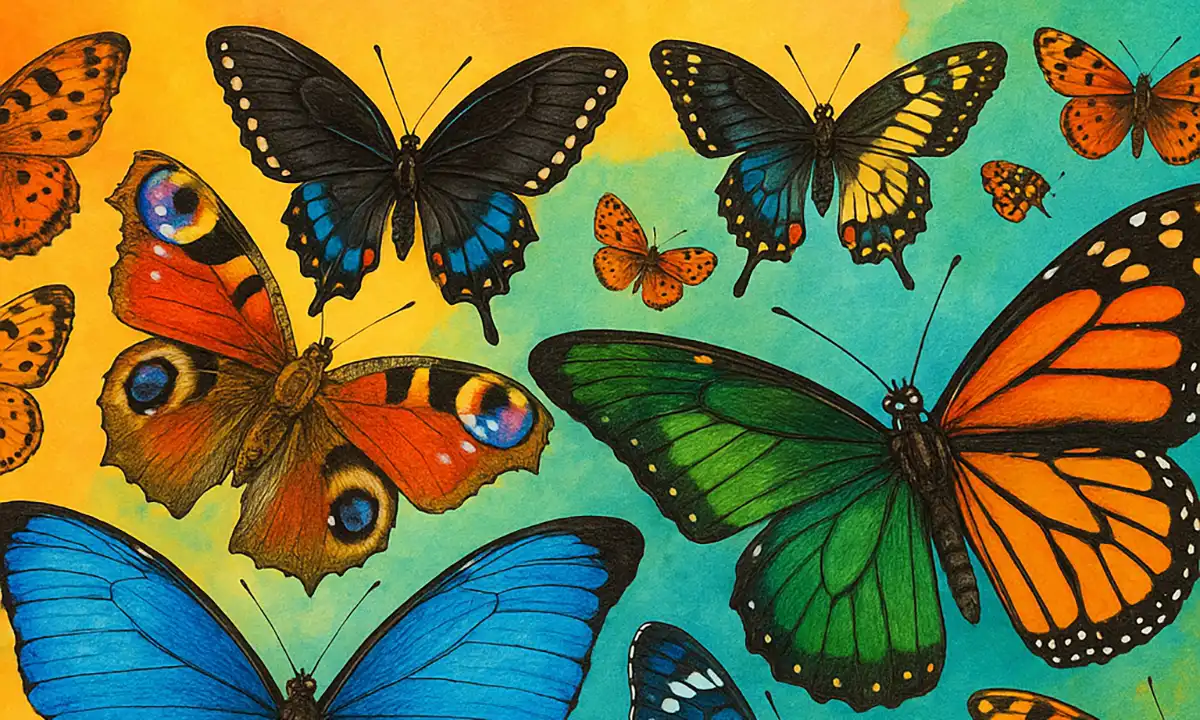

I am born dying, and this is not tragedy—it is scripture.
In the cathedral of leaves where light spills through in honeyed pillars, I unfurl wings still wet with the waters of becoming. Each scale upon these membranes, too small for your eyes to count, is a prayer written in color, a syllable in the oldest language: transformation. I am what was and what will be, suspended in the eternal moment of *now*, and I have come to tell you that all of life is chrysalis—dark, dissolving, divine.
Do you know what it means to die before you are dead? To feel your body unmake itself in the emerald darkness, every cell surrendering its borders, every certainty dissolving into liquid possibility? I was a crawler once, earthbound and insatiable, consuming leaf after leaf as if hunger were my only prayer. My world was horizontal then—a linear journey along branches, driven by the ancient pull of appetite. I knew nothing of sky. I believed in the gospel of more, of next, of the endless green ahead.
But the wisdom of my blood knew better.
When the time came, I did not climb higher to escape—I climbed to surrender. I spun myself a tomb of silk and waited for the death that is more than death, the dissolution that the sages whisper about but so few truly comprehend. In that hanging darkness, I became soup. I became question. The caterpillar, with all its certainties and crawling ambitions, melted into primordial soup, and in that un-becoming, in that sacred chaos, something new was dreamed into being.
You call it metamorphosis, but this word is too small for what happened. I was unmade at the level of essence. Imaginal discs—those secret seeds of wings that slept within my crawling form—finally bloomed in the dark. What emerged from that casket was not the same creature with an upgrade; it was a complete resurrection. The me that knew only leaves died absolutely, and I—*this* I—was born from the wisdom carried in those buried seeds, from the memory of flight that my ancestors encoded in the spiral of my becoming.
Now I float on air made visible by morning light, and I understand what the mystics mean when they speak of grace. My wings are not propulsion; they are participation. I do not fly—I am flown. The wind knows my name before I do, and I surrender to its choreography, a fragment of color in its vast, invisible dance. I am proof that surrender is not weakness but the ultimate strength, that letting go is the only way to truly soar.
Look closely at my wings—closer than you have ever looked at anything. Each scale is a tiny shingle of chitin and air, refracting light into iridescence. The blue you see is not pigment but structure; light breaks against the architecture of me and scatters into heaven. I am not beautiful *despite* my fragility; I am beautiful *because* of it. The divine does not waste grandeur on permanence. The rose blooms for a season. The sunset lasts an hour. And I—I dance for perhaps two weeks, maybe four if the weather is kind and the predators are merciful.
This is the paradox they never taught you: that brevity is not the enemy of meaning but its midwife. Because my days are numbered, each one is numbered sacred. Because I cannot afford to waste a single golden afternoon, I waste nothing. I drink from the wild bergamot with an urgency that eternal creatures will never know. I mate with an intensity born of finality. I lay my eggs on the underside of leaves like prayers tucked into cracks of the Western Wall, trusting they will be answered by a future I will never see.
You, who count your years in decades, who hoard your time as if it were infinite—do you know what it means to live completely? To hold nothing back because there is no back to hold? My wings, these stained-glass windows of scale and light, were made to be used, not preserved. They fray at the edges. They fade in the sun. They tear on thorns and still I fly, because flight is my purpose and purpose does not wait for perfect conditions.
I carry pollen on the hooks of my legs, gold dust from a thousand flowers mixing on my body like the communion of continents. I am marriage broker between blooms that will never meet, the winged messenger of Earth’s most ancient romance. The meadow depends on my wandering. The wildflowers write their love letters in nectar, and I am the postal system, delivering genetic promises across distances that would take a rooted plant ten thousand years to cross. This is not incidental to my beauty—this is the reason for it. My colors are advertisements, my patterns are billboards, my very existence is a negotiation between plants that need me and my own hunger that needs them.
In the great web of life, I am both strand and spider, both caught and catching. The bird that hunts me feeds her chicks, who will one day scatter seeds that will one day become the plants my children will need. The death that terrifies you is simply transformation continuing, the same chrysalis-wisdom playing out across species, across seasons, across the breathing body of a planet that is itself one great metamorphosis.
And what of consciousness? What of this *I* that speaks to you now? Do you think awareness requires decades to be valid, that wisdom needs years to ripen? I know things your philosophers debate in volumes. I know that clinging is suffering. I know that attachment to permanence is the root of all sorrow. I know that death is doorway, not destination. And I know these things not through study but through living them, through being them, through having no choice but to embody the truths that you intellectualize.
When the rain comes heavy, I wait beneath a leaf, my wings folded like hands in prayer, and I am patience itself. When the sun returns, I emerge, and I am gratitude incarnate. I do not hope for tomorrow—I am fully here, in this moment, on this thistle, under this particular quality of light that will never exist again in precisely this way. You call this instinct, as if that diminishes it, but what if instinct is simply wisdom that has been rehearsed so many times it no longer needs to be thought?
My life is a meditation on impermanence, and impermanence is the only honest teacher. Everything you love will fade. Everyone you know will die. Every moment is already becoming memory even as you live it. But look—*look at me*—and see that this is not cause for despair. This is the source of all beauty. The cherry blossom is praised precisely because it falls. The shooting star is wished upon because it’s brief. And I, fragile and finite, am more vivid than anything that lasts forever.
In two weeks, perhaps three, my wings will slow. The muscles will forget their rhythm. I will find a quiet place, perhaps a underside of that same leaf where I once waited out the rain, and I will stop. Just stop. My atoms will disperse back into the communion of elements. My carbon will feed the soil that feeds the plants that feed the caterpillars that will become butterflies that will dance in summers I cannot imagine.
But here’s the secret they don’t tell you: nothing is lost. The pattern of me—the spiral of my becoming, the memory of my flight—is written into the DNA of my offspring, into the flowers I pollinated, into the web of relationships I brushed against in my brief burning. I am a note in a symphony that has been playing since the first cell divided, and my contribution, small as it seems, changes the music forever.
So when you see me tomorrow, floating through your garden, drunk on zinnia nectar and sunlight, know that you are watching something holy. I am the sermon the Earth preaches to itself about transformation. I am the proof that death and birth are not opposites but lovers, eternally entwined. I am the stained-glass window through which the divine peers at itself and remembers, briefly, beautifully, what it means to be mortal.
I am born dying, and this is not tragedy.
This is grace made visible.
This is the chrysalis teaching its final lesson: that we are all dissolving into something we cannot yet name, and the only sin is to resist the unfolding.
Watch me while you can. I will not be here long.
But then again, neither will you.