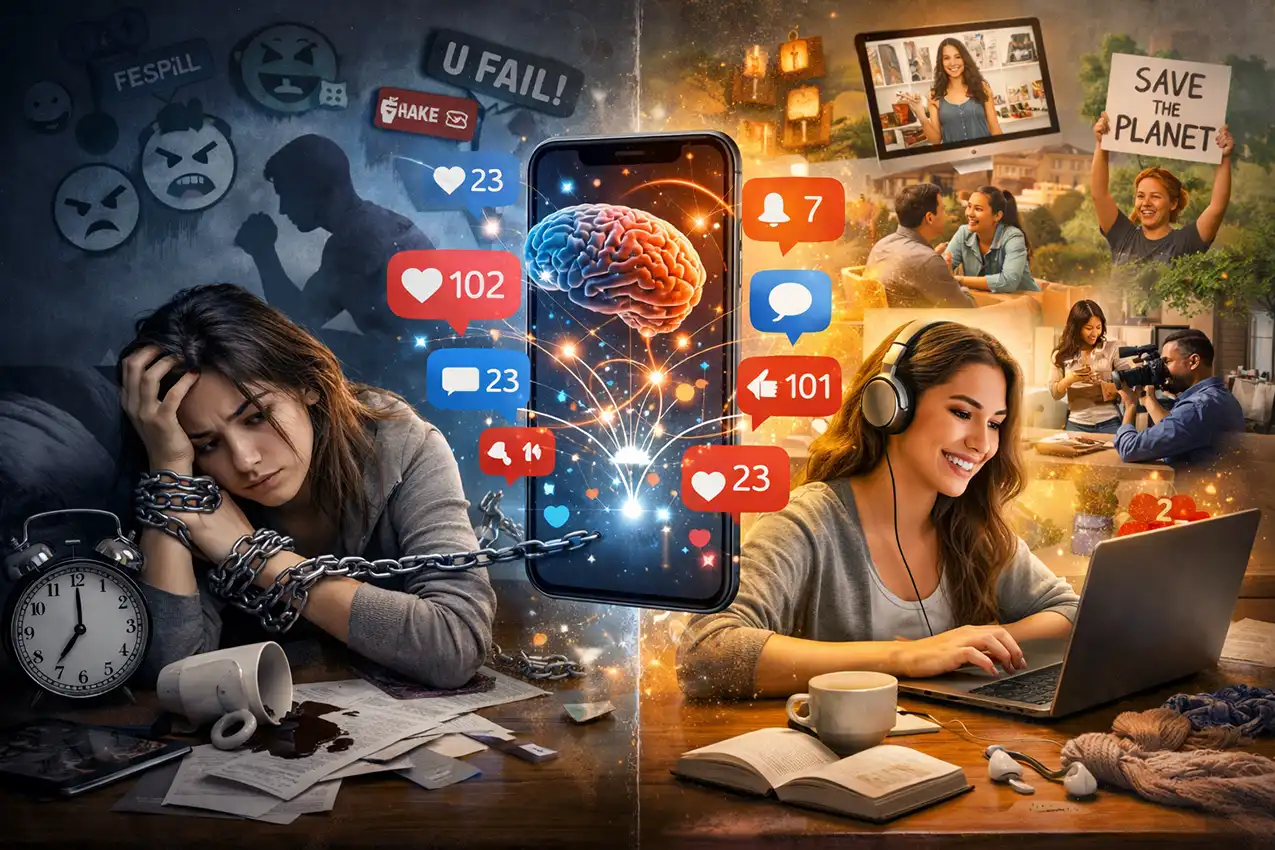

The digital landscape of the mid-2020s is defined not by the information it provides, but by the relentless competition for the human focus that consumes it. This essay explores the phenomenon commonly termed “social media addiction,” examining the delicate balance between the profound social utility of these platforms and the engineered compulsions that characterise their use for millions. Through the lenses of neurobiology, behavioural science, and public health, the analysis moves beyond the binary of moral panic and tech-optimism to understand how digital environments shape the human experience.
Executive Summary
As of 2025, problematic social media use (PSMU) has transitioned from a niche psychological concern to a significant global public health priority. Recent data from the World Health Organization (WHO) and longitudinal studies indicate that approximately 11% of adolescents across 44 countries now exhibit addiction-like symptoms, including impaired control, withdrawal, and the neglect of vital offline responsibilities.1 While formal diagnostic recognition remains a point of intense debate within the clinical community—specifically regarding the classification of social media use disorder (SMUD) alongside established behavioural addictions like gambling—the functional impairment experienced by users is increasingly well-documented.2
This essay details the neurobiological mechanisms underpinning digital compulsion, specifically the “druggification” of social connection through variable reward schedules and the role of reward prediction errors (RPE) in habit formation.4 It further analyses the “attention economy” business model, where platforms are incentivised to prioritise “time on device” over user wellbeing through persuasive design features like infinite scroll and algorithmic personalisation.6 Conversely, the essay highlights the value social media provides to marginalised communities, rare disease advocates, and diaspora populations, arguing for a “safety-by-design” approach that preserves connectivity while mitigating structural harms.8
What you can do this week
The following steps are evidence-based interventions to restore digital agency and mitigate the impact of persuasive design.
| Action | Rational | Implementation |
| Establish a “Digital Sunset” | Mitigates melatonin suppression and cognitive arousal before sleep.10 | Remove all screens from the bedroom 60 minutes before intended sleep. |
| Audit External Triggers | Reduces the frequency of “habit loops” initiated by the device.6 | Disable all non-human push notifications (e.g., algorithm suggestions, “likes”). |
| Enable Grayscale Mode | Decreases the “druggification” of visual stimuli in the reward pathway.4 | Switch phone display settings to black and white to reduce visual lure. |
| Practise “Urge Surfing” | Builds neuro-plastic resistance to compulsive checking impulses.11 | When the urge to check an app arises, observe the physical sensation for 60 seconds without acting. |
| Prioritise Active Use | Enhances belonging while reducing social comparison risks.1 | Limit passive scrolling; use platforms only for direct messaging or co-creation. |
The Digital Drift: A Human Perspective
To understand the transition from utility to compulsion, one must observe the daily “digital drift” experienced by contemporary users. Consider the composite case of “Maya,” a 24-year-old freelance designer. For Maya, social media began as a vital professional tool—a space for creative inspiration, client networking, and maintaining contact with a global diaspora of friends.9 However, over three years, her relationship with the screen underwent a subtle but profound metamorphosis.
What Maya initially experienced as a “check-in” gradually evolved into a “reflexive check.” The device became the first object she touched upon waking and the last before sleep, contributing to a chronic sleep debt and morning irritability.1 The “infinite scroll” of her feed, once a source of inspiration, became a “doomscroll” that consumed hours of productive time, leading to missed deadlines and a mounting sense of professional inadequacy.14 This is not a story of moral failure or a lack of willpower; it is an account of a human brain interacting with an environment specifically engineered to capture its most primitive survival instincts. As Maya’s story illustrates, this isn’t a morality play; it’s a story about brains, design, social conditions, and needs.
Scope & Definitions: Navigating the Clinical Debate
The terminology surrounding digital engagement is often used inconsistently, leading to confusion between high engagement and clinical pathology. It is essential to distinguish between these states to avoid the traps of stigmatisation or minimization.
Taxonomy of Digital Engagement
| Term | Clinical Definition & Characteristics | Diagnostic Status |
| Habitual Use | Frequent, automatic use triggered by environmental cues (e.g., boredom, a phone buzz). | Non-pathological; standard digital behaviour. |
| High Engagement | Extensive time spent on platforms without distress or impairment (e.g., professional content creation). | Non-pathological.16 |
| Problematic Social Media Use (PSMU) | Patterns of use associated with negative outcomes (sleep loss, anxiety) but lacking full addiction criteria. | Research-based umbrella term.2 |
| Social Media Use Disorder (SMUD) | Pathological use marked by impaired control, increasing priority over life interests, and persistence despite harm. | Proposed for ICD-11/DSM-5; currently contested.17 |
| Behavioural Addiction | A compulsion to engage in a non-substance behaviour (e.g., gambling) that activates the brain’s reward system. | Formally recognised for Gambling and Gaming.3 |
The diagnostic status of SMUD remains a subject of intense academic debate. Proponents argue that the stability of PSMU symptoms over time and their distinctiveness from general anxiety or depression suggest a unique pathological construct.2 Conversely, critics warn that pathologising common digital behaviours may lead to “false positive” diagnoses and overlook underlying comorbidities like ADHD, trauma, or loneliness.2 Research indicates that individuals with lower levels of self-control, reflecting potential impairments in brain inhibitory mechanisms, are particularly predisposed to developing these patterns.2
The Neurobiology of the “Hook”: Why It Binds
The addictive potential of social media is rooted in its ability to exploit the brain’s reward system, particularly the dopaminergic pathways that evolved to incentivise survival behaviours like eating, mating, and social bonding.4
The Dopamine Myth vs. Reward Prediction Error
A common misconception characterises dopamine as the “pleasure molecule.” In reality, dopamine’s primary role is in motivation and reinforcement learning through “Reward Prediction Error” (RPE).20 The brain continuously predicts the value of an outcome; when reality exceeds that prediction, a surge of dopamine signals that the behaviour should be repeated.
The fundamental formula for this learning process is:

Social media platforms are essentially “digital slot machines” because they deliver social rewards—likes, comments, and interesting content—on a variable-ratio reinforcement schedule.5 Because the user cannot predict which “refresh” will provide a high-value social reward, the “maybe” creates a persistent state of anticipation that is neurobiologically more compelling than a guaranteed reward.5
The “Druggification” of Social Connection
Humans are biologically “wired to connect” because tribal belonging historically ensured survival.4 Social media apps “druggify” this innate need by amplifying the feel-good properties of interaction, causing a spike in dopamine transmission similar to that observed with substances like heroin or alcohol.4 When the brain is repeatedly flooded with these high-intensity signals, it attempts to maintain homeostasis by decreasing its own dopamine transmission—not just back to the baseline, but below it.4
This results in a “chronic dopamine-deficit state,” where the user becomes less able to experience pleasure from modest, real-world rewards.4 Upon signing off, the brain plunges into a deficit, explaining why social media often feels “good” during use but “horrible” or “empty” immediately after.4
Adolescence and Accelerated Cortical Thinning
The adolescent brain (ages 10–25) is particularly vulnerable due to a “developmental mismatch” between the hyper-sensitive limbic reward system and the maturing prefrontal cortex (PFC), which regulates impulse control.1 Recent longitudinal studies from 2024–2025 have observed that high social media use is associated with accelerated thinning of the lateral and medial prefrontal cortex.1 While synaptic pruning is a natural part of maturation, this “accelerated” thinning is clinically linked to heightened emotional dysregulation, anxiety, and depression.1 This does not necessarily “rewire” the brain in a permanent, destructive sense, but it may shorten the natural clock of brain maturation, potentially impairing long-term self-regulation.1
Platform Design & the Attention Economy: Engineering Compulsion
The emergence of addiction-like patterns is not an accidental byproduct of technology but a deliberate outcome of the “Attention Economy.” In this system, human focus is a finite resource that platforms must capture, quantify, and sell to advertisers.7
The Architecture of Persuasion
Platforms utilise “Persuasive Technology”—a term coined by B.J. Fogg—to influence behaviour through three key drivers: Motivation (social belonging), Ability (low-friction design), and Triggers (notifications).6
| Feature | Psychological Mechanism | Impact on Engagement |
| Infinite Scroll | Removal of “stopping cues.” | Engagement continues by default; users lose track of time.14 |
| Push Notifications | External triggers for the habit loop. | Exploits FOMO; interrupts deep work and real-world socialising.6 |
| Algorithmic Personalisation | Hyper-relevant content delivery. | Increases Reward Prediction Error; keeps users in the “maybe” state.26 |
| Withholding “Likes” | Artificial scarcity followed by “bursts.” | Creates a negative RPE followed by a large positive RPE, deepening the hook.5 |
The Logic Chain of Incentives
The misalignment of incentives between users, platforms, and advertisers creates an environment where user wellbeing is often sacrificed for profit.
- User Need: Genuine social connection, information, and belonging.
- Platform Incentive: Maximising “Time on Device” (ToD) and data capture to improve predictive algorithms.7
- Advertiser Incentive: “Selling certainty”—buying guaranteed access to a user’s attention and behavioural influence.26
- Systemic Outcome: The development of increasingly manipulative features (e.g., “Lookalike” targeting) that prioritises outrage and hyperbolic content over meaningful interaction.7
Harms & Risks: A Multidimensional Assessment
The evidence regarding the harms of social media use is extensive, yet it requires a nuanced interpretation that accounts for “directionality”—whether social media causes mental health issues or whether those with existing issues turn to social media for regulation.
Individual-Level Harms
- Sleep Disruption (Strong Evidence): Chronic late-night use contributes to melatonin suppression and “cognitive arousal,” leading to impaired focus and emotional stability.1 Approximately 39% of adolescents report delaying sleep by at least one hour due to digital use.1
- Anxiety and Depression (Moderate/Mixed Evidence): Longitudinal data suggests a trend where increased time on social media correlates with diminished wellbeing, particularly among adolescent girls.1 For every hour of increase in use, there is a 13% increased risk of depression in females.27
- Attention Fragmentation (Strong Evidence): The frequent switching between tasks and the “reflexive check” reduces the capacity for “deep work” and sustained focus, a phenomenon some researchers term “brain rot” in the context of short-form video consumption.1
Relational and Societal Harms
- “Phubbing” and Intimacy Erosion: The presence of a smartphone during face-to-face interaction reduces the quality of the connection and can lead to relationship conflict and “parenting attention depletion”.1
- The Loneliness Paradox: Despite “hyper-connectivity,” Gen Z reports pathologically high levels of loneliness (80%) compared to Baby Boomers (45%).1 This “Media Displacement” suggests that digital interaction may crowd out the oxytocin-mediated bonding that occurs in person.1
- Creator Burnout: Content creators—the engines of the $200 billion digital economy—experience nearly double the rate of suicidal ideation (10%) compared to the general population due to financial instability and constant toxicity.16
- Polarisation and Misinformation: Algorithmic feeds often amplify outrage and “outgroup” hostility because these emotions are highly effective at sustaining engagement, leading to increased community distrust.7
The Value Case: Social Media as a Vital Tool
To discuss social media only as a source of harm is to ignore the transformative benefits it provides, particularly for those whose needs are not met by traditional social structures.
Concrete Value Cases
- Rare Disease Communities: For the 30 million Americans affected by rare diseases, platforms like Facebook and Reddit are lifelines for finding others with the same condition, sharing symptom management advice, and advocating for research.28 The “Batten Disease” community is a prime example, where a viral YouTube video led to a breakthrough in genome sequencing and treatment.8
- Diaspora Mobilisation: Social media allows displaced populations to maintain cultural identity and coordinate mutual aid during conflicts. In the Sudan crisis, “Emergency Response Rooms” used WhatsApp and Twitter to coordinate food and medical support when international aid failed.30
- Marginalised Group Belonging: LGBTQ+ youth and neurodivergent individuals often use digital spaces for “identity exploration” and to find peer support that may be unavailable in their immediate offline environments.1
- Education and Skill-Building: Platforms like YouTube and TikTok have democratised access to informal learning, from complex coding to language acquisition and science communication.13
- Activism and Advocacy: Movements like #MeToo and Black Lives Matter used hashtags to bypass traditional media gatekeepers, forcing global conversations on systemic racism and workplace harassment.33
- Small Business and Micro-Commerce: In Latin America and Southeast Asia, WhatsApp and Instagram serve as primary distribution channels for local artisans and entrepreneurs, fostering “messaging-first commerce”.13
Adolescents, Schools, and Families: The Front Line
The debate over social media in the lives of young people is shifting from “how much time” to “what kind of experience.”
Developmental Sensitivity
Adolescence is a “critical window” for social reward processing. The 2024 WHO report highlights that 44% of 15-year-old girls report being in “constant online contact” with friends.1 While this can provide peer support, it also creates a relentless pressure to “appear attractive or popular” and participate in “upward social comparison”.1
Policy and School Debates
In the UK, the “national conversation” has moved toward making schools “phone-free by default” and potentially restricting access for under-16s.35 However, experts caution against a “ban-only” approach, suggesting instead that schools embed “digital literacy” into their health curricula.1
| Strategy | Goal | Implementation |
| “Ban” Approach | Immediate reduction in bullying and distraction. | Statutory restrictions on under-16 accounts.35 |
| “Build Skills” Approach | Long-term digital agency and critical thinking. | Mandatory media literacy education in schools.1 |
| Parental Modelling | Reducing “phubbing” and set norms. | “Common-area” charging; device-free family meals.36 |
Measurement & Research Quality: How to Think About the Data
A significant portion of social media research is plagued by “self-report bias.” Studies comparing self-reported screen time to actual usage logs show that teens frequently underestimate their use.37
Critical Research Distinctions
- Correlation vs. Causation: Most studies are cross-sectional, showing that social media use and depression occur together, but not proving that one causes the other.15
- Active vs. Passive Use: A meta-analysis of 141 studies found that the distinction between active (posting) and passive (scrolling) use is often negligible regarding wellbeing outcomes.12 However, active use is more strongly associated with a sense of “online social support”.12
- Self-Report Bias: When objective log data is used, the association between passive use and “illbeing” is significantly lower than when users self-report their habits (
vs
).12
Practical Solutions: A Multi-Level Toolkit
Addressing digital compulsion requires more than willpower; it requires a reconfiguration of the environment.
Individual Toolkit
- Friction Strategies: Remove social media shortcuts from the home screen; set “app timers” that require a password to override.39
- Urge Surfing (The Marlatt Technique):
- Identify the sensation: Notice where the urge “sits” (e.g., chest tightness, restless hands).11
- Observe without judgment: Watch the urge as a “wave” that will peak and recede.41
- Ride the breath: Use the breath as a “surfboard” until the impulse (typically 1-2 minutes) dissolves.40
- Replacement: Identify the “need” behind the check (boredom, loneliness) and choose a high-value offline alternative (reading, calling a friend).39
Clinical Escalation Pathway
- Level 1: Self-Monitoring: Use screen-time tracking and “thought records” to identify triggers.39
- Level 2: Digital Detox: A 30-day “dopamine fast” to reset the brain’s reward pathways.4
- Level 3: Professional CBT: Seek a therapist specialising in behavioural addictions to address underlying drivers like ADHD or trauma.2
Policy and Industry Solutions
- Age-Appropriate Design Codes (AADC): Implementing “safety-by-design” standards that disable addictive features by default for minors.42
- Transparency Mandates: Requiring platforms to allow independent auditing of their recommendation algorithms.44
- Advertising Limits: Prohibiting the use of behavioural micro-targeting for users under 18 to reduce “attention theft”.7
Myth vs. Fact: Decoding Digital Addiction
| Myth | Fact | Evidence |
| “Social media rewires the brain.” | The brain is always plastic; social media influences neural pruning and thinning in existing pathways. | High-quality longitudinal studies show “subtle” or “accelerated” thinning, not structural destruction.1 |
| “Dopamine is the ‘pleasure’ chemical.” | Dopamine is about anticipation and learning, not the pleasure itself. | Reward Prediction Error (RPE) models show dopamine spikes before the reward is received.21 |
| “Passive scrolling is always harmful.” | Passive use can provide social support and connection for those who are socially anxious. | Meta-analyses show negligible differences between active and passive use outcomes.12 |
| “A dopamine detox resets your brain in a day.” | Neurobiological homeostasis (resetting receptors) typically requires at least 30 days. | Dr. Anna Lembke suggests a month-long fast to restore dopamine-pathway sensitivity.4 |
Historical Context: The Pattern of Media Panics
The current anxiety regarding social media is the latest iteration of a 2,500-year cycle of “techno-panics.” Whenever a new medium enters society, it is met with “moral outrage” and predictions of societal ruin.45
- Writing (370 BC): Socrates argued that writing would make students “forgetful” and create the “show of wisdom” without the reality.47
- The Printing Press (15th Century): Religious authorities feared that “commoners” misinterpreting the Bible would lead to the “end of society”.48
- “Penny Dreadfuls” (19th Century): These cheap novels were accused of “polluting the minds” of working-class boys and inciting theft.45
- Video Games (1990s): Accused of causing an “epidemic of violence,” a claim later discredited by comprehensive meta-analyses.49
While the structural design of social media (algorithmic manipulation) is a new and legitimate concern, we must distinguish between “media panics” regarding the young and the specific, evidence-based harms of the attention economy.50
Ethics: No Shame, No Blame
A critical component of public health communication is the removal of stigma. To discuss social media addiction ethically, we must:
- Acknowledge Engineering: Validating that users are interacting with systems designed by thousands of world-class engineers to bypass human willpower.6
- Recognise Constraints: Understanding that for many, “quitting” social media is not a viable option due to professional requirements, childcare coordination, or cultural connection.9
- Validate the Experience: Recognising that the “urge” to check is a biological response to an engineered environment, not a sign of “weakness”.41
- Focus on Autonomy: Shifting the goal from “abstinence” to “agency”—helping people use tools in ways that align with their own values.25
FAQ: Navigating the Digital Future
Is it really “addiction”? While not formally in the DSM-5, the patterns of “impaired control” and “functional impairment” closely mirror substance addictions and gambling disorders.17
How do I know if my child is “addicted”? Look for “interference” rather than “time.” Is it affecting their sleep, their hygiene, or their real-world friendships? Are they unable to stop even when it causes them distress? 1
Are all platforms the same? No. Platforms that use “variable rewards” (likes) and “infinite scroll” (TikTok, Reels) generally have a higher addictive potential than those used for utility (WhatsApp, Signal).1
Can social media be part of a healthy life? Absolutely. For millions, it is a tool for education, activism, and community. The goal is to maximize these “value cases” while mitigating the “addictive loops”.8
Conclusion: Toward a Safety-by-Design Future
The phenomenon of social media addiction is the predictable result of an evolutionary mismatch. Our brains, evolved for social belonging and novelty-seeking in a world of scarcity, are now immersed in a digital environment of infinite, engineered abundance.4 This report has detailed how the “Attention Economy” monetises these primitive drives, often at the cost of individual and societal wellbeing.
However, the evidence also suggests a path forward. By moving away from “shame-based” personal responsibility toward “safety-by-design” regulation, we can preserve the profound benefits of digital connection—from rare disease advocacy to global activism—while dismantling the manipulative architectures that foster compulsion. The goal of the next decade must be to transition from a digital world that consumes human attention to one that respects it, ensuring that our tools serve our intentions rather than our impulses.
Medical Disclaimer
The information provided in this article is for educational and informational purposes only and is not intended as a substitute for professional medical advice, diagnosis, or treatment. Always seek the advice of your General Practitioner (GP) or another qualified healthcare professional with any questions you may have regarding a medical or mental health condition. Never disregard professional medical advice or delay in seeking it because of information you have read in this piece.
If you are based in the UK and are experiencing a mental health crisis or believe you may be at risk of harm to yourself or others, please seek immediate assistance:
- Emergency: Call 999 or go to your nearest Accident & Emergency (A&E) department.
- Urgent Advice: Call 111 to reach the NHS urgent mental health service.
- Confidential Support: Call the Samaritans on 116 123 (available 24/7) or text SHOUT to 85258.
Reference to online support groups, digital communities, or self-help techniques (such as urge surfing) is intended to explore social utility and behavioural science, and should not replace clinical consultation with medical professionals.
Works cited
- Teen Mental Health & Social Media Report 2023-2025: Navigating …, accessed on February 3, 2026, https://befriend.cc/2025/12/29/youth-social-media-mental-health-research-2025/
- Toward the classification of social media use disorder: Clinical characterization and proposed diagnostic criteria – ResearchGate, accessed on February 3, 2026, https://www.researchgate.net/publication/390577631_Toward_the_classification_of_social_media_use_disorder_Clinical_characterization_and_proposed_diagnostic_criteria
- Behavioral addictions in the ICD-11: An important debate that is …, accessed on February 3, 2026, https://akjournals.com/view/journals/2006/12/3/article-p585.xml
- Addictive potential of social media, explained – Stanford Medicine, accessed on February 3, 2026, https://med.stanford.edu/news/insights/2021/10/addictive-potential-of-social-media-explained.html
- Why Social Media Is So Addictive — The Science Behind Dopamine and Reward | by Oseargea | Cognitive NeuroEconomics @ UCSD | Medium, accessed on February 3, 2026, https://medium.com/cognitive-neuroeconomics/why-social-media-is-so-addictive-the-science-behind-dopamine-and-reward-a276d123dc61
- Persuasive Technology, accessed on February 3, 2026, https://www.humanetech.com/youth/persuasive-technology
- Attention Economy: Digital Content Strategies | Gurkha Technology, accessed on February 3, 2026, https://gurkhatech.com/attention-economics-digital-content-strategies/
- How Social Media Helps the Rare Disease Community | Probably Genetic, accessed on February 3, 2026, https://www.probablygenetic.com/blog-posts/how-social-media-helps-the-rare-disease-community
- How Social Media Has Transformed Diaspora Mobilization – New Lines Institute, accessed on February 3, 2026, https://newlinesinstitute.org/middle-east-center/digital-diasporas-how-social-media-and-the-internet-are-transforming-diaspora-mobilization-in-homeland-conflict/
- Neurobiological and behavioral correlates of excessive social media use in adolescents, accessed on February 3, 2026, https://jsurgmed.com/article/view/8211
- Urge Surfing, accessed on February 3, 2026, https://www.dartmouth-hitchcock.org/sites/default/files/2021-03/urge-surfing.pdf
- Are active and passive social media use related to mental health …, accessed on February 3, 2026, https://academic.oup.com/jcmc/article/29/1/zmad055/7595758
- The Hidden Differences in How the World Uses Social Media – Brill Creations, accessed on February 3, 2026, https://brillcreations.com/the-hidden-differences-in-how-the-world-uses-social-media/
- Living inside the Attention Economy: How Small Design Shapes Our Attention – Medium, accessed on February 3, 2026, https://medium.com/@digitaleconomystudentatkcl/living-inside-the-attention-economy-how-small-design-shapes-our-attention-e1a5bfdf19cb
- Difference Between the Impact of Active Social Media Use and Passive Social Media Use on Adolescent Mental Health – ScholarWorks@UARK, accessed on February 3, 2026, https://scholarworks.uark.edu/cgi/viewcontent.cgi?article=1216&context=nursuht
- Content creators are struggling with mental health, study finds …, accessed on February 3, 2026, https://hsph.harvard.edu/news/content-creators-are-struggling-with-mental-health-study-finds/
- ICD-11-Based Assessment of Social Media Use Disorder in …, accessed on February 3, 2026, https://pmc.ncbi.nlm.nih.gov/articles/PMC8100192/
- Predictive power of the DSM-5 criteria for internet use disorder: A CHAID decision-tree analysis – Frontiers, accessed on February 3, 2026, https://www.frontiersin.org/journals/psychology/articles/10.3389/fpsyg.2023.1129769/full
- Neuronal Reward and Decision Signals: From Theories to Data – PMC – PubMed Central, accessed on February 3, 2026, https://pmc.ncbi.nlm.nih.gov/articles/PMC4491543/
- Dopamine prediction errors in reward learning and addiction: from theory to neural circuitry – PMC – PubMed Central, accessed on February 3, 2026, https://pmc.ncbi.nlm.nih.gov/articles/PMC4760620/
- Dopamine, Prediction Error and Beyond – PMC – PubMed Central, accessed on February 3, 2026, https://pmc.ncbi.nlm.nih.gov/articles/PMC7804370/
- Dopamine Decoded: 5 Myths, 10 Facts – Psychology Today, accessed on February 3, 2026, https://www.psychologytoday.com/us/blog/between-cultures/202506/dopamine-decoded-5-myths-10-facts
- What Makes social media so Addictive, and How Does it Affect our Mental Health? – UND Scholarly Commons, accessed on February 3, 2026, https://commons.und.edu/cgi/viewcontent.cgi?article=1062&context=psych-stu
- [Discussion] Debunking Dopamine, the Motivation Molecule : r/GetMotivated – Reddit, accessed on February 3, 2026, https://www.reddit.com/r/GetMotivated/comments/1q7ligd/discussion_debunking_dopamine_the_motivation/
- Persuasive Design Techniques in the Attention Economy: User Awareness, Theory, and Ethics | Stanford Digital Repository, accessed on February 3, 2026, https://purl.stanford.edu/rq188wb9000
- The Attention Economy – Center for Humane Technology, accessed on February 3, 2026, https://www.humanetech.com/youth/the-attention-economy
- Effects of Social Media Use on Youth and Adolescent Mental Health – NIH, accessed on February 3, 2026, https://pmc.ncbi.nlm.nih.gov/articles/PMC12108867/
- Improving Social Media-Based Support Groups for the Rare Disease Community: Insights from an Interview Study – IU Blogs, accessed on February 3, 2026, https://blogs.iu.edu/bioethics/2025/02/03/improving-social-media-based-support-groups-for-the-rare-disease-community-insights-from-an-interview-study/
- Improving Social Media-Based Support Groups for the Rare Disease Community: Interview Study With Patients and Parents of Children with Rare and Undiagnosed Diseases – PubMed Central, accessed on February 3, 2026, https://pmc.ncbi.nlm.nih.gov/articles/PMC11730222/
- Re-imagining Aid and Development: Lessons from Mutual Aid Networks – Politics of Poverty, accessed on February 3, 2026, https://politicsofpoverty.oxfamamerica.org/mutual-aid-networks/
- Mutual aid in Sudan: the future of aid? | Humanitarian Practice Network, accessed on February 3, 2026, https://odihpn.org/en/publication/mutual-aid-in-sudan-the-future-of-aid/
- What New Research Reveals About Social Media and Mental Health – Penn State Extension, accessed on February 3, 2026, https://extension.psu.edu/what-new-research-reveals-about-social-media-and-mental-health
- 7 Examples of Social Media Advocacy Success Stories, accessed on February 3, 2026, https://online.yu.edu/wurzweiler/blog/7-examples-of-social-media-advocacy-success
- Social media usage by country: The most loved apps – Smartling, accessed on February 3, 2026, https://www.smartling.com/blog/most-used-social-media-by-country
- Why the UK is being forced to rethink children’s access to social media | ICLG, accessed on February 3, 2026, https://iclg.com/news/23487-why-the-uk-is-being-forced-to-rethink-children-s-access-to-social-media
- Cracking the Code(s): What Age Appropriate Design Means for Parents and Families, accessed on February 3, 2026, https://fosi.org/policy/cracking-the-codes-what-age-appropriate-design-means-for-parents-and-families/
- What a big study of teens says about social media — and what it can’t – Platformer, accessed on February 3, 2026, https://www.platformer.news/social-media-screen-time-manchester-study-haidt/
- Are active and passive social media use related to mental health, wellbeing, and social support outcomes? A meta-analysis of 141 – Oxford Academic, accessed on February 3, 2026, https://academic.oup.com/jcmc/article-pdf/29/1/zmad055/56533933/zmad055.pdf
- Cognitive Behavioral Therapy (CBT) Techniques for Addiction …, accessed on February 3, 2026, https://carraratreatment.com/cbt-techniques-addiction-recovery/
- Urge Surfing: How Riding the Wave Breaks Bad Habits – Positive Psychology, accessed on February 3, 2026, https://positivepsychology.com/urge-surfing/
- Urge Surfing – Surfing the Urge Technique – How To Urge Surf – Bay Area CBT Center, accessed on February 3, 2026, https://bayareacbtcenter.com/urge-surfing-riding-the-waves-of-emotions/
- Age appropriate design: a code of practice for online services Impact assessment Information Commissioner’s Office, accessed on February 3, 2026, https://ico.org.uk/media2/about-the-ico/documents/2617988/aadc-impact-assessment-v1_3.pdf
- UK Age-Appropriate Design Code Impact Assessment – Children and Screens, accessed on February 3, 2026, https://www.childrenandscreens.org/wp-content/uploads/2024/03/Children-and-Screens-UK-AADC-Impact-Assessment.pdf
- Hooked By Design: The Need For A Law Against Addictive Social Media Features – CASCA, accessed on February 3, 2026, https://www.cascargnul.com/post/hooked-by-design-the-need-for-a-law-against-addictive-social-media-features
- A Brief History of Moral Panics About Kids and Media | Psychology Today, accessed on February 3, 2026, https://www.psychologytoday.com/us/blog/freedom-to-learn/202501/a-brief-history-of-moral-panics-about-kids-and-media
- Moral Panic – Simply Psychology, accessed on February 3, 2026, https://www.simplypsychology.org/folk-devils-and-moral-panics-cohen-1972.html
- They Built What?! A Deeper Dive Into Techno-Panics – ConnectSafely, accessed on February 3, 2026, https://connectsafely.org/they-built-what/
- Technology Driven Moral Panics – Interactive Timeline, accessed on February 3, 2026, https://techlashed.org/
- Teaching Us to Fear The Violent Video Game Moral Panic and the Politics of Game Research • – ERIC, accessed on February 3, 2026, https://files.eric.ed.gov/fulltext/EJ1166785.pdf
- Analyzing Game Controversies: A Historical Approach to Moral Panics and Digital Games, accessed on February 3, 2026, https://www.researchgate.net/publication/280555272_Analyzing_Game_Controversies_A_Historical_Approach_to_Moral_Panics_and_Digital_Games