

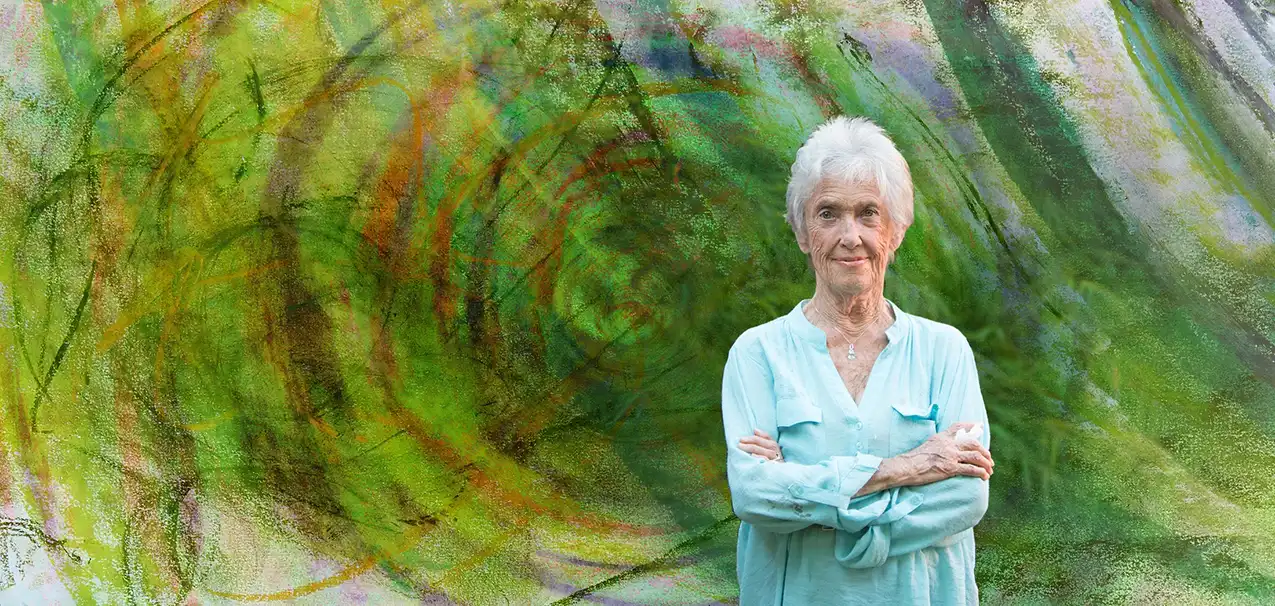
“Active Hope is waking up to the beauty of life on whose behalf we can act. We belong to this world.” Joanna Macy
Although our paths never crossed, the life and work and work of Joanna Macy have been a significant influence on my own activism and impulse since the 1980s. Her passing, on 19 July 2025 (age 96 years), was both a moment of sadness and a prompt to contemplate and celebrate her legacy. Macy was steadfast over many decades in helping to reimagine our world as many of us would like it to be. More than that, she grounded her vision in practical ways to process, practice and promote a different way of being and doing whilst paying attention to the need to grieve. My heart felt thanks both on a personal and planetary level for all that you did Joanna. – Kevin Parker Site Publisher
Audio discussion of essay content
The Voice in the Bardo
When the history of the transition from the Industrial Growth Society to a Life-Sustaining Civilization is finally written—assuming there are historians left to write it—the name Joanna Macy will appear not merely as a footnote, but as a primary structural beam. For nearly a century, spanning from the Great Depression to the burning summers of the mid-2020s, Macy served as a navigator for the human soul through the treacherous waters of the Anthropocene. She stood at the precise intersection where the ancient lineage of the Buddha met the cold, hard feedback loops of General Systems Theory; where the stillness of the meditation hall collided with the raucous desperation of the blockade line.
Joanna Macy, who departed this life on July 19, 2025, at the age of 96, was more than an environmental activist or a scholar of religion.1 She was a cultural midwife. She attended to the painful, bloody, and uncertain birth of a new form of human consciousness. Her life’s work was the articulation of a “wild love for the world”—a love that refused to be anesthetized by the comforts of consumerism or paralyzed by the terrors of “omnicide.”
The world today finds itself in what Tibetan Buddhism calls the bardo—a gap between known worlds. The old structures of the 20th century—fossil fuel dominance, infinite growth economics, the myth of the separate self—are fraying, their foundations liquefying under the heat of climate chaos and social fragmentation. The new world has not yet fully formed. It is a terrifying space, defined by a loss of certainly and the disintegration of reliable narratives.3
In this gap, where anxiety and paralysis often reign, Macy’s voice resonated with a clarity that cut through the noise of despair. She argued that the pain we feel for the world—the grief for burning forests, the rage at injustice, the fear for future generations—is not a pathology to be treated with pills or distractions. It is, instead, the most reliable evidence of our interconnection with all life. It is the burning wire of feedback that proves the organism is still alive. By reframing despair as proof of connection, Macy gifted the environmental movement its psychological survival kit.
This report offers an exhaustive examination of Macy’s life, philosophy, and enduring legacy. It traces the unlikely trajectory that took her from the halls of the CIA to the refugee camps of India, and from the rigorous academia of Syracuse University to the radioactive perimeters of nuclear waste sites. It dissects the “Work That Reconnects,” her methodological spiral for transforming grief into agency. It explores her navigation of the contentious debates between Deep Ecology and Ecofeminism. Finally, it assesses the critical utility of her teachings in navigating the “poly-crisis” of the post-2025 world.
Part I: The Weaver’s Origins — Biography and Context
The Early Threads: From Los Angeles to the Cold War
Born Mary Joanne Rogers on May 2, 1929, in Los Angeles, Joanna Macy’s life encompassed the great arcs of the 20th century.1 Her early years were marked by a curiosity that would eventually lead her far beyond the confines of conventional Western academia. Yet, her path to becoming a “dharma elder” was neither linear nor obvious. It was a weaving of disparate threads—political, spiritual, and intellectual—that would eventually form a sturdy rope of resilience.
In her young adulthood, Macy was not yet the radical environmentalist. She was deeply embedded in the structures of the establishment she would later critique. In the years following World War II, she worked for the Central Intelligence Agency (CIA) in Cold War Germany.4 This period is crucial for understanding her later work; she saw the machinery of geopolitical power from the inside. She witnessed the polarization of the world into opposing camps and the terrified logic of “Mutually Assured Destruction” (MAD). This early exposure to the institutionalization of paranoia and the mechanics of empire likely planted the seeds for her later rejection of the “power-over” dynamic in favor of “power-with.”
Her marriage to Francis Underhill Macy, a Russian scholar and activist, further placed her in the stream of global history.1 Francis, who would later found the Center for Safe Energy, was a partner in both life and activism. Together, they navigated the complexities of the Cold War, not as passive observers but as engaged participants seeking bridges across the Iron Curtain.
The Turn East: India and the Dalai Lama
The trajectory of Macy’s life shifted decisively in the 1960s when she and her husband moved to India, where Francis ran the Peace Corps program.4 It was here, amidst the vibrant chaos of post-colonial India, that Macy encountered the Dharma in its living form. She worked directly with Tibetan refugees, witnessing a resilience that defied Western materialist logic.
It was during this time that she encountered the young, newly exiled Dalai Lama.5 This was not merely a meeting of dignitary and aid worker; it was an encounter with a worldview that placed compassion and interdependence at the center of political reality. The Tibetans, having lost their homeland, possessed a “psychic technology” for dealing with loss that the West lacked. They understood sunyata (emptiness) and paticca samuppada (dependent co-arising)—concepts that would later become the bedrock of Macy’s own philosophy.
This immersion in Buddhist practice was not a retreat from the world but an entry into it. Macy realized that the spiritual stamina of the Tibetans was not passivity; it was a profound engagement with reality. She began to see that the “activist” and the “mystic” were not contradictory roles. The mystic sees the connection; the activist acts to protect it.
The Academic Anchor: Syracuse and Systems Theory
Upon returning to the West, Macy did not abandon her intellect for esoteric spirituality. Instead, she sought to rigorously integrate her Eastern experiences with Western science. She taught at Syracuse University from 1974 to 1976 and earned her Ph.D. in Religion in 1978.6
Her dissertation, Interdependence: Mutual Causality in Early Buddhist Teachings and General Systems Theory, remains the Rosetta Stone for decoding her worldview.7 In the late 1970s, General Systems Theory (GST) was emerging as a revolutionary way to understand complexity. Pioneered by thinkers like Ludwig von Bertalanffy and Norbert Wiener, GST moved science away from the reductionist Newtonian view—where the world is a clock made of separate parts—toward a view of the world as a web of dynamic relationships.
Macy’s genius lay in recognizing a structural homology between this cutting-edge cybernetics and the ancient teachings of the Buddha. She saw that the “feedback loops” of systems theory were describing exactly what the Buddha had realized under the Bodhi tree 2,500 years earlier. This synthesis allowed her to speak to Western audiences in the language of science (tipping points, synergy, homeostasis) while grounding that action in a spiritual reality (interbeing, compassion).
The Nuclear Catalyst and Deep Time
If Systems Theory provided the map, the nuclear threat provided the urgency. In the late 1970s and 80s, facing the terrifying prospect of nuclear annihilation and the silent, geological-scale poison of nuclear waste, Macy confronted a new kind of despair.2
She realized that the human psyche was ill-equipped to process threats of this magnitude. The potential for “omnicide”—the death of all—triggered a defense mechanism she termed “psychic numbing”.9 People were not indifferent to the end of the world; they were paralyzed by it. The horror was too great, so the mind shut down. This realization shifted her focus from merely protesting bombs to addressing the psychological paralysis that allowed the bombs to exist.
This work led her to the concept of Deep Time. Dealing with nuclear isotopes like Plutonium-239, which has a half-life of 24,000 years, forced Macy to expand her temporal horizon. She realized that modern humans live in a “temporal prison” of the immediate present—the election cycle, the fiscal quarter. To be responsible citizens of a nuclear age, we had to inhabit “Deep Time,” seeing ourselves as ancestors to beings ten thousand years hence. This birthed the “Guardianship Ethic,” proposing that nuclear waste should not be buried and forgotten, but monitored by a “Nuclear Guardianship” priesthood of sorts, kept visible to ensure future generations remained aware of the danger.8
Part II: The Philosophical Architecture
Macy’s work is built on a rigorous philosophical architecture that challenges the fundamental assumptions of the Western Enlightenment. At its core is a critique of the “separate self” and a proposal for a new ontology of connection.
Mutual Causality: The End of Linear Power
The central pillar of Macy’s philosophy is Mutual Causality. In the dominant Western worldview, power is often viewed as “power-over”—the ability of one agent to force a result upon another. This is linear causality: A strikes B, causing C. It is the logic of the bullet, the bill, and the bulldozer.
Macy, drawing on her doctoral work, champions “power-with” or synergistic power. In a system characterized by mutual causality, change does not happen through brute force but through resonance and feedback.10 In a nonlinear system, a small shift in one part of the web can ripple out and transform the whole, provided the feedback loops are open.
This view liberates the activist from the burden of immediate, visible results. If causality is non-linear, one cannot know the full fruit of one’s actions. An act of courage today might not topple a dictator tomorrow, but it might seed a shift in consciousness that blossoms fifty years hence. This understanding allows for what Macy calls “Active Hope”—action undertaken not because one calculates a high probability of success, but because it aligns with one’s intention and the needs of the web of life.11
| Feature | Linear Causality (Newtonian) | Mutual Causality (Systems/Buddhist) |
| Structure | Unidirectional (A $\rightarrow$ B) | Circular/Reciprocal (A $\leftrightarrow$ B) |
| Power Dynamic | Power-Over (Domination) | Power-With (Synergy) |
| Self-View | Independent, Isolated Entity | Interdependent, Relational Node |
| Change Mechanism | Force/Impact | Feedback/Resonance |
| Activist Goal | Control the Outcome | Participate in the Process |
The Greening of the Self
One of Macy’s most influential concepts is the “Greening of the Self,” a psychological expansion of identity. She argues that the environmental crisis is fundamentally a crisis of the “egoic self”—the delusion that we are separate, skin-encapsulated egos competing for resources.13
This “dysfunctional and pathogenic notion of the self” creates a dualism between humans and nature.15 We attack the Earth because we view it as “other,” as a supply house or a sewer. Macy suggests that through the systemic understanding of interconnection, the boundaries of the self can expand.
When one breathes, one is participating in the biosphere. When one drinks, the watershed is entering the body. The “I” expands to include the tree, the river, and the atmosphere. This is the Ecological Self. From this perspective, protecting the rainforest is not “altruism”; it is self-defense. As Macy famously wrote, “I am the rainforest defending herself”.14 This shift dissolves the false dichotomy between selfishness and selflessness. If the world is my body, then acting for the world is the ultimate self-care.
The Rilkean Influence
It is impossible to understand Macy’s voice without acknowledging her relationship with the German poet Rainer Maria Rilke. Working with Anita Barrows, Macy produced three volumes of Rilke translations.2 Rilke was her spiritual companion, a poet who faced the darkness of the early 20th century without looking away.
Rilke’s lines, “I live my life in widening circles / that reach out across the world,” became a mantra for Macy’s own philosophy. Rilke provided the poetic language for the Systems Theory concepts she was teaching. Where Systems Theory spoke of “feedback loops,” Rilke spoke of “listening to the stone.” He validated the “darkness” not as a place of evil, but as the womb of transformation. “Let this darkness be a bell tower,” he wrote—a call to ring out true even when surrounded by the void. This poetic sensibility infused Macy’s activism with a beauty and gravitas that prevented it from becoming dry or merely political.
Part III: The Work That Reconnects — Methodology of Transformation
The philosophical concepts of mutual causality and the ecological self are potent, but ideas alone rarely change behavior. Macy’s most tangible gift to society is the Work That Reconnects (WTR), a group-work methodology designed to operationalize these philosophies. It is a psychological process for transforming despair into empowerment.8
The WTR is structured as a spiral, a dynamic movement through four distinct stages. The spiral form is intentional; it is not a ladder to be climbed once, but a cycle to be repeated, deepening with each iteration.17
The Spiral Structure
Stage 1: Coming from Gratitude
The work begins not with the problem, but with the resource. “Coming from Gratitude” grounds participants in the sheer improbability and beauty of existence. In a culture of scarcity and complaint, gratitude is a radical act. It quiets the frantic, fearful mind and connects the individual to the “self-healing powers of the web of life”.16
This stage is not about spiritual bypassing or pretending everything is fine. It is about building a psychological platform strong enough to bear the weight of the grief that will follow. By acknowledging what we love, we gather the strength to face what threatens it.20
Stage 2: Honoring Our Pain for the World
This is the “critical passage” or hinge of the workshop.17 In modern society, pain for the world—grief, fear, anger, despair—is often pathologized. It is viewed as a personal failure, a sign of weakness, or a depressive disorder. We are told to “cheer up” or “move on.”
Macy argues that this repression creates a dangerous “feedback dampening.” If an organism represses the pain of injury, it continues to injure itself. Society’s refusal to feel the pain of ecological destruction allows that destruction to continue unchecked.19
In WTR, participants are invited to openly express their grief and rage. This is done through rituals like the Truth Mandala, where people step into a circle containing symbolic objects (a dry leaf for grief, a stone for fear, a stick for anger) to vocalize their emotions. The insight here is profound: the pain we feel is not ours alone; it is the Earth suffering through us. By honoring it, the pain is transmuted into compassion (literally “suffering with”) and energy. The energy previously used to suppress the grief is released and becomes available for action.9
Stage 3: Seeing with New Eyes
Having grounded in gratitude and released the burden of repressed grief, the participant is ready to shift perception. “Seeing with New Eyes” involves reframing reality through the lens of Systems Theory, Deep Ecology, and Deep Time.19
Here, the intellectual concepts of “Mutual Causality” and the “Ecological Self” are experienced viscerally. Exercises like the Council of All Beings—developed with John Seed—invite participants to set aside their human identity and speak on behalf of other life forms.22 A participant might speak as “The Colorado River” or “The Wolf,” articulating the suffering and the endurance of the non-human world. The goal is to strip away the illusion of the separate, isolated self and reveal the web of relationships. Participants realize they are not lone saviors carrying the weight of the world, but part of a vast, collective immune response.16
Stage 4: Going Forth
The final stage acts as a bridge back to the world of action. “Going Forth” is about identifying one’s specific role in the Great Turning. It is not about saving the world in one grand gesture, but about finding “what is mine to do”.16
Crucially, this stage emphasizes community. Participants make plans not as isolated individuals but as connected nodes in a network. They leave with “Active Hope”—not a guarantee of a happy ending, but a commitment to participate in the healing of the world regardless of the outcome.
| Stage | Core Function | Psychological Shift | Key Practice/Ritual |
| Gratitude | Resource Building | Scarcity $\rightarrow$ Sufficiency | “Open Sentences”, Nature connection |
| Honoring Pain | Unblocking Feedback | Isolation $\rightarrow$ Compassion | Truth Mandala, Despair Rituals |
| New Eyes | Cognitive Reframing | Separateness $\rightarrow$ Interbeing | Council of All Beings, Deep Time Walk |
| Going Forth | Action Planning | Paralysis $\rightarrow$ Agency | Corridors for the Future, Networking |
Part IV: The Great Turning vs. The Great Unraveling
Macy frames the current historical moment as a contest between three narratives or “stories of our time.” Understanding these stories is essential to her pedagogy, as they shape how we interpret the chaotic data of the modern world.3
Story 1: Business as Usual
This is the narrative of the Industrial Growth Society. It insists that economic growth is the primary metric of success, that nature is a commodity, and that technology will solve all limits. It requires “psychic numbing” to maintain, as one must ignore the clear signals of biosphere collapse to believe it. It is the story of denial.
Story 2: The Great Unraveling
This is the story of collapse. It acknowledges what “Business as Usual” denies: the melting ice caps, the dying coral, the failing states, the mass extinctions. It is a narrative of fear and catastrophe. While factually grounded in many ways, getting stuck in this story leads to paralysis, panic, and nihilism. It strips the individual of agency.
Story 3: The Great Turning
This is the story Macy invites us to inhabit. The Great Turning is the “essential adventure of our time”—the transition from an Industrial Growth Society to a Life-Sustaining Society. It is not a guarantee, but a possibility that we can actively cultivate.
Macy identifies three dimensions of the Great Turning, all of which are necessary 25:
- Holding Actions: Activism that slows down the destruction. This includes protests, blockades, lawsuits, and legal defense of land. It buys time. It saves specific forests, species, and communities. It is the “stopping” energy.
- Structural Change (Life-Sustaining Systems): Creating the new models that will replace the old. This includes permaculture, renewable energy, restorative justice, local currencies, and new educational models. This is the “building” energy.
- Shift in Consciousness: A profound change in our values and perception of reality. This is the spiritual and cognitive work—Deep Ecology, the WTR, and the move from anthropocentrism to biocentrism. This is the “seeing” energy.
Macy emphasizes that no single dimension is sufficient. The protester needs the permaculturist; the permaculturist needs the philosopher. The “Holding Action” warrior might burn out without the “Shift in Consciousness.” The “Structural Change” architect needs the time bought by the “Holding Action.” This framework allows activists from different sectors to see themselves as collaborators rather than competitors.
Part V: Navigating the Philosophical Tensions — Deep Ecology and Ecofeminism
Macy’s work situates her firmly within the Deep Ecology movement, yet she also navigates the critiques launched by Ecofeminism. This intersection is a rich field of philosophical tension and synthesis.
The Deep Ecology Foundation
Deep Ecology, coined by Norwegian philosopher Arne Naess, distinguishes itself from “shallow ecology” (which protects nature only for its utility to humans) by asserting the intrinsic value of all living beings.15 Macy was an early adopter and popularizer of this view, co-authoring Thinking Like a Mountain and promoting the “Council of All Beings”.2 Her work helped move Deep Ecology from an abstract philosophy into an embodied practice.
The Ecofeminist Critique
In the 1980s and 90s, Ecofeminists critiqued Deep Ecology for being “androcentric” (male-centered). They argued that Deep Ecology’s focus on “anthropocentrism” (human-centeredness) as the root evil ignored the fact that it was specifically patriarchal structures—historically dominated by men—that have driven ecological destruction.27
Thinkers like Ariel Salleh argued that the Deep Ecology concept of “expanding the self” to include nature was a male solution to a male problem. Men, socialized to be separate and autonomous, needed to “expand” their egos to feel connected. Women, they argued, through their biological and social roles (childbirth, caretaking), often already possessed a relational sense of self.28 They worried that Deep Ecology erased the specific social and political dynamics of gender, universalizing a male experience of alienation.
Macy’s Synthesis: The Relational Self
Macy, while identifying as a Deep Ecologist, integrated Ecofeminist insights through her systems lens. She acknowledged the “dysfunctional and pathogenic” self as a product of a specific cultural history—one that is indeed patriarchal and dualistic.15 However, she avoided the trap of essentialism.
Her synthesis lies in the concept of relationality. Both Deep Ecology and Ecofeminism ultimately champion a relational view of the world over a separatist one. Macy’s “Work That Reconnects” does not demand that participants adopt a specific gender analysis, but the outcome—realizing one’s interbeing with the web of life—serves the goals of both movements. She bridges the gap by focusing on the phenomenological experience of connection. Whether one calls it the “Ecological Self” or a “feminist relational self,” the result is a human being who feels the Earth’s suffering as their own and acts to heal it.27 Furthermore, later iterations of her work explicitly included “Undoing Oppression” as a foundational pillar, acknowledging that social hierarchy and ecological destruction are intertwined roots of the same systemic disease.16
Part VI: Active Hope in the Age of Anxiety
In her later years, Macy, along with Dr. Chris Johnstone, crystallized her teachings into the concept of Active Hope. This distinction became vital for a society obsessed with optimism but plagued by depression.
Hope vs. Optimism
Macy distinguishes sharply between “passive hope” (or optimism) and “Active Hope.”
- Passive Hope is a noun; it is something you have. It is an assessment of probability. It asks, “Will it be alright?” If the data suggests the answer is “no,” passive hope collapses into despair. It relies on external agencies to deliver a good outcome.
- Active Hope is a verb; it is something you do. It is a practice. It does not require a positive forecast. It involves clarifying what you love and moving in that direction, regardless of the odds.12
The Three Steps of Active Hope
Active Hope is a practice that can be applied to any situation, from a personal health crisis to planetary climate change. It involves three key steps 20:
- Clear View of Reality: Unflinchingly facing the mess we are in. This means acknowledging the “Great Unraveling” without turning away. It requires the courage to look at the data without the filter of denial.
- Identify Intention: Clarifying what we hope for and the values we wish to embody. What kind of world do we want? What values (compassion, justice, beauty) do we want to champion, even if we are the last ones to do so?
- Take Steps: Moving in the direction of that hope. We find “what is ours to do” and do it. We do not wait for a guarantee of success.
This redefinition is Macy’s antidote to “climate anxiety.” It liberates the activist from the tyranny of outcomes. One does not need to believe the world will be saved to work for its salvation. One works for it because it is the only way to live with dignity and integrity. As Macy puts it, “I am not insisting that we be brimming with hope… The main thing is that you’re showing up”.33
Part VII: Usefulness in Tackling Current Global Challenges
As we navigate the mid-21st century, the utility of Macy’s teachings is increasing. We are facing a “poly-crisis”: climate collapse, pandemics, geopolitical instability, and a mental health epidemic. Macy’s work offers specific tools for this era.
1. Addressing Climate Anxiety and Eco-Grief
Macy’s work is the primary therapeutic modality for the Anthropocene. As “eco-anxiety” becomes a recognized psychological condition, the WTR provides a proven methodology for processing this distress. It moves people from isolation (“I am the only one terrified”) to solidarity (“We are feeling this together”). This shift from private pathology to collective processing is essential for maintaining a functional citizenry in a time of crisis.34
2. Sustaining Activism (Preventing Burnout)
The “Great Turning” framework helps prevent activist burnout. By validating “Holding Actions” (protest) alongside “Consciousness Shift” (spirituality), it reduces the infighting between different factions of the change movement. It allows the exhausted frontline defender to see the meditation teacher not as escaping the world, but as holding the flank of “consciousness.” This integral view creates a more resilient movement ecology.
3. Navigating Uncertainty (The Bardo)
Macy’s late-life teaching on the Bardo—the space without a map—is a crucial tool for leadership today. We are entering an era where historical precedents no longer apply. Leaders and citizens alike need tools to navigate radical uncertainty without collapsing into authoritarianism or nihilism. Macy draws on the image of the Buddha Akshobhya, the “Immovable One,” who holds a mirror representing “Mirror Wisdom.” This mirror reflects things exactly as they are, without distortion or judgment. In the Bardo, our task is not to panic, but to “sustain the gaze”—to look into the mirror of our reality with radical attention and total acceptance. Only by fully accepting where we are can we find the path to where we must go.3
4. Social Justice and Intersectional Solidarity
Macy’s inclusion of “Undoing Oppression” in the WTR acknowledges that environmental destruction is inextricably linked to social injustice. Her systems view argues that racism, poverty, and colonialism are not just bad policies; they are systemic blockages that prevent the “Earth body” from healing. You cannot have a healthy planet with sick, oppressed communities. This offers a spiritual basis for intersectional solidarity, grounding social justice in the metaphysical reality of interbeing.
Part VIII: Joanna’s Gift to Society
What is Joanna Macy’s ultimate gift to society? It is, perhaps, the restoration of our capacity to feel.
In an age of anesthesia—where screens, drugs, and consumerism are used to numb the ache of living in a dying world—Macy was the relentless advocate for the broken heart. She taught us that the heart breaks open, not down. She re-consecrated grief, elevating it from a private neurosis to a sacred civic duty.
Her legacy is institutionalized in places like Naropa University, where the Joanna Macy Center for Resilience and Regeneration continues to train scholars and activists.24 It lives on in the thousands of “Work That Reconnects” facilitators holding circles in living rooms, community centers, and protest camps from Ukraine to California.2 It endures in her prolific bibliography, including seminal texts like World as Lover, World as Self, Coming Back to Life, and Active Hope.1
Figures like the Dalai Lama have recognized her contribution, noting her role in translating the concept of interdependence into the language of global responsibility.5 Poet Gary Snyder and Zen Master Thich Nhat Hanh have praised her for giving voice to the “crying of the Earth”.9
Conclusion: A Wild Love for the World
Joanna Macy’s life work can be summarized as a love affair with the world. Not a romantic, idealized world, but the gritty, suffering, beautiful, and endangered world we actually inhabit.
She called us to a “wild love”—a love that is not contingent on safety or success. In the face of the Great Unraveling, she asked us to inhabit the “Bardo” with courage. She taught that we are not isolated atoms drifting in a meaningless void, but the living, feeling nerve endings of a vast, miraculous planet.
As we move forward without her physical presence, her teachings remain as a guide. They remind us that even when the map is lost, the compass of the heart—tuned to the magnetic north of compassion—remains true. In the end, her message was simple yet revolutionary: Do not look away. Do not close your heart. Keep your gaze steady, your gratitude fresh, and your hand ready to do the work that is yours to do.


