
I. A Farm at the Crossroads
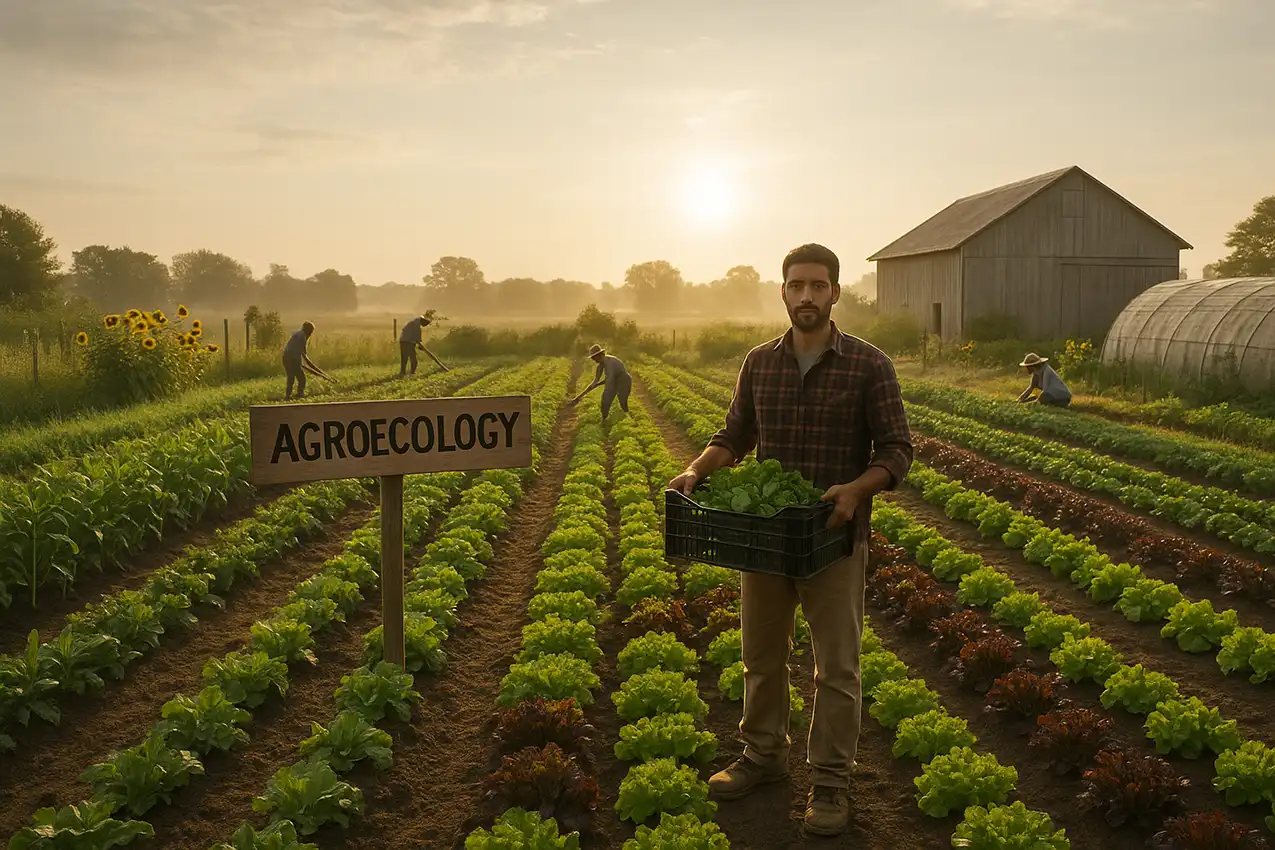
The dawn light over the Anantapur district in Andhra Pradesh, India, reveals a landscape that defies the prevailing logic of modern agriculture. In a region historically plagued by drought and agrarian distress, where the scorched earth often mirrors the despair of debt-ridden farmers, the field belonging to Lakshmi Devi stands as a verdant anomaly. It is not the monotonous green of a single crop stretched to the horizon, the industrial ideal that has dominated global farming for nearly a century. Instead, it is a chaotic, vibrant mosaic. Rows of pigeon peas cast dappled shade over lower-growing chickpeas and millets; marigolds bloom in bright orange bursts, acting as trap crops for pests; and the soil, rather than being exposed and baking in the tropical sun, is covered in a mulch of crop residues that holds moisture like a sponge.
There is a distinct absence of the chemical tang that hangs over many neighboring plots during the spraying season. Lakshmi does not purchase bags of urea or bottles of glyphosate. She treats her soil with Jeevamrutham, a fermented microbial innoculant made from cow dung, urine, jaggery, and pulse flour—a concoction teeming with beneficial bacteria and fungi that she prepares in a drum behind her house. This is “Community Managed Natural Farming” (APCNF), a movement that has swept across the state, enrolling nearly a million farmers in a quiet revolution that prioritizes biology over chemistry.^1
To the uninitiated observer, Lakshmi’s farm might look like a throwback to a pre-industrial past, a romantic but inefficient relic. To the trained ecologist or the soil scientist, however, it represents something far more sophisticated: a complex adaptive system that mimics the structural and functional diversity of a forest while producing food. It is a living laboratory of agroecology.
Contrast this with the view from a satellite monitoring the soy plantations of the Brazilian Cerrado or the corn belt of the American Midwest. There, the geometry is Euclidian and absolute. Perfect circles of pivot irrigation drain ancient aquifers to water genetically identical cultivars. The soil is treated not as a living ecosystem but as a sterile medium, a mere substrate for holding roots while chemical inputs provide the fertility and protection. This is the “machine”—the dominant industrial food system. It produces calories at a staggering scale, but its accounts are bleeding. The soil is eroding, biodiversity is collapsing, and the farmers themselves are trapped in a cycle of debt and dependency.
We stand at a civilizational crossroads. For decades, the debate over the future of food has been framed as a binary choice: the “efficiency” of industrial agriculture versus the “idealism” of organic alternatives. But as the planetary boundaries close in—as climate change disrupts monsoon cycles, as topsoil disappears, and as rural economies hollow out—the calculus has changed. The argument for agroecology is no longer a plea for a return to nature; it is a rigorous, evidence-based case for the only model of agriculture compatible with the long-term survival of human civilization. The central question of our time is not whether agroecology can feed the world, but whether the industrial status quo can survive long enough to be dismantled before it takes the biosphere down with it.
II. How We Built the Industrial Food Machine
To understand the necessity of the agroecological transition, one must first perform a forensic audit of the system it seeks to replace. The industrial food system did not arise by accident; it was built through specific geopolitical decisions, technological choices, and economic structures that prioritized yield above all else.
The Green Revolution: A Cold War Legacy
The origins of the modern industrial food system lie in the mid-20th century, specifically in the geopolitical anxieties of the Cold War. In the 1940s and 50s, the Ford and Rockefeller Foundations, working with the U.S. government, launched an ambitious program to modernize agriculture in the Global South. The concern was Malthusian but also political: a hungry peasantry was seen as a breeding ground for communism. The solution was the “Green Revolution.”^2
Led by scientists like Norman Borlaug, this revolution was based on a specific “package” of technologies: high-yielding varieties (HYVs) of wheat, rice, and maize that were bred to respond to high doses of synthetic nitrogen fertilizer and reliable irrigation. These semi-dwarf varieties were miracles of engineering; they put their energy into grain rather than straw, and their stiff stalks could support heavy heads of grain without toppling over (lodging).
The statistical success was undeniable. Between 1960 and 2000, global cereal production more than doubled. India, once mocked as a “begging bowl,” became self-sufficient in grain. The specter of imminent mass famine, predicted by alarmists like Paul Ehrlich, was held at bay. Borlaug was awarded the Nobel Peace Prize, and the narrative was set: technology, chemistry, and intensification had saved humanity.^3
The Hidden Bill of Fare
However, biology is not a machine, and the bill for this productivity is now coming due. The Green Revolution fundamentally altered the metabolic rift between humans and the soil.
1. The Nitrogen Addiction:
The Haber-Bosch process, which synthesizes ammonia from atmospheric nitrogen using fossil fuels, is perhaps the most significant industrial intervention in the Earth’s cycles. It allowed humanity to bypass the biological limits of soil fertility. But this came at a cost. Today, we apply over 100 million tonnes of synthetic nitrogen annually. Less than half is taken up by crops; the rest runs off into waterways, creating hypoxic “dead zones” like the one the size of New Jersey in the Gulf of Mexico, or volatilizes into nitrous oxide, a greenhouse gas nearly 300 times more potent than carbon dioxide.^4
2. The Soil Crisis:
Industrial agriculture treats soil biology as an impediment or an irrelevance. Heavy tillage oxidizes soil carbon, releasing it into the atmosphere. Fungicides and pesticides decimate the mycorrhizal fungi and soil bacteria that facilitate nutrient exchange. The result is “dirt”—inert mineral matter that requires ever-increasing doses of fertilizer to function. The UN Food and Agriculture Organization (FAO) warns that a third of the world’s soils are already degraded, and we may have fewer than 60 harvests left at current rates of erosion.^5
3. The Water Deficit:
The HYVs of the Green Revolution are thirsty. They require precise water management, leading to the massive expansion of irrigation. In Punjab, the breadbasket of India, the water table is plummeting by meters every year. We are essentially mining fossil water to grow grain, a biophysical impossibility in the long run.^6
4. The Social Hollow:
The “package” was expensive. It required farmers to buy seeds, fertilizers, and pesticides every season. This favored larger, wealthier farmers who could access credit and absorb risk. Smallholders were squeezed out, leading to massive land consolidation and rural-to-urban migration. The “get big or get out” philosophy hollowed out rural communities from Iowa to Indonesia. In India, the tragedy of over 300,000 farmer suicides since the mid-1990s is inextricably linked to the debt cycles of high-input agriculture.^7
III. What Agroecology Actually Means
In the face of these cascading crises, agroecology has emerged as a counter-paradigm. However, the term is often co-opted or misunderstood. It is not merely “organic farming,” which can still be industrial in scale (huge monocultures of organic lettuce). Nor is it a primitive retreat. Agroecology is a scientific discipline, a set of practices, and a social movement.
1. Agroecology as Science
As a science, agroecology applies ecological principles to the design and management of sustainable food systems. It moves beyond the reductionist approach of agronomy (which isolates the crop from its environment) to a systems approach. It studies the interactions between plants, animals, humans, and the environment.
Key scientific principles include:
- Diversity: Replacing monocultures with polycultures (intercropping, agroforestry) to maximize light capture and resource use efficiency.
- Synergy: designing systems where components support each other (e.g., legumes fixing nitrogen for cereals; trees providing shade and leaf litter).
- Recycling: Closing nutrient loops so that waste from one part of the system becomes food for another, minimizing external inputs.
- Regulation: Enhancing biological control mechanisms (predators, parasites) to manage pests rather than eradicating them with chemicals.^8
2. Agroecology as Practice
On the ground, this translates into a diverse toolkit of techniques adapted to local contexts.
- Push-Pull Technology: Developed by the International Centre of Insect Physiology and Ecology (ICIPE) in Kenya, this system addresses the twin problems of stem borer pests and Striga weed in maize. Farmers plant a “push” plant (Desmodium) between maize rows, which repels the moths and suppresses the weed. They plant a “pull” plant (Napier grass) on the border, which attracts the moths. The result is higher yields, fodder for livestock, and improved soil fertility—all without chemicals.^9
- Rice-Fish-Duck Systems: In parts of Asia, farmers reintroduce fish and ducks into rice paddies. The animals eat pests and weeds, oxygenate the water, and fertilize the rice with their droppings, providing a diverse diet of carbohydrates and protein.^10
3. Agroecology as a Movement
Crucially, agroecology is political. Unlike “sustainable intensification,” which seeks to tweak the industrial model without changing power structures, agroecology is aligned with the concept of Food Sovereignty. It asserts the right of peoples to define their own food and agriculture systems. It centers the agency of the peasant, the indigenous person, and the woman farmer. It challenges the corporate control of seeds and land. As the peasant movement La Via Campesina declares, “Agroecology is a tool for the social transformation of rural life.”^11
IV. The Evidence: Yields, Resilience, and Livelihoods
The most persistent critique of agroecology is the “yield gap”—the idea that without synthetic inputs, we cannot produce enough food to feed a growing population. This argument, advanced by critics like Vaclav Smil and proponents of the “Borlaug hypothesis,” rests on the assumption that only high-input systems can achieve the necessary caloric density.^12 However, a granular look at the data reveals a different reality.
The Yield Debate: Quantity vs. Quality
Meta-analyses published in journals like Nature and Proceedings of the National Academy of Sciences (PNAS) have found that while organic systems (a proxy for agroecology) can have yields 10–20% lower than conventional systems under optimal industrial conditions, this gap narrows or disappears when best practices like multi-cropping and crop rotations are used.^13
More importantly, the “yield” metric itself is flawed. It measures the output of a single commodity (e.g., tons of maize per hectare). Agroecological systems often produce a diverse array of outputs from the same plot (maize + beans + pumpkins + fruit + fodder). When measured by the Land Equivalent Ratio (LER), agroecological intercropping systems often outperform monocultures. An LER of 1.5 means that a monoculture farm would need 50% more land to produce the same amount of food as the intercropped farm.^14
Furthermore, in the Global South, where yields are often limited by poor soil quality and lack of water rather than genetic potential, agroecological interventions frequently lead to significant yield increases. A seminal study by Jules Pretty examining 286 projects in 57 countries found an average yield increase of 79% after adopting resource-conserving technologies.^15
Resilience in a Warming World
As the climate destabilizes, the primary metric of success is shifting from maximization to stability. Industrial monocultures are brittle; they are engineered for a narrow band of climatic conditions. When a heatwave hits or the rains fail, the monoculture collapses.
Agroecological systems are resilient. Their high soil organic matter acts as a buffer.
- Drought Resistance: In the drought-prone regions of West Africa, farmers using traditional zaï pits (planting pockets enriched with compost) have rehabilitated tens of thousands of hectares of degraded land. These fields remain green and productive long after conventional fields have withered.^16
- Extreme Weather: Following Hurricane Mitch in Central America in 1998, a massive survey found that farms using agroecological practices (contour farming, cover crops, agroforestry) retained 20–40% more topsoil and suffered significantly less economic damage than their conventional neighbors. The complex root structures and soil cover held the mountain together.^17
Soil Health and Biodiversity
The evidence for agroecology’s environmental benefits is unequivocal.
- Carbon Sequestration: Agroecological soils, rich in organic matter, act as massive carbon sinks. The “4 per 1000” initiative launched by France estimates that increasing soil carbon stocks by just 0.4% per year could offset a significant portion of anthropogenic emissions.^18
- Biodiversity: A meta-analysis in Global Change Biology found that diversified farming systems support far higher levels of biodiversity—birds, pollinators, soil fauna—than simplified systems. This biodiversity is not just “nice to have”; it is the functional infrastructure of the farm, providing pollination and pest control services worth billions of dollars.^19
Livelihoods and Gender
The industrial model, with its emphasis on mechanization, is inherently labor-saving—which is a euphemism for job-destroying. In the Global South, where youth unemployment is a demographic time bomb, agroecology offers a pathway to dignified employment. It is knowledge-intensive rather than capital-intensive.
Agroecology also has a distinct gender dimension. In many cultures, women are the custodians of seed diversity and manage complex home gardens that provide essential micronutrients. Industrialization often displaces these crops with male-controlled cash crops. Agroecology re-centers women’s knowledge. The Deccan Development Society in India, comprised of Dalit women, has reclaimed land and biodiversity through millet farming, achieving food sovereignty and social status in a caste-ridden society.^20
V. Follow the Money: The Political Economy of Lock-ins
If the evidence for agroecology is so compelling—if it restores soil, saves water, sequesters carbon, and empowers farmers—why is it not the dominant model? Why do we continue to subsidize and support a failing industrial system?
The answer lies in the “lock-ins” of the political economy. The International Panel of Experts on Sustainable Food Systems (IPES-Food) describes a web of reinforcing structures that keep the industrial model in place.^21
Corporate Concentration
The most obvious barrier is the sheer concentration of power in the agribusiness sector. Following a wave of mega-mergers, just four firms—Bayer (which acquired Monsanto), Corteva (Dow + DuPont), Syngenta (acquired by ChemChina), and BASF—control over 60% of the global proprietary seed market and more than 70% of the agrochemical market.^22
This oligopoly exerts immense influence:
- Lobbying: In 2023 alone, the agribusiness sector spent over $178 million on lobbying in the United States.^23 In the European Union, a fierce lobbying campaign by CropLife Europe and Copa-Cogeca successfully derailed the “Farm to Fork” strategy, which aimed to reduce pesticide use by 50% by 2030. Using the war in Ukraine as a pretext, they argued that any reduction in inputs would threaten food security—a claim debunked by scientists but swallowed by policymakers.^24
- Intellectual Property: The expansion of patent regimes (via the UPOV convention and WTO TRIPS agreement) has criminalized the age-old practice of seed saving. Farmers are forced to purchase seeds every season, locking them into a dependency on corporate supply chains. This “technological lock-in” ensures a steady stream of revenue for the giants while eroding farmer autonomy.^25
The Subsidy Machine
Public finance is the engine of the industrial model. Governments worldwide provide over $700 billion annually in agricultural support. The vast majority of this flows to commodity crops (corn, soy, wheat, rice) and input-intensive practices. These subsidies distort markets, making industrial food artificially cheap while rendering labor-intensive, eco-friendly farming economically precarious. We are effectively paying corporations to destroy the planet, then paying again to clean up the mess.^26
Supply Chain Bottlenecks
The physical infrastructure of the food system—grain elevators, processing plants, supermarket logistics—is designed for uniformity. It handles standard grades of corn and soy efficiently but struggles with the diversity of an agroecological farm. A farmer growing ten different heritage crops faces a “market access” barrier because the supply chain demands homogenization.
VI. Science, Knowledge, and Epistemic Injustice
Beyond the economic lock-ins, there is a cognitive lock-in. The very way we define “science” and “innovation” is rigged against agroecology.
The Research Gap
We fund what we value. A study of USDA research funding revealed that less than 2% of the budget goes to agroecology. The situation is similar in the UK and Europe. The vast majority of public and private R&D spending goes to biotechnological fixes—GMOs, gene editing, digital agriculture—that result in patentable products.^27
The Bill & Melinda Gates Foundation, a massive influencer in global agricultural development, exemplifies this bias. Through the Alliance for a Green Revolution in Africa (AGRA), the foundation has poured billions into promoting commercial seeds and fertilizers. A recent analysis by Biovision and IPES-Food found that only a tiny fraction of Gates Foundation agricultural funding in Africa went to projects with agroecological components, while the lion’s share supported industrial approaches.^28
Epistemic Injustice
This funding bias creates an “epistemic injustice.” Agroecology is often dismissed by mainstream institutions as “anecdotal,” “unscalable,” or “anti-science.” This stems from a reductionist scientific paradigm that privileges lab-based, variable-controlled experiments over complex, field-based observations.
Agroecological knowledge is often context-specific, developed by farmers through generations of observation. It resides in the oral traditions of indigenous peoples and the practical skills of peasants. When a scientist in a lab coat modifies a gene, it is called “innovation.” When a farmer in the Andes breeds a potato variety resistant to frost through centuries of selection, it is called “tradition.” The industrial model extracts this traditional knowledge (biopiracy) while simultaneously dismissing the systems that produced it.^29
Author Jack Kloppenburg, in his seminal work First the Seed, argues that the commodification of the seed was the critical step in wresting control of agriculture from the farmer to the capital accumulation process. Agroecology seeks to reverse this, reclaiming the “commons” of knowledge.^30
VII. Competing Food Futures: Tech Fixes vs. Agroecological Transitions
We are currently witnessing a struggle over the future of food, often described as a clash between “techno-optimism” and “agroecology.”
The Techno-Fix Narrative
The dominant narrative, pushed by the “Food Systems Summit” and corporate actors, is that technology will save us.
- New Genomic Techniques (NGTs): CRISPR and gene editing promise to create crops that are drought-tolerant and pest-resistant without the “messiness” of transgenics. However, critics argue this is merely Green Revolution 2.0—a way to extend the patent model and avoid addressing the root causes of vulnerability (soil health).
- Precision Agriculture & AI: The vision of “farming 4.0” involves drones, sensors, and AI-driven tractors that apply inputs with millimeter precision. While efficiency is good, this path deepens the farmer’s dependency on Big Tech and data platforms, turning the farmer into a mere operator of proprietary algorithms.
- Vertical Farming and Lab Meat: These decouple food production from the land entirely. While they may have niche applications, they are energy-intensive and do nothing to restore the degraded ecosystems where the vast majority of our food—and biodiversity—must exist.^31
Co-optation: The “Regenerative” Pivot
Sensing the shift in public sentiment, corporations have recently pivoted to the language of “Regenerative Agriculture.” Companies like Cargill, McDonald’s, and Bayer have launched regenerative initiatives focused on soil health and carbon sequestration.
However, civil society groups warn of co-optation. The corporate definition of “regenerative” often cherry-picks practices (like no-till or cover cropping) while ignoring the social dimensions (pesticide use, corporate power, land rights). For instance, Bayer promotes a “regenerative” system that relies on glyphosate to kill cover crops—a practice that many soil ecologists argue is antithetical to true regeneration. This “greenwashing” threatens to dilute the transformative potential of the movement, turning it into a marketing label rather than a paradigm shift.^32
VIII. Policy, Law, and the Politics of Transition
Despite the headwinds, the policy landscape is shifting. Agroecology has moved from the fringes to the center of global policy debates.
The International Stage
The FAO, once the bastion of the Green Revolution, has officially embraced agroecology, launching the “Scaling Up Agroecology” initiative. The Committee on World Food Security (CFS) recently adopted policy recommendations on agroecological and other innovative approaches, giving the concept diplomatic legitimacy.^33
National Divergences
- Brazil: Under the presidency of Lula da Silva (in his first terms) and Dilma Rousseff, Brazil implemented the National Policy on Agroecology and Organic Production (PNAPO). It was a world-leading framework that integrated public procurement (buying from family farmers for school meals) with credit and extension services. While the Bolsonaro administration dismantled much of this, the institutional memory and the movements (like the Landless Workers Movement, MST) remain strong, and efforts are underway to rebuild it.^34
- France: In 2014, France passed the “Law for the Future of Agriculture,” which explicitly set a goal to transition French agriculture towards agroecology. While implementation has been mixed and faced resistance from the powerful FNSEA union, it remains a unique example of a Global North nation legislating for an agroecological transition.^35
- Andhra Pradesh (India): The APCNF program mentioned in the opening vignette is perhaps the most significant policy experiment in the world. Backed by the state government, it demonstrates that agroecology can be scaled not by corporate franchises, but by investing in “social capital”—the women’s self-help groups that spread knowledge village to village.^36
The Trade Trap
However, national ambitions are often constrained by international trade rules. The WTO and bilateral free trade agreements generally forbid mechanisms that protect local markets or subsidize domestic producers, classifying them as “trade-distorting.” A country that wants to ban cheap, subsidized powdered milk imports to protect its own agroecological dairy farmers often faces sanctions. Reforming the global trade regime to allow for “food sovereignty” protections is a prerequisite for a global transition.^37
IX. Objections, Hard Questions, and Honest Limits
To be a credible alternative, agroecology must confront its critics and its own limitations honestly.
Objection 1: “Agroecology cannot feed 10 billion people.”
Response: This argument assumes that the current system does feed the world. It doesn’t. We produce enough calories for 10 billion people today, yet hunger persists because of poverty and distribution. Furthermore, roughly a third of global food production is wasted, and a huge percentage of grain is fed to livestock or cars (biofuels). An agroecological transition implies a dietary transition: less industrial meat, more plants. Modeling studies, such as the “Ten Years for Agroecology” (TYFA) scenario for Europe, show that it is biophysically possible to feed the population agroecologically if diets change and waste is reduced.^38
Objection 2: “It’s too labor-intensive.”
Response: Agroecology is more labor-intensive. In the West, where labor is expensive and scarce, this is a challenge. It requires a shift in how we value food (paying more) and potentially a re-peopling of the countryside. However, we must distinguish between “drudgery” and “meaningful work.” Appropriate technology—small-scale mechanization, robotics designed for polycultures—can reduce the back-breaking aspect without replacing the human intelligence required to manage complex systems. In the Global South, where unemployment is high, the labor intensity is a feature, not a bug—it is an engine for rural livelihoods.^39
Objection 3: “It’s too slow.”
Response: Restoring soil takes time. There is often a “transition period” (3–5 years) where yields drop before the biological systems kick in. Farmers operating on thin margins cannot survive this dip without support. This is where “payments for ecosystem services” are crucial. We must pay farmers to transition, viewing it as an investment in public infrastructure (soil and water).
X. A Different Horizon: What an Agroecological World Might Look Like
Imagine a food system transformed.
The Landscape:
The landscape is no longer a checkerboard of monocultures. It is a mosaic. Fields are smaller, bordered by hedgerows and trees (silvopasture) that act as wildlife corridors. Wetlands have been restored to filter water. Livestock are not crammed into CAFOs but rotated across pastures, their manure fertilizing the soil. Cities are ringed by “green belts” of market gardens that provide fresh produce, reducing “food miles.”
The Economy:
The economy is circular and regional. Food hubs and cooperatives aggregate produce from small farmers to supply schools, hospitals, and supermarkets. Farmers are paid fair prices that reflect the cost of stewardship. The “True Cost” of food is recognized; the polluter pays, and the steward is rewarded.
The Knowledge:
Research stations are open spaces where scientists and farmers co-design experiments. Indigenous knowledge is respected as a sophisticated adaptation to place. Digital tools are open-source and controlled by farmer cooperatives, used to monitor soil health or coordinate logistics, not to extract data for corporate gain.
The Governance:
Food is treated as a human right, not just a commodity. Local food policy councils give citizens a voice in how their food system is run. Trade rules privilege ecological sustainability and social justice over the free flow of capital.
Conclusion: The Necessity of Hope
The argument for agroecology is not that it is easy. It is that it is necessary. The industrial food system is a bubble, inflated by cheap fossil fuels, stable climates, and the unpriced looting of natural capital. That bubble is leaking.
We can choose to patch the leaks with more technology—more gene editing, more drones, more synthetic inputs—hoping to squeeze a few more decades out of a dying model. Or we can choose the path of resilience.
Agroecology is the path of resilience. It is the recognition that human agriculture is a subset of the biosphere, and it must obey the laws of biology, not just the laws of the market. It finds hope in the red earth of Andhra Pradesh, where Lakshmi Devi’s soil is teeming with life. It finds hope in the peasant movements demanding justice. It is a vision of a future where we do not just feed the world, but heal it.
This essay was produced with the help of Gemini Pro 3.0. Please check all details are to your satisfaction before reproduction.
Endnotes
^1. Rythu Sadhikara Samstha, “Andhra Pradesh Community Managed Natural Farming,” apcnf.in, accessed May 2024, https://apcnf.in/. See also: T. Vijay Kumar et al., “Pre-Monsoon Dry Sowing (PMDS): A Breakthrough in Rainfed Agriculture,” RySS Process Note, 2019.
^2. Raj Patel, Stuffed and Starved: The Hidden Battle for the World Food System (London: Portobello Books, 2007), 120-125; John H. Perkins, Geopolitics and the Green Revolution: Wheat, Genes, and the Cold War (Oxford: Oxford University Press, 1997).
^3. P.L. Pingali, “Green Revolution: Impacts, limits, and the path ahead,” Proceedings of the National Academy of Sciences 109, no. 31 (2012): 12302–12308.
^4. J.W. Erisman et al., “How a century of ammonia synthesis changed the world,” Nature Geoscience 1 (2008): 636–639.
^5. FAO, Status of the World’s Soil Resources (SWSR) (Rome: Food and Agriculture Organization of the United Nations, 2015).
^6. Upmanu Lall et al., “India’s Water Crisis: The Seen and Unseen,” Water Security 11 (2020): 100072.
^7. A.R. Vasavi, Shadow Space: Suicides and the Predicament of Rural India (New Delhi: Three Essays Collective, 2012).
^8. Miguel A. Altieri, Agroecology: The Science of Sustainable Agriculture (Boulder: Westview Press, 1995); Stephen R. Gliessman, Agroecology: The Ecology of Sustainable Food Systems (Boca Raton: CRC Press, 2014).
^9. Z.R. Khan et al., “Economic performance of the ‘push-pull’ technology for stemborer and Striga control in smallholder farming systems in western Kenya,” Crop Protection 27, no. 7 (2008): 1084-1097.
^10. L.H. Frei and K. Becker, “Integrated rice-fish culture: Coupled production saves resources,” Natural Resources Forum 29 (2005): 135–143.
^11. La Via Campesina, “The Declaration of Nyéléni,” Nyéléni 2007 – Forum for Food Sovereignty, February 27, 2007.
^12. Vaclav Smil, “Detonator of the population explosion,” Nature 400 (1999): 415.
^13. Lauren C. Ponisio et al., “Diversification practices reduce organic yield gaps,” Proceedings of the National Academy of Sciences 112, no. 2 (2015): 729-734; Verena Seufert, Navin Ramankutty, and Jonathan A. Foley, “Comparing the yields of organic and conventional agriculture,” Nature 485 (2012): 229–232.
^14. John Vandermeer, The Ecology of Intercropping (Cambridge: Cambridge University Press, 1989).
^15. Jules Pretty et al., “Resource-Conserving Agriculture Increases Yields in Developing Countries,” Environmental Science & Technology 40, no. 4 (2006): 1114–1119.
^16. Chris Reij, Gray Tappan, and Melinda Smale, “Agroenvironmental Transformation in the Sahel: Another Kind of ‘Green Revolution’,” IFPRI Discussion Paper 00914 (2009).
^17. Eric Holt-Giménez, “Measuring farmers’ agroecological resistance after Hurricane Mitch in Nicaragua: a case study in participatory, sustainable land management impact monitoring,” Agriculture, Ecosystems & Environment 93, no. 1-3 (2002): 87-105.
^18. B. Minasny et al., “Soil carbon 4 per mille,” Geoderma 292 (2017): 59-86.
^19. D.S. Karp et al., “Crop pests and predators exhibit inconsistent responses to surrounding landscape composition,” Proceedings of the National Academy of Sciences 115, no. 33 (2018): E7863-E7870.
^20. P.V. Satheesh, “Millet Sisters: The Women of the Deccan Development Society,” Leisa India, 2018.
^21. IPES-Food, From Uniformity to Diversity: A paradigm shift from industrial agriculture to diversified agroecological systems (Louvain-la-Neuve: International Panel of Experts on Sustainable Food Systems, 2016).
^22. ETC Group, Plate Tech-Tonics: Mapping Corporate Power in Big Food (Ottawa: ETC Group, 2019).
^23. OpenSecrets, “Agribusiness: Lobbying, 2023,” accessed May 2024, https://www.opensecrets.org/industries/lobbying?ind=A.
^24. Corporate Europe Observatory, “A loud lobby for a silent spring: The pesticide industry’s toxic lobbying tactics against the EU Farm to Fork Strategy,” CEO Report, 2022.
^25. Jack Kloppenburg, “Re-purposing the master’s tools: the open source seed initiative and the struggle for seed sovereignty,” The Journal of Peasant Studies 41, no. 6 (2014): 1225-1246.
^26. FAO, UNDP and UNEP, A Multi-Billion Dollar Opportunity: Repurposing agricultural support to transform food systems (Rome: FAO, 2021).
^27. M.S. DeLonge, A. Miles, and L. Carlisle, “Investing in the transition to sustainable agriculture,” Environmental Science & Policy 55 (2016): 266-273.
^28. Biovision Foundation for Ecological Development & IPES-Food, Money Flows: What is holding back investment in agroecological research for Africa? (Zurich/Brussels: Biovision/IPES-Food, 2020).
^29. Boaventura de Sousa Santos, Epistemologies of the South: Justice Against Epistemicide (Boulder: Paradigm Publishers, 2014).
^30. Jack Ralph Kloppenburg Jr., First the Seed: The Political Economy of Plant Biotechnology, 1492-2000 (Cambridge: Cambridge University Press, 1988).
^31. George Monbiot, Regenesis: Feeding the World without Devouring the Planet (London: Penguin, 2022). Note: Monbiot argues for precision fermentation, representing the tension in the “future of food” debate.
^32. GRAIN, “Regenerative agriculture: corporate greenwashing or a real path for the future?” GRAIN Briefing, 2021.
^33. CFS, Policy Recommendations on Agroecological and Other Innovative Approaches for Sustainable Agriculture and Food Systems that Enhance Food Security and Nutrition (Rome: Committee on World Food Security, 2021).
^34. Claudia Schmitt et al., “Institutionalization of Agroecology in Brazil: State, Civil Society and the Construction of the National Policy for Agroecology and Organic Production,” Sustainability 12 (2020): 1-17.
^35. Ministère de l’Agriculture et de la Souveraineté alimentaire, “Le projet agro-écologique pour la France,” agriculture.gouv.fr, 2014.
^36. T. Vijay Kumar, “Andhra Pradesh Community Managed Natural Farming: A transformation in progress,” Circular Economy in the Global South (London: Routledge, 2020).
^37. Olivier De Schutter, “International Trade and the Right to Food,” Report of the Special Rapporteur on the right to food to the UN Human Rights Council (A/HRC/10/5), 2009.
^38. X. Poux and P. Aubert, An agroecological Europe in 2050: multifunctional agriculture for healthy eating. Findings from the Ten Years For Agroecology (TYFA) modelling exercise (Paris: Iddri-AScA, 2018).
^39. Jan Douwe van der Ploeg, The New Peasantries: Struggles for Autonomy and Sustainability in an Era of Empire and Globalization (London: Earthscan, 2008).