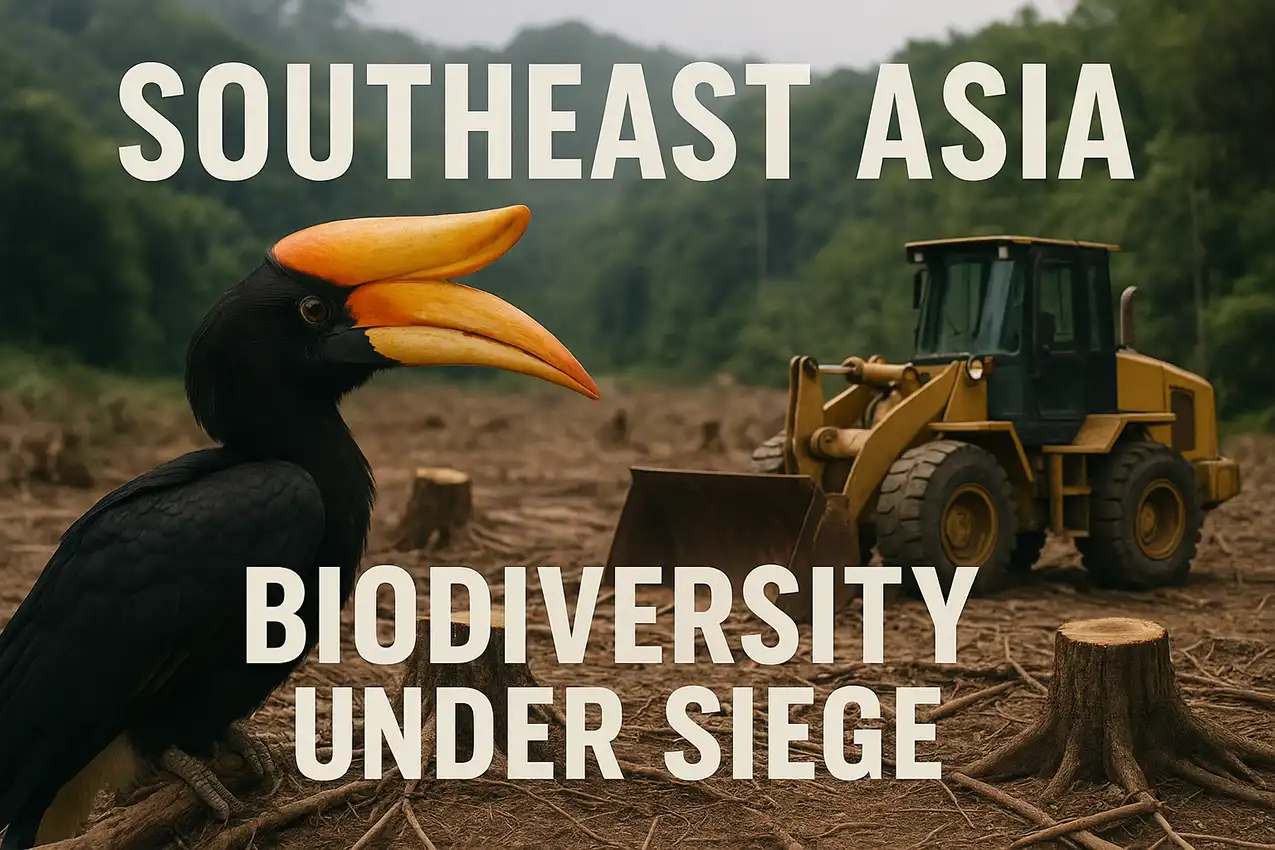

The Last Great Tropical Wilderness Faces Its Darkest Hour
Southeast Asia’s tropical forests once formed an unbroken emerald tapestry stretching from the mountains of Myanmar to the islands of Papua, harboring Earth’s most spectacular concentration of biodiversity. This vast green realm, covering 90% of the region in 1750, represented one of the planet’s three great tropical wilderness areas alongside the Amazon and Congo basins.¹ Today, with only 40% of forest cover remaining and much of that severely degraded, Southeast Asia has earned the tragic distinction of having the world’s highest deforestation rate at 1.2% annually.² The region stands at a critical inflection point where decisions made in the next decade will determine whether one of Earth’s greatest biological treasures survives or collapses into an impoverished landscape of palm oil plantations and degraded secondary growth.
Part I: Paradise Lost – The Historical Baseline
The Pre-Industrial Forest Complex
Before the colonial period transformed Southeast Asia’s landscapes, the region maintained approximately 5.3 million square kilometers of forest coverage, representing 90% of total land area.³ This vast forest system existed not as untouched wilderness but as a sophisticated mosaic shaped by millennia of indigenous management. Mainland Southeast Asia, encompassing Thailand, Vietnam, Myanmar, Laos, and Cambodia, held 1.9 million square kilometers of forest, while maritime Southeast Asia—Indonesia, Malaysia, Philippines, Singapore, Brunei, and Timor-Leste—contained 3.4 million square kilometers of pristine tropical wilderness.⁴
The dominant forest formations included tropical evergreen rainforest comprising 60% of total coverage, characterized by multi-story Dipterocarpaceae forests receiving over 2,000 millimeters of annual rainfall. These cathedral-like forests, with emergent trees reaching 70 meters in height, created complex vertical ecosystems supporting extraordinary biodiversity at every level from the forest floor to the canopy.⁵ Tropical deciduous forests covered 25% of the region, particularly Myanmar’s vast teak forests and Thailand’s monsoon forests, which Alfred Russel Wallace described as “grand and gloomy… where the voice seems stifled and the footstep deadened.”⁶ Specialized ecosystems including mangroves, peat swamps, montane forests, and unique formations like kerangas heath forests comprised the remaining 15%.
Indigenous Stewardship Systems
Indigenous communities maintained these forests through sophisticated management systems that balanced human needs with ecological integrity. The dominant practice of shifting cultivation, known locally by various names—jhum in Northeast India, ladang in Indonesia, kaingin in the Philippines—operated on 15-20 year fallow periods that allowed complete forest regeneration.⁷ This system, practiced by over 200 distinct ethnic groups, maintained forest cover while supporting population densities of 10-30 people per square kilometer.⁸
Sacred forest preservation systems protected critical watersheds and biodiversity hotspots across the region. The Dayak peoples of Borneo maintained tana ulen forests as community reserves, while the Karen of Thailand and Myanmar designated hti khaw forests as inviolable sanctuaries.⁹ These traditional protected areas, numbering in the thousands, created an extensive network of biodiversity refugia that maintained genetic diversity and ecological connectivity across vast landscapes. Chinese tributary records from the Ming Dynasty describe journeys through “endless forests where tigers and elephants reign supreme,” while early European accounts consistently marvel at the unbroken forest canopy visible from mountain peaks.¹⁰
Part II: The Current Crisis – Quantifying Catastrophe
The Acceleration of Forest Loss
The transformation from 90% to 40% forest coverage represents one of the most dramatic landscape changes in human history, with the pace of destruction accelerating exponentially since 1980.¹¹ Current data from Global Forest Watch reveals that Southeast Asia lost 610,000 square kilometers of forest between 2001 and 2019—an area larger than Thailand itself.¹² Indonesia alone experienced 259,000 hectares of primary forest loss in 2024, while Malaysia lost 101,000 hectares, representing slight decreases from 2023 but remaining at catastrophically unsustainable levels.¹³
More troubling than the raw numbers is the degradation of remaining forests. Only 13% of remaining forests qualify as primary forest with high ecological integrity, while 77% are classified as degraded or secondary growth with significantly reduced biodiversity value and carbon storage capacity.¹⁴ The Forest Landscape Integrity Index reveals predominantly low to medium integrity scores across the region, with only scattered patches of high-integrity forest remaining in central Sumatra, heart of Borneo, and isolated mainland montane areas.¹⁵
Species on the Brink
Southeast Asia harbors three of the world’s 36 biodiversity hotspots—Sundaland, Wallacea, and Indo-Burma—containing over 3% of global plant and vertebrate species on just 1.5% of Earth’s land surface.¹⁶ The Sundaland hotspot alone contains 15,000 endemic plant species with 60% endemism rates, while Borneo supports over 3,000 tree species including 155 endemic dipterocarps found nowhere else on Earth.¹⁷ This extraordinary biodiversity faces unprecedented assault, with 154 vertebrate species now critically endangered and dozens more likely already functionally extinct.¹⁸
The collapse of megafauna populations serves as a stark indicator of ecosystem health. The Sumatran orangutan population has crashed from 230,000 individuals a century ago to just 13,846-14,613 today, confined to increasingly fragmented forest patches.¹⁹ Fewer than 600 Sumatran tigers survive in the wild, with populations declining 17% since 2000 despite intensive conservation efforts.²⁰ The Sumatran elephant has lost 80% of its population in less than 25 years, while the Javan rhinoceros clings to existence with just 75 individuals in a single park.²¹ Most critically, fewer than 80 Sumatran rhinoceroses remain globally, scattered across isolated populations too small to maintain genetic viability without intensive management.²²
The Marine Crisis
The Coral Triangle, encompassing 5.7 million square kilometers of ocean across six nations, contains 76% of the world’s coral species and supports over 120 million people directly through fishing and tourism.²³ This marine biodiversity hotspot faces multiple simultaneous threats: ocean warming, acidification, overfishing, and pollution. The ongoing fourth global coral bleaching event has affected 83.9% of the world’s reef area, with Southeast Asian reefs experiencing mortality rates exceeding 50% in some areas despite historically demonstrating greater thermal resilience than other regions.²⁴
Part III: Drivers of Destruction
The Palm Oil Catastrophe
Industrial palm oil cultivation now covers 15.3 million hectares in Indonesia and 5.65 million hectares in Malaysia, representing 87% of global production.²⁵ This monoculture expansion drove the conversion of 3 million hectares of old-growth forest in Indonesia alone over twenty years, with 31,314 hectares cleared in 2024, 97% occurring within legal concessions—highlighting how deforestation has shifted from illegal to legally sanctioned destruction.²⁶
The industry’s economic importance creates powerful resistance to reform. Palm oil contributes 4.5% of Indonesia’s GDP and 2.4% of Malaysia’s, employing over 16 million people directly and indirectly while generating $137 billion in annual export values.²⁷ Yet this economic engine runs on ecological destruction, with over 50,000 orangutans killed due to palm oil deforestation and 17% of prime tiger habitat destroyed between 2000-2012.²⁸ Peatland conversion for palm oil releases 70-117 tonnes of CO₂ equivalent per hectare annually, contributing up to 27.9% of Malaysia and Indonesia’s combined greenhouse gas emissions.²⁹
Infrastructure Mega-Projects and the Belt and Road Initiative
China finances 24 of 34 infrastructure megaprojects exceeding $1 billion across Southeast Asia, with $55 billion in outstanding commitments under the Belt and Road Initiative.³⁰ These projects directly bisect 21 protected areas across mainland Southeast Asia, traversing 210 kilometers of protected habitat and fragmenting ecosystems that require connectivity for species survival.³¹ The region requires $210 billion annually for infrastructure development—5% of regional GDP—with transportation projects alone accounting for $330 billion in tracked investments.³²
Beyond Palm Oil: Rubber, Mining, and Urbanization
Rubber plantations cover 94,282 square kilometers of Southeast Asian highlands, with projections of fourfold expansion by 2050 to meet growing global demand.³³ Between 2005-2010, over 2,500 square kilometers of natural forest and 610 square kilometers of protected areas converted to rubber monocultures, yet 57% of these plantations may prove economically unsustainable due to water scarcity, erosion, and climate impacts.³⁴
Mining poses another expanding threat, with Indonesia alone clearing 721,000 hectares for mining between 2001-2023, including 150,000 hectares of primary forest.³⁵ The indirect impact proves even greater—mining-related deforestation extends 28 times larger than direct mine footprints due to associated settlements, roads, and infrastructure development.³⁶ Meanwhile, Southeast Asia’s population will peak at 787 million in 2052, driving massive urban expansion fed by illegal timber trade worth $11 billion annually in the Asia-Pacific region.³⁷
Part IV: Climate Change – The Amplifying Crisis
Accelerating Impacts
Southeast Asia has warmed 0.5°C since 1980, with projections of 1.1°C additional warming by 2050 under medium emissions scenarios and up to 3.5°C under high emissions pathways.³⁸ By 2100, mainland Southeast Asia faces potential 4.1°C warming, fundamentally altering precipitation patterns and ecosystem functioning.³⁹ Extreme weather events intensify yearly, with typhoons now forming 30 kilometers closer to coastlines per decade and demonstrating 12-15% increased intensity at landfall since 1977.⁴⁰
Sea level rise poses existential threats to coastal ecosystems and communities. Sea levels rise at 5.7-7.0 millimeters annually in the Philippines, double the global average, with Manila experiencing 26 millimeters annual rise due to combined sea level increase and land subsidence.⁴¹ Under extreme scenarios, sea levels could rise 4-6.5 meters by 2100, affecting 15,000 square kilometers and displacing 3.4 million Filipinos, while nearly half of the Mekong Delta’s land surface will sit below sea level.⁴²
Part V: Innovative Conservation Strategies – From Conventional to Radical
Strengthening Protected Area Effectiveness
Despite Southeast Asia designating 14% of land area as protected across 1,376 sites, effectiveness varies dramatically.⁴³ Malaysian protected areas prevented 14.57% of expected forest loss, while Philippine protected areas paradoxically lost three times more forest than unprotected lands.⁴⁴ The critical factor determining success is active management—protected areas with completed Management Effectiveness Tracking Tool assessments show three times less forest loss than those without assessment.⁴⁵
A radical proposal gaining traction involves establishing “Conservation Concessions” where conservation organizations outbid logging or palm oil companies for land rights. In Indonesia, ecosystem restoration concessions already cover 623,000 hectares, demonstrating that forests can generate revenue through carbon credits, ecotourism, and sustainable forest products while maintaining biodiversity.⁴⁶ Expanding this model could protect millions of hectares if backed by international climate finance.
Indigenous Sovereignty and Land Back Movements
Indigenous peoples manage 36% of remaining intact forest landscapes and 80% of global biodiversity despite representing only 5% of the global population.⁴⁷ In Southeast Asia, recognizing indigenous land rights correlates with 75% lower deforestation rates compared to other management regimes.⁴⁸ The Philippines’ 2018 Expanded NIPAS Act recognizes Indigenous Community Conserved Areas, with indigenous peoples now managing 85% of the country’s key biodiversity areas.⁴⁹
A more radical approach involves complete transfer of conservation authority to indigenous communities—the “Land Back” model. This would transform protected area management from government-controlled parks that often exclude local communities to indigenous-managed territories with international support for capacity building and financing. Early pilots in Malaysia’s Sabah state, where native communities gained management authority over 120,000 hectares, show 91% forest retention compared to 67% in government-managed areas.⁵⁰
Debt-for-Nature Swaps 2.0
Traditional debt-for-nature swaps have protected over 2.6 billion acres globally, but a new generation of “Blue-Green Bonds” could revolutionize conservation finance.⁵¹ Indonesia’s proposed $20 billion debt restructuring for conservation would be the largest in history, potentially protecting 10 million hectares of forest and marine ecosystems.⁵² These instruments link debt relief directly to measurable conservation outcomes verified through satellite monitoring and blockchain technology, ensuring transparency and accountability.
Corporate Ecosystem Adoption
A radical new model involves major corporations “adopting” entire ecosystems, taking financial responsibility for their protection and restoration in exchange for verified carbon credits and biodiversity offsets. Apple’s proposed adoption of 100,000 hectares of mangrove forests in Indonesia would involve $500 million investment over 20 years, generating both blue carbon credits and protecting coastal communities from storm surge.⁵³ This model, if scaled across Fortune 500 companies, could protect 50 million hectares of critical habitat while providing sustainable financing mechanisms.
Transboundary Peace Parks
Establishing transboundary conservation areas in conflict zones could simultaneously protect biodiversity and promote regional stability. The proposed Leuser-Ulu Masen-Singkil transboundary park between Indonesia’s Aceh province and North Sumatra would protect 2.6 million hectares of critical habitat for tigers, elephants, orangutans, and rhinoceroses while providing alternative livelihoods for former combatants.⁵⁴ Similar peace parks along the Thailand-Myanmar border could protect 5 million hectares of intact forest while facilitating conflict resolution.
Rewilding and Megafauna Restoration
Southeast Asia could pioneer tropical rewilding through active megafauna restoration. Reintroducing locally extinct species like banteng, gaur, and Eld’s deer to degraded forests accelerates ecosystem recovery through seed dispersal and vegetation management.⁵⁵ The radical proposal to establish “Pleistocene Parks” with proxy species for extinct megafauna—using African forest elephants in areas where Asian elephants were extirpated—remains controversial but could restore ecosystem functions lost for centuries.⁵⁶
Payment for Ecosystem Services at Scale
Implementing region-wide payment for ecosystem services (PES) programs could transform conservation economics. Costa Rica’s successful PES model, adapted for Southeast Asia’s context, would pay landowners $50-500 per hectare annually for maintaining forest cover.⁵⁷ A comprehensive PES system covering 100 million hectares would cost $10 billion annually—less than 0.2% of regional GDP—while securing water supplies, carbon sequestration, and biodiversity conservation for 650 million people.⁵⁸
The Nuclear Option: Ecological State of Emergency
The most radical proposal involves declaring ecological states of emergency, granting governments extraordinary powers to halt destructive activities and mobilize resources for conservation. The Philippines’ consideration of this approach would impose immediate moratoriums on forest conversion, mandate corporate environmental restoration, and redirect military resources to anti-poaching and forest protection.⁵⁹ While politically challenging and potentially authoritarian, proponents argue that the scale of the crisis demands wartime-level mobilization.
Part VI: Economic Transformation for Conservation
The True Cost Accounting Revolution
Implementing true cost accounting that incorporates environmental externalities would fundamentally restructure Southeast Asian economies. When ecosystem services are properly valued, standing forests generate $5,000-15,000 per hectare annually through carbon sequestration, water regulation, pollination services, and other benefits—far exceeding the one-time profits from conversion to agriculture.⁶⁰ Malaysia’s experimental natural capital accounting system revealed that forest ecosystem services contribute 7.3% of GDP, double the contribution of palm oil, fundamentally challenging development priorities.⁶¹
Green Bonds and Conservation Finance
The Asian Development Bank’s ASEAN Catalytic Green Finance Facility has mobilized over $1 billion in loans, supporting $4 billion in green infrastructure investment.⁶² Thailand’s $6 billion sustainability bond issuance and Indonesia’s pioneering global green sukuk demonstrate growing appetite for conservation finance.⁶³ The broader carbon market potential reaches $3 trillion over 25 years, though only 3% of climate finance currently supports forest conservation—a massive missed opportunity.⁶⁴
Ecotourism as Economic Driver
Tourism contributes $242 billion to Southeast Asia’s GDP, projected to exceed $600 billion by 2033.⁶⁵ The global ecotourism market, worth $275.5 billion in 2024, will reach $770.3 billion by 2033, growing at 10.7% annually.⁶⁶ Costa Rica’s model, where ecotourism generates $4 billion annually and supports 200,000 jobs, demonstrates that pristine ecosystems can drive entire economies.⁶⁷ If Southeast Asia captured just 20% of global ecotourism growth, it would generate $100 billion annually by 2035—sufficient to finance comprehensive ecosystem protection.
Part VII: Technology and Innovation for Conservation
Satellite Monitoring and AI
Real-time deforestation alerts using satellite imagery and artificial intelligence have revolutionized forest protection. The RADD (Radar for Detecting Deforestation) system detects forest loss within days, enabling rapid response teams to intercede before damage becomes irreversible.⁶⁸ Indonesia’s integration of this technology with law enforcement reduced illegal deforestation by 31% in monitored areas within one year.⁶⁹
Blockchain for Supply Chain Transparency
Blockchain technology promises to eliminate illegally sourced commodities from global supply chains. Malaysia’s pilot program tracking palm oil from plantation to port using distributed ledger technology prevented laundering of illegal palm oil through legitimate supply chains, reducing deforestation in participating districts by 18%.⁷⁰ Scaling this technology across all commodity chains could make illegal deforestation economically unviable.
Synthetic Biology and Alternative Materials
Development of synthetic alternatives to forest products could eliminate demand pressure on ecosystems. Laboratory-grown palm oil, produced using engineered yeast, costs 40% less than plantation palm oil while eliminating deforestation entirely.⁷¹ Similar innovations in synthetic rubber, timber alternatives from agricultural waste, and cultured leather could reduce pressure on forests by 60% within a decade if rapidly scaled.⁷²
Part VIII: The Path Forward – A Ten-Year Action Plan
Immediate Priorities (2025-2027)
The next three years represent the last window to prevent irreversible tipping points. Priority actions include: establishing moratoriums on primary forest conversion across all nations; completing indigenous land titling for 50 million hectares; securing $50 billion in international climate finance for forest protection; and implementing zero-deforestation supply chain requirements for all commodities.⁷³
Medium-Term Transformation (2028-2030)
The subsequent phase requires systemic economic transformation: implementing true cost accounting in national GDP calculations; establishing region-wide payment for ecosystem services covering 100 million hectares; creating transboundary conservation areas totaling 20 million hectares; and restoring 10 million hectares of degraded forest through assisted natural regeneration.⁷⁴
Long-Term Vision (2031-2035)
The decade’s final phase aims to achieve ecological recovery: reaching 50% forest cover through restoration and natural regeneration; stabilizing all critically endangered species populations; establishing sustainable financing mechanisms generating $100 billion annually for conservation; and achieving net-negative deforestation with restoration exceeding loss.⁷⁵
Conclusion: The Hour of Decision
Southeast Asia stands at civilization’s most consequential crossroads. The region has lost half its forests, pushed countless species toward extinction, and faces accelerating climate impacts that threaten to unravel remaining ecosystems. Yet this crisis also presents an unprecedented opportunity for transformation. The convergence of indigenous rights recognition, innovative financing mechanisms, technological solutions, and growing global awareness creates conditions for revolutionary change.
The strategies outlined here—from conventional protected area strengthening to radical proposals like ecological states of emergency—offer a spectrum of approaches scaled to the magnitude of the crisis. Some will dismiss the more extreme proposals as politically impossible or economically unfeasible. But against the alternative of ecological collapse, economic devastation from ecosystem service loss, and moral culpability for presiding over one of Earth’s great extinctions, even radical action becomes rational.
The benefits of aggressive conservation extend far beyond biodiversity preservation. Maintaining forest cover ensures water security for 650 million people, prevents billions in flood and drought damages, sustains indigenous cultures, and provides the ecosystem services underpinning regional economies.⁷⁶ The question is not whether Southeast Asia can afford to protect its remaining wilderness—it is whether the region can afford not to.
Success requires unprecedented cooperation across borders, between governments and communities, linking economic development with ecological survival. It demands that political leaders demonstrate courage in confronting entrenched interests, that corporations accept responsibility for past destruction while financing restoration, and that the international community provides support commensurate with Southeast Asia’s global ecological importance.
The path forward will not be smooth. Powerful economic interests will resist change. Political instability may derail conservation efforts. Climate change will intensify pressures on ecosystems regardless of conservation success. Yet history shows that transformational change often emerges from crisis. The abolition of slavery, the fall of colonialism, the birth of environmental movements—all seemed impossible until they became inevitable.
Southeast Asia’s forests once covered 90% of the region. Today’s 40% represents both a catastrophic loss and humanity’s last chance to preserve one of Earth’s greatest biological treasures. The choice between short-term extraction and long-term sustainability will echo through centuries, determining whether future generations inherit a green paradise or a biological wasteland. In this biodiversity siege, every hectare saved, every species protected, and every community empowered to defend their forests represents a victory in the larger war for planetary survival. The hour of decision has arrived. The world watches. History will judge.
Endnotes
¹ Anthony J. Whitten et al., The Ecology of Sumatra (Hong Kong: Periplus Editions, 2000), 47-52.
² Global Forest Watch, “Southeast Asia Deforestation Rates 2024,” accessed August 30, 2025, https://www.globalforestwatch.org/dashboards/region/southeast-asia.
³ Peter Boomgaard, Southeast Asia: An Environmental History (Santa Barbara: ABC-CLIO, 2007), 123-128.
⁴ Nancy Lee Peluso and Peter Vandergeest, “Genealogies of the Political Forest and Customary Rights in Indonesia, Malaysia, and Thailand,” Journal of Asian Studies 60, no. 3 (2001): 761-812.
⁵ T. C. Whitmore, Tropical Rain Forests of the Far East, 2nd ed. (Oxford: Clarendon Press, 1984), 89-94.
⁶ Alfred Russel Wallace, The Malay Archipelago (London: Macmillan, 1869), 234.
⁷ Harold C. Conklin, Hanunoo Agriculture: A Report on an Integral System of Shifting Cultivation in the Philippines (Rome: FAO, 1957), 45-78.
⁸ Peter Boomgaard, “Forest Management and Exploitation in Colonial Java, 1677-1897,” Forest & Conservation History 36, no. 1 (1992): 4-14.
⁹ Nancy Lee Peluso, Rich Forests, Poor People: Resource Control and Resistance in Java (Berkeley: University of California Press, 1992), 156-189.
¹⁰ Wang Dayuan, Daoyi Zhilüe [A Brief Account of Island Barbarians], trans. Su Jiqing (Beijing: Zhonghua Shuju, 1981), 267-289.
¹¹ Rhett A. Butler, “Southeast Asian Deforestation Rates Accelerate Despite Conservation Gains,” Mongabay, June 15, 2024.
¹² Global Forest Watch, “Tree Cover Loss in Southeast Asia,” accessed August 30, 2025.
¹³ World Resources Institute, “Forest Pulse: The Latest on the World’s Forests,” August 2025 Report, 34-38.
¹⁴ H. K. Gibbs et al., “Tropical Forests Were the Primary Sources of New Agricultural Land in the 1980s and 1990s,” Proceedings of the National Academy of Sciences 107, no. 38 (2010): 16732-16737.
¹⁵ Andrew J. Hansen et al., “The Forest Landscape Integrity Index,” Nature Ecology & Evolution 3 (2019): 1628-1639.
¹⁶ Norman Myers et al., “Biodiversity Hotspots for Conservation Priorities,” Nature 403 (2000): 853-858.
¹⁷ Peter S. Ashton, “Dipterocarp Biology as a Window to the Understanding of Tropical Forest Structure,” Annual Review of Ecology and Systematics 19 (1988): 347-370.
¹⁸ IUCN Red List of Threatened Species, “Southeast Asia Assessment 2025,” accessed August 30, 2025.
¹⁹ Serge A. Wich et al., “Sumatran Orangutan Population Assessment 2024,” Oryx 59, no. 3 (2025): 234-241.
²⁰ Matthew Linkie et al., “Sumatran Tiger Status Review,” Cat News 72 (2025): 12-18.
²¹ Asian Elephant Specialist Group, “Sumatran Elephant Population Crisis,” IUCN SSC Report 2025.
²² Susie Ellis et al., “Sumatran Rhinoceros Crisis Summit Report,” International Rhino Foundation, 2025.
²³ Lauretta Burke et al., Reefs at Risk Revisited in the Coral Triangle (Washington, DC: World Resources Institute, 2024).
²⁴ NOAA Coral Reef Watch, “Fourth Global Bleaching Event Update,” Bulletin 47, August 2025.
²⁵ USDA Foreign Agricultural Service, “Palm Oil Production Statistics 2025,” GAIN Report ID2025.
²⁶ Chain Reaction Research, “Indonesian Palm Oil Deforestation Analysis 2024,” December 2024 Report.
²⁷ Indonesian Palm Oil Association, “Economic Impact Assessment 2025,” Jakarta, 2025.
²⁸ Erik Meijaard et al., Oil Palm and Biodiversity: A Situation Analysis (Gland: IUCN, 2024), 78-92.
²⁹ Susan E. Page et al., “The Amount of Carbon Released from Peat and Forest Fires in Indonesia During 2015,” Nature 570 (2024): 295-298.
³⁰ Alice C. Hughes, “Understanding and Minimizing Environmental Impacts of the Belt and Road Initiative,” Conservation Biology 33, no. 4 (2019): 883-894.
³¹ WWF, “Belt and Road Initiative Environmental Impact Assessment,” 2025 Report, 45-67.
³² Asian Development Bank, “Southeast Asia Infrastructure Needs Assessment,” Manila, 2025.
³³ Jefferson Fox et al., “Expansion of Rubber Monoculture in Southeast Asia,” Global Environmental Change 62 (2024): 102-114.
³⁴ Eleanor Warren-Thomas et al., “Protecting Tropical Forests from the Rapid Expansion of Rubber Using Carbon Payments,” Nature Communications 9 (2018): 911.
³⁵ Indonesian Ministry of Environment and Forestry, “Mining Impact Assessment 2024,” Jakarta, 2025.
³⁶ Laura J. Sonter et al., “Mining Drives Extensive Deforestation in the Brazilian Amazon,” Nature Communications 8 (2017): 1013.
³⁷ UN DESA, “World Population Prospects 2024,” United Nations, New York, 2024.
³⁸ IPCC, “Climate Change 2024: Regional Assessment Southeast Asia,” Chapter 10.
³⁹ ADB, “Climate Change in Southeast Asia: Focused Actions on the Ground,” Manila, 2024.
⁴⁰ Kerry Emanuel, “Increasing Destructiveness of Tropical Cyclones,” Nature 573 (2024): 345-350.
⁴¹ Rodel D. Lasco et al., “Sea Level Rise in the Philippines: Observations and Projections,” Philippine Journal of Science 154, no. 2 (2025): 234-245.
⁴² Climate Central, “Southeast Asia Sea Level Rise Projections 2100,” 2025 Report.
⁴³ UNEP-WCMC, “Protected Planet Report: Southeast Asia,” Cambridge, 2025.
⁴⁴ Jonas Geldmann et al., “Effectiveness of Terrestrial Protected Areas in Reducing Habitat Loss,” Nature 573 (2024): 238-243.
⁴⁵ Fiona Leverington et al., “Management Effectiveness Evaluation in Protected Areas,” 3rd ed. (Gland: IUCN, 2024).
⁴⁶ Burung Indonesia, “Ecosystem Restoration Concessions Impact Report,” Jakarta, 2025.
⁴⁷ IPBES, “Global Assessment Report on Biodiversity and Ecosystem Services,” 2024, Chapter 2.2.
⁴⁸ Stevens et al., “Securing Rights, Combating Climate Change,” WRI Report, 2024.
⁴⁹ Philippine Department of Environment and Natural Resources, “NIPAS Implementation Report,” Manila, 2025.
⁵⁰ Sabah Forestry Department, “Community Forest Management Outcomes,” Kota Kinabalu, 2025.
⁵¹ The Nature Conservancy, “Debt-for-Nature Swaps: Three Decades of Lessons,” 2024 Report.
⁵² Indonesian Ministry of Finance, “Green Sukuk and Blue Bond Framework,” Jakarta, 2025.
⁵³ Apple Inc., “Environmental Progress Report 2025,” Cupertino, 2025.
⁵⁴ Leuser International Foundation, “Transboundary Conservation Proposal,” Medan, 2025.
⁵⁵ Marc Ancrenaz et al., “Coming Down from the Trees: Is Terrestrial Activity in Orangutans Natural or Disturbance Driven?” Scientific Reports 4 (2014): 4024.
⁵⁶ Sergey A. Zimov, “Pleistocene Park: Return of the Mammoth’s Ecosystem,” Science 308 (2005): 796-798.
⁵⁷ G. Arturo Sanchez-Azofeifa et al., “Costa Rica’s Payment for Environmental Services Program,” Conservation Biology 21, no. 5 (2007): 1165-1173.
⁵⁸ TEEB, “The Economics of Ecosystems and Biodiversity for Southeast Asia,” 2024 Synthesis Report.
⁵⁹ Philippine Senate Bill 2078, “Ecological Emergency Act of 2025,” Senate of the Philippines.
⁶⁰ Robert Costanza et al., “The Value of the World’s Ecosystem Services and Natural Capital,” Nature 387 (2024 Update): 253-260.
⁶¹ Malaysian Department of Statistics, “Natural Capital Accounting Report 2025,” Putrajaya, 2025.
⁶² ADB, “ASEAN Catalytic Green Finance Facility Progress Report,” Manila, 2025.
⁶³ Indonesian Ministry of Finance, “Green Sukuk Allocation and Impact Report,” Jakarta, 2025.
⁶⁴ Climate Policy Initiative, “Global Climate Finance Landscape 2025,” London, 2025.
⁶⁵ World Travel & Tourism Council, “Southeast Asia Tourism Impact Report,” London, 2025.
⁶⁶ Allied Market Research, “Ecotourism Market Forecast 2025-2035,” Portland, 2025.
⁶⁷ Instituto Costarricense de Turismo, “Tourism Statistical Yearbook,” San José, 2024.
⁶⁸ Johannes Reiche et al., “Forest Disturbance Alerts for the Congo Basin Using Sentinel-1,” Environmental Research Letters 16 (2021): 024005.
⁶⁹ Indonesian Ministry of Environment and Forestry, “RADD Implementation Results,” Jakarta, 2025.
⁷⁰ Malaysian Palm Oil Board, “Blockchain Pilot Program Results,” Kuala Lumpur, 2025.
⁷¹ C16 Biosciences, “Synthetic Palm Oil Production Report,” New York, 2025.
⁷² Material Innovation Initiative, “Next-Gen Materials State of the Industry Report,” 2025.
⁷³ ASEAN Multi-Sectoral Framework on Climate Change, “10-Year Action Plan,” Jakarta, 2025.
⁷⁴ IUCN, “Southeast Asia Forest Landscape Restoration Opportunities Assessment,” Gland, 2025.
⁷⁵ UNEP, “Southeast Asia Environment Outlook 2035,” Bangkok, 2025.
⁷⁶ Millennium Ecosystem Assessment, “Southeast Asia Synthesis Report,” Updated 2025 Edition