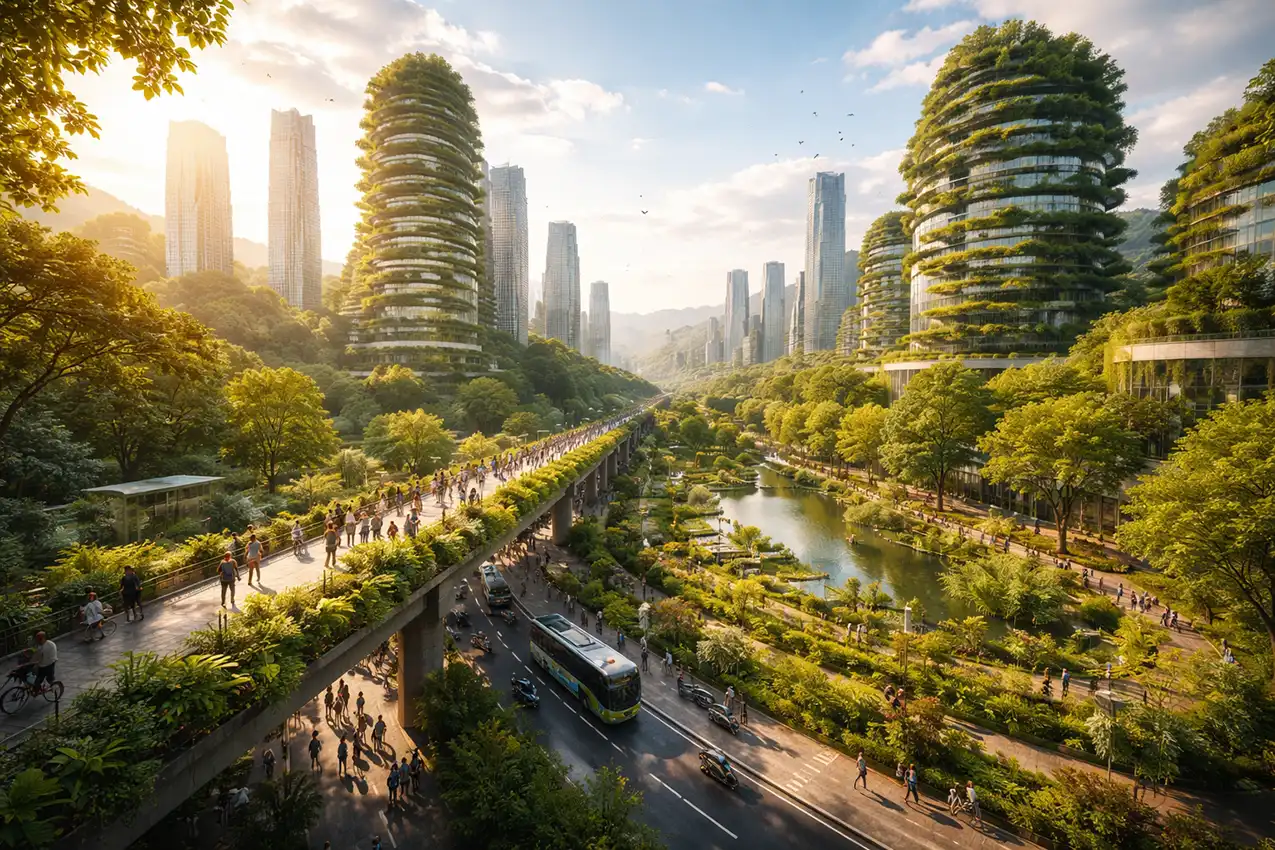

The City Must Breathe
An introduction to the Green Cities series: what we mean, how we will judge, and why the urban future is now the decisive environmental story
| Standfirst The green city has become one of the great promises of the twenty-first century. Yet the phrase is often used so loosely that it can mean almost anything: a line of trees beside a six-lane road, a luxury tower with plants on its balconies, a bike lane painted where a bus should have been. This series begins from a stricter conviction: that a truly green city is not a branding exercise but a lived ecological settlement, judged by air, water, heat, mobility, health, equity, and the fate of the more-than-human life threaded through its streets. |
There is a difference between a city that has learned to decorate itself with nature and a city that has begun, however imperfectly, to live within ecological limits. The first gives you renderings. The second changes the terms of daily life. It reduces the exhaust in a child’s lungs, the heat stored in asphalt, the distance between a home and a tree, the number of hours a commuter loses to traffic, the volume of stormwater shunted into a flooding river, the degree to which birds, bats, pollinators, fish, and people are asked to survive in spaces designed for engines alone. That, rather than public relations, will be the concern of this series.
The stakes are immense because the urban century is no longer approaching; it is here. The United Nations has long projected that by 2050 roughly 68% of the world’s population will live in urban areas, up from 55% in 2018. At the same time, the IPCC and UN-Habitat have stressed that urban areas account for roughly 71-76% of carbon dioxide emissions from global final energy use, and are also among the places most exposed to heat, flooding, infrastructure stress, and widening social vulnerability. Cities are therefore both driver and victim: they are where climate damage is concentrated, and where meaningful mitigation and adaptation must either become ordinary or fail.1
That would be reason enough to look closely. But there is another reason, more intimate and more urgent. The World Health Organization warns that poorly designed urban transport systems expose people to road injury, air pollution, noise pollution, and reduced physical activity, while an estimated 91% of people in urban areas breathe polluted air. WHO has also found that urban green spaces can reduce morbidity and mortality, support mental and physical health, and improve wellbeing. The case for better cities is not only climatic. It is respiratory, cardiovascular, neurological, psychological, civic. It is about what sort of nervous system a city imposes on those who inhabit it.2
Noise belongs in that ledger too. UNEP has argued that urban noise pollution is not a minor irritation but a serious environmental and health issue linked to sleep disturbance, poorer mental health, cardiovascular stress, and broader harm to urban life. A city that has lowered its emissions but still subjects its residents to an endless metallic roar has solved less than it thinks. The green city, in other words, is not merely a low-carbon machine. It is also a question of human tolerability, sensory dignity, and ecological texture.3
So what, then, will count as ‘green’ in this series?
Not perfection. No city on Earth deserves that word without qualification. Even the celebrated cases are compromised by inequality, by embodied carbon, by housing stress, by political backlash, by ecological trade-offs, by the stubborn inertia of systems built in a hotter, cheaper, more extractive age. A useful standard must therefore be exacting without being naive. This series will be looking less for saints than for settlements that are measurably changing their metabolism.
Our first criterion will be structural seriousness. A city is not green because it has added a waterfront promenade, installed a few solar panels, or held a conference on resilience. It becomes interesting when it alters the hard plumbing of urban life: transport priorities, building rules, heating and cooling systems, flood management, sewage treatment, waste streams, land use, canopy cover, groundwater, and the allocation of street space. New York’s Local Law 97 matters for this reason. The city notes that buildings generate more than two-thirds of its greenhouse-gas emissions, and the law places emissions limits on large buildings beginning in 2024, with stricter limits in 2030, aiming for a 40% reduction from those buildings by 2030 and net zero by 2050. That is not aesthetic greening. It is regulatory force applied to the urban machine.4
Our second criterion will be public-health reality. The green city must improve the lived condition of bodies. That means less toxic air, less deadly heat, less sedentary compulsion, safer walking, safer cycling, more shade, more access to parks, cleaner water, quieter streets. Barcelona’s superblock model has drawn attention precisely because researchers have estimated that reducing traffic, air pollution, noise, and heat while increasing access to physical activity and green space could yield substantial health benefits; the point is not simply that a street looks nicer, but that its redesign can alter exposure and behaviour at population scale.5
Our third criterion will be ecological intelligence. A green city is not only a better place for affluent pedestrians. It must make room for water, soil, vegetation, insects, birds, and the small continuities of habitat without which urban nature becomes decorative and brittle. Singapore’s ‘City in Nature’ programme is significant not because it solved the environmental contradictions of a highly engineered island-state, but because it has explicitly tied urban greening to habitat restoration, ecological corridors, and biodiversity stewardship. Its official planning documents increasingly speak of connected green and blue networks, ecological corridors, and bringing nature back into the urban fabric, rather than simply trimming parks more elegantly.6
Our fourth criterion will be evidence over mythology. Some cities enjoy reputations out of proportion to their performance. Others are doing important work with far less glamour. Copenhagen remains one of the emblematic cycling cities because its investment has been sustained for decades and because bikes truly occupy a large share of everyday mobility. Paris is compelling because it has moved with unusual speed in reallocating street space, expanding cycle infrastructure, planting large numbers of trees, and, in 2025, winning voter support for pedestrianising and greening 500 more streets. Yet neither city is beyond scrutiny. Paris still lags some European peers in green infrastructure, and the politics of its anti-car turn remain contested, especially by suburban commuters and critics of symbolic urbanism. Admiration, in this series, will never preclude inspection.7
Our fifth criterion will be justice. The green city cannot be judged only by what it offers the already comfortable. A shaded boulevard in a wealthy district does not redeem a metropolis where poorer residents live beside highways, breathe worse air, or face floodwater first. London’s Ultra Low Emission Zone is worth studying partly because it has produced measurable air-quality gains: Transport for London says the policy helped reduce roadside nitrogen dioxide concentrations by 27% across London compared with a scenario without the ULEZ and its expansions, with sharper falls in central areas, while City Hall’s one-year report found compliance around 97% and significant reductions in pollutant emissions after the London-wide expansion. But that is only half the story. The real question is who benefits, who pays, what exemptions exist, whether alternatives to driving are adequate, and whether cleaner air arrives fastest in the boroughs that have borne the heaviest burden.8
Those criteria help explain why certain projects have become touchstones. Seoul’s Cheonggyecheon restoration remains one of the great symbolic reversals of modern urbanism because it removed elevated road infrastructure and restored a stream corridor through the city centre. Seoul describes the project as restoring 5.84 kilometres of stream, with extensive greenery and public space. The lesson is not that every city can or should replicate it exactly. It is that buried rivers, paved channels, and traffic sewers are political choices, not natural law. A city that daylightens water is often announcing that engineering alone will no longer define its relationship to land.9
Medellin’s green corridors are another such case. Through interconnected vegetated corridors linking roads, waterways, parks, and slopes, the city pursued cooling, carbon uptake, and public-space improvement in response to heat and pollution. C40’s knowledge hub cites average temperature reductions of around 2C in affected areas. Again, the point is not the slogan but the intervention: vegetation used not as garnish but as thermal, ecological, and social infrastructure.10
Curitiba, meanwhile, remains indispensable because it reminds us that transport reform is never just about transport. ITDP’s BRT guide notes that what later became bus rapid transit in Curitiba emerged as part of a wider strategy to manage growth, restrain motorisation, and shape compact, walkable, transit-oriented development. The city’s enduring lesson is that mobility systems and urban form must be designed together. A fast bus line threading through sprawl is better than nothing. A transit spine that organises the city itself is something else again.11
China’s ‘sponge city’ programme will also be central to this series because it widens the field beyond the familiar Euro-American repertoire of bike lanes and plazas. The World Bank has described the initiative as an attempt to integrate green spaces, wetlands, and other blue-green systems with conventional ‘grey’ infrastructure so cities can better absorb, store, and manage water. In an era of harsher downpours and flash floods, this is not decorative landscaping. It is a rethinking of hydrology in the urban century.12
But a credible series must also make room for failure, distortion, and warning. The green city is not only a story of pioneers. It is also a story of places where ecological stress is outrunning governance. Mexico City, for instance, cannot be understood through design ambition alone. It sits within a broader context of severe water strain, leakage, over-extraction, pollution, and social vulnerability; WRI has pointed to water-resilience efforts such as rainwater harvesting, but the city’s hydrological predicament remains a profound warning about urban development that has outrun its watershed. Jakarta offers another, starker lesson. The World Bank noted years ago that parts of North Jakarta were subsiding by 15-25 centimetres a year, largely because deep groundwater extraction compensated for inadequate piped supply. A city may talk about resilience all it likes; if the ground is physically dropping beneath it, rhetoric has met geology and lost.13
This is why the series will resist the seduction of rankings. ‘Best green city’ lists are usually too crude to be useful. A city may excel in cycling and fail in housing. It may electrify buses while remaining dangerously unequal in access to parks. It may restore wetlands while demolishing mature ecosystems elsewhere. It may boast a skyline of ‘sustainable’ towers whose residents commute through heat islands and whose embodied materials tell a harsher story. The more interesting question is not who wins the branding contest. It is which cities are confronting the full complexity of urban ecological life, and which are merely curating an image of responsibility.
Nor will this project be confined to the usual northern canon. Paris, Copenhagen, London, Amsterdam, Vienna, and Barcelona matter. So do Singapore, Seoul, Tokyo, Melbourne, and New York. But so do Bogota, Medellin, Curitiba, Kigali, Cape Town, Mexico City, Bangkok, Jakarta, and a long list of smaller municipalities where practical intelligence may be more instructive than metropolitan glamour. Some of the most interesting work in the coming decade will occur not in famous capitals but in secondary cities dealing with heat, water scarcity, informal growth, biodiversity loss, failing drainage, degraded rivers, and impossible transport inheritance under far tighter fiscal constraints.
What lies ahead, then, is not a parade of eco-utopias. It is a global inquiry into urban metabolism. We will look at cities that have reclaimed streets from cars; cities that have daylighted buried water; cities trying to retrofit old building stock; cities using law to force emissions down; cities experimenting with district energy, wetlands, composting, urban forests, heat adaptation, ecological corridors, and circular waste systems; and cities where the gap between plan and reality remains painfully wide. We will also look at places where environmental progress in one domain conceals damage in another. The green city, to deserve the name, must be judged as a whole settlement.
That wholeness matters because the city is where modernity becomes tactile. It is where ideology turns into kerb height, tree canopy, rent burden, bus frequency, asthma rate, sewage overflow, summer shade, and birdsong. It is where a political theory can be heard, or not heard, in the noise outside a bedroom window at 2 a.m. It is where climate change ceases to be an abstraction and becomes a schoolyard without trees, an overheated apartment, a flood-prone underpass, or a hospital admission after a heatwave.
The best cities in this series will not be those that promise paradise. They will be those that accept limits, repair damage, measure results, and learn to share space more honestly between people, water, weather, and the rest of life. The worst will not necessarily be the poorest or fastest-growing. They will be the ones that continue, in full knowledge, to confuse growth with wisdom and spectacle with settlement.
The city must breathe. That is where we begin.
Endnotes
1. United Nations, World Urbanization Prospects; UN-Habitat, Climate Change; IPCC, AR6 Working Group II, Chapter 6; UN-Habitat, World Cities Report 2024: Cities and Climate Action.
2. World Health Organization, Urban green spaces and health; WHO, Urban health; WHO, Ambient (outdoor) air pollution.
3. United Nations Environment Programme, Frontiers 2022: Noise, Blazes and Mismatches; UNEP commentary on urban noise pollution.
4. New York City Department of Buildings, Local Law 97 Greenhouse Gas Emissions Reduction and Buildings Emissions Limits Under Local Law 97.
5. Mueller et al., ‘Changing the urban design of cities for health’; C40 Cities, Barcelona Superblocks.
6. Singapore Green Plan 2030, City in Nature; NParks, City in Nature: key strategies; Urban Redevelopment Authority, Ecological Corridors and Draft Master Plan 2025.
7. City of Paris, A new cycling plan for a 100% bikeable city; City of Paris, Sustainable Development Annual Report 2023; Reuters reporting on Paris’s 2025 street-pedestrianisation vote.
8. Transport for London, London’s air quality and Why we have ULEZ; London City Hall, London-wide ULEZ One Year Report; Reuters fact-check on disability exemptions.
9. Seoul Metropolitan Government, Cheonggyecheon Stream Restoration Project; Landscape Performance Series, Cheonggyecheon Stream Restoration Project; recent reporting on the project’s longer legacy.
10. C40 Knowledge Hub, Medellin’s interconnected green corridors.
11. ITDP, BRT Guide, chapter on transit-oriented development; UITP, 50 years of BRT.
12. World Bank, Nature-based solutions in China: Financing sponge cities; World Bank, The Gray, Green, Blue Continuum.
13. World Resources Institute, Improving Water Security Helps Reduce the Gender Gap in Mexico City; WRI, 25 Countries Face Extremely High Water Stress; World Bank material on Jakarta subsidence and flood risk.
Source Note
For this opening essay, I leaned chiefly on official and quasi-official sources: UN, IPCC, WHO, UNEP, municipal governments, city transport authorities, planning agencies, and the World Bank, supplemented by a small number of peer-reviewed studies and carefully chosen news reports where they added recent context. The city-by-city essays in the series should go wider again, drawing more deeply on books, local journalism, academic papers, conference proceedings, podcasts, and long-form reporting.
Green Cities Series | Article One