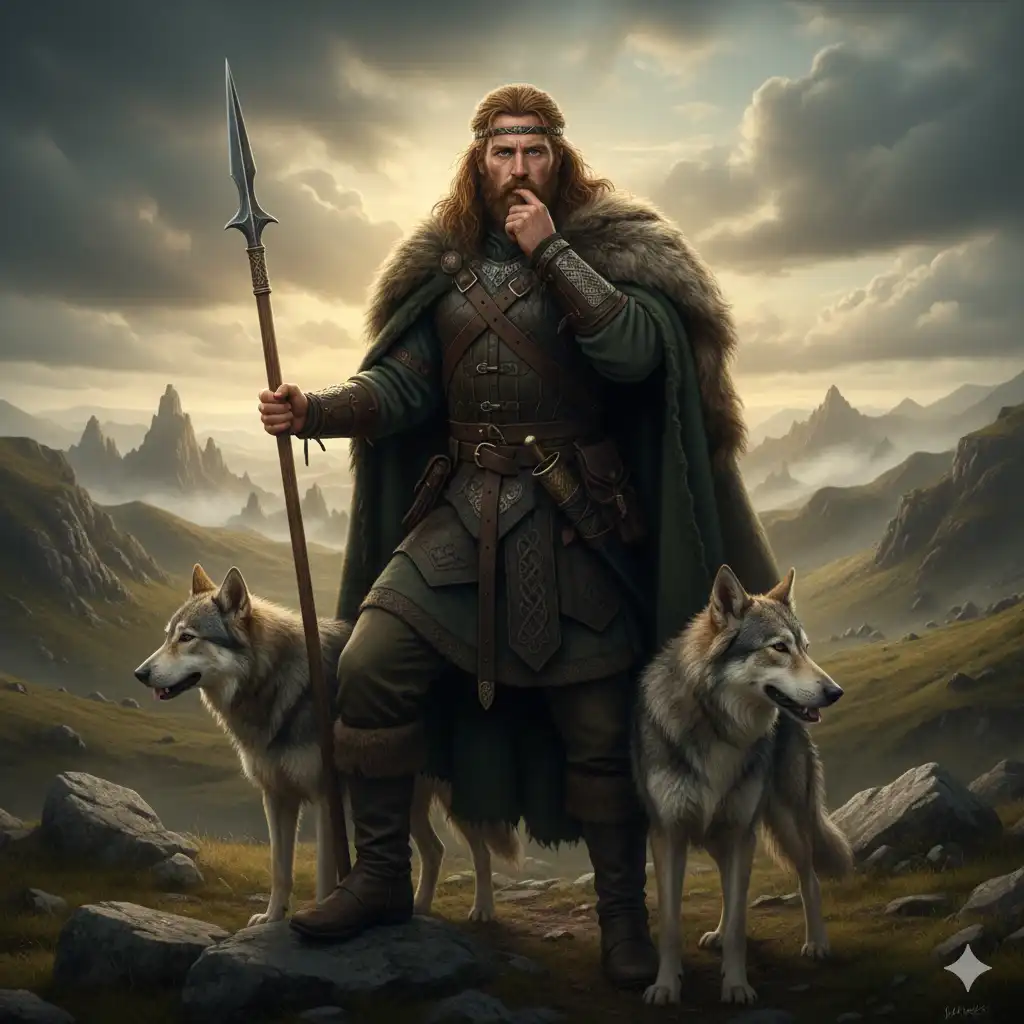

In the hollows of the hills, deep beneath the green skin of Ireland, a giant sleeps. He is not dead, merely waiting. Around him lie his warriors, the Fianna, their hounds at their feet, their spears at their sides. This is Fionn mac Cumhaill, and folklore holds that when the Dord Fiann, the great hunting horn of his war band, is sounded three times, he will rise again, as strong as he ever was, to defend the island in its hour of greatest need.¹
This is not the story of a historical relic, but of an immortal presence. Fionn, often anglicized as Finn MacCool, is an archetype woven into the very fabric of the Gaelic imagination. He is a figure of profound and fascinating dualities: the peerless warrior who was also Ireland’s greatest poet; the seer of superhuman wisdom who could be consumed by the most petty and human of jealousies; the protector of the High King who lived as an outlaw on the fringes of the very society he guarded.²
His story, captured in the vast collection of tales known as the Fenian Cycle, is more than a series of heroic exploits. It is an exploration of leadership, of the tension between the wild and the civilized, and of the complex, contradictory nature of heroism itself. To understand Fionn is to understand a particular vision of the world, one that values instinct as much as intellect, poetry as much as power. What, then, does this sleeping king, this hunter-poet, this flawed and magnificent hero, have to say to us now?
Listen to our 5-minute discussion about Fionn MacCool
Part I: The Forging of a Hero
A Son of Shadow and Prophecy
Fionn’s story begins not in glory, but in loss. It is a narrative of exile, born from a forbidden love that set clans and kings to war. His father was Cumhall, the formidable leader of the Fianna and chief of Clan Bascna.³ His mother was Muirne of the Fair Neck, the daughter of a powerful and possessive druid, Tadg mac Nuadat.⁴
Tadg had foreseen that his daughter’s marriage would cost him his ancestral home on the Hill of Almu, and so he refused all suitors.⁵ But Cumhall, leader of a warrior band that lived by its own rules, would not be denied. He abducted Muirne, an act of defiance that Tadg could not forgive. The druid appealed to the High King of Ireland, Conn of the Hundred Battles, who outlawed Cumhall.⁶
The inevitable conflict came at the Battle of Cnucha. There, Cumhall’s forces were overwhelmed, and he was slain by his great rival, Goll mac Morna, chief of Clan Morna, who promptly usurped leadership of the Fianna.⁷ The stage was set for a blood feud that would shadow the next generation.
Muirne, now pregnant and widowed, was cast out by her father, who in his rage ordered her to be burned. It was the High King Conn who intervened, placing her under the protection of Cumhall’s sister, the druidess Bodhmall.⁸ In secret, Muirne gave birth to a son she named Deimne, a word meaning “sureness” or, fittingly, “young deer.”⁹ To protect him from Goll and the sons of Morna, the infant was immediately spirited away into the deep forests of Sliabh Bladhma.¹⁰
Here, in the wilderness, the hero was forged. Deimne was raised by two remarkable foster mothers: Bodhmall, his druidess aunt, and the fierce woman warrior Liath Luachra.¹¹ They taught him the arts of survival, the skills of the hunt, and the discipline of a warrior. His upbringing was not in the halls of power but among the whispering trees and rushing streams, embedding in him a deep, instinctual connection to the natural world that would define him for the rest of his life.¹²
Fionn’s entire identity was thus shaped on the margins of society. He was an outsider, an exile born into a legacy of loss, his birthright stolen before he could claim it. Unlike heroes born to thrones and privilege, his journey would be one of reclamation, of forging an identity not from what he inherited, but from what he had to win back for himself.
The Glimmer of Wisdom
The boy Deimne, having learned the ways of the warrior, next sought the wisdom of the poet. He found his way to the banks of the River Boyne, where he became an apprentice to the aged sage Finnegas, a man renowned throughout Ireland for his vast knowledge.¹³
Finnegas had a singular obsession. For seven long years, he had patiently fished a dark pool on the Boyne, seeking a particular creature of legend: An Bradán Feasa, the Salmon of Knowledge.¹⁴ This mystical fish was said to have gained all the wisdom of the world by consuming nine sacred hazelnuts that fell from the trees surrounding the Well of Wisdom, an Tobar Segais.¹⁵ Prophecy held that the first person to eat the flesh of this salmon would inherit its profound insight.¹⁶
One day, the old poet’s patience was rewarded. He caught the magnificent, silver-scaled fish and, exhausted by the struggle, gave it to his young apprentice to cook, with one strict command: he was not to eat a single bite.¹⁷
Deimne carefully cooked the salmon over a fire. As he turned the fish to ensure it was cooked through, a drop of blistering hot fat spattered onto his thumb. Acting on pure instinct, he thrust the thumb into his mouth to soothe the pain.¹⁸ In that single, reflexive moment, he unknowingly absorbed the entirety of the salmon’s concentrated wisdom.¹⁹
When he brought the cooked meal to his master, Finnegas saw a new light shining in the boy’s eyes. “Have you eaten any of the salmon?” he asked. Deimne told the truth—that he had not, but had only tasted the fat that burned his thumb. The old poet understood at once that destiny had sidestepped him. He gave the rest of the fish to the boy, who from that day forward would be known as Fionn, “the Fair One.”²⁰
This acquisition of wisdom is profoundly significant. It arrives not through years of study, but through accident and instinct. It suggests a cultural reverence for a different kind of knowledge—one that is innate, physical, and deeply connected to the natural and mystical worlds. Fionn’s wisdom is not an abstract philosophy; it is a tangible power, a tool he can access simply by placing his thumb in his mouth, the dét fis or “Tooth of Wisdom.”²¹ It is the perfect gift for a hero who must be a man of both immediate action and deep insight.
The Guardian of Tara
Armed with the strength of a warrior and the wisdom of a seer, the young Fionn set out to claim his destiny. His path led him to the Hill of Tara, the sacred seat of the High King, a place plagued by a supernatural terror.²²
For twenty-three years, on the eve of the festival of Samhain, when the veil between the worlds grew thin, Tara had been attacked. A being from the Otherworld, a fire-breathing goblin of the Tuatha Dé Danann named Aillén mac Midgna, would emerge from his fairy mound.²³ His assault was insidious. He played enchanting music on his harp, a melody so powerful it lulled every warrior in Tara into a deep, magical slumber. Once the fortress was defenseless, Aillén would unleash his fiery breath, burning the great halls to the ground before vanishing back into his mound.²⁴
Fionn, still an unknown youth, arrived at the king’s court and made a bold offer: he would defeat Aillén in exchange for his birthright, the captaincy of the Fianna. The king, desperate after two decades of failure, agreed. Fionn knew that brute force would be useless against Aillén’s magic. He needed a magical defense. From another warrior, he obtained a special enchanted spear. On the night of Samhain, as Aillén’s soporific music began to drift over Tara, Fionn pressed the poisoned point of the spear to his forehead, inhaling its sharp fumes. The pain and the magic of the spear kept him wide awake while all around him, the champions of Ireland fell into a deep sleep.²⁵
As Aillén, believing his spell had worked, began his fiery assault, Fionn sprang from his hiding place and cast his spear, slaying the supernatural arsonist.²⁶ The threat was ended. The king, true to his word, named Fionn the new leader of the Fianna. Goll mac Morna, the man who had killed his father, was forced to step down and swear fealty to the young hero who had saved the heart of the kingdom.²⁷
This victory was Fionn’s rite of passage from outlaw to national hero. He succeeded where all others had failed, not through greater strength, but through superior cunning and the application of his unique wisdom. The feat proved he was more than just Cumhall’s son; he was a new kind of leader, one who fused the primal skills of the wilderness with the mystical insight of a seer.
Part II: The World of the Fianna
The Hero Outside the Tribe
To understand Fionn, one must understand the Fianna. In Irish history and myth, a fían was a band of landless young men, often of noble birth, who existed in a liminal state between the end of their fosterage and their inheritance of land and status.²⁸ For much of the year, they lived on the margins of settled society, roaming the wilderness, hunting, raiding, and hiring themselves out as mercenaries.²⁹ They were, in essence, a tolerated institution of outlaws, a warrior brotherhood with its own fierce code of honor.³⁰
To join the Fianna under Fionn was to pass a series of grueling tests. A candidate had to be a master of poetry, knowledgeable in the twelve traditional books.³¹ He had to be swift enough to outrun his pursuers through a forest while not breaking a single twig underfoot, and nimble enough to remove a thorn from his foot without slowing his pace.³² He was required to be generous, courteous to women, and brave enough to stand his ground against nine warriors.³³ Their motto captured this holistic ideal: “Purity of our hearts, Strength of our limbs, Action to match our speech.”³⁴
Fionn’s role as the leader of this outsider group places him in stark contrast to the other great hero of Irish mythology, Cú Chulainn of the Ulster Cycle. Their differences illuminate two competing ideals of heroism within the ancient Irish world.
| Feature | Fionn mac Cumhaill (Fenian Cycle) | Cú Chulainn (Ulster Cycle) |
| Mythological Cycle & Era | Fenian Cycle, set c. 3rd Century AD³⁵ | Ulster Cycle, set c. 1st Century AD³⁶ |
| Primary Role/Identity | Leader of a nomadic warrior band (Fianna), hunter, poet, seer³⁷ | Champion of a specific tribe (Ulaid), defender of the realm³⁸ |
| Source of Power | Acquired wisdom (Salmon of Knowledge), cunning, connection to nature³⁹ | Divine heritage (son of the god Lugh), superhuman battle-frenzy (ríastrad)⁴⁰ |
| Key Virtues | Wisdom, generosity, poetic insight, strategic thinking, loyalty to his band⁴¹ | Unflinching courage, martial prowess, loyalty to his king and tribe⁴² |
| Defining Flaw | Jealousy, bitterness, vindictiveness (as seen with Diarmuid)⁴³ | Arrogance, uncontrollable rage, recklessness⁴⁴ |
| Relationship to Society | The Outsider: Lives on the margins, operates by his own code⁴⁵ | The Insider: The ultimate defender of the tribal aristocracy and its values⁴⁶ |
| Geographical Scope | Pan-Irish and Scottish: Roams across Leinster, Munster, and Scotland⁴⁷ | Regional: Primarily focused on Ulster and its borders⁴⁸ |
| Legacy/Modern Invocation | A folkloric giant, a literary figure of complexity (Joyce), a symbol of natural wisdom⁴⁹ | A potent symbol of Irish nationalism and martial sacrifice (Easter Rising)⁵⁰ |
Cú Chulainn is the quintessential hero of a settled, aristocratic society, his identity inextricably linked to his king and his ancestral lands. His great epic, the Táin Bó Cúailnge (The Cattle Raid of Cooley), is fundamentally about defending the borders and property of his tribe. Fionn, by contrast, is the hero of a more fluid, decentralized world. His power derives not from inherited status but from personal merit and his bond with his warrior brotherhood. He represents a more individualistic, nature-centric form of heroism, one that exists in a state of creative tension with the settled world it both protects and preys upon.
A Tapestry of Tales
The Fenian Cycle is rich with stories that blend high adventure, romance, and constant traffic with the supernatural Otherworld. These tales paint a picture of a world where the magical is an everyday reality for the Fianna.
One of the most poignant of these is the story of Fionn’s first wife, Sadhbh. While hunting, Fionn’s hounds, Bran and Sceólang (who were themselves his enchanted cousins), refused to kill a beautiful doe. That night, the deer transformed into a lovely woman, Sadhbh, who had been cursed by a dark druid. Within the protective bounds of Fionn’s stronghold, the spell was broken. They fell in love and married.⁵¹
Sadhbh soon became pregnant, but while Fionn was away repelling invaders, the druid returned, tricked her into leaving the safety of the dun, and turned her back into a deer forever. Fionn searched for years but never saw her again. All he found was a naked boy living wild in the forest, whom he recognized as his son and named Oisín, or “little deer.”⁵²
Oisín grew up to become one of the greatest of the Fianna and, crucially, its most celebrated poet. It is Oisín who, in the literary tradition, is the narrator of the Fenian Cycle, recounting the glories of his father and the Fianna to St. Patrick centuries later.⁵³ This narrative framing is essential. It places the act of storytelling, the art of the poet, at the very heart of the legend. The Fianna were not simply warriors; they were keepers of culture, and a hero’s deeds were not truly complete until they were preserved in song.
The Cracks in the Shield
For all his wisdom and heroism, Fionn was not a flawless champion. The most famous and tragic tale of the cycle, Tóraíocht Dhiarmada agus Ghráinne (The Pursuit of Diarmuid and Gráinne), reveals a dark, vindictive, and deeply human side to his character.
The story begins with an aging Fionn betrothed to Gráinne, the beautiful and vibrant young daughter of the High King Cormac mac Airt.⁵⁴ At the betrothal feast, Gráinne is horrified at the prospect of marrying a man older than her own father. Her eyes fall instead upon Diarmuid Ua Duibhne, one of Fionn’s most handsome and loyal warriors, who bore a magical “love spot” on his forehead that made him irresistible to women.⁵⁵
Gráinne drugs the entire assembly, and, approaching Diarmuid, places a geis upon him—a magical, unbreakable taboo—that forces him to elope with her. Torn between his loyalty to Fionn and the power of the geis, Diarmuid has no choice but to flee with her into the night.⁵⁶
What follows is a grim, years-long pursuit across the length and breadth of Ireland and Scotland. The landscape is dotted with megalithic tombs known to this day as “Diarmuid and Gráinne’s Beds,” folkloric testaments to their flight.⁵⁷ This is no romantic chase; it is the hunt of a leader consumed by wounded pride and a bitter, obsessive jealousy.⁵⁸
Eventually, a truce is brokered, and the lovers are allowed to live in peace. But Fionn’s resentment never fades. Years later, he organizes a boar hunt on the mountain of Benbulbin, knowing full well that Diarmuid is under a prophecy to be killed by a boar. The beast mortally wounds Diarmuid.⁵⁹
Fionn possesses a unique gift: water cupped in his hands has the power to heal. As Diarmuid lay dying, he begged his old leader for a drink. Twice Fionn went to a well, and twice, thinking of Gráinne, he deliberately let the life-saving water trickle through his fingers. By the time his grandson Oscar threatened him into a third attempt, it was too late. Diarmuid was dead.⁶⁰
This tale is a masterpiece of psychological complexity. It shatters the simple heroic mold, presenting a Fionn who is fallible, cruel, and tragic. The storytellers who shaped this myth were not interested in blind hero-worship. They were exploring the deepest complexities of the human heart: the conflict between love and loyalty, the bitterness of aging, and the corrosive power of jealousy. This moral ambiguity is what elevates Fionn from a mere folklore figure to an enduring literary character, capable of containing all the contradictions of a great but flawed leader.
Part III: The Enduring Archetype
From Myth to Manuscript
The tales of the Fenian Cycle are set in a semi-historical Ireland of the 3rd century AD, during the reign of High King Cormac mac Airt.⁶¹ This setting, however, is a literary reconstruction of a pre-Christian past, imagined centuries later. The stories themselves lived for generations in a vibrant oral tradition, passed down by bards and storytellers.⁶²
Their survival into the modern era is owed to the work of Christian monks in the medieval period. Beginning around the 11th and 12th centuries, these scribes began the monumental task of transcribing the ancient Gaelic oral sagas into manuscripts like the Book of the Dun Cow and the Book of Leinster.⁶³ This act of preservation was also an act of transformation. The monks were not merely transcribers; they were cultural editors, framing the pagan narratives within a new Christian worldview.⁶⁴
The Fenian Cycle, which was at the height of its popularity during this period, underwent a more thorough “Christianization” than the older, more starkly pagan Ulster Cycle.⁶⁵ This is most brilliantly realized in the 12th-century text Acallam na Senórach (“The Colloquy of the Ancients”). In this frame story, the last surviving members of the Fianna, the aged warriors Oisín and Caoilte, meet St. Patrick and travel with him across Ireland, recounting the tales of their heroic past at each landmark they visit.⁶⁶
This framing device is a masterful act of cultural synthesis. It allows the Christian scribe to honor and record the beloved pagan past while ultimately subordinating it to the new Christian present. The overt divinity of the old gods is downplayed, and the stories are reshaped to fit a new moral universe.⁶⁷ The Fionn we read today is therefore a composite figure, a product of both the pre-Christian oral tradition and the medieval Christian literary one.
The Giant on the Shore
While the manuscript tradition preserved Fionn as a complex human hero, the popular oral tradition took him in a different direction. In the tales told by the hearth and on the roadside, Fionn underwent a physical inflation, evolving from a human-scaled warrior into a literal giant, a force of nature capable of shaping the very landscape.⁶⁸
This evolution is best seen in the famous etiological myth of the Giant’s Causeway. In this tale, Fionn is an Irish giant who builds a causeway of stone columns across the sea to Scotland in order to fight his rival, the Scottish giant Benandonner. When Fionn sees that Benandonner is far larger than he anticipated, he retreats.⁶⁹
The story then pivots from might to cunning. Fionn’s quick-witted wife, Oonagh, disguises him as a baby and puts him in a massive cradle. When Benandonner arrives and sees the enormous “infant,” he is terrified. If the baby is this large, he reasons, the father must be unimaginably huge. He flees back to Scotland in a panic, tearing up the causeway behind him to prevent Fionn from following.⁷⁰
This transformation from hero to giant signifies a profound shift in the myth’s function. In the literary cycle, Fionn is a character who acts within the world. In the folk tradition, he becomes a creator figure who shapes the world, his actions providing mythic explanations for geological wonders. His legend is literally written onto the physical terrain of Ireland and Scotland, making him an immanent and enduring presence in the land itself.
Fionn in the Modern Wake
Fionn’s story did not end with the medieval manuscripts or the folk tales. He was rediscovered by the writers of the 19th and 20th-century Celtic Revival, such as W.B. Yeats and Lady Gregory, who saw in the ancient myths a wellspring of authentic Irish identity.⁷¹
His most profound and complex modern literary incarnation, however, is in James Joyce’s Finnegans Wake. The very title of that famously difficult book is a play on his name (“Finn again is awake”), and the novel’s central, cyclical structure is a grand metaphor for the sleeping hero who is destined to rise again.⁷²
Today, Fionn’s presence continues to be felt. He is memorialized in public art, like Lynn Kirkham’s powerful steel sculpture “Fionn Mac Cumhaill and his hounds” that stands guard over the plains of Kildare, near his legendary home on the Hill of Allen.⁷³ He is re-imagined in paintings, prints, and modern storytelling.⁷⁴ He remains, as one analysis notes, a “dynamic cultural resource,” a figure constantly being reinterpreted to reflect new cultural values and contemporary concerns.⁷⁵
Fionn’s enduring relevance lies in the rich complexity of his archetype. He is not a simple strongman or a one-dimensional saint. He is a model of adaptable, holistic leadership. In a world that often prizes hyper-specialization, his warrior-poet ideal champions the value of integrated, multifaceted intelligence. In an era of ecological crisis, his deep connection to the wilderness offers a powerful symbol for a more harmonious relationship with the natural world.
Most importantly, in a time of polarized and simplistic leadership models, his profound human flaws make him a far more realistic and instructive figure. He teaches that wisdom can be instinctual, that leadership must be earned through cunning as well as courage, and that even the greatest of heroes are vulnerable to their own worst impulses. This nuanced, adaptable, and deeply human archetype is precisely what makes Fionn mac Cumhaill not just a hero of Irish myth, but a sleeping king whose story continues to resonate in our own time.
Endnotes
- “The True Power of Fionn Mac Cumhail aka Irish Heracles,” Reddit, accessed November 15, 2023, https://www.reddit.com/r/grandorder/comments/9o1mxi/the_true_power_of_fionn_mac_cumhail_aka_irish/.
- “Fionn MacCumhaill,” Discovering Ireland, accessed November 15, 2023, https://www.discoveringireland.com/fionn-mac-cumhail/.
- “Fionn mac Cumhaill,” Wikipedia, last modified October 2023, https://en.wikipedia.org/wiki/Fionn_mac_Cumhaill.
- “The Legend of Finn Mac Cumhaill and the Salmon of Knowledge,” IrishCentral, last modified October 1, 2025, https://www.irishcentral.com/roots/legend-finn-mac-cumhail-salmon-knowledge.
- “Fionn mac Cumhaill (Finn MacCool),” Your Irish, accessed November 15, 2023, https://yourirish.com/folklore/fionn-maccumhal.
- “The Fenian Cycle,” Finn-McCool.co.uk, accessed November 15, 2023, https://finn-mccool.co.uk/irish-mythology/the-legend-of-finn-mccool/the-fenian-cycle/.
- “Fenian Cycle,” Wikipedia, last modified October 2023, https://en.wikipedia.org/wiki/Fenian_Cycle.
- “Fionn mac Cumhaill (Finn MacCool).”
- “Fionn mac Cumhaill,” Wikipedia.
- “Fionn mac Cumhaill (Finn MacCool).”
- “What is the Fenian Cycle (an Fhiannaíocht)?,” LetsLearnIrish.com, accessed November 15, 2023, https://letslearnirish.com/articles/what-is-the-fenian-cycle/.
- “IRISH LEGENDS & MYTHOLOGY,” Malleyman, last modified January 2, 2022, https://malleyman.com/2022/01/02/irish-legends-mythology/.
- “Fionn Mac Cumhaill,” Bard Mythologies, accessed November 15, 2023, https://bardmythologies.com/fionn-mac-cumhaill/.
- “The Salmon of Knowledge,” Ask About Ireland, accessed November 15, 2023, https://www.askaboutireland.ie/reading-room/life-society/irish-language-legends/the-salmon-of-knowledge/.
- “Salmon of Knowledge,” Wikipedia, last modified October 2023, https://en.wikipedia.org/wiki/Salmon_of_Knowledge.
- “The Salmon of Knowledge,” Ask About Ireland.
- “The Salmon of Knowledge,” Irelands Myths and Legends, accessed November 15, 2023, https://www.irelandsmythsandlegends.com/the-salmon-of-knowledge.
- “Fionn Mac Cumhaill.”
- “The Salmon of Knowledge,” Irelands Myths and Legends.
- “The Legend of Finn Mac Cumhaill and the Salmon of Knowledge.”
- “Fionn mac Cumhaill,” Wikipedia.
- “Fionn and the Phantom,” Emerald Isle, accessed November 15, 2023, https://emeraldisle.ie/fionn-and-the-phantom.
- “Aillen Mac Midgna the fire breathing goblin,” Your Irish, accessed November 15, 2023, https://yourirish.com/folklore/aillen-mac-midgna-goblin.
- “Fionn Mac Cumhaill,” Celtic Native, accessed November 15, 2023, https://celticnative.com/fionn-mac-cumhaill/.
- “Why’s Fionn mac Cumhaill so important to Irish mythology?,” Ireland.com Community, accessed November 15, 2023, https://community.ireland.com/21521/Whys-Fionn-mac-Cumhaill-so-important-to-Irish-mythology.
- “Aillen,” Wikipedia, last modified October 2023, https://en.wikipedia.org/wiki/Aillen.
- “Aillen Mac Midgna the fire breathing goblin.”
- “Fianna,” Wikipedia, last modified October 2023, [https://en.wikipedia.org/wiki/Fianna#:~:text=A%20f%C3%ADan%20(plural%20f%C3%ADana%20or,landowning%20members%20of%20the%20t%C3%BAath%22](https://en.wikipedia.org/wiki/Fianna#:~:text=A%20f%C3%ADan%20(plural%20f%C3%ADana%20or,landowning%20members%20of%20the%20t%C3%BAath%22).
- “Fianna,” Wikipedia, last modified October 2023, https://en.wikipedia.org/wiki/Fianna.
- “Get the look: Old Irish fian warrior,” Celtic Web Merchant, accessed November 15, 2023, https://www.celticwebmerchant.com/en/blogs/info/get-the-look-old-irish-fian-warrior/.
- “The Fianna: The Legendary Warriors of Irish Mythology,” The Irish Road Trip, accessed November 15, 2023, https://www.theirishroadtrip.com/the-fianna/.
- “By the Chase, the Hunt, and the Song: The Linguistic Origins of Na Fianna, Ireland’s Elite Band of Warrior-Hunter-Poets,” Brehon Academy, accessed November 15, 2023, https://brehonacademy.org/by-the-chase-the-hunt-and-the-song-the-linguistic-origins-of-na-fianna-irelands-elite-band-of-warrior-hunter-poets/.
- “The Fianna: The Legendary Warriors of Irish Mythology.”
- “The Fianna: The Legendary Warriors of Irish Mythology.”
- “The Fenian Cycle,” Celtic Native, accessed November 15, 2023, https://celticnative.com/the-fenian-cycle/.
- “Ireland – The Mythology,” The Celtic Journey, last modified October 2022, https://thecelticjourney.wordpress.com/tag/fenian-cycle/.
- “Fenian Cycle Stories,” Bard Mythologies, accessed November 15, 2023, https://bardmythologies.com/fenian-cycle-stories/.
- “Academic analysis of Fionn mac Cumhaill vs Cú Chulainn,” Reddit, accessed November 15, 2023, https://www.reddit.com/r/IrishHistory/comments/1fah3mz/were_the_mythical_figures_of_c%C3%BA_chulainn_or_fionn/.
- “Fionn Mac Cumhaill.”
- “Heroes of the Celts,” Fellowship and Fairydust, last modified August 24, 2020, https://fellowshipandfairydust.com/2020/08/24/heroes-of-the-celts/.
- “Fenian cycle,” Britannica, accessed November 15, 2023, https://www.britannica.com/art/Fenian-cycle.
- “The Legend of Finn McCool,” Finn-McCool.co.uk, accessed November 15, 2023, https://www.connollycove.com/legend-finn-mccool-isle-man/.
- “The Pursuit of Diarmuid and Gráinne,” Wikipedia, last modified October 2023, https://en.wikipedia.org/wiki/The_Pursuit_of_Diarmuid_and_Gr%C3%A1inne.
- “IRISH LEGENDS & MYTHOLOGY.”
- “Fenian Cycle Stories.”
- “Academic analysis of Fionn mac Cumhaill vs Cú Chulainn.”
- “What is the Fenian Cycle (an Fhiannaíocht)?.”
- “Ireland – The Mythology.”
- “Fionn mac Cumhail,” Syracuse University Press, accessed November 15, 2023, https://press.syr.edu/supressbooks/1823/fionn-mac-cumhail/.
- “Cú Chulainn,” Wikipedia, last modified October 2023, https://en.wikipedia.org/wiki/C%C3%BA_Chulainn.
- “Fenian Cycle.”
- “The Fenian Cycle.”
- “Ossian (Irish warrior poet),” EBSCO, accessed November 15, 2023, https://www.ebsco.com/research-starters/history/ossian-irish-warrior-poet.
- “The Journey of Gráinne and Diarmuid through the eyes of Lady Gregory,” National Library of Ireland, accessed November 15, 2023, https://www.nli.ie/news-stories/stories/journey-grainne-and-diarmuid-through-eyes-lady-gregory#:~:text=Gr%C3%A1inne%20and%20Fionn%2C%20a%20royal,tension%20between%20duty%20and%20passion.
- “The Pursuit of Diarmuid and Gráinne.”
- “The Pursuit of Diarmuid and Grainne,” Irish Playography, accessed November 15, 2023, https://irishplayography.com/play/the-pursuit-of-diarmuid-and-grainne.
- “The Journey of Gráinne and Diarmuid through the eyes of Lady Gregory.”
- “What is the Fenian Cycle (an Fhiannaíocht)?.”
- “The Pursuit of Diarmuid and Gráinne.”
- “Fionn Mac Cumhaill.”
- “Fenian cycle | Mythology, Legends & Folklore,” Britannica, accessed November 15, 2023, https://www.britannica.com/art/Fenian-cycle#:~:text=Fenian%20cycle%2C%20in%20Irish%20literature,in%20the%203rd%20century%20ad.
- “Story Telling,” Ask About Ireland, accessed November 15, 2023, https://www.askaboutireland.ie/reading-room/life-society/irish-language-legends/story-telling/.
- “Ireland – The Mythology.”
- “Celtic literature: The Fenian cycle,” Britannica, accessed November 15, 2023, https://www.britannica.com/art/Celtic-literature/The-Fenian-cycle.
- “Academic analysis of Fionn mac Cumhaill vs Cú Chulainn.”
- “The Fenian Cycle.”
- “Academic analysis of Fionn mac Cumhaill vs Cú Chulainn.”
- “The Story of Fionn MacCumhaill,” Claddagh Design, accessed November 15, 2023, https://www.claddaghdesign.com/blogs/irish-interest/the-story-of-fionn-maccumhaill.
- “The Legend of Finn McCool.”
- “Fionn MacCumhaill Limited Edition,” Dingle Artworks, accessed November 15, 2023, https://dingleartworks.com/products/fionn-maccumhaill-limited-edition.
- “Cú Chulainn.”
- “Fionn mac Cumhail.”
- “Fionn Mac Cumhaill and his hounds,” Public Art, accessed November 15, 2023, https://publicart.ie/main/directory/directory/view/fionn-mac-cumhaill-and-his-hounds/0dfcadf5c4e87d3af7217bf8f4b31764/.
- “Irish Giant – Finn McCool – (Fionn mac Cumhaill) – Ceramic Sculpture,” Saatchi Art, accessed November 15, 2023, https://www.saatchiart.com/art/Sculpture-Irish-Giant-Finn-McCool-Fionn-mac-Cumhaill-Ceramic-Sculpture/912662/8575947/view.
- “Fionn MacCumhaill,” Myth Cloud, accessed November 15, 2023, https://www.mythcloud.eu/compendium/fionn-mac-cumhaill.