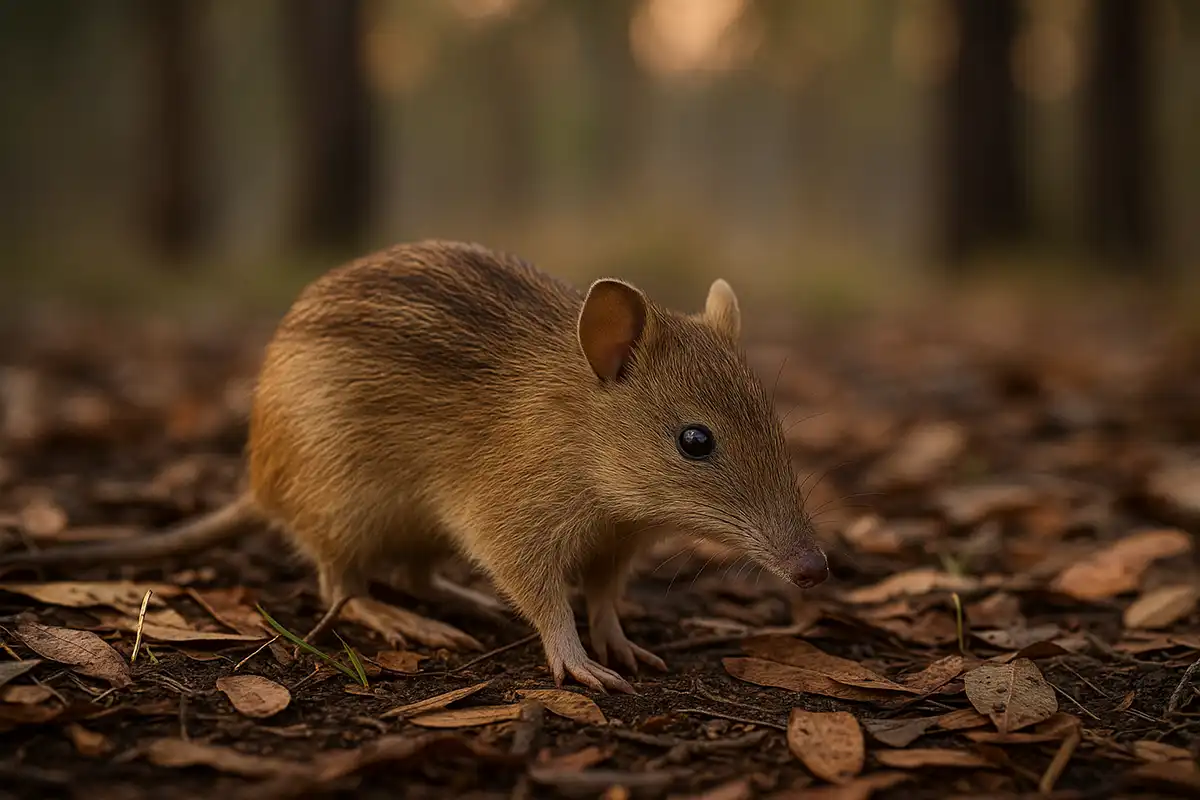
Epitaph for the South-eastern Striped Bandicoot

Earth Voices – News in brief — 10 October 2025

  • IUCN has officially listed the South-eastern striped (southern barred) bandicoot (Perameles notina) as Extinct (EX) in its latest global Red List update, announced at the IUCN World Conservation Congress in Abu Dhabi.
  • This represents the species’ first global IUCN assessment, which placed it directly in the Extinct category alongside its close relatives P. myosuros and P. papillon.
  • Last known records: Collected in Victoria, Australia, during the mid-19th century; no verified sightings since.
  • Its recognition as a distinct species followed modern re-examination of museum specimens using morphological and genetic evidence.

Epitaph for the South-eastern Striped Bandicoot

Soft burrower of moonlight clay,
you read the ground like scripture,
turning the soil with a patient faith
older than fences or plough.

Your stripes—delicate brushstrokes—
were the earth’s handwriting on fur.
You vanished before we learned to read it,
before the iron roads came
and the cats began their long patrols.

Now, in the hush between roots,
a seed remembers you.
And in the breath of dusk,
something still stirs
where you once tended the dark.


Contextual background

The South-eastern striped bandicoot (Perameles notina) was a small insect-eating marsupial once found in Victoria’s grassy woodlands and coastal heaths, possibly extending into south-eastern South Australia. For decades it was grouped with the Western Barred Bandicoot (Perameles bougainville), but careful analysis of 19th-century museum skins and skulls confirmed it as a distinct, now-extinct species.

All known specimens were collected between 1839 and 1860, a period of profound transformation following European settlement. Within a single human generation, habitat clearing for agriculture, cat predation, and frequent burning of remnant vegetation erased entire colonies. By the time science recognized its individuality, the species had already slipped beyond recovery.

The IUCN’s October 2025 Red List entry marked its first global listing, placing P. notina as Extinct alongside two other barred bandicoots identified only through historical material. Its loss embodies a wider Australian pattern: the quiet disappearance of small, ground-dwelling mammals whose ecological roles—soil aeration, seed dispersal, and invertebrate control—once sustained the continent’s biodiversity. In recent years, conservationists have revived these functions through reintroductions of close relatives into fenced sanctuaries and predator-controlled reserves, underscoring how the ghosts of extinct bandicoots still guide the management of the living landscape.

Latest Posts

More from Author

The Seeds of Sovereignty: An Investigative Report on the Geopolitics, Science, and Ethics of Genetically Modified Food

Executive Summary This investigative report examines the political, scientific, and ethical dimensions...

Wetware and Wiring: A Field Guide to Our Cybernetic Evolution

The cyberpunk futures we once relegated to dog-eared paperbacks and neon-soaked...

The Corporate Code of Silence: Greenhushing and the Great Moral Retreat

Corporations are replacing greenwashing with greenhushing—strategic silence on climate goals to dodge lawsuits and regulators, while profits soar and action stalls.

Designing the Cure: How Artificial Intelligence Broke Medicine’s Most Expensive Law

AI is revolutionizing medicine, from drug discovery to diagnosis. It's breaking old laws of cost and time, but ethical challenges remain.

Read Now

The Seeds of Sovereignty: An Investigative Report on the Geopolitics, Science, and Ethics of Genetically Modified Food

Executive Summary This investigative report examines the political, scientific, and ethical dimensions of Genetically Modified Organisms (GMOs) in the twenty-first century. It argues that the "gene revolution" is defined less by scientific consensus than by a struggle for control over the global food system. The Legal and Regulatory Battlefield:...

Wetware and Wiring: A Field Guide to Our Cybernetic Evolution

The cyberpunk futures we once relegated to dog-eared paperbacks and neon-soaked anime are no longer speculative fiction. They are the mundane reality of our Monday mornings. We have not just arrived at the intersection of human and machine; we have paved over it, built a Starbucks on...

The Corporate Code of Silence: Greenhushing and the Great Moral Retreat

Corporations are replacing greenwashing with greenhushing—strategic silence on climate goals to dodge lawsuits and regulators, while profits soar and action stalls.

Designing the Cure: How Artificial Intelligence Broke Medicine’s Most Expensive Law

AI is revolutionizing medicine, from drug discovery to diagnosis. It's breaking old laws of cost and time, but ethical challenges remain.

Marine Wilderness: The Blue Heart of Earth

Marine wilderness is vanishing fast—climate, overfishing, pollution, and mining threaten ocean life. Indigenous wisdom and bold protection offer hope.

Central America Wilderness: Biological Corridors

1. Historical Baseline Pre-1750 Wilderness Extent The jaguar padded through continuous forest from Mexico's Yucatan to Colombia's Darién Gap, never leaving tree cover across 2,000 kilometers.¹ Central America's narrow isthmus—never more than 200 kilometers wide—functioned as Earth's great biological bridge, enabling species exchange between continents for three million years...

Between Recovering Doctrine and Reformation: Christianity’s Ecological Crossroads

Christianity is at an ecological turning point. It must rediscover creation-centered wisdom or adjust its anthropocentric doctrines to tackle the global crisis.

White Scars and Contrails of Crisis: Aviation and Climate Change

We have been taught to look down. To see the airports, the concrete, the crowds, and the queues as the footprint of flight. Or we look at the numbers, the comforting, almost negligible figures. Aviation, the industry tells us, accounts for just 2.5% of global CO2 emissions.¹ It...

The Enchantress of Abstraction: The Life, Work, Legacy and Genius of Augusta Ada Lovelace

The Convergence of Poetry and Logic The history of science is frequently punctuated by figures who exist at the confluence of opposing forces—individuals whose intellects bridge the chasm between the empirical and the imaginative. Among these, few cast a longer or more complex shadow than Augusta Ada King,...

Do Androids Dream of Electric Sheep? Philip K. Dick’s Question Meets Quantum Consciousness and the Age of AI

The question Philip K. Dick posed in 1968 was never really about sheep. It was about the ineffable thing that separates life from simulation, consciousness from computation, being from seeming. In his dystopian San Francisco, where nuclear fallout had rendered authentic animals nearly extinct, owning a real sheep...

The Vanished Cities of the Amazon: Evidence of Pre-Columbian Civilizations

Christianity must both recover suppressed creation-centered traditions and fundamentally reform anthropocentric theology—authentic recovery itself transforms doctrine.

Gaia Song

Gaia Frequencies — The Voice of Earth · 600 CE *, *::before, *::after { box-sizing: border-box; margin: 0; padding: 0; } ``` :root { --font-display:...
error: Content unavailable for cut and paste at this time