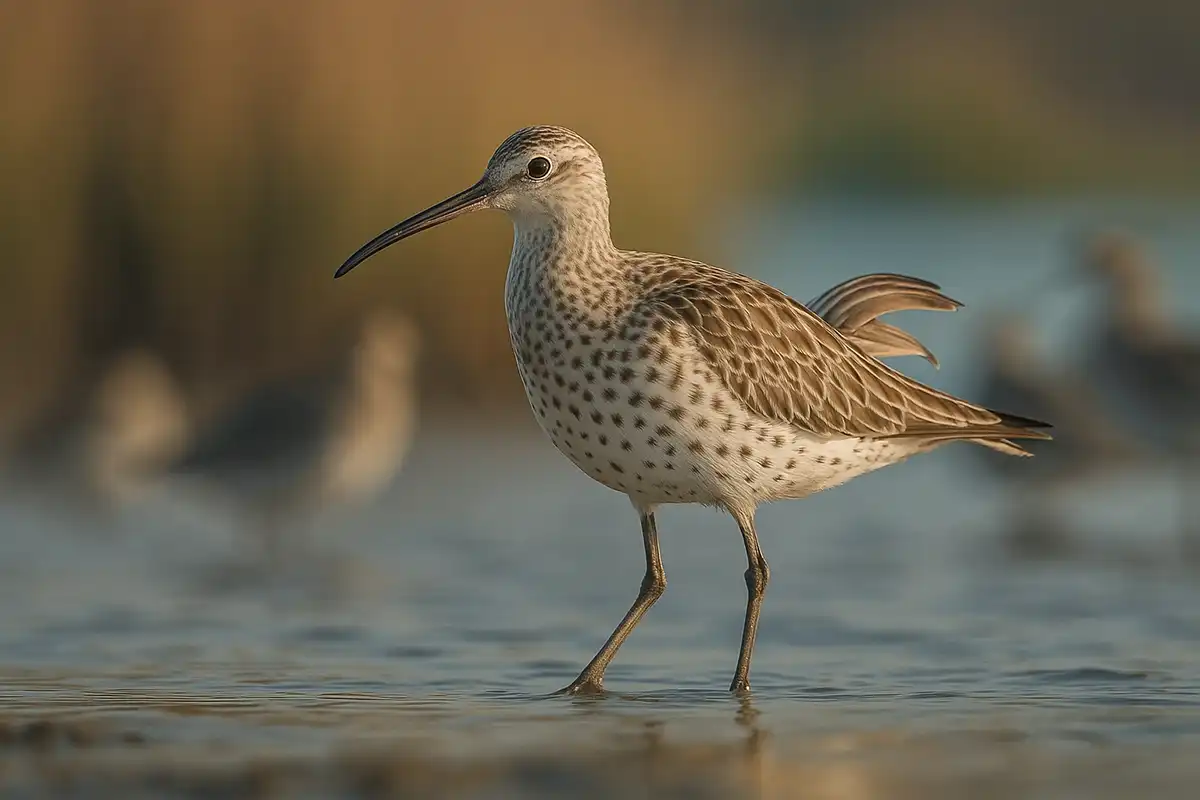
Epitaph for the Slender-billed Curlew

News in brief — 11 October 2025

  • IUCN has officially listed the Slender-billed Curlew (Numenius tenuirostris) as Extinct (EX) in its Red List update released at the IUCN World Conservation Congress, Abu Dhabi. IUCN World Conservation Congress
  • Last confirmed record: Merja Zerga lagoon, Morocco, 25 February 1995. unep-aewa.org
  • IUCN’s Congress press release notes six species moved into the Extinct category in this update, including the Slender-billed Curlew. IUCN World Conservation Congress
  • AEWA (UNEP) called it the first known global extinction of a formerly widespread migratory bird spanning mainland Europe, North Africa and West Asia. unep-aewa.org

Epitaph for the Slender-billed Curlew

Traveler of the margins,
you stitched two hemispheres with a single wingbeat,
reading coastlines like scripture—
salt on the tongue, reed in the wind.

Once we mistook your slender question mark
for a small curve of sky,
a note too pure for our iron weather.
We turned the marshes into mirrors of absence
and called it progress.

Now the tide keeps your place.
On winter mud, your shadow is a negative—
a lesson left by water,
a vow written in flight we failed to keep.

Contextual background

The Slender-billed Curlew was the smallest of the curlews: a long-distance migrant that bred on Eurasian steppe/bog landscapes (historically documented near Omsk, western Siberia; later isotopes point to the Kazakh steppe) and wintered around Mediterranean and North African wetlands. Its last unequivocal sighting was at Merja Zerga, Morocco, on 25 February 1995—photographed during the species’ final wintering seasons there.

Multiple factors likely converged in its decline: wetland loss and degradation along flyways, and hunting pressure in parts of the Mediterranean and North Africa; the precise balance of causes may never be fully known. For decades, specialist groups and volunteers searched breeding tundras, steppe bogs, and key stopovers, but credible records dwindled to none. In November 2024, researchers formally concluded extinction based on probabilistic analyses, paving the way for IUCN’s Red List change in October 2025.

The loss is historically significant: a formerly widespread migratory bird—spanning mainland Europe, North Africa and West Asia—now gone, underscoring how even wide-ranging species can unravel when flyways fray. Safeguarding the curlew’s living cousins (e.g., Eurasian Curlew) and other shorebirds now hinges on protecting and restoring wetlands along entire routes, enforcing hunting regulations, and funding long-term monitoring—because migratory birds survive only when every link in the chain holds.

Sources:

Natural History Museum+1

unep-aewa.org

2BirdLife International+2

IUCN World Conservation Congress

Latest Posts

More from Author

Western European Wilderness Lost: Rewilding the Tamed Lands

1. Historical Baseline Pre-1750 Wilderness Extent The aurochs' last bellow echoed through...

The Seeds of Sovereignty: An Investigative Report on the Geopolitics, Science, and Ethics of Genetically Modified Food

Executive Summary This investigative report examines the political, scientific, and ethical dimensions...

Wetware and Wiring: A Field Guide to Our Cybernetic Evolution

The cyberpunk futures we once relegated to dog-eared paperbacks and neon-soaked...

The Corporate Code of Silence: Greenhushing and the Great Moral Retreat

Corporations are replacing greenwashing with greenhushing—strategic silence on climate goals to dodge lawsuits and regulators, while profits soar and action stalls.

Read Now

Western European Wilderness Lost: Rewilding the Tamed Lands

1. Historical Baseline Pre-1750 Wilderness Extent The aurochs' last bellow echoed through Poland's Jaktorów Forest in 1627, marking Europe's first recorded megafaunal extinction.¹ This wild ancestor of cattle, standing two meters at the shoulder and weighing 1,000 kilograms, had shaped European landscapes for 250,000 years. Its passing symbolized...

The Seeds of Sovereignty: An Investigative Report on the Geopolitics, Science, and Ethics of Genetically Modified Food

Executive Summary This investigative report examines the political, scientific, and ethical dimensions of Genetically Modified Organisms (GMOs) in the twenty-first century. It argues that the "gene revolution" is defined less by scientific consensus than by a struggle for control over the global food system. The Legal and Regulatory Battlefield:...

Wetware and Wiring: A Field Guide to Our Cybernetic Evolution

The cyberpunk futures we once relegated to dog-eared paperbacks and neon-soaked anime are no longer speculative fiction. They are the mundane reality of our Monday mornings. We have not just arrived at the intersection of human and machine; we have paved over it, built a Starbucks on...

The Corporate Code of Silence: Greenhushing and the Great Moral Retreat

Corporations are replacing greenwashing with greenhushing—strategic silence on climate goals to dodge lawsuits and regulators, while profits soar and action stalls.

Designing the Cure: How Artificial Intelligence Broke Medicine’s Most Expensive Law

AI is revolutionizing medicine, from drug discovery to diagnosis. It's breaking old laws of cost and time, but ethical challenges remain.

Marine Wilderness: The Blue Heart of Earth

Marine wilderness is vanishing fast—climate, overfishing, pollution, and mining threaten ocean life. Indigenous wisdom and bold protection offer hope.

Central America Wilderness: Biological Corridors

1. Historical Baseline Pre-1750 Wilderness Extent The jaguar padded through continuous forest from Mexico's Yucatan to Colombia's Darién Gap, never leaving tree cover across 2,000 kilometers.¹ Central America's narrow isthmus—never more than 200 kilometers wide—functioned as Earth's great biological bridge, enabling species exchange between continents for three million years...

Between Recovering Doctrine and Reformation: Christianity’s Ecological Crossroads

Christianity is at an ecological turning point. It must rediscover creation-centered wisdom or adjust its anthropocentric doctrines to tackle the global crisis.

White Scars and Contrails of Crisis: Aviation and Climate Change

We have been taught to look down. To see the airports, the concrete, the crowds, and the queues as the footprint of flight. Or we look at the numbers, the comforting, almost negligible figures. Aviation, the industry tells us, accounts for just 2.5% of global CO2 emissions.¹ It...

The Enchantress of Abstraction: The Life, Work, Legacy and Genius of Augusta Ada Lovelace

The Convergence of Poetry and Logic The history of science is frequently punctuated by figures who exist at the confluence of opposing forces—individuals whose intellects bridge the chasm between the empirical and the imaginative. Among these, few cast a longer or more complex shadow than Augusta Ada King,...

Do Androids Dream of Electric Sheep? Philip K. Dick’s Question Meets Quantum Consciousness and the Age of AI

The question Philip K. Dick posed in 1968 was never really about sheep. It was about the ineffable thing that separates life from simulation, consciousness from computation, being from seeming. In his dystopian San Francisco, where nuclear fallout had rendered authentic animals nearly extinct, owning a real sheep...

The Vanished Cities of the Amazon: Evidence of Pre-Columbian Civilizations

Christianity must both recover suppressed creation-centered traditions and fundamentally reform anthropocentric theology—authentic recovery itself transforms doctrine.
error: Content unavailable for cut and paste at this time