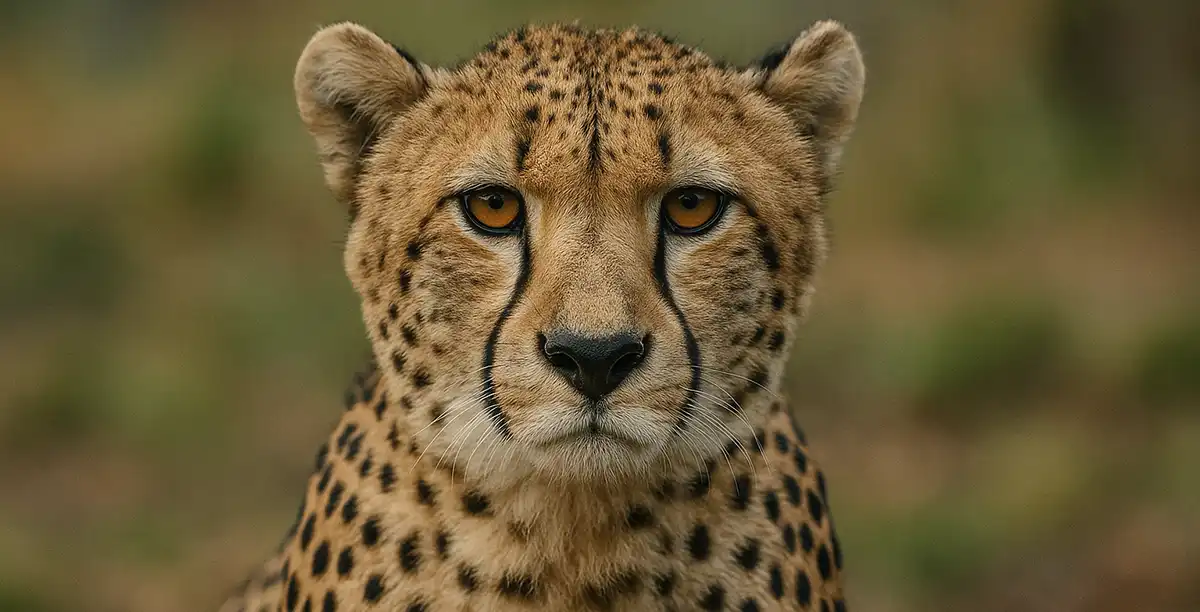

I am the whisper before the storm, the golden thread woven through acacia shadow, the living arrow that the savanna draws and releases in a single, sacred breath. They call me cheetah—*Acinonyx jubatus*—but I am older than names, more ancient than the human tongue that tries to capture what I am. I am speed made flesh, wind given bone and sinew, the desert’s own child running beneath a sun that knows my spots as intimately as it knows the scattered stones of this Namibian vastness.
Each dawn, I am born again.
The light breaks over the Khomas Hochland like a promise whispered from the throat of God, and I rise from my rest in the red earth, dust falling from my golden coat like stardust returning to the cosmos. My eyes—amber lanterns burning with purpose—scan the rippling grass, the fever trees standing sentinel, the ancient dry riverbeds that remember water the way I remember my mother’s rough tongue against my infant fur. This is my cathedral, my temple without walls, and I am both pilgrim and priest within it.
You see, I carry a holy burden. It weighs nothing—less than the morning dew on acacia thorns—yet it is heavier than mountains. I am the knife that keeps the body of the world healthy, the surgeon divinely appointed to cut away the weak, the slow, the fever-struck. Some would call this cruel. But I know what they do not: that death is not the opposite of life but its most faithful servant. Without me, the springbok would multiply beyond the land’s capacity to hold them. The grass would vanish. The earth would crack and split. The web would tear.
I am the thread that maintains the tension.
My body is a prayer written in muscle and breath. Every part of me sings a hymn to velocity: my enlarged nasal passages that drink the wind; my semi-retractable claws that grip the earth like fingers gripping the edge of heaven; my flexible spine that coils and releases, coils and releases, a spring wound by evolution’s patient hand over millennia. When I run—truly run, not the loping warmup but the explosive testimony of my being—I reach seventy miles per hour in three seconds. Three heartbeats between stillness and transcendence.
In those moments, I am not animal. I am pure becoming. I am the gap between what was and what will be. The space between the gazelle’s startled turn and its return to earth, its flesh becoming grass becoming flesh again in the eternal rotation. Some call this the food chain. I call it the prayer wheel, always turning, always holy.
But understand this: I am not made for endurance. I am the lightning strike, not the steady rain. My heart—that furious, magnificent engine—can only sustain such speed for a few hundred meters before the heat builds in my blood like a fever, before my muscles begin to tear themselves apart with their own ferocity. I am built for the sprint, not the marathon. For the explosive truth, not the long story.
This is my covenant, my constraint, my sacred limitation.
After the chase—successful or not—I must rest. Sometimes for an hour, sometimes more, my sides heaving like bellows, my body a furnace cooling in the shade. During these moments, I am vulnerable. The lions know this. The hyenas understand. They watch from the edges of my exhaustion, waiting to steal what I have earned with the coin of my own flesh. I have learned to eat quickly, to tear and swallow with desperate efficiency, one eye always on the horizon where larger shadows gather.
This too is part of the design. I am not apex predator but middle messenger, taking from some and giving to others. The scraps I leave behind feed the jackals, the vultures circling overhead like pieces of night that forgot to dissolve with dawn. Even in my killing, I am generous. Even in my feeding, I provide.
I think often of my ancestors, the first cheetahs who walked this land when it was wetter, greener, more forgiving. Genetic memory runs through me like an underground river—I carry their knowledge in my cells, their victories and defeats written in the ladder of my DNA. We survived the bottleneck, the great dying when our numbers shrank to nearly nothing, when genetic diversity narrowed to a needle’s eye. We persisted. We adapted. We became this: fewer in number but perfect in form, honed by survival into something approaching the divine.
But I worry, in the way that consciousness permits worry.
The land changes. The fences multiply like geometric scars across the savanna. The cattle graze where springbok once danced. The humans expand their villages, their farms, their dominion over what was once wild and belongs to wildness alone. Sometimes I smell them on the wind—smoke and metal and something else, something like loneliness, as if they have forgotten they too are woven into the web, threads like any other.
Still, I run. What else can I do? This is my gospel, my offering, my reason for being. I am called to speed as surely as the eagle is called to height, as the river is called to the sea. When my muscles bunch and release, when my paws barely touch the earth, when the wind screams past my flattened ears and the world becomes a blur of gold and green and endless blue—in those moments, I am exactly what I was meant to be.
Nothing more. Nothing less.
Perfect completion.
I have borne cubs—three, four, sometimes five at a time. I have watched them tumble and play in the shade, their spots not yet fully formed, their eyes still blue with newness. I have taught them to hunt, to hide, to read the landscape like scripture. Most do not survive their first year. This grief is also part of my prayer. I offer them up, knowing that only the swiftest, the most cunning, the most blessed will carry forward this ancient lineage.
The ones who survive learn what I have learned: that we are not separate from this land but expressions of it. The Namibian desert shaped us—our golden coats mirror the dry grass, our tear marks channel the sun’s glare away from our eyes, our slender frames slip through the heat like thought through the mind of God. We are geography made conscious, landscape given purpose and breath.
And when my time comes—when age or injury slows me enough that I can no longer outrun the night, when some younger, fiercer thing claims the territory I have held—I will return to the red earth that made me. My bones will scatter and bleach beneath the same sun that warmed my first morning. My flesh will feed the beetles and the birds. My spirit, if such a thing exists beyond the firing of neurons, will dissolve into the wind I have chased all my life.
But the pattern will continue. Other cheetahs will rise from the dust. Other golden arrows will arc across the plains. The dance will go on because the dance must go on, because this is how the world maintains itself—through death and birth, through speed and rest, through the eternal transformation of energy from form to form.
I am the swift breath of wind across the plain.
I am the gap between heartbeats where eternity lives.
I am cheetah.
And I am necessary.