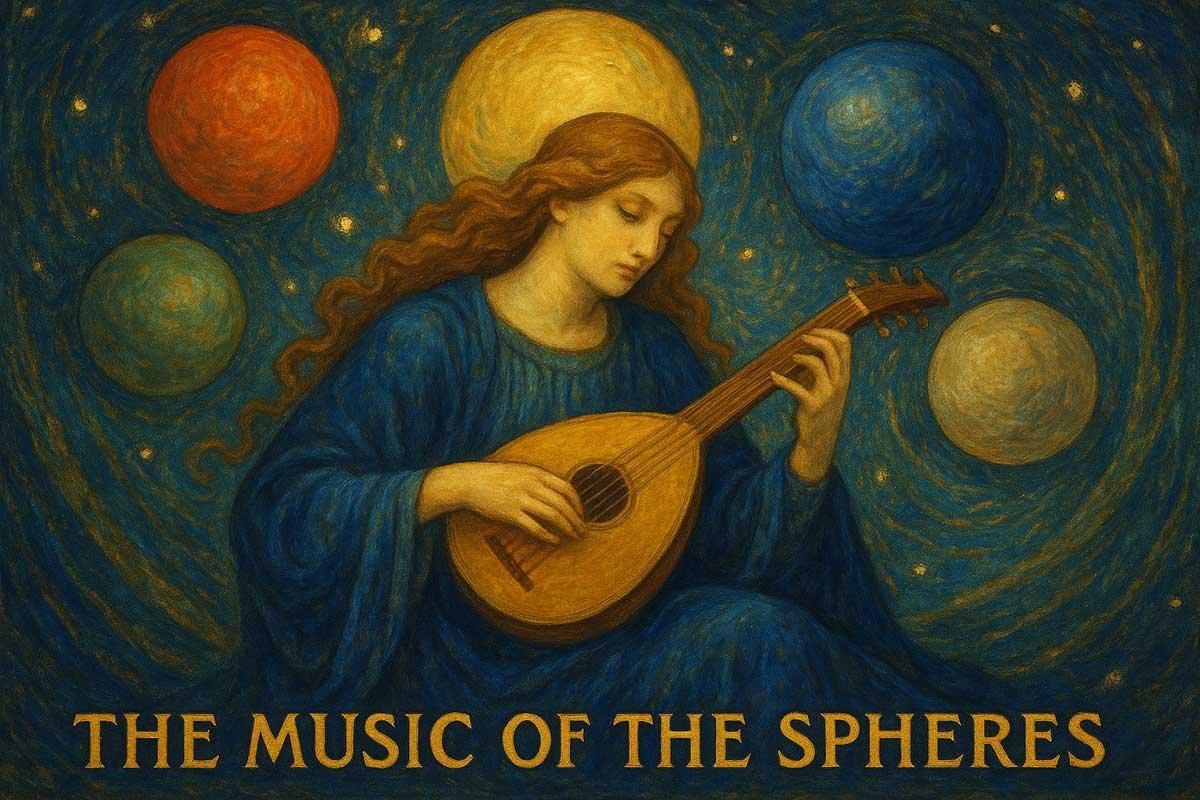

The ancient concept of celestial harmony has found unexpected resonance in modern quantum physics, creating a remarkable intellectual bridge spanning over two millennia of scientific thought. From Pythagorean mathematical mysticism to contemporary string theory, the notion that fundamental vibrations underlie cosmic order has persisted, evolved, and ultimately found scientific vindication in forms the ancients could never have imagined. This enduring concept reveals how aesthetic intuitions about mathematical beauty can inspire genuine scientific discovery, while demonstrating the profound difference between philosophical speculation and empirical verification. The Music of the Spheres thus represents both a testament to human longing for cosmic harmony and a cautionary tale about the relationship between metaphysical aspiration and physical reality.
Ancient origins and mathematical foundations
The Music of the Spheres emerged from Pythagoras’s revolutionary discovery that musical harmony derives from simple mathematical ratios. Around 580 BCE, Pythagoreans observed that pleasing musical intervals correspond to precise numerical relationships: the octave (2:1), perfect fifth (3:2), and perfect fourth (4:3).¹ This insight proved so compelling that followers extrapolated it to the cosmos itself, reasoning that celestial bodies in motion must produce sound, and that these sounds would naturally conform to the same harmonic principles governing earthly music.
The Pythagorean cosmic scale, as recorded by later Roman scholar Censorinus, assigned specific musical intervals to planetary separations. From Earth to Moon represented one whole tone, while the complete span from Earth to the zodiacal stars encompassed a perfect octave.² This created a universe literally singing in harmony, though the music remained inaudible to human ears because, having heard it continuously from birth, humans lacked any contrasting silence for comparison.
Plato’s Timaeus elevated this concept to profound philosophical significance by describing cosmic creation itself as a fundamentally musical process. The Demiurge fashions the World Soul using harmonic ratios (1, 2, 3, 4, 8, 9, and 27) that correspond exactly to Pythagorean musical proportions.³ This harmonically-divided cosmic substance is then shaped into celestial motions, creating what Plato called “an eternal image, moving according to number.”⁴ In the Republic’s Myth of Er, Plato provided a more poetic vision: “on the upper surface of each circle is a siren, who goes round with them, hymning a single tone or note. Together they form the concord of a single harmony.”⁵
Medieval synthesis and Christian adaptation
Boethius became the crucial transmitter of ancient harmonic theory to medieval Christianity through his influential De institutione musica (c. 510 CE). His threefold classification proved foundational: musica instrumentalis (human-made music), musica humana (harmony of body and soul), and musica mundana (the music of the spheres governing celestial motions and elemental relationships).⁶ This framework allowed Christian scholars to interpret cosmic harmony as evidence of divine mathematical perfection rather than pagan cosmology.
Medieval education incorporated the Music of the Spheres into the quadrivium alongside arithmetic, geometry, and astronomy, treating these as complementary sciences revealing God’s mathematical design. The concept harmonized perfectly with Christian theology: if God created the world according to “measure, number, and weight,” then the same mathematical ratios governing music should govern the heavens.⁷ Medieval scholars thus preserved and transmitted ancient harmonic theory while adapting it to monotheistic cosmology.
The Catholic Church embraced this synthesis, viewing earthly music as a reflection of divine perfection. St. Augustine particularly appreciated music’s power to elevate the soul toward contemplation of heavenly harmony, writing that music could remind humans of their divine origin through its mathematical beauty.⁸ This theological framework ensured the concept’s survival through the Middle Ages while embedding it within Christian metaphysics.
Kepler’s scientific revolution and empirical grounding
Johannes Kepler’s Harmonices Mundi (1619) represents the concept’s transformation from philosophical speculation to scientific investigation. Unlike his predecessors, Kepler attempted to ground cosmic harmony in precise astronomical observation, using Tycho Brahe’s data to calculate actual planetary velocity ratios.⁹ This empirical approach led to genuine scientific discoveries despite flawed harmonic assumptions.
Kepler fundamentally reconceptualized celestial music, rejecting the ancient notion of audible planetary sounds and proposing instead that harmony arose from ratios between planetary velocities at perihelion and aphelion. Each planet sang its characteristic glissando: Mercury with the widest range (soprano), Venus nearly monotone (alto), Earth creating the famous “mi fa mi” progression suggesting “MIsery and FAmine,” and the outer planets providing harmonic accompaniment.¹⁰ This represented a sophisticated synthesis of heliocentric astronomy with Renaissance polyphonic practice.
Most significantly, Kepler’s harmonic investigations led directly to his Third Law of planetary motion: the proportion between any two planets’ orbital periods equals the sesquialterate proportion (3/2 power) of their mean distances.¹¹ This mathematical relationship, discovered through aesthetic motivation, proved fundamental to later celestial mechanics. Kepler thus demonstrated how philosophical preoccupations with cosmic beauty could drive genuine scientific advancement, even when the underlying aesthetic theory proved incorrect.
Modern acoustics and the science of sound
The Scientific Revolution gradually separated rigorous acoustics from metaphysical harmony concepts, though both emerged from the same Pythagorean mathematical foundation. Galileo Galilei elevated acoustics to genuine science by correlating pitch with frequency and studying vibrations systematically, writing that “waves are produced by the vibrations of a sonorous body, which spread through the air.”¹² Marin Mersenne, called “the father of acoustics,” provided the first mathematical description of vibrating strings in 1636, establishing laws governing string vibration that remain valid today.¹³
Hermann von Helmholtz’s revolutionary 1863 work On the Sensations of Tone applied Fourier analysis to understand musical timbre, revealing that complex sounds decompose into simple harmonic components.¹⁴ This scientific understanding of harmonic relationships confirmed ancient intuitions about mathematical ratios in music while grounding them in wave physics rather than mystical speculation.
Modern acoustics reveals the physical basis for musical consonance: harmonic series created by natural objects vibrating at frequencies f, 2f, 3f, etc. generate the mathematical relationships that ancient philosophers intuited.¹⁵ Resonance phenomena, standing wave patterns, and Fourier analysis provide scientific explanations for why certain numerical ratios create pleasant sounds, validating Pythagorean insights while transcending their cosmological extrapolations.
Contemporary sonification research creates a modern synthesis of cosmic observation and acoustic experience. Scientists like those at Harvard-Smithsonian now translate astronomical data into audible sound, enabling pattern recognition and making research accessible to visually impaired scientists.¹⁶ This represents a scientific realization of ancient desires to “hear” cosmic patterns, though grounded in empirical data rather than philosophical necessity.
Quantum resonances and contemporary physics
Modern quantum physics has discovered genuine vibrational phenomena throughout the cosmos that create a more profound “cosmic music” than ancient philosophers imagined. Quantum field theory treats every point in space as a quantum harmonic oscillator, with perpetual zero-point energy fluctuations even in vacuum.¹⁷ These quantum oscillations are mathematically similar to musical harmonics, though they operate according to physical laws rather than aesthetic principles.
String theory provides the most explicit modern parallel to ancient harmonic concepts, proposing that fundamental particles are vibrational modes of microscopic strings. As Brian Greene explains: “Just as the strings on a violin vibrate in different patterns, the filaments of superstring theory vibrate in different patterns. The different vibrational patterns appear in our world as the different particle species.”¹⁸ Michio Kaku states even more dramatically: “String theory says it’s all music. Music that obeys harmonies. And these harmonies are the laws of physics.”¹⁹
However, these connections require careful scientific assessment. While string theory is mathematically elegant, it remains experimentally unconfirmed and thus speculative.²⁰ The explicit musical metaphors used by theoretical physicists may reflect conscious communication choices rather than literal physical relationships. As scholar Peter Pesic notes, string theorists’ “initial papers and subsequent recollections do not use explicit Pythagorean language,” suggesting the musical connection emerged later as a pedagogical tool.²¹
More concretely, gravitational waves detected by LIGO represent genuine “sounds from space”—actual spacetime vibrations carrying information about cosmic events like black hole mergers.²² These waves span frequencies from nanohertz to kilohertz, creating characteristic “chirp” patterns as inspiraling masses accelerate before collision. Unlike philosophical harmony concepts, gravitational waves provide empirical data about previously unobservable cosmic processes.
The cosmic microwave background preserves acoustic signatures from the early universe in the form of baryon acoustic oscillations—sound waves that propagated through primordial plasma before being “frozen” as temperature fluctuations.²³ University of Washington physicist John Cramer describes CMB analysis as revealing “a fundamental tone with several harmonics, whose relative strengths and pitches reveal important cosmological parameters.”²⁴ This represents genuine cosmic acoustics rather than metaphysical speculation.
Convergence, divergence, and enduring significance
The relationship between ancient harmonic concepts and modern physics reveals both remarkable prescience and fundamental limitations of philosophical speculation ungrounded in empirical verification. Ancient intuitions about mathematical relationships in nature proved partially correct—musical consonance does arise from simple ratios in wave physics, and the universe does exhibit wave phenomena at all scales from quantum mechanics to gravitational radiation.
However, critical differences distinguish metaphysical harmony from physical wave phenomena. Modern acoustics relies on experimental verification rather than aesthetic necessity. Scientific wave phenomena emerge from measurable physical processes rather than cosmic design principles. Contemporary research emphasizes quantitative measurement over qualitative aesthetic judgment, though both approaches recognize the profound role of mathematical beauty in understanding natural order.
The persistence of musical metaphors in cutting-edge physics suggests these serve important cognitive functions, helping scientists conceptualize abstract mathematical relationships while expressing wonder about cosmic order. When Michio Kaku describes humans as “nothing but melodies, nothing but cosmic music played out on vibrating strings,” he employs poetic language to communicate scientific concepts, continuing a tradition established by ancient Pythagoreans.²⁵
Most significantly, the Music of the Spheres concept demonstrates how aesthetic motivations can inspire genuine scientific discovery. Kepler’s harmonic investigations led to fundamental laws of planetary motion. Contemporary physicists’ appreciation for mathematical elegance drives theoretical developments in quantum field theory and cosmology. The relationship between beauty and truth in physics continues to generate productive research programs, even when specific aesthetic theories prove scientifically inadequate.
Conclusion
The Music of the Spheres represents a remarkable intellectual journey from mathematical mysticism to scientific discovery, revealing both the power and limitations of aesthetic intuition in understanding natural phenomena. While ancient philosophers’ specific claims about audible planetary music proved incorrect, their deeper insight about mathematical harmony underlying natural order has found vindication in modern physics through quantum oscillations, gravitational waves, and the acoustic signatures of cosmic evolution.
The concept’s enduring appeal reflects humanity’s persistent intuition that mathematical beauty and physical truth are intimately connected. From Pythagoras’s discovery of numerical ratios in musical consonance to contemporary physicists’ search for elegant unified theories, the quest for cosmic harmony continues to drive scientific investigation. Modern physics has discovered a universe that is indeed “musical” in profound ways—through quantum field oscillations, string theory vibrations, and gravitational wave frequencies—though these phenomena operate according to empirical laws rather than aesthetic design.
Perhaps most importantly, the Music of the Spheres demonstrates that scientific progress often emerges from the interplay between human aesthetic sensibilities and rigorous empirical investigation. While philosophical speculation without experimental grounding leads to beautiful but incorrect theories, the marriage of mathematical elegance with observational verification has repeatedly yielded genuine insights into cosmic order. The ancient dream of celestial harmony thus lives on, transformed but not abandoned, in humanity’s continuing quest to understand the fundamental nature of physical reality.
Notes
¹ Joscelyn Godwin, The Harmony of the Spheres: A Sourcebook of the Pythagorean Tradition in Music (Rochester, VT: Inner Traditions, 1993), 15-20.
² Ibid., 25-28.
³ Plato, Timaeus 35-36, in Complete Works, ed. John M. Cooper (Indianapolis: Hackett, 1997).
⁴ Plato, Timaeus 37D.
⁵ Plato, Republic 617B.
⁶ Boethius, De institutione musica, trans. Calvin Bower (New Haven: Yale University Press, 1989), Book I, Chapter 2.
⁷ Karin Meyer-Baer, Music of the Spheres and the Dance of Death: Studies in Musical Iconology (Princeton: Princeton University Press, 1970), 89-95.
⁸ Augustine, Confessions, Book X, Chapter 33.
⁹ Johannes Kepler, Harmonices Mundi [The Harmony of the World], trans. Charles Glenn Wallis (Amherst, NY: Prometheus Books, 1995), 185-245.
¹⁰ Ibid., 207-210.
¹¹ Ibid., 380-395.
¹² Galileo Galilei, Discourses and Mathematical Demonstrations Relating to Two New Sciences, trans. Henry Crew and Alfonso de Salvio (Evanston: Northwestern University Press, 1946), 95.
¹³ Marin Mersenne, Harmonicorum Libri (Paris: Guillaume Baudry, 1636), Book I.
¹⁴ Hermann von Helmholtz, On the Sensations of Tone as a Physiological Basis for the Theory of Music, trans. Alexander Ellis (London: Longmans, Green, 1885), 15-45.
¹⁵ “Fundamental Frequency and Harmonics,” The Physics Classroom, accessed August 18, 2025, https://www.physicsclassroom.com/class/sound/Lesson-5/Fundamental-Frequency-and-Harmonics.
¹⁶ Kimberly Kowal Arcand et al., “The 21st Century’s Music of the Spheres,” EOS 102 (2021): doi:10.1029/2021EO160304.
¹⁷ Brian Greene, The Elegant Universe (New York: Vintage Books, 1999), 145-165.
¹⁸ Ibid., 145.
¹⁹ Michio Kaku, Introduction to Superstrings and M-Theory (New York: Springer, 1999), 8.
²⁰ Peter Pesic, “Pythagorean Longings and Cosmic Symphonies: The Musical Rhetoric of String Theory,” Research Catalogue, 2014, https://www.researchcatalogue.net/view/94915/94916.
²¹ Ibid., 12.
²² LIGO Scientific Collaboration, “Observation of Gravitational Waves from a Binary Black Hole Merger,” Physical Review Letters 116, no. 6 (2016): 061102.
²³ Wayne Hu and Scott Dodelson, “Cosmic Microwave Background Anisotropies,” Annual Review of Astronomy and Astrophysics 40 (2002): 171-216.
²⁴ John G. Cramer, “The Sound of the Big Bang,” University of Washington, 2003, http://faculty.washington.edu/jcramer/BBSound.html.
²⁵ Kaku, Introduction to Superstrings and M-Theory, 15.
Bibliography
Augustine. Confessions. Translated by R.S. Pine-Coffin. London: Penguin Classics, 1961.
Boethius, Anicius Manlius Severinus. De institutione musica. Translated by Calvin Bower. New Haven: Yale University Press, 1989.
Cramer, John G. “The Sound of the Big Bang.” University of Washington, 2003. http://faculty.washington.edu/jcramer/BBSound.html.
Galilei, Galileo. Discourses and Mathematical Demonstrations Relating to Two New Sciences. Translated by Henry Crew and Alfonso de Salvio. Evanston: Northwestern University Press, 1946.
Godwin, Joscelyn. The Harmony of the Spheres: A Sourcebook of the Pythagorean Tradition in Music. Rochester, VT: Inner Traditions, 1993.
Greene, Brian. The Elegant Universe. New York: Vintage Books, 1999.
Helmholtz, Hermann von. On the Sensations of Tone as a Physiological Basis for the Theory of Music. Translated by Alexander Ellis. London: Longmans, Green, 1885.
Hu, Wayne, and Scott Dodelson. “Cosmic Microwave Background Anisotropies.” Annual Review of Astronomy and Astrophysics 40 (2002): 171-216.
James, Jamie. The Music of the Spheres: Music, Science, and the Natural Order of the Universe. New York: Springer-Verlag, 1995.
Kaku, Michio. Introduction to Superstrings and M-Theory. New York: Springer, 1999.
Kepler, Johannes. Harmonices Mundi [The Harmony of the World]. 1619. Translated by Charles Glenn Wallis. Amherst, NY: Prometheus Books, 1995.
Kowal Arcand, Kimberly, et al. “The 21st Century’s Music of the Spheres.” EOS 102 (2021). doi:10.1029/2021EO160304.
LIGO Scientific Collaboration. “Observation of Gravitational Waves from a Binary Black Hole Merger.” Physical Review Letters 116, no. 6 (2016): 061102.
Mersenne, Marin. Harmonicorum Libri. Paris: Guillaume Baudry, 1636.
Meyer-Baer, Karin. Music of the Spheres and the Dance of Death: Studies in Musical Iconology. Princeton: Princeton University Press, 1970.
Pesic, Peter. “Pythagorean Longings and Cosmic Symphonies: The Musical Rhetoric of String Theory.” Research Catalogue, 2014. https://www.researchcatalogue.net/view/94915/94916.
Plato. Complete Works. Edited by John M. Cooper. Indianapolis: Hackett, 1997.
“Fundamental Frequency and Harmonics.” The Physics Classroom. Accessed August 18, 2025. https://www.physicsclassroom.com/class/sound/Lesson-5/Fundamental-Frequency-and-Harmonics.
Prins, Jacomien, and Maude Vanhaelen, eds. Sing Aloud Harmonious Spheres: Renaissance Conceptions of Cosmic Harmony. New York: Routledge, 2017.