
Introduction
Alan Wilson Watts (1915-1973) emerged as one of the most influential interpreters of Eastern philosophy for Western audiences during the twentieth century. His unique ability to translate complex Buddhist, Taoist, and Hindu concepts into accessible language made him a pivotal figure in the counterculture movement of the 1960s and beyond.¹ Today, as we grapple with digital overwhelm, environmental crisis, and questions of meaning in an increasingly interconnected world, Watts’ teachings offer surprisingly relevant insights for contemporary life.
Core Philosophical Themes
The Illusion of Separateness
Central to Watts’ philosophy is the notion that the feeling of being a separate, isolated self is a kind of optical delusion of consciousness. Drawing from Vedantic and Buddhist traditions, he argued that what we call “I” is not a standalone entity but rather a continuous process intimately connected with everything else in the universe.² In The Book: On the Taboo Against Knowing Who You Are, Watts writes, “We do not ‘come into’ this world; we come out of it, as leaves from a tree.”³
This teaching resonates powerfully in our current age of ecological crisis. Climate change and environmental degradation have made it abundantly clear that human actions cannot be separated from their environmental consequences. The COVID-19 pandemic further illustrated our fundamental interconnectedness—a virus emerging in one part of the world rapidly affecting every corner of human civilization. Watts’ emphasis on ecological thinking, decades before it became mainstream, now appears prophetic.
The Wisdom of Insecurity
Watts challenged the Western obsession with security, control, and certainty. In The Wisdom of Insecurity, he argued that life is essentially a flowing process and that our attempts to grasp and solidify it create suffering.⁴ He suggested that genuine security comes not from building walls against change but from learning to move with it gracefully.
This teaching speaks directly to contemporary challenges. In an era of rapid technological change, economic uncertainty, and social transformation, the ability to embrace uncertainty becomes a crucial life skill. The gig economy, career pivots, and the constant need for reskilling have made Watts’ insights about the futility of seeking permanent security particularly relevant. His teachings offer a philosophical framework for navigating what sociologist Zygmunt Bauman termed “liquid modernity”—a condition where social forms melt and reform constantly.⁵
Present-Moment Awareness
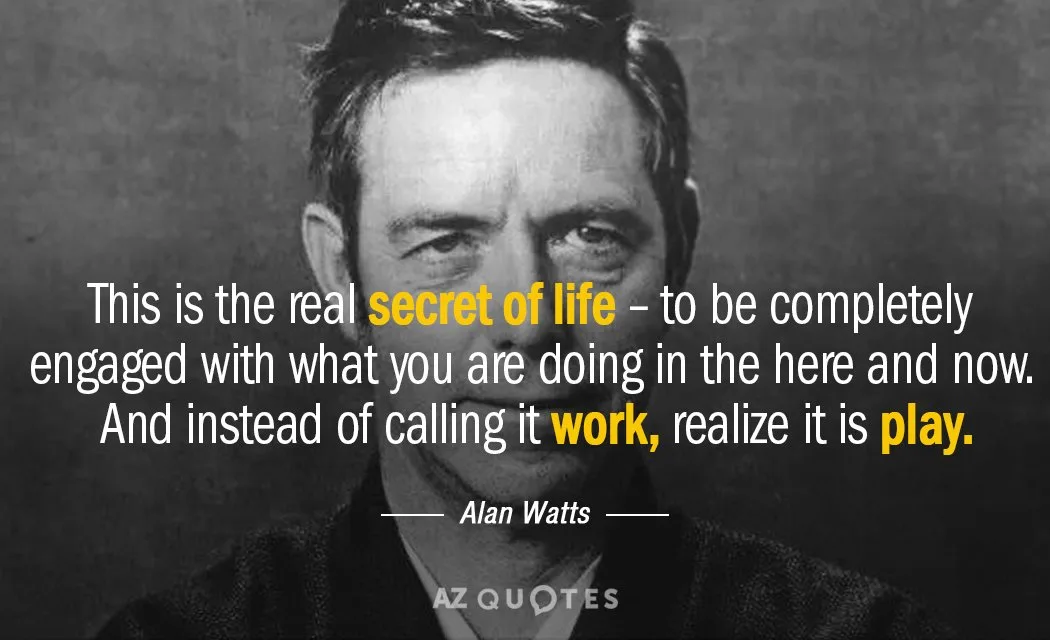
One of Watts’ most enduring contributions was his emphasis on present-moment awareness, drawn from Zen Buddhism. He argued that anxiety arises from living in the future while depression often stems from dwelling in the past. True life, he insisted, exists only in the eternal now.⁶ “This is the real secret of life,” Watts wrote, “to be completely engaged with what you are doing in the here and now. And instead of calling it work, realize it is play.”⁷
The contemporary mindfulness movement, now backed by extensive neuroscientific research, validates many of Watts’ insights about present-moment awareness. Studies have shown that mindfulness practices can reduce stress, improve emotional regulation, and enhance overall well-being.⁸ Major corporations like Google, Apple, and Goldman Sachs have incorporated mindfulness programs, demonstrating the practical applicability of what Watts advocated decades ago.
The Unity of Opposites
Drawing heavily from Taoism, Watts emphasized the complementary nature of opposites—light and dark, life and death, order and chaos. He used the Chinese concept of yin-yang to illustrate that opposing forces are not in conflict but rather dance together in a greater harmony.⁹ This perspective challenges Western either/or thinking in favor of both/and approaches.
This teaching offers valuable insights for navigating contemporary polarization. In an era of extreme political division, social media echo chambers, and ideological tribalism, Watts’ emphasis on the unity of opposites provides a framework for transcending binary thinking. His approach suggests that seemingly contradictory viewpoints might both contain truth and that wisdom lies in holding paradox rather than resolving it prematurely.
Contemporary Applications
Digital Mindfulness and Technology
While Watts died before the digital revolution, his teachings about consciousness and attention are remarkably applicable to our relationship with technology. His warnings about mistaking the map for the territory—confusing our mental concepts with reality itself—take on new meaning in an age of virtual reality and social media.¹⁰ The addictive nature of digital devices and the constant pull of notifications echo what Watts described as the “feedback loop” of the ego always seeking more stimulation and validation.
His prescription—regular returns to direct, unmediated experience—aligns with contemporary digital detox movements and the growing recognition that technological progress must be balanced with contemplative practices. Tech leaders like Jack Dorsey and Marc Benioff have publicly embraced meditation, suggesting a growing awareness of what Watts long advocated: the need to balance doing with being.
Environmental Consciousness
Watts’ ecological worldview, expressed decades before environmental awareness became mainstream, offers crucial insights for addressing climate change. His teaching that humans are not separate from nature but expressions of it challenges the anthropocentric worldview underlying much environmental destruction.¹¹ “The world is your body,” he often said, suggesting that harming the environment is literally self-harm.¹²
This perspective supports contemporary movements toward sustainable living, regenerative agriculture, and circular economy models. It provides a spiritual and philosophical foundation for the practical changes needed to address environmental challenges, suggesting that ecological action flows naturally from ecological consciousness.
Mental Health and Well-being
The mental health crisis affecting many developed nations—with rising rates of anxiety, depression, and suicide—can be partially understood through Watts’ analysis of the “double-bind” situations created by modern life.¹³ He identified how societal demands to be spontaneous on command, to relax while striving, or to be authentic while conforming create psychological tension.
His teachings offer pathways out of these binds through acceptance, humor, and the recognition that many of our problems stem from fighting the fundamental nature of reality. Contemporary therapeutic approaches like Acceptance and Commitment Therapy (ACT) echo many of Watts’ insights about the futility of struggling against unwanted thoughts and emotions.¹⁴
Critiques and Limitations
Despite his contributions, Watts’ philosophy has faced legitimate critiques. Some scholars argue that his interpretations of Eastern philosophy were oversimplified or westernized, potentially contributing to the commodification of spiritual practices.¹⁵ Others point out that his emphasis on spontaneity and “going with the flow” could be misinterpreted as endorsing irresponsibility or ethical relativism.
Additionally, Watts’ personal struggles with alcoholism raise questions about the gap between philosophical understanding and lived practice—a tension he himself acknowledged. These limitations remind us that philosophical insights, however profound, must be integrated with practical wisdom and ethical responsibility.
Conclusion
Alan Watts’ philosophy remains remarkably relevant for navigating twenty-first-century challenges. His insights about interconnectedness speak to environmental crisis; his teachings on uncertainty address economic and social instability; his emphasis on present-moment awareness offers antidotes to digital distraction; and his non-dualistic thinking provides frameworks for transcending polarization.
Perhaps most importantly, Watts offered a vision of human life as fundamentally playful rather than problematic—a perspective that becomes increasingly valuable as we face complex global challenges. His teaching that “the meaning of life is just to be alive”¹⁶ offers both simplicity and profundity, suggesting that beneath our complicated problems lies a simple invitation to presence and participation in the cosmic dance.
As we continue to grapple with questions of meaning, identity, and purpose in an rapidly changing world, Watts’ synthesis of Eastern wisdom and Western accessibility provides valuable resources. His work reminds us that ancient wisdom traditions offer not escape from modern life but deeper engagement with it—not through adding more complexity but through recognizing the simplicity that underlies apparent complexity. In this way, Alan Watts continues to serve as a philosophical bridge, helping contemporary seekers find timeless wisdom for timely challenges.
Notes
- Monica Furlong, Zen Effects: The Life of Alan Watts (Boston: Houghton Mifflin, 1986), 45-67.
- Alan Watts, The Way of Zen (New York: Vintage Books, 1957), 115-118.
- Alan Watts, The Book: On the Taboo Against Knowing Who You Are (New York: Vintage Books, 1966), 8.
- Alan Watts, The Wisdom of Insecurity: A Message for an Age of Anxiety (New York: Vintage Books, 1951), 23-45.
- Zygmunt Bauman, Liquid Modernity (Cambridge: Polity Press, 2000), 1-15.
- Alan Watts, The Way of Zen, 154-160.
- Alan Watts, The Essence of Alan Watts (Millbrae, CA: Celestial Arts, 1977), 45.
- Jon Kabat-Zinn, “Mindfulness-Based Interventions in Context: Past, Present, and Future,” Clinical Psychology: Science and Practice 10, no. 2 (2003): 144-156.
- Alan Watts, Tao: The Watercourse Way (New York: Pantheon Books, 1975), 19-30.
- Alan Watts, The Way of Zen, 178-180.
- David Loy, “Alan Watts Reconsidered,” in A New Buddhist Path: Enlightenment, Evolution, and Ethics in the Modern World (Boston: Wisdom Publications, 2015), 123-134.
- Alan Watts, Nature, Man and Woman (New York: Vintage Books, 1958), 7.
- Alan Watts, Psychotherapy East and West (New York: Ballantine Books, 1961), 89-112.
- Steven C. Hayes, Kirk D. Strosahl, and Kelly G. Wilson, Acceptance and Commitment Therapy: The Process and Practice of Mindful Change, 2nd ed. (New York: Guilford Press, 2012), 15-23.
- Peter Harvey, An Introduction to Buddhism: Teachings, History and Practices, 2nd ed. (Cambridge: Cambridge University Press, 2013), 412-415.
- Alan Watts, Still the Mind: An Introduction to Meditation (Novato, CA: New World Library, 2000), 89.