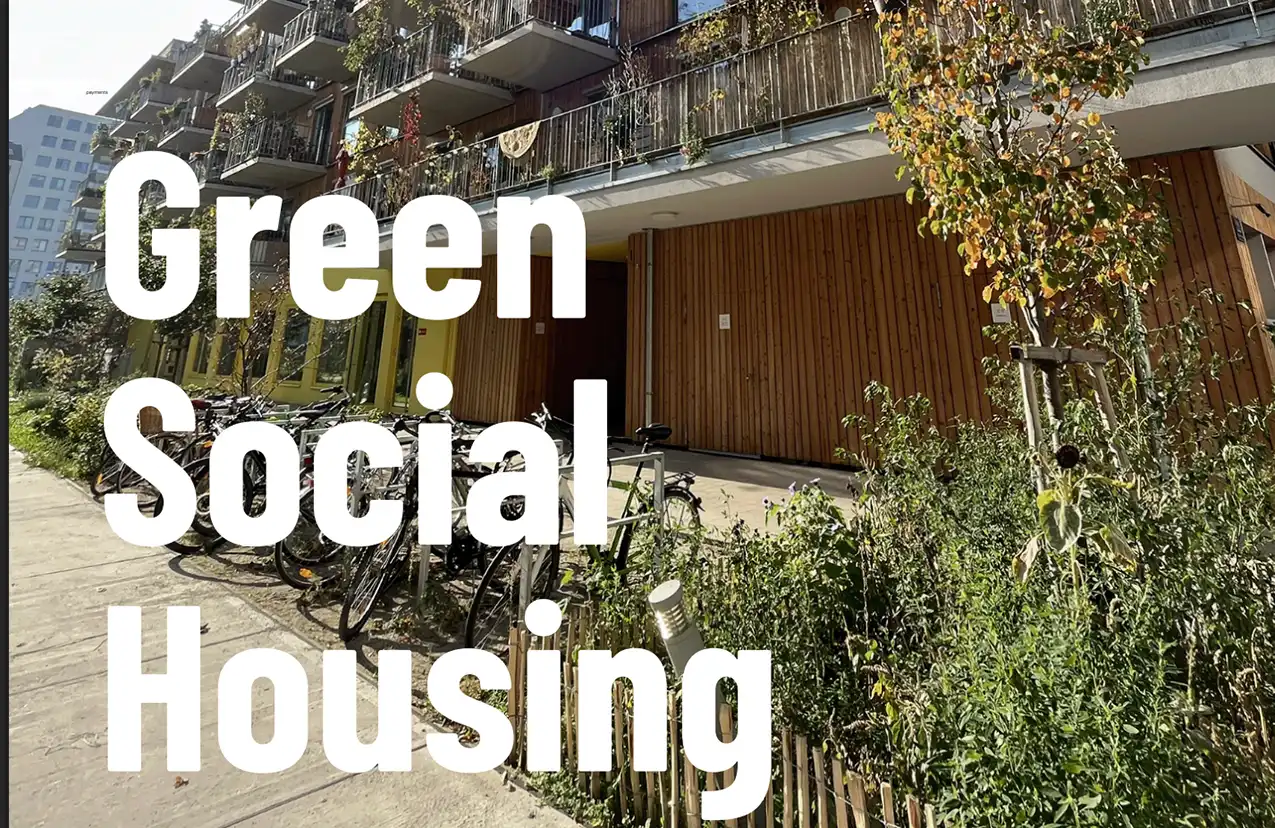

GREEN CITIES SERIES | ARTICLE 3
For a century, Vienna has built homes that shelter half its population from the market. Now the same political tradition that gave the city its Gemeindebauten is attempting something even more ambitious: to decarbonise a metropolis of two million people without making them pay for it.
On a cold morning in the 11th district of Simmering, a construction crew is tearing up asphalt. A section of Simmeringer Hauptstrasse that has baked through a dozen summers as a heat island — concrete, tarmac, diesel exhaust — is being broken open. In its place, plane trees will go in. Beds of lavender, drinking fountains, permeable paving. The work is not ceremonial. By last summer, climate researchers had already mapped this street as one of the hottest corridors in the district, a place where the urban temperature premium runs several degrees above the rural fringe. The city has a name for the programme driving these changes: Raus aus dem Asphalt — Out of the Asphalt. It is blunter than most bureaucratic slogans, and that bluntness is intentional. After a century of progressive urbanism, Vienna has decided that the decisive environmental challenge is not in the headlines but underfoot.
A Century of Radical Ordinariness
Vienna is a city that solved its housing problem a hundred years ago and never stopped. In 1919, reeling from the collapse of the Habsburg Empire and a catastrophic housing shortage, the newly elected Social Democratic city government began levying progressive taxes on luxury goods and using the proceeds to build community buildings — Gemeindebauten — for the working class. The ambition was not merely functional but political: to demonstrate that the state could provide beautiful, healthy, well-situated homes, and that doing so was the foundation of a dignified urban life.
That conviction has never entirely left office. Vienna has never sold off its municipal housing stock — a distinction it shares with almost no other major European city. Today, roughly a third of the city’s two million residents live in directly municipally owned housing, and a further third live in ‘limited-profit’ housing subsidised and regulated by the city. Together, more than 60% of Viennese households are shielded from the full force of the private rental market. Average rents in the social sector run around 700 euros for a large one-bedroom apartment — extraordinary by the standards of any comparable western capital.
This matters for reasons that go well beyond real estate. Stable, affordable tenure creates the social infrastructure for long-term urban investment: residents who expect to stay in a building for decades are more likely to support and maintain it. Mixed-income integration — Vienna has built social housing in every one of its 23 districts — reduces the spatial segregation that makes so many cities harder and more expensive to govern. And crucially, for the present moment, it means that the city owns or controls enough of the built environment to use housing as a direct lever of climate policy. That is an opportunity that most cities, which long ago sold or gave away their public estate, no longer have.
The Pressures: Heat, Gas, and a Growing City
Vienna is growing faster than almost any other city in the European Union. Its population, which dipped after the Second World War and the end of the Habsburg imperial economy, has been climbing steadily since the 1980s and crossed two million in recent years. That growth creates pressure on every urban system: transport, schools, housing supply, and, increasingly, climate resilience.
The heat problem is already acute. Urban climate modelling by GeoSphere Austria and the AIT Austrian Institute of Technology shows that in densely built-up districts, the number of days exceeding 30 degrees Celsius has risen sharply, and the projections are sobering. Under high-emissions scenarios, densely built areas of Vienna could face roughly 100 summer days and 40 heat days annually by the end of the century. Older residents, outdoor workers, and people in poorly insulated apartments face disproportionate risk. The same models suggest, however, that realistic nature-based interventions — tree planting, surface unsealing, green roofs, lighter paving — could reduce heat days by up to 12% across the city, and by far more in individual districts.
The second pressure is gas. The building sector accounts for close to 30% of Vienna’s climate-relevant greenhouse gas emissions, and almost 90% of those emissions come from gas-fired heating systems. Vienna currently has around 600,000 gas boilers — a figure that reads less like a technical fact than a policy challenge in plain numbers. Many of these are decentralised units in individual apartments in older buildings, serving households that have no individual ability to switch technologies without collective action at the building level. Phasing them out requires the city to organise the transition, fund it, and persuade roughly half a million households to participate — in apartments they do not own, in buildings with fractured ownership structures, on timelines imposed by a climate crisis they did not cause.
Vienna has set itself the goal of being climate-neutral by 2040 — a decade ahead of the European Union’s 2050 target.
What Vienna Is Actually Doing
The city’s approach has three distinct but interconnected strands: transforming the housing stock it controls; replacing gas with renewable heat at city scale; and redesigning the streets and public realm to make the urban surface itself part of the climate solution.
On housing, the competition model that Vienna pioneered in the 1990s has been retooled as a climate instrument. When developers — public, limited-profit, or private — compete for land and low-interest city loans to build subsidised housing, they are judged by a jury that now awards significant points for sustainability. Energy efficiency, green roofs, sustainable building materials, lifecycle carbon analysis — these are not bonus features but conditions of winning. Architects who design for climate find that it genuinely improves their chances of securing the site. The feedback loop is self-reinforcing: each competition cycle ratchets up the baseline, and innovation in subsidised housing increasingly filters through to the private market, which must compete for tenants in a city where well-designed affordable alternatives are widespread.
The publicly owned utility Wien Energie has committed over one billion euros to the gas phase-out and renewable heat transition. The headline project is deep geothermal energy: in December 2024, drilling began at Aspern in the 22nd district, going more than 3,000 metres below the city to reach formation water heated by the earth to temperatures exceeding 100 degrees Celsius. The joint venture between Wien Energie and OMV — a partnership that would have seemed improbable a decade ago — plans to use the technology to decarbonise heating for up to 200,000 homes. A pilot plant in Aspern is scheduled to come online in 2028, producing around 20 megawatts of climate-neutral district heat, enough for 20,000 households.
That project sits within a larger transformation of Vienna’s district heating network, which already serves more than 460,000 homes through over 1,300 kilometres of pipes. Wien Energie’s roadmap for 2040 sees district heating supply drawn mainly from four sources: heat pumps and recovered waste heat (31%), deep geothermal (26%), renewable combined heat and power (22%), and waste incineration (21%). In January 2026, a new large-scale heat pump came online at the Spittelau waste incineration plant, a facility whose Hundertwasser-designed facade is one of Vienna’s most photographed buildings. The pump uses heat energy extracted from flue gas cleaning — energy that was previously lost — to supply an additional 16,000 households. Spittelau now heats 76,000 households in total.
The third strand is the street. The Raus aus dem Asphalt programme has since 2021 driven over 320 projects across all 23 districts, funded through a 100 million euro city allocation called the Liveable Climate Model City programme. The results are measurable: more than 3,000 new trees planted, 243,000 square metres of parks and green spaces created or redesigned, 74,000 square metres of street space greened, and nearly 2,000 square metres of water features installed. The scale is modest relative to the city’s total sealed surface, but the ambition behind it is genuine. Each project tackles a heat island. Each tree is also a cooling device, a stormwater interceptor, and, over decades, a carbon store.
The 365-Euro Question
Running through all of this is the transit system, which is the silent infrastructure that makes everything else possible. Wiener Linien operates one of the most intensively used public transport networks in Europe. In 2022, it carried 792 million passengers. Its underground trains and trams already run on 100% green electricity. The modal split in Vienna is striking: 34% of trips by public transport, 30% on foot, 11% by rail, and just 25% by car — compared to 58% car use across the rest of Austria. Traffic has been calmed on 80% of streets to 30 km/h speed limits, reducing both noise and collisions.
The political decision that anchors this system is the annual travel pass, set at 365 euros — one euro a day — and held at that price since 2012. Over one million people, half the city’s population, hold one. The political logic is elegant: affordable transit is not a subsidy to the poor but a mass service for everyone, and its existence continuously erodes the case for car ownership in a city where alternatives are reliable and cheap. Car ownership has been declining in Vienna since 2005. In a 2025 survey by the Department of Urban Planning, 27% of car-owning Viennese said they could imagine living without one — a number that would have been unthinkable a generation ago. (The annual pass price will rise to 461 euros from January 2026, the first increase in over a decade; the political cost of that adjustment was carefully managed.)
The network is expanding. The new U5 metro line and the modernisation of the U2 are major projects currently underway, adding 12 new underground stations when complete. The U2 project has been delayed from 2028 to 2030 due to engineering challenges, a reminder that even well-funded urban infrastructure is subject to the ordinary frictions of complexity. Wiener Linien’s bus fleet is converting to electric and hydrogen vehicles, with ten lines in outer districts already fully electric by the end of 2025.
What Is Working — And for Whom
The Vienna model works, in the first instance, because of a remarkable continuity of political will. The Social Democratic Party has governed the city in every free election since 1919. That stability has allowed systems to be built, maintained, and refined over generations rather than dismantled by each incoming administration. The housing competition model has had over thirty years to bed in. The transit system has been protected from the revenue volatility that undermines transit elsewhere. The district heating network has been steadily extended rather than abandoned. Continuity is not glamorous, but in urban systems it is often decisive.
The structural integration of housing, transit, and climate policy is also notable. Vienna does not manage these as separate portfolios with separate budgets and separate political champions; they are understood as a single system in which decisions about where to build housing determine demand for transit, which shapes land values, which affects what the city can afford to do with public space. Seestadt Aspern, the new urban district being developed in the 22nd district, illustrates this: it was opened by the metro extension before significant residential population arrived, ensuring that transit habits formed from the first day of occupation rather than being retrofitted into an already car-dependent neighbourhood.
The benefits are widely distributed. Income diversity within Vienna’s neighbourhoods is genuinely greater than in comparable cities. Residents in social housing in the city’s outer districts can reach the centre cheaply and reliably. The unsealing and greening programme has been geographically targeted at heat-vulnerable and lower-income areas rather than concentrating improvements in already leafy, prosperous districts. The Heat Action Plan, updated annually, identifies ten specific vulnerable groups — elderly people, children, outdoor workers, the socially isolated — and coordinates responses across dozens of city departments. These are not gestures. They reflect a political culture that still regards housing as a public good and public space as a shared resource.
The Contradictions: Gas, Immigration, and the Limits of the Model
None of which means the picture is uncomplicated. Vienna’s most pressing climate challenge — the 600,000 gas boilers — remains largely ahead of it. The city has developed a phase-out plan and a subsidy structure, including a 1,000 to 1,500 euro decarbonisation premium for households switching away from gas since March 2024. But the scale of the challenge is formidable. Many of the most problematic units are in older buildings with complex, multi-party ownership structures where no single actor can simply decide to act. The intrusion into private domestic life required by retrofitting — workmen in kitchens, temporary loss of heating, months of disruption — generates genuine resistance from tenants who have little personal stake in climate targets. “The biggest concern is this intrusion into their private lives,” the head of new construction at the Vienna Housing Fund has noted. “The tenants aren’t against our ideas. They generally also understand that we have to do our part for the climate.” Understanding and enthusiastically consenting are, however, different things.
The timeline for phasing out decentralised gas — tens of thousands of individual boilers every year for fifteen years — requires a workforce, supply chain, and regulatory apparatus that does not yet fully exist. Vienna will need trained heating technicians in numbers it has not historically trained. District heating connections must be physically extended to buildings not currently served. The financial models that make the transition affordable for low-income tenants must be designed to hold even as energy prices fluctuate and political coalitions shift.
The transit system, for all its achievements, also has documented equity gaps. Recent research by Denis Can Teoman at Monash University found that immigrants from the Middle East and former Yugoslavia in Vienna drive significantly more than native Austrians on average — not primarily for cultural reasons but because of barriers to transit access. As recently as early 2025, Vienna’s ticket machines did not offer Turkish or Arabic language options, despite both communities representing large fractions of the city’s population. Nearly half of Vienna’s residents have foreign origins, yet the city’s self-image as a transit exemplar has not always prompted scrutiny of who the system serves least well. Public spaces, including transit, have also been sites of documented hate incidents targeting Muslim and Black residents. A green city that works beautifully for its dominant population while subjecting minorities to discrimination and inaccessibility is not as green as it appears.
And then there is the consumption question that haunts every wealthy northern city. Vienna’s per-capita emissions from domestic activities look relatively good. But Vienna is also the capital of a high-income country whose residents fly extensively, import heavily, and consume at rates that the planet’s systems cannot indefinitely absorb. The ecological footprint of a Viennese household — measured not just by what happens within city boundaries but by what their consumption demands from the world — is substantially larger than headline urban emissions figures suggest. Vienna’s Smart City Wien framework strategy, which stretches to 2050, engages with this honestly; many of its targets are about quality of life rather than consumption growth. But closing the gap between what the city produces and what its residents consume remains one of the deepest unresolved tensions in urban sustainability anywhere.
The Shape of 2040
Vienna’s vision for 2040 is not a utopia. It is a managed transition, financed by a combination of municipal funds, state subsidies, EU green finance instruments, and the revenues of publicly owned utilities. The geothermal programme, if it proceeds on schedule, will transform the character of the city’s energy infrastructure — shifting it from dependence on Russian gas, which the 2022 price shock made brutally visible, to renewable heat harvested from beneath the city’s own streets. The transit expansion will give another 55,000 residents in the dense 5th district their first underground station. The Raus aus dem Asphalt programme will continue greening what the 20th century paved over, tree by plane tree, square by reopened square.
The housing competition model will continue to be the most powerful innovation engine Vienna possesses. Each new round of competition will embed more ambitious climate standards into the subsidised sector, and from there into the wider market. Mass timber, circular construction, passive design, integrated renewable generation — these are already appearing in competition-winning buildings, and they will become ordinary rather than exceptional. The Gleis 21 development in the 11th district, built on an old rail yard, with rooftop solar, sustainable materials, lifecycle carbon analysis, shared community spaces, and affordable rents, is less a showcase than a current production standard. What was radical a decade ago is now the baseline.
The political precondition for all of this is continued Social Democratic governance — or at least continued cross-party commitment to the public housing and transit model. Vienna has so far maintained that consensus. The rise of far-right politics in Austrian national politics has not, to date, fundamentally disrupted the city’s progressive urban policy framework. Whether that holds through the economic and political turbulence of the late 2020s and 2030s is an open question. Political durability cannot be assumed; it must be earned in each election cycle.
The Argument Beneath the Asphalt
What Vienna demonstrates, more clearly than almost any other city, is that the housing question and the climate question are not separate problems requiring separate solutions. They are the same problem. A city that provides stable, affordable, well-located homes to the majority of its population can use that housing stock as a direct instrument of energy transition, without creating the poverty and displacement that market-based retrofit programmes so often generate. A city with excellent, affordable public transit will have lower car dependence — not because its residents are virtuous but because the alternative is genuinely better. A city that has maintained its public utilities can fund a billion-euro gas phase-out and geothermal drilling programme and charge the costs to a system that serves 460,000 households rather than extracting them from individual tenants.
None of this came cheaply. The Viennese housing system required a century of political continuity, sustained public investment, and a civic culture that still regards the city as a collective enterprise rather than a platform for individual asset accumulation. That is not a model that can be imported in a single policy cycle. But its logic — that public ownership creates public leverage, that decent housing is climate infrastructure, that transit is not a subsidy but a foundation — is neither obscure nor ideologically exotic. It is available to any city willing to think in generations rather than electoral cycles.
Meanwhile, in Simmering, the plane trees are going in. The asphalt is coming up. The heat island is, incrementally, cooling. It is unglamorous work. It does not render well. But in Vienna’s century-old tradition of building things that last, unglamorous and durable are often the same word.
Endnotes
1. Climate and Community Institute, Green Social Housing: Lessons from Vienna (2025). The report draws on City of Vienna data (2024) and primary research visits to Vienna.
2. NPR Science Desk, ‘Vienna has found a way to build affordable housing and combat climate change at the same time’ (15 June 2025). Gerald Kössl, Austrian Federation of Limited-Profit Housing Associations, quoted on average social housing rent levels.
3. City of Vienna / Wohnfonds Wien (Housing Fund Vienna). On the competition model, see Wolfgang Förster, PUSH Consulting / former Head of Vienna State Housing Research Department, cited across multiple sources. For the Gleis 21 project specifically: NPR (ibid.) and Breakingon reporting, June 2025.
4. City of Vienna, Phasing Out Gas — Heating and Cooling Vienna 2040 (official policy document). On the approximately 600,000 gas boilers in Vienna, around 474,000 decentralised.
5. Green European Journal, ‘Light, Air, Sun, Carbon Neutrality: Greening Vienna’s Social Housing’ (2024/2025). Silvia Hofer, Vienna Housing Fund, quoted on long-term thinking in construction.
6. World Economic Forum / Wien Energie, ‘Vienna taps geothermal heat to decarbonize homes’ (June 2025). On the ‘deeep’ joint venture between Wien Energie and OMV, see OMV press release, 6 November 2023, and subsequent drilling launch announcement, December 2024.
7. GreenEnergyLab.at, ‘Large heat pump in Vienna’s Spittelau district now operational’ (January 2026). Wien Energie, Heat generation in Vienna in 2040 roadmap data.
8. City of Vienna Climate Guide Monitoring Portal, ‘Public space and buildings — climate adaptation’. On the Lebenswerte Klimamusterstadt programme: 100 million euros, 320 projects, 3,004 trees planted, 243,000 sqm of parks redesigned.
9. Vienna city data, 2022 modal share survey. Futura-Mobility field report (November 2025) for modal split figures. On the €365 annual pass: Euronews reporting (October 2024), Josef Taucher, Vienna city council member.
10. Wiener Linien, Sustainability / UN Sustainable Development Goals page. On the U2xU5 expansion, Medill Reports Chicago, ‘Vienna’s public transit works for the environment — but not for everyone’ (early 2026).
11. Denis Can Teoman, Monash University, on immigrant transit behaviour in Vienna: Medill Reports (ibid.). On ticket machines without Turkish or Arabic, ibid. On hate crime statistics (2023): Austrian government report cited in Medill Reports.
12. GeoSphere Austria / AIT, ‘Nature-based Solutions are effective against heat stress in Vienna’ (research published in npj Urban Sustainability). Key finding: comprehensive greening can reduce heat days by up to 12% citywide, and far more in specific districts. Under RCP8.5, densely built areas face around 100 summer days and 40 heat days annually by end of century.
13. City of Vienna Heat Action Plan 2025 (updated annually from 2022 original). Identifies ten vulnerability groups; coordinated by a Steering Board covering dozens of city departments.
14. Vienna.at, ‘Out of the Asphalt: New Interactive Vienna Map Shows All Projects at a Glance’ (April 2025). Vol.at reporting on individual district projects (2025). EU Urban Mobility Observatory on Raus aus dem Asphalt origins (October 2022).
Source Note
This article draws primarily on official municipal sources (City of Vienna climate monitoring portal, Wien Energie press releases and annual reports, Wiener Linien sustainability documentation, the Phasing Out Gas policy paper), supplemented by recent investigative and feature journalism from NPR, Euronews, Medill Reports, and the Green European Journal. Academic research on housing provision, heat adaptation, and transit equity is cited throughout. The geothermal programme was covered primarily through Wien Energie and OMV joint venture announcements. The Raus aus dem Asphalt programme was covered through translated Vienna.at and Vol.at reporting and the EU Urban Mobility Observatory.
Further Reading / Watching
Download Green-Social-Housing_Lessons-from-Vienna_report.pdf
Wolfgang Förster and William Menking (eds.), The Vienna Model 2: Housing for the City of the 21st Century (Jovis, 2018) — the standard reference on Vienna’s housing system.
Climate and Community Institute, Green Social Housing: Lessons from Vienna (2025) — a comparative analysis written for an American policy audience, with rigorous data on income distribution, neighbourhood equity, and climate integration.
City of Vienna Climate Guide Monitoring Portal (wien.gv.at/spezial/klimafahrplan-monitoring-en) — a continuously updated database of Vienna’s climate targets and progress across all sectors.
Kaja Seruga (2024), cited in Climate and Community Institute (2025), on mapping social housing distribution across Vienna’s districts.