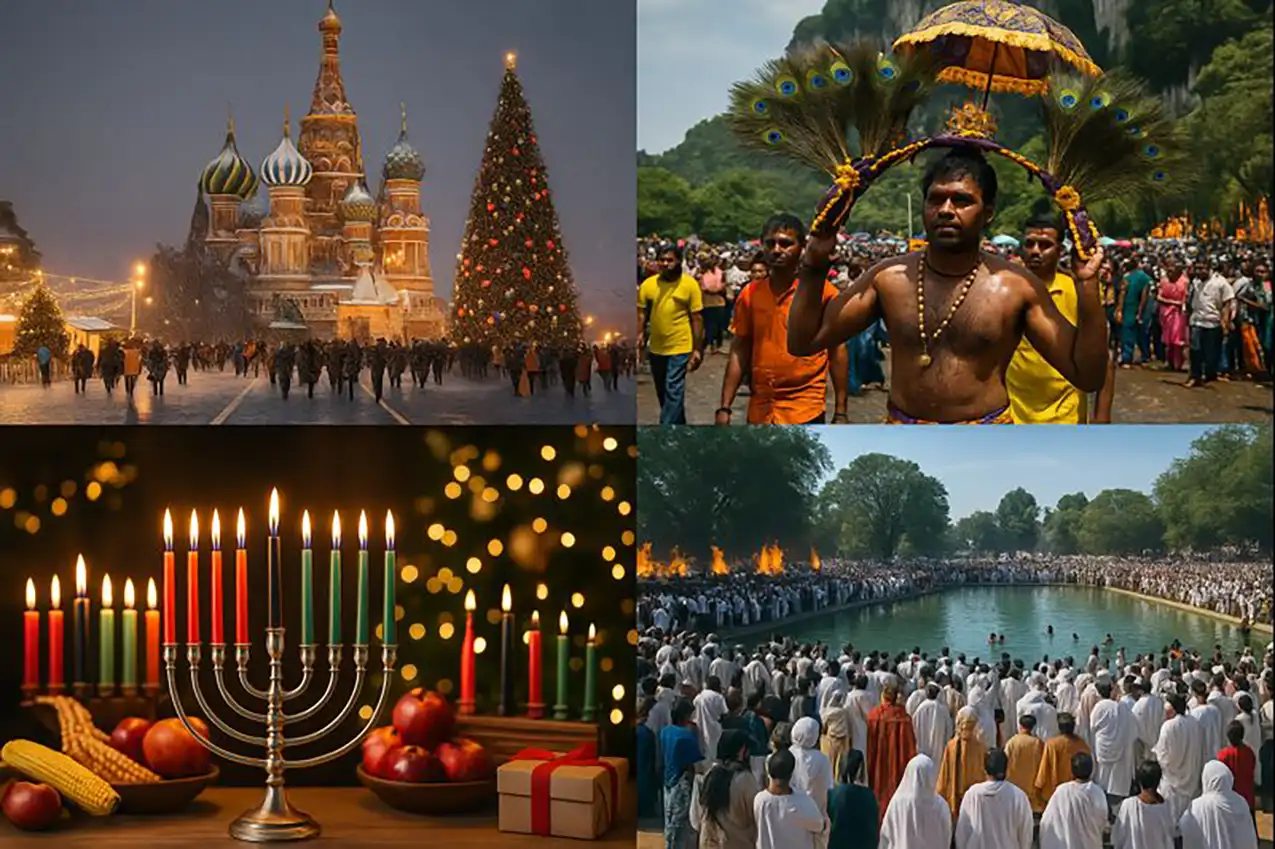

Walk through any Western shopping district in December and you can be forgiven for thinking the season has only one storyline: Christmas, Santa, and a single set of cultural cues exported worldwide. Yet the same weeks that carry Christmas and New Year in the Gregorian calendar also hold solstice feasts, lunar “festival of lights” rituals, Buddhist commemorations of awakening, harvest thanksgivings, and spectacular water-and-fire ceremonies—some religious, some cultural, many both.
The overlap isn’t an accident. Late December sits near the winter solstice in the Northern Hemisphere, a moment that has long invited human societies to mark darkness, survival, and the promise of returning light. Meanwhile, many communities don’t anchor their sacred calendars to the Gregorian year at all: some follow solar calendars (tied to the sun’s seasonal cycle), others follow lunar calendars (tied to the moon’s phases), and many use lunisolar calendars (a hybrid that keeps months lunar while periodically adjusting to stay aligned with seasons). The result is a global “holiday belt” that often runs across December and January—but never means the same thing everywhere.¹⁴
Below is a field guide to some of the major observances that commonly fall in this window—including but beyond Christianity—with notes on timing (solar/lunar/lunisolar), purpose, traditions, and where communities gather.
A quick guide to the season (evergreen date windows)
Fixed or near-fixed (solar / solstice / civic calendar)
- Christmas (many Christians): Dec 25 (Gregorian solar date) — Nativity of Jesus.²
- Yule (Neo-Pagan / Wiccan / Germanic-rooted): Dec 21–22 (winter solstice in the Northern Hemisphere) — solstice rites, candles, evergreen decor.³
- Dongzhi (China; also across East Asia): Dec 21–23 (solstice period) — family gathering; foods such as tangyuan (rice balls).⁴
- Yalda / Shab-e Yalda (Iranian cultural tradition with ancient roots): winter solstice — staying up through the longest night with poetry and symbolic foods like pomegranates.⁵
- Kwanzaa (African-American cultural holiday): Dec 26–Jan 1 — seven principles (Nguzo Saba), kinara candles, community feast (karamu).⁶
- Shōgatsu (Japan): Jan 1–3 — New Year observances, including shrine/temple visits (hatsumōde).⁷
Moveable (lunar or lunisolar calendars)
- Hanukkah (Judaism): begins 25 Kislev (Hebrew lunisolar calendar; late Nov–late Dec in Gregorian years) — eight nights of lights.⁸
- Bodhi Day / Rōhatsu (many Mahayana/Zen communities, widely observed on Dec 8): Dec 8 (common fixed-date observance) — Buddha’s awakening; meditation and practice.⁹
- Laba Festival (China; 8th day of 12th lunar month): usually early January (varies) — laba congee; end-of-year and Buddhist associations in some traditions.¹⁰
- Spring Festival / Lunar New Year (Chinese lunisolar; also related traditions across East Asia): Jan 21–Feb 20 window — family reunion meals, offerings, public festivities.¹¹
- Thaipusam (Tamil Hindu festival): Jan–Feb (full moon tied to Tamil month Thai) — pilgrimages and vows, notably in the Tamil diaspora (e.g., Malaysia, Singapore).¹²
Also in January (often fixed by church calendar or tied to Julian vs Gregorian)
- Epiphany / Theophany (Christianity): typically Jan 6 (many Western/Eastern churches) — Magi in some traditions; Baptism of Jesus and blessing of waters in others.¹³
- Orthodox Christmas (some Eastern Orthodox churches using the Julian calendar): Jan 7 (Gregorian equivalent of Dec 25 Julian).¹⁴
- Timkat / Ethiopian Epiphany (Ethiopian Orthodox): Jan 19 (Jan 20 in leap years) — major baptismal commemoration with processions and water blessings.¹⁵
- Sadeh (Iranian/Zoroastrian-rooted festival): late Jan / early Feb (often described as ~50 days before Nowruz) — communal fire celebration.¹⁶
The holidays in context: what they are, and what people do
1) Christianity’s many “Christmas seasons”
In much of the world, “Christmas” is treated as a single day—December 25—but Christianity itself contains multiple calendars and arcs of celebration.
- Christmas Day (Dec 25): marks the Nativity of Jesus in most Western Christian churches.²
- Orthodox Christmas (Jan 7 for some churches): Many Eastern Orthodox churches still reckon liturgical dates using the older Julian calendar, which currently sits 13 days behind the Gregorian calendar—so “Dec 25” becomes Jan 7 on civil calendars.¹⁴
- Epiphany / Theophany (Jan 6, and sometimes Jan 19): In parts of Western Christianity, Epiphany spotlights the visit of the Magi; in much of Eastern Christianity it emphasizes the baptism of Jesus, often with a blessing of waters and, in some places, public cross-dives.¹³
The important point for a “Christmas-only” worldview is that even within Christianity, the December–January window is not a single uniform event—it’s a cluster of calendars, theologies, and regional customs.¹³¹⁴
2) Hanukkah: light as memory and resistance
Hanukkah is a Jewish festival that begins on the 25th of Kislev in the Hebrew lunisolar calendar, meaning its Gregorian start date can range from late November to late December.⁸
Its central ritual is the nightly lighting of a hanukkiah (a nine-branched lamp), adding one light each night across eight nights—an image that resonates with the season’s darkness without sharing Christmas’s theology. Food traditions often feature oil (think latkes), echoing the story of the Temple lamp’s endurance.⁸
And crucially, Hanukkah’s modern visibility in some countries is partly a by-product of proximity: when it overlaps with Christmas, it becomes more publicly legible in multicultural cities—sometimes misunderstood as “Jewish Christmas,” though it’s not.⁸
3) Buddhist awakenings: Bodhi Day, Rōhatsu, and (in China) Laba
Many Buddhists mark the Buddha’s awakening in early December, often observed on December 8 in numerous Mahayana and Zen contexts.⁹ In Japanese Zen, the observance is commonly called Rōhatsu, with intensive meditation practice in some communities.⁹
In China, the season also includes Laba—the eighth day of the twelfth lunar month—which frequently lands in early January and is widely associated with eating laba congee (a mixed-grain porridge).¹⁰ Laba can carry layered meanings: end-of-year seasonal rites, and—through Buddhist influence—associations with awakening narratives in some traditions.¹⁰
This is a useful corrective to the Santa monoculture: for many Buddhists, the point of the season is not gift exchange, but practice—reflection, meditation, ethical intention—sometimes described in the simplest possible terms: wake up.⁹¹⁰
4) Solstice season: Dongzhi, Yule, and Yalda
Long before December became “holiday season,” it was “solstice season”—and multiple cultures still center the turning of the sun.
- Dongzhi (Dec 21–23): In China, Dongzhi is a major winter observance tied to the solstice period, commonly framed around family reunion and seasonal foods (including tangyuan, glutinous rice balls).⁴
- Yule (Dec 21–22 in the Northern Hemisphere): A winter festival historically observed by Germanic peoples and widely adopted in modern Neo-Pagan traditions; it explicitly marks the solstice and the symbolic return of light.³
- Yalda / Shab-e Yalda (solstice night): A Persian/Iranian solstice celebration centered on the longest night, often kept with gatherings, storytelling and poetry, and symbolic red foods such as pomegranates.⁵
These holidays don’t share doctrine, but they share a recognizable human grammar: darkness, endurance, community, and a wager on dawn.³⁴⁵
5) New Year as ritual reset: Japan’s Shōgatsu and East Asia’s Spring Festival
In Japan, Shōgatsu is a public holiday observed on January 1–3 (and sometimes longer in practice), anchored to the civic calendar but infused with religious texture—especially the custom of hatsumōde, the first shrine/temple visit of the year.⁷
Across the Chinese cultural sphere, the New Year is often not January 1 at all, but the Spring Festival / Lunar New Year, beginning on the first day of the traditional lunisolar calendar—falling somewhere between Jan 21 and Feb 20.¹¹ UNESCO’s description highlights family reunion meals on New Year’s Eve, offerings to ancestors, greetings exchanged across communities, and large public festivities.¹¹
For readers who assume “New Year = fireworks + hangover,” these traditions underline something older: New Year as social repair—a recommitment to kinship, elders, memory, and good fortune.⁷¹¹
6) January festivals of water and fire: Timkat and Sadeh
If Christmas has become visually dominated by snowflakes and tinsel, other January observances lean into elemental spectacle.
- Timkat (Jan 19; Jan 20 in leap years): Ethiopian Epiphany is celebrated across Ethiopia with processions and a major focus on water blessing and the commemoration of Jesus’ baptism.¹⁵
- Sadeh (late January/early February): An ancient Iranian festival often described as a fire celebration, with communal flames symbolizing warmth, protection, and the pushback of winter.¹⁶
These rites remind us that the season’s “light” theme isn’t only metaphorical. Sometimes it is literally fire and water, carried into public space.¹⁵¹⁶
7) Tamil Hindu devotion and harvest: Thaipusam and Pongal
January in South Asia and the Tamil diaspora is rich with major observances that are often invisible in Christmas-centric media.
- Pongal (mid-January, often 14–15; multi-day): A Tamil harvest festival celebrated over several days (including Bhogi, Thai Pongal, Mattu Pongal, and sometimes Kaanum Pongal), with the ceremonial cooking of pongal and, in some traditions, honoring cattle for their role in agrarian life.¹⁷
- Thaipusam (Jan–Feb, full moon): A Tamil Hindu festival tied to the full moon of the Tamil month Thai, marked in many communities by vows, pilgrimages, and the carrying of kavadi as an act of devotion—famously in Malaysia (including the Batu Caves area near Kuala Lumpur) and other diaspora hubs.¹²¹⁸
This isn’t “Santa season.” It’s an ecosystem of gratitude, discipline, and community identity—often expressed through movement (processions), food, and public devotion.¹⁷¹⁸
8) Kwanzaa: a cultural holiday built to widen the story
Kwanzaa runs Dec 26–Jan 1 and was created in 1966 as a cultural celebration of African heritage and community values in the United States and broader African diaspora. Its structure is explicit: seven days, seven principles (Nguzo Saba), seven candles on the kinara, and often a communal feast (karamu).⁶
In a season where “holiday spirit” can be reduced to shopping, Kwanzaa’s design is a reminder that some holidays are intentionally built to emphasize collective responsibility, purpose, creativity, and faith—without being Christian, and without needing Santa as a mascot.⁶
What this changes about “Christmas season”
To see December–January as “purely Christian” is, at best, to mistake one calendar for the world. In reality, this window is a crossroads: solar rites around the solstice; lunisolar festivals that drift year to year; New Year rituals anchored in community; and religious commemorations that follow their own clocks.
For anyone trying to host, teach, report, or simply live more accurately in a plural world, the practical takeaway is simple: ask what calendar you’re in before you assume what the date “means.”
You might be interested in The Hollow Manger: The Christmas Myth and the Crisis of Connection – KJP
Endnotes (sources)
- Encyclopaedia Britannica, “Yule.” Encyclopedia Britannica
- (Context on calendar differences around Orthodox Christmas) SBS News explainer on Julian vs Gregorian dating for Christmas. SBS Australia
- Encyclopaedia Britannica, “Yule” (timing at winter solstice; modern Neo-Pagan observance). Encyclopedia Britannica
- Encyclopaedia Britannica, “Dong Zhi,” in “7 Winter Solstice Celebrations.” Encyclopedia Britannica
- Encyclopaedia Britannica, “Yalda,” in “7 Winter Solstice Celebrations.” Encyclopedia Britannica
- Encyclopaedia Britannica, “Kwanzaa” (dates; seven principles; kinara; karamu). Encyclopedia Britannica+1
- Encyclopaedia Britannica, “Shōgatsu” (Jan 1–3). Encyclopedia Britannica
- Associated Press explainer on Hanukkah (25 Kislev; eight nights; oil story; date variability). AP News
- KPBS explainer on Bodhi Day (Dec 8; commemoration of Buddha’s awakening). KPBS
- UNESCO Intangible Cultural Heritage listing for Spring Festival (social practices; reunion; offerings; greetings; public festivities). Intangible Cultural Heritage – UNESCO+1
- Wikipedia overview of Chinese New Year date window (new moon between Jan 21 and Feb 20). Wikipedia
- Overview of Thaipusam timing and core practice (full moon tied to Tamil month Thai; kavadi). Wikipedia+1
- AP explainer on Epiphany/Theophany and water-blessing traditions. AP News+1
- AP explainer on Orthodox Christmas dating (Julian vs Gregorian; Jan 7). AP News
- UNESCO Intangible Cultural Heritage entry on Ethiopian Epiphany (Timkat) and its commemoration of baptism with events beginning Jan 18. Intangible Cultural Heritage – UNESCO
- UNESCO Intangible Cultural Heritage entry on Sadeh (fire celebration; Iranian tradition). Intangible Cultural Heritage – UNESCO+1
- Pongal overview (multi-day harvest festival; typical mid-January timing; practices). Wikipedia+1
- Batu Caves as focal point for Thaipusam in Malaysia (location and association with the festival).