
When Revolutionary Observation Transforms Pedagogy
In January 1907, something extraordinary unfolded in Rome’s impoverished San Lorenzo district—a physician’s experimental classroom for sixty slum children would revolutionize global education. Within months, these economically disadvantaged five-year-olds were reading, writing, and demonstrating sustained concentration that drew international visitors. By 2022, this single Casa dei Bambini had spawned 15,763 schools across 154 countries, with contemporary meta-analyses demonstrating students achieve 0.24 standard deviation improvement in academic outcomes—equivalent to being one full year ahead by sixth grade.¹
The transformation from medical observation to educational revolution began with Maria Montessori, Italy’s first female physician, whose work with children deemed “uneducable” at Rome’s Orthophrenic School revealed profound insights about natural learning. Her reflection proved prescient: “While everyone was admiring the progress of my idiots, I was searching for the reasons which could keep the happy, healthy children of the common schools on so low a plane.”² This observation would catalyze an educational movement that continues challenging traditional pedagogy over a century later.
Context Setting: Beyond Traditional Schooling
As educational systems globally grapple with preparing children for rapidly changing futures, Montessori education offers a radically different approach grounded in empirical observation rather than theoretical speculation. Building on developmental psychology’s insights while anticipating neuroscience discoveries by decades, the method emphasizes child-led learning within carefully prepared environments that honor natural development.³
This essay examines Montessori education through critical lenses: its historical evolution from early twentieth-century Rome to contemporary global expansion, philosophical foundations emphasizing developmental appropriateness, current implementation revealing both growth and persistent challenges, empirical validation through educational research and neuroscience, and ongoing controversies surrounding accessibility, standardization, and cultural adaptation.
Defining the Territory: What Is Montessori Education?
Montessori education represents a comprehensive pedagogical system based on scientific observation of children’s natural learning processes. Rather than adult-imposed curricula, the method follows children’s intrinsic motivation through self-directed activity, hands-on learning, and collaborative play.⁴ Key distinguishing features include mixed-age classrooms spanning three years, student choice of activity from prescribed options, uninterrupted three-hour work periods, and specialized educational materials designed for self-correction.⁵
The approach fundamentally reframes the teacher’s role from instructor to “guide” or “directress,” observing children to discern their interests and developmental readiness before introducing appropriate materials.⁶ This shift from teaching to facilitating learning reflects Montessori’s conviction that “the greatest sign of success for a teacher is to be able to say, ‘The children are now working as if I did not exist.'”⁷
Historical Foundations: From Medical Observation to Global Movement
The Physician Who Revolutionized Education
Maria Montessori’s journey began with barrier-breaking determination. Born in 1870 in Chiaravalle, Italy, she overcame substantial opposition to become one of Italy’s first female physicians in 1896.⁸ Her initial work at the University of Rome’s psychiatric clinic brought her into contact with children with intellectual disabilities, confined in asylums alongside adults. Observing these children desperately searching for sensory stimulation—grabbing crumbs from the floor—Montessori recognized their behavior revealed not deficiency but developmental need.⁹
From 1898 to 1901, Montessori directed the Orthophrenic School, adapting materials from physicians Jean-Marc-Gaspard Itard and Édouard Séguin.¹⁰ Her students’ remarkable progress—many passing state examinations alongside typically developing peers—led to her revolutionary insight about mainstream education’s failures. This success prompted two years of additional study in anthropology and educational philosophy, preparing for her true life’s work.¹¹
Casa dei Bambini: The Children’s House Revolution
The opportunity emerged through Rome’s urban renewal efforts. The Instituto Romano di Beni Stabili sought to address vandalism in San Lorenzo’s tenement buildings by providing daytime supervision for preschool children while parents worked.¹² On January 6, 1907, Montessori opened the first Casa dei Bambini with fifty to sixty children ages two to seven, furnished with child-sized furniture—itself a radical innovation.¹³
Within this “laboratory” setting, Montessori discovered phenomena that would define her method. Children demonstrated unexpected capacity for concentration, repeatedly choosing challenging activities over toys. They showed preference for order, real work over fantasy play, and ability to teach themselves and younger peers.¹⁴ Most remarkably, behavioral problems disappeared as children engaged with purposeful activity, a transformation Montessori termed “normalization.”¹⁵
International Expansion and Initial Resistance
Word of the Casa dei Bambini’s success spread rapidly. By 1909, Swiss educator Hermann Baur established the first Montessori school outside Italy.¹⁶ The 1912 English translation of “Il Metodo della Pedagogia Scientifica” (The Montessori Method) became an instant bestseller, with American editions selling out repeatedly.¹⁷ Notable supporters included Alexander Graham Bell, who founded the Montessori Educational Association with Margaret Wilson (President Woodrow Wilson’s daughter) as secretary.¹⁸
However, the American movement faced devastating criticism from William Heard Kilpatrick, Columbia Teachers College’s influential professor. His 1914 book “The Montessori System Examined” dismissed Montessori’s theoretical contributions as “fifty years behind present-day psychological thought,” effectively ending the first American Montessori movement.¹⁹ Kilpatrick’s critique aligned American progressives against Montessori, viewing her structured materials as constraining creativity—a fundamental misunderstanding of the method’s balance between freedom and structure.²⁰
War, Exile, and Evolution
The interwar period brought complex challenges and unexpected developments. Initially embraced by Mussolini’s government, which established the Opera Nazionale Montessori in 1924, Montessori accepted support pragmatically while maintaining pedagogical independence.²¹ By 1934, conflicts over fascist demands to militarize her peace-centered curriculum led to her schools’ closure and Montessori’s exile. Nazi Germany had already banned her methods in 1933, viewing child-centered education as incompatible with authoritarian control.²²
Montessori’s forced residence in India from 1939 to 1946—initially attending a conference when World War II erupted—proved transformative.²³ Working with Indian educators, she developed the Cosmic Education curriculum for elementary students, emphasizing interconnectedness of knowledge and humanity’s role in cosmic evolution. She trained over 1,000 Indian teachers during this period, establishing foundations for the movement’s significant Asian presence.²⁴
The American Revival and Institutional Schism
Nancy McCormick Rambusch catalyzed Montessori’s American revival after encountering the method in Paris. Training at the London Montessori Centre, she returned to establish Whitby School in Greenwich, Connecticut in 1958.²⁵ Recognizing American educational contexts differed from European settings, Rambusch advocated for cultural adaptation and flexibility that brought her into conflict with Association Montessori Internationale (AMI), founded by Maria Montessori in 1929 to preserve method authenticity.²⁶
The 1960 founding of the American Montessori Society (AMS) under Rambusch’s leadership created an irreparable institutional split.²⁷ While AMI maintained strict adherence to Montessori’s original methods and materials, AMS permitted innovations including technology integration, supplementary materials, and credentialed teachers without Montessori training. This division persists today, generating ongoing debates about authenticity versus adaptation.²⁸
Philosophical Foundations: The Science of Child Development
The Absorbent Mind and Sensitive Periods
Montessori’s observations revealed children possess an “absorbent mind” from birth to age six, unconsciously soaking up environmental information like sponges.²⁹ This capacity operates in two phases: unconscious absorption (0-3 years) where children absorb impressions without awareness, and conscious absorption (3-6 years) where deliberate exploration predominates.³⁰
Within this framework, Montessori identified “sensitive periods”—windows of intense receptivity to specific learning.³¹ These include:
- Language acquisition (birth to 6 years): From absorbing sounds to complex grammar
- Order (18 months to 3 years): Intense need for routine and predictability
- Sensory refinement (birth to 5 years): Discrimination of sensory stimuli
- Movement coordination (18 months to 4 years): Gross and fine motor development
- Social behavior (2.5 to 6 years): Understanding courtesy and grace
- Small objects (18 months to 3 years): Attention to minute details
Missing these windows doesn’t prevent later learning but requires significantly more effort—a principle now validated by neuroscience research on critical periods.³²
The Four Planes of Development
Montessori conceptualized development through four six-year planes, each with distinct characteristics requiring different educational approaches:³³
First Plane (0-6 years): The Absorbent Mind Children unconsciously absorb environmental impressions, constructing personality foundations. Education emphasizes sensorial exploration, practical life skills, and concrete learning through manipulative materials.³⁴
Second Plane (6-12 years): The Reasoning Mind Children develop abstract thinking, moral reasoning, and intense interest in culture and justice. Cosmic Education introduces interconnected knowledge through five Great Lessons spanning universe creation to human civilization.³⁵
Third Plane (12-18 years): The Social Mind Adolescents focus on identity formation, social belonging, and economic independence. Montessori advocated for “Erdkinder” (earth children) farm schools providing real work experiences, though few exist today.³⁶
Fourth Plane (18-24 years): The Specialist Mind Young adults pursue specialized knowledge and establish their societal role. Though Montessori wrote less about this plane, she emphasized university students’ need for economic independence and practical application.³⁷
The Prepared Environment and Materials
The prepared environment represents Montessori’s most visible innovation—carefully designed spaces enabling independent learning.³⁸ Key principles include:
- Accessibility: Child-sized furniture and materials within reach
- Order: Consistent placement supporting orientation and security
- Beauty: Aesthetic appeal inviting engagement
- Reality-based: Real tools and breakable materials teaching care
- Limited choices: Sufficient options without overwhelming
- Mixed ages: Three-year spans enabling peer teaching
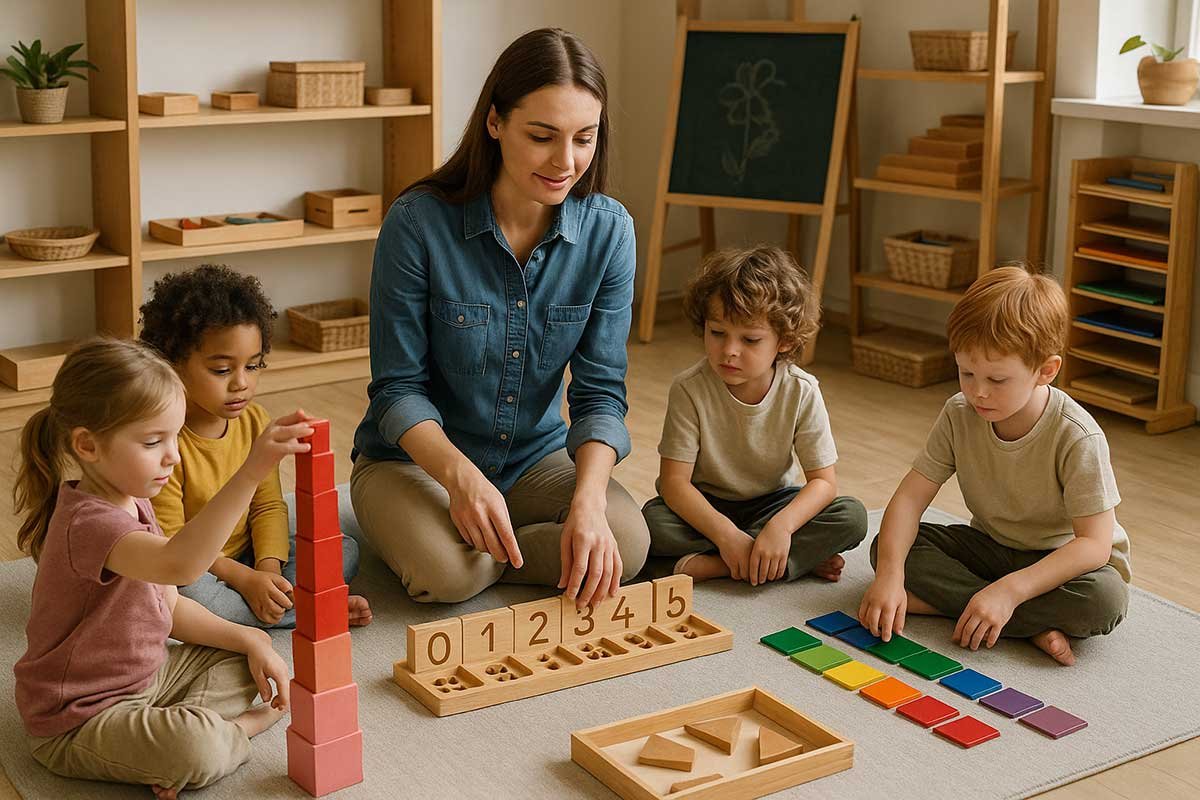
Montessori materials embody sophisticated pedagogical principles. Each material isolates a single concept, includes self-correction mechanisms, progresses from concrete to abstract, and appeals aesthetically.³⁹ The iconic pink tower, for instance, develops visual discrimination of dimension, mathematical concepts of cubing, and motor control—all through child-directed manipulation.⁴⁰
The Teacher as Guide
Montessori fundamentally reconceptualized the teacher’s role from instructor to observer and facilitator.⁴¹ Rather than delivering group lessons, guides observe individual children to discern readiness, present materials through precise demonstrations, then withdraw to allow independent exploration. This requires extensive training—typically 200-300 hours of instruction plus supervised practice.⁴²
The guide maintains detailed observations documenting each child’s progress, interests, and challenges. These observations inform decisions about introducing new materials, suggesting activities, and facilitating social connections.⁴³ As Montessori emphasized, the teacher must “follow the child,” respecting individual developmental timelines rather than imposing arbitrary schedules.⁴⁴
Peace Education and Global Citizenship
Montessori’s experiences with two world wars profoundly shaped her educational philosophy. She argued “preventing conflicts is the work of politics; establishing peace is the work of education.”⁴⁵ This commitment led to three Nobel Peace Prize nominations between 1949 and 1951.⁴⁶
Peace education permeates Montessori classrooms through:
- Grace and courtesy lessons teaching respectful interaction
- Conflict resolution practices emphasizing communication over punishment
- Cultural studies promoting global understanding
- Environmental stewardship connecting human and natural systems
- Community service developing social responsibility
Contemporary research confirms these practices’ effectiveness, with Montessori students demonstrating superior social skills and reduced aggression compared to traditional school peers.⁴⁷
Contemporary Implementation: Scale and Challenges
Global Reach and Distribution
The 2022 Global Montessori Census documented 15,763 schools across 154 countries, representing substantial global reach though unevenly distributed.⁴⁸ The United States leads with approximately 3,500 schools, followed by India, China, and European nations. However, accessibility remains problematic—over 90% of programs operate as private institutions with annual tuition ranging from $12,000 to $35,000 depending on location.⁴⁹
Public Montessori has grown significantly, with over 590 programs serving approximately 150,000 students across the United States.⁵⁰ These programs predominantly operate as magnet schools (40%) or charter schools (35%), with traditional district schools comprising 25%. Public programs serve more diverse populations, yet challenges persist regarding equitable access and authentic implementation.⁵¹
Institutional Complexity and Accreditation
The historical AMI-AMS split created lasting institutional complexity. Association Montessori Internationale maintains strict fidelity to Maria Montessori’s original methods, operating training centers globally without requiring membership fees.⁵² The American Montessori Society represents 1,300 schools with over 20,000 members, permitting greater flexibility and cultural adaptation.⁵³
The Montessori Accreditation Council for Teacher Education (MACTE) serves as the U.S. Department of Education’s recognized accreditor for teacher preparation programs, attempting to bridge philosophical divides through common standards.⁵⁴ However, without trademark protection, any school can claim the Montessori name regardless of implementation quality, creating consumer confusion and quality control challenges.⁵⁵
Teacher Preparation and Workforce Challenges
Montessori teacher preparation requires substantial investment—training costs range from $2,200 to $3,200 with programs lasting several months to two years.⁵⁶ The field employs approximately 967,798 teachers in the United States, with concerning demographic patterns: 91.9% women, 69.5% white, raising questions about diversity and representation.⁵⁷
Only eight states recognize Montessori credentials for teaching licensure, forcing many public school teachers to maintain dual certifications.⁵⁸ This creates barriers to entry and contributes to teacher shortages, particularly in public programs serving diverse communities. Limited professional development opportunities and mentorship programs further compromise sustained implementation quality.⁵⁹
Student Demographics and Equity Concerns
While public Montessori programs serve majority students of color, significant equity challenges persist.⁶⁰ Charter Montessori schools remain whiter and serve fewer low-income students than district programs. Yale researcher Mira Debs documented “prestige charter” phenomena where public Montessori schools maintain selective enrollment despite public funding.⁶¹
Enrollment methods contribute to segregation patterns:
- Lottery systems (52% of schools) can disadvantage families lacking enrollment knowledge
- First-come-first-served (23%) favors families with time and resources to navigate systems
- Sibling preferences perpetuate existing demographic patterns
- Transportation availability correlates with racial composition
These patterns contradict Montessori’s origins serving Rome’s most disadvantaged children.⁶²
Scientific Evidence: What Research Reveals
Meta-Analytic Evidence of Effectiveness
Randolph et al.’s 2023 Campbell Systematic Review represents the most comprehensive analysis to date, synthesizing 32 high-quality studies across 132,249 data points.⁶³ Key findings include:
- Academic outcomes: Composite effect size of 0.24 standard deviations
- Mathematics: Effect size of 0.22 (equivalent to 8.5 percentile points)
- Language: Effect size of 0.17 (equivalent to 6.7 percentile points)
- Non-academic outcomes: Effect size of 0.33 (executive function, creativity, social skills)
These effects translate to Montessori students being approximately one full academic year ahead by sixth grade—significant given that many educational interventions show negligible long-term impacts.⁶⁴
Randomized Lottery Studies
Dr. Angeline Lillard’s research at the University of Virginia provides crucial evidence through randomized lottery studies eliminating selection bias.⁶⁵ Her 2017 study found Montessori preschool “elevates and equalizes child outcomes” with remarkable equity implications:
- Socioeconomic achievement gaps became statistically insignificant
- Low-income children showed particular benefits in executive function
- 40% of Montessori students found schoolwork intrinsically motivating versus 24% in traditional settings
- Academic advantages persisted through elementary school
Lillard’s current $3.3 million Institute of Education Sciences grant examines 600 children across nine states to determine optimal implementation conditions.⁶⁶
Neuroscience Validation
Contemporary neuroscience research validates many of Montessori’s empirical observations.⁶⁷ Brain imaging studies by Denervaud et al. (2020) reveal:
- Greater functional brain network integration in Montessori students
- Enhanced connectivity in attention and executive function networks
- More stable and flexible neural system operation
- Increased cortical thickness in areas associated with executive function
Catherine’s 2020 review in Mind, Brain, and Education validated four Montessori pillars through neuroscience: sensitive periods align with critical periods for neural plasticity, sensorial education shapes perceptual neural networks, prepared environments influence brain development through environmental enrichment, and repetition drives neural pathway strengthening.⁶⁸
Implementation Fidelity Matters
Research consistently demonstrates implementation quality determines outcomes.⁶⁹ “Classic” Montessori following authentic principles shows stronger effects than “supplemented” versions incorporating non-Montessori materials. Critical implementation factors include:
- Three-hour uninterrupted work periods
- Full complement of Montessori materials
- Trained guides with low student-teacher ratios
- Mixed-age classrooms with three-year cycles
- Student choice within prepared environment
Public Montessori programs maintaining these elements achieve remarkable equity outcomes, with Black children scoring significantly higher than district peers in both mathematics and English language arts.⁷⁰
Longitudinal Evidence
Long-term studies suggest lasting benefits extending beyond immediate academic gains.⁷¹ Milwaukee’s longitudinal study (1997-2007) found Montessori students maintained advantages after transitioning to traditional high schools, particularly in mathematics and science. French randomized controlled trials with disadvantaged preschoolers showed large reading advantages (d=0.68) persisting through elementary school.⁷²
Studies examining adult outcomes remain limited, though notable alumni spanning technology (Jeff Bezos, Larry Page, Sergey Brin), arts (Beyoncé, Taylor Swift), and public service (Jacqueline Kennedy Onassis) suggest potential long-term benefits.⁷³ However, systematic longitudinal research tracking Montessori students into adulthood remains desperately needed.
Critical Perspectives: Legitimate Concerns and Controversies
Research Methodology Limitations
Despite positive findings, significant methodological concerns persist.⁷⁴ Nature’s 2017 review noted absence of large-scale randomized control trials with most studies involving small samples from single schools. Dutch lottery studies finding no significant differences between Montessori and traditional students suggest implementation quality varies dramatically.⁷⁵
Publication bias likely inflates positive findings—studies showing significant results are three times more likely to reach publication.⁷⁶ Many studies lack proper randomization, adequate blinding, and correction for multiple comparisons. Funding sources often connect to Montessori organizations, raising questions about independence.
Historical Controversies and Contemporary Implications
Maria Montessori’s decade-long relationship with Mussolini’s government (1922-1934) continues generating discussion.⁷⁷ While she ultimately rejected fascist demands and fled Italy, accepting initial support raises questions about pragmatic compromises. University of Gothenburg research suggests the movement has “tried to sweep under the carpet” this complex history.⁷⁸
The persistent AMI-AMS philosophical split creates confusion about authentic Montessori education.⁷⁹ Without trademark protection, schools claiming the Montessori name range from rigorous implementations to barely recognizable adaptations. Parents struggle distinguishing quality programs while teachers navigate conflicting training standards and philosophical approaches.
Accessibility and Diversity Challenges
Despite origins serving disadvantaged children, contemporary Montessori education predominantly serves privileged populations.⁸⁰ With private school tuition exceeding many families’ annual income, economic barriers remain insurmountable for most. Even public programs often locate in affluent neighborhoods with active parent communities capable of fundraising and advocacy.
Families of color express greater concerns about Montessori’s long-term academic rigor and cultural relevance.⁸¹ The overwhelmingly white teaching force raises questions about cultural competence and representation. Limited diversity in leadership positions perpetuates these patterns despite growing awareness and intervention efforts.
Transition Challenges
Students transitioning from Montessori to traditional schools face documented adjustment challenges.⁸² Research identifies difficulties with:
- Rigid schedules versus self-paced learning
- Teacher-directed instruction versus independent exploration
- Homework requirements absent in Montessori
- Standardized testing formats emphasizing speed over depth
- Competitive grading versus intrinsic motivation
Limited Montessori secondary options force most students to transition during adolescence—precisely when consistency might be most beneficial.⁸³
Special Needs Accommodation Debates
While Montessori originally worked with children with disabilities, contemporary programs struggle with inclusion.⁸⁴ Tensions exist between maintaining method integrity and providing necessary modifications. Teacher training inadequately prepares educators for diverse learning needs, while collaboration with special education professionals remains limited. Some argue Montessori’s individualized approach naturally accommodates differences; critics contend insufficient structure harms children requiring explicit instruction.⁸⁵
Technology Integration Resistance
Traditional Montessori philosophy emphasizing concrete, hands-on learning creates tension with digital age requirements.⁸⁶ Many programs prohibit screens before age six and limit technology through elementary school. COVID-19 forced rapid digital adoption, revealing philosophical tensions about appropriate technology use. Critics argue inadequate digital literacy preparation disadvantages students; defenders maintain protecting childhood from premature screen exposure.⁸⁷
Cultural Responsiveness Questions
Montessori materials and curriculum developed within early twentieth-century European contexts raise cultural relevance questions.⁸⁸ The pink tower and golden beads may not resonate across cultures. Geography materials often center European perspectives. Limited representation in peace education stories and cultural materials perpetuates Eurocentrism. Efforts toward culturally sustaining Montessori practices remain nascent despite growing awareness.⁸⁹
Path Forward: Integration and Innovation
Priorities for Advancement
The convergence of neuroscience validation, positive meta-analytic findings, and equity benefits for disadvantaged populations supports continued Montessori expansion. However, realizing this potential requires addressing persistent challenges:
- Conducting rigorous research: Large-scale randomized trials with long-term follow-up
- Improving accessibility: Sustainable public funding models and sliding-scale tuition
- Enhancing diversity: Recruitment, training, and retention of diverse educators
- Supporting transitions: Secondary programs and transition preparation
- Balancing fidelity and flexibility: Cultural responsiveness within Montessori frameworks
- Integrating technology thoughtfully: Age-appropriate digital literacy
- Strengthening teacher preparation: Affordable, accessible, high-quality training
Bridging Philosophical Divides
The AMI-AMS split may be irreparable, but collaboration on shared priorities could advance the movement. Common ground exists around child development principles, peaceful education values, and commitment to following children’s natural learning patterns. Establishing baseline implementation standards while permitting cultural adaptation could protect quality while enabling flexibility.⁹⁰
Implications for Educational Reform
Montessori’s emphasis on intrinsic motivation, collaborative learning, and holistic development offers valuable insights for broader educational reform. Elements successfully integrated into mainstream education include multi-age groupings, project-based learning, social-emotional learning, and student choice. However, piecemeal adoption without understanding underlying philosophy limits effectiveness.⁹¹
Conclusion: Enduring Relevance Amid Contemporary Challenges
Over a century after its inception in a Roman slum, Montessori education demonstrates remarkable vitality and continued evolution. Scientific validation of core principles, documented benefits for diverse learners, and alignment with twenty-first-century skills suggest enduring relevance. Yet persistent challenges regarding accessibility, quality control, and cultural responsiveness require systematic attention.
The method’s greatest contribution may be demonstrating that children, given appropriate environments and respectful guidance, naturally develop into capable, creative, and compassionate individuals. As Maria Montessori observed, “The child is both a hope and a promise for mankind.”⁹² Whether implemented through strict AMI adherence or flexible AMS adaptation, this fundamental respect for children’s inherent potential continues inspiring educators worldwide.
The path forward requires neither uncritical acceptance nor wholesale rejection, but rather thoughtful integration of Montessori insights with contemporary knowledge and diverse cultural wisdom. As educational systems globally confront unprecedented challenges, Montessori’s vision of education as “an aid to life” offers both practical strategies and philosophical inspiration for nurturing human potential across all backgrounds and circumstances.⁹³
Notes
¹ Journal of Montessori Research, “Global Diffusion of Montessori Schools: A Report From the 2022 Global Montessori Census,” Journal of Montessori Research 8, no. 2 (2022): 1-22; Christian W. Randolph et al., “Montessori Education’s Impact on Academic and Nonacademic Outcomes: A Systematic Review,” Campbell Systematic Reviews 19, no. 3 (2023): e1330.
² Maria Montessori, The Montessori Method: Scientific Pedagogy as Applied to Child Education in “The Children’s Houses”, trans. Anne E. George (New York: Frederick A. Stokes Company, 1912), 33.
³ Chloë Marshall, “Montessori Education: A Review of the Evidence Base,” npj Science of Learning 2, no. 11 (2017): 1-9.
⁴ Angeline S. Lillard, Montessori: The Science Behind the Genius, 3rd ed. (New York: Oxford University Press, 2017), 29-47.
⁵ Association Montessori Internationale, “The Montessori Method,” accessed January 2025, https://montessori-ami.org.
⁶ Paula Polk Lillard and Lynn Lillard Jessen, Montessori from the Start: The Child at Home, from Birth to Age Three (New York: Schocken Books, 2003), 15-18.
⁷ Montessori, The Montessori Method, 88.
⁸ Rita Kramer, Maria Montessori: A Biography (Chicago: University of Chicago Press, 1976), 32-51.
⁹ Maria Montessori, The Secret of Childhood, trans. M. Joseph Costelloe (New York: Ballantine Books, 1966), 23-24.
¹⁰ Gerald Lee Gutek, The Montessori Method: The Origins of an Educational Innovation (Lanham, MD: Rowman & Littlefield, 2004), 21-29.
¹¹ E. M. Standing, Maria Montessori: Her Life and Work (New York: Plume, 1998), 28-35.
¹² Montessori Australia, “The First Casa dei Bambini,” accessed January 2025, https://montessori.org.au/first-casa-dei-bambini.
¹³ Kramer, Maria Montessori, 112-115.
¹⁴ Maria Montessori, The Absorbent Mind (New York: Henry Holt, 1995), 76-82.
¹⁵ Maria Montessori, The Discovery of the Child, trans. M. Joseph Costelloe (New York: Ballantine Books, 1967), 184-189.
¹⁶ Hermann Röhrs, “Maria Montessori (1870-1952),” Prospects: The Quarterly Review of Comparative Education 24, no. 1/2 (1994): 169-183.
¹⁷ Nancy McCormick Rambusch, Learning How to Learn: An American Approach to Montessori (Baltimore: Helicon Press, 1962), 18-23.
¹⁸ Dorothy Canfield Fisher, A Montessori Mother (New York: Henry Holt, 1912), 12-15.
¹⁹ William Heard Kilpatrick, The Montessori System Examined (Boston: Houghton Mifflin, 1914), 63-65.
²⁰ J. Chris Seidel, “The Montessori Controversy in Progressive Era America” (PhD diss., University of California, Los Angeles, 2012), 145-178.
²¹ Catherine Read, “Research Sheds Light on Montessori’s Collaboration with Mussolini,” University of Gothenburg News, November 15, 2022.
²² Paola Trabalzini, “Maria Montessori Through the Seasons of the ‘Method’,” The NAMTA Journal 36, no. 2 (2011): 197-211.
²³ Maria Montessori, Education for a New World (Madras: Kalakshetra Publications, 1946), 5-8.
²⁴ Roma Saraswati, “Maria Montessori’s Years in India,” The Hindu, August 31, 2020.
²⁵ Rambusch, Learning How to Learn, 45-52.
²⁶ American Montessori Society, “History of AMS,” accessed January 2025, https://amshq.org/About-Montessori/History-of-Montessori/AMS-History.
²⁷ Keith Whitescarver and Jacqueline Cossentino, “Montessori and the Mainstream: A Century of Reform on the Margins,” Teachers College Record 110, no. 12 (2008): 2571-2600.
²⁸ Mira Debs, Diverse Families, Desirable Schools: Public Montessori in the Era of School Choice (Cambridge, MA: Harvard Education Press, 2019), 23-45.
²⁹ Montessori, The Absorbent Mind, 17-25.
³⁰ Maria Montessori, The Formation of Man, trans. A. M. Joosten (Madras: Theosophical Publishing House, 1955), 89-94.
³¹ Montessori, The Secret of Childhood, 38-45.
³² Takao K. Hensch, “Critical Period Regulation,” Annual Review of Neuroscience 27 (2004): 549-579.
³³ Maria Montessori, The Four Planes of Education (Amsterdam: Association Montessori Internationale, 1971), 1-3.
³⁴ Montessori, The Absorbent Mind, 84-91.
³⁵ Maria Montessori, To Educate the Human Potential (Madras: Kalakshetra Publications, 1948), 14-22.
³⁶ Maria Montessori, From Childhood to Adolescence (New York: Schocken Books, 1973), 97-105.
³⁷ Mario M. Montessori, “The Human Tendencies and Montessori Education,” AMI Communications (1956): 12-15.
³⁸ Maria Montessori, The Child in the Family, trans. Nancy Rockmore Cirillo (Chicago: Henry Regnery, 1970), 55-63.
³⁹ Lillard, Montessori: The Science Behind the Genius, 82-94.
⁴⁰ Gay Wilkinson and Andrew Bryant, “The Pink Tower: Symbol of the Montessori Method,” Montessori Life 25, no. 1 (2013): 32-36.
⁴¹ Montessori, The Discovery of the Child, 163-171.
⁴² Montessori Accreditation Council for Teacher Education, “MACTE Standards,” accessed January 2025, https://www.macte.org.
⁴³ Patricia Orlick, “Observation in Montessori Classrooms,” Montessori Life 21, no. 4 (2009): 38-43.
⁴⁴ Montessori, The Montessori Method, 87.
⁴⁵ Maria Montessori, Education and Peace, trans. Helen R. Lane (Chicago: Henry Regnery, 1972), 27.
⁴⁶ Trabalzini, “Maria Montessori Through the Seasons,” 208.
⁴⁷ Angeline Lillard and Nicole Else-Quest, “Evaluating Montessori Education,” Science 313, no. 5795 (2006): 1893-1894.
⁴⁸ Journal of Montessori Research, “Global Diffusion,” 4-8.
⁴⁹ TrustedCare, “How Much Does Montessori School Cost? (2025),” accessed January 2025, https://trustedcare.com/costs/montessori-schools-cost.
⁵⁰ National Center for Montessori in the Public Sector, “Montessori Census 2022-2023,” accessed January 2025, https://www.public-montessori.org/montessori.
⁵¹ Katie Brown and Andrew Murray, “Race and Class in Montessori Public Schools,” Journal of Montessori Research 4, no. 1 (2018): 1-13.
⁵² Association Montessori Internationale, “About AMI,” accessed January 2025, https://montessori-ami.org.
⁵³ American Montessori Society, “AMS Fact Sheet,” accessed January 2025, https://amshq.org.
⁵⁴ MACTE, “About MACTE,” accessed January 2025, https://www.macte.org/about.
⁵⁵ Debs, Diverse Families, 67-72.
⁵⁶ Montessori Toddler, “How Much Does It Cost To Get Montessori Certified?” accessed January 2025, https://montessoritoddler.com.
⁵⁷ Zippia, “Montessori Teacher Demographics and Statistics,” accessed January 2025, https://www.zippia.com/montessori-teacher-jobs/demographics.
⁵⁸ MontessoriPublic, “Credential Recognition for Montessori Training,” May 1, 2018, https://www.montessoripublic.org.
⁵⁹ Angela Murray and Brooke Petery, “Teacher Perceptions of Training and Support in Public Montessori Schools,” Journal of Montessori Research 5, no. 2 (2019): 1-15.
⁶⁰ Mira Debs, “Racial and Economic Diversity in U.S. Public Montessori Schools,” Journal of Montessori Research 2, no. 2 (2016): 15-34.
⁶¹ Debs, Diverse Families, 89-112.
⁶² Stacy Brown, “Equality in Public Montessori Education,” Trinity College Educational Studies Senior Thesis, 2016.
⁶³ Randolph et al., “Montessori Education’s Impact,” e1330.
⁶⁴ John Hattie, Visible Learning: A Synthesis of Over 800 Meta-Analyses Relating to Achievement (London: Routledge, 2009), 18-23.
⁶⁵ Angeline S. Lillard et al., “Montessori Preschool Elevates and Equalizes Child Outcomes: A Longitudinal Study,” Frontiers in Psychology 8 (2017): 1783.
⁶⁶ Institute of Education Sciences, “$3.3 Million Grant Awarded to Study Montessori Education,” U.S. Department of Education, 2023.
⁶⁷ Solange Denervaud et al., “Education Shapes the Structure of Semantic Memory and Impacts Creative Thinking,” npj Science of Learning 5, no. 14 (2020): 1-7.
⁶⁸ Catherine L’Ecuyer, “Four Pillars of the Montessori Method and Their Support by Current Neuroscience,” Mind, Brain, and Education 14, no. 4 (2020): 322-334.
⁶⁹ Lillard, Montessori: The Science Behind the Genius, 325-351.
⁷⁰ Brooke Day, “Montessori Charter School Outcomes,” Public School Forum of North Carolina, 2022.
⁷¹ Kevin Rathunde, “Montessori Education and Optimal Experience: A Framework for New Research,” The NAMTA Journal 26, no. 1 (2001): 11-43.
⁷² Philippine Courtier et al., “Effects of Montessori Education on the Academic, Cognitive, and Social Development of Disadvantaged Preschoolers: A Randomized Controlled Study in the French Public-School System,” Child Development 92, no. 5 (2021): 2069-2088.
⁷³ Fort Collins Montessori School, “Notable Montessorians,” accessed January 2025, https://www.focomontessori.org.
⁷⁴ Marshall, “Montessori Education: A Review,” 6-8.
⁷⁵ Jaap de Brouwer, “The Effects of Montessori Education: Evidence from Admission Lotteries,” Economics of Education Review 61 (2017): 19-34.
⁷⁶ Annie Franco et al., “Publication Bias in the Social Sciences: Unlocking the File Drawer,” Science 345, no. 6203 (2014): 1502-1505.
⁷⁷ Read, “Research Sheds Light.”
⁷⁸ Catherine Read, The Montessori Method and Mussolini: Italy’s Political Exploitation of Montessori Education (Gothenburg: University of Gothenburg Press, 2022), 234-267.
⁷⁹ Jacqueline Cossentino, “Whiteness in Montessori: A Critical Race Theory Analysis” (paper presented at American Educational Research Association, San Francisco, April 2020).
⁸⁰ Debs, Diverse Families, 134-156.
⁸¹ Angela Murray, “Parent Perceptions of Montessori Education: A Mixed-Methods Study,” Journal of School Choice 6, no. 4 (2012): 568-587.
⁸² AIM Montessori Teacher Training, “FAQ: How Will My Child Adjust to Traditional School After Being in Montessori School?” accessed January 2025, https://aimmontessoriteachertraining.org.
⁸³ Betsy Coe, “Montessori Secondary Education: Present Status and Future Prospects,” The NAMTA Journal 44, no. 2 (2019): 67-82.
⁸⁴ American Montessori Society, “Montessori for Children with Disabilities and Neurodivergences,” accessed January 2025, https://amshq.org.
⁸⁵ Marie Eichwald and Carol Scheffner, “Inclusion in Montessori: Theory Into Practice,” Montessori Life 31, no. 2 (2019): 40-45.
⁸⁶ Forest Bluff School, “Screen Time and Your Child’s Development: A Montessori Perspective,” accessed January 2025, https://forestbluffschool.org.
⁸⁷ Philip Stoops, “Montessori Education in a Time of Physical Distancing,” International Montessori Council, 2020.
⁸⁸ Teresa Phelps, “Culturally Responsive Montessori,” Public Montessori in Action 4, no. 1 (2022): 12-18.
⁸⁹ Aline Wolf, “A Parents’ Guide to the Montessori Classroom,” Parent Child Press, 2019, 45-52.
⁹⁰ Keith Whitescarver, “Montessori in the United States: Historical Context and Contemporary Challenges,” in The Bloomsbury Handbook of Montessori Education, ed. Angela Murray et al. (London: Bloomsbury, 2023), 234-251.
⁹¹ William Damon, “The Montessori Difference: What the Research Says About Montessori,” Tomorrow’s Child 22, no. 1 (2014): 5-7.
⁹² Maria Montessori, The Child, Society and the World: Unpublished Speeches and Writings (Oxford: Clio Press, 1989), 98.
⁹³ Montessori, Education and Peace, 98.
Bibliography
AIM Montessori Teacher Training. “FAQ: How Will My Child Adjust to Traditional School After Being in Montessori School?” Accessed January 2025. https://aimmontessoriteachertraining.org.
American Montessori Society. “AMS Fact Sheet.” Accessed January 2025. https://amshq.org.
———. “History of AMS.” Accessed January 2025. https://amshq.org/About-Montessori/History-of-Montessori/AMS-History.
———. “Montessori for Children with Disabilities and Neurodivergences.” Accessed January 2025. https://amshq.org.
Association Montessori Internationale. “About AMI.” Accessed January 2025. https://montessori-ami.org.
———. “The Montessori Method.” Accessed January 2025. https://montessori-ami.org.
Brown, Katie, and Andrew Murray. “Race and Class in Montessori Public Schools.” Journal of Montessori Research 4, no. 1 (2018): 1-13.
Brown, Stacy. “Equality in Public Montessori Education.” Trinity College Educational Studies Senior Thesis, 2016.
Catherine L’Ecuyer. “Four Pillars of the Montessori Method and Their Support by Current Neuroscience.” Mind, Brain, and Education 14, no. 4 (2020): 322-334.
Coe, Betsy. “Montessori Secondary Education: Present Status and Future Prospects.” The NAMTA Journal 44, no. 2 (2019): 67-82.
Cossentino, Jacqueline. “Whiteness in Montessori: A Critical Race Theory Analysis.” Paper presented at American Educational Research Association, San Francisco, April 2020.
Courtier, Philippine, Marie-Line Gardes, Jean-Baptiste Van der Henst, Ira A. Noveck, Marie-Caroline Croset, Justine Epinat-Duclos, Jessica Léone, and Jérôme Prado. “Effects of Montessori Education on the Academic, Cognitive, and Social Development of Disadvantaged Preschoolers: A Randomized Controlled Study in the French Public-School System.” Child Development 92, no. 5 (2021): 2069-2088.
Damon, William. “The Montessori Difference: What the Research Says About Montessori.” Tomorrow’s Child 22, no. 1 (2014): 5-7.
Day, Brooke. “Montessori Charter School Outcomes.” Public School Forum of North Carolina, 2022.
de Brouwer, Jaap. “The Effects of Montessori Education: Evidence from Admission Lotteries.” Economics of Education Review 61 (2017): 19-34.
Debs, Mira. Diverse Families, Desirable Schools: Public Montessori in the Era of School Choice. Cambridge, MA: Harvard Education Press, 2019.
———. “Racial and Economic Diversity in U.S. Public Montessori Schools.” Journal of Montessori Research 2, no. 2 (2016): 15-34.
Denervaud, Solange, Hiroko Mori, Mary Helen Immordino-Yang, and Patrik Vuilleumier. “Education Shapes the Structure of Semantic Memory and Impacts Creative Thinking.” npj Science of Learning 5, no. 14 (2020): 1-7.
Eichwald, Marie, and Carol Scheffner. “Inclusion in Montessori: Theory Into Practice.” Montessori Life 31, no. 2 (2019): 40-45.
Fisher, Dorothy Canfield. A Montessori Mother. New York: Henry Holt, 1912.
Forest Bluff School. “Screen Time and Your Child’s Development: A Montessori Perspective.” Accessed January 2025. https://forestbluffschool.org.
Fort Collins Montessori School. “Notable Montessorians.” Accessed January 2025. https://www.focomontessori.org.
Franco, Annie, Neil Malhotra, and Gabor Simonovits. “Publication Bias in the Social Sciences: Unlocking the File Drawer.” Science 345, no. 6203 (2014): 1502-1505.
Gutek, Gerald Lee. The Montessori Method: The Origins of an Educational Innovation. Lanham, MD: Rowman & Littlefield, 2004.
Hattie, John. Visible Learning: A Synthesis of Over 800 Meta-Analyses Relating to Achievement. London: Routledge, 2009.
Hensch, Takao K. “Critical Period Regulation.” Annual Review of Neuroscience 27 (2004): 549-579.
Institute of Education Sciences. “$3.3 Million Grant Awarded to Study Montessori Education.” U.S. Department of Education, 2023.
Journal of Montessori Research. “Global Diffusion of Montessori Schools: A Report From the 2022 Global Montessori Census.” Journal of Montessori Research 8, no. 2 (2022): 1-22.
Kilpatrick, William Heard. The Montessori System Examined. Boston: Houghton Mifflin, 1914.
Kramer, Rita. Maria Montessori: A Biography. Chicago: University of Chicago Press, 1976.
Lillard, Angeline S. Montessori: The Science Behind the Genius. 3rd ed. New York: Oxford University Press, 2017.
Lillard, Angeline S., and Nicole Else-Quest. “Evaluating Montessori Education.” Science 313, no. 5795 (2006): 1893-1894.
Lillard, Angeline S., Megan J. Heise, Eve M. Richey, Xin Tong, Alyssa Hart, and Paige M. Bray. “Montessori Preschool Elevates and Equalizes Child Outcomes: A Longitudinal Study.” Frontiers in Psychology 8 (2017): 1783.
Lillard, Paula Polk, and Lynn Lillard Jessen. Montessori from the Start: The Child at Home, from Birth to Age Three. New York: Schocken Books, 2003.
Marshall, Chloë. “Montessori Education: A Review of the Evidence Base.” npj Science of Learning 2, no. 11 (2017): 1-9.
Montessori, Maria. The Absorbent Mind. New York: Henry Holt, 1995.
———. The Child in the Family. Translated by Nancy Rockmore Cirillo. Chicago: Henry Regnery, 1970.
———. The Child, Society and the World: Unpublished Speeches and Writings. Oxford: Clio Press, 1989.
———. The Discovery of the Child. Translated by M. Joseph Costelloe. New York: Ballantine Books, 1967.
———. Education and Peace. Translated by Helen R. Lane. Chicago: Henry Regnery, 1972.
———. Education for a New World. Madras: Kalakshetra Publications, 1946.
———. The Formation of Man. Translated by A. M. Joosten. Madras: Theosophical Publishing House, 1955.
———. The Four Planes of Education. Amsterdam: Association Montessori Internationale, 1971.
———. From Childhood to Adolescence. New York: Schocken Books, 1973.
———. The Montessori Method: Scientific Pedagogy as Applied to Child Education in “The Children’s Houses.” Translated by Anne E. George. New York: Frederick A. Stokes Company, 1912.
———. The Secret of Childhood. Translated by M. Joseph Costelloe. New York: Ballantine Books, 1966.
———. To Educate the Human Potential. Madras: Kalakshetra Publications, 1948.
Montessori, Mario M. “The Human Tendencies and Montessori Education.” AMI Communications (1956): 12-15.
Montessori Accreditation Council for Teacher Education. “About MACTE.” Accessed January 2025. https://www.macte.org/about.
———. “MACTE Standards.” Accessed January 2025. https://www.macte.org.
Montessori Australia. “The First Casa dei Bambini.” Accessed January 2025. https://montessori.org.au/first-casa-dei-bambini.
MontessoriPublic. “Credential Recognition for Montessori Training.” May 1, 2018. https://www.montessoripublic.org.
Montessori Toddler. “How Much Does It Cost To Get Montessori Certified?” Accessed January 2025. https://montessoritoddler.com.
Murray, Angela. “Parent Perceptions of Montessori Education: A Mixed-Methods Study.” Journal of School Choice 6, no. 4 (2012): 568-587.
Murray, Angela, and Brooke Petery. “Teacher Perceptions of Training and Support in Public Montessori Schools.” Journal of Montessori Research 5, no. 2 (2019): 1-15.
National Center for Montessori in the Public Sector. “Montessori Census 2022-2023.” Accessed January 2025. https://www.public-montessori.org/montessori.
Orlick, Patricia. “Observation in Montessori Classrooms.” Montessori Life 21, no. 4 (2009): 38-43.
Phelps, Teresa. “Culturally Responsive Montessori.” Public Montessori in Action 4, no. 1 (2022): 12-18.
Rambusch, Nancy McCormick. Learning How to Learn: An American Approach to Montessori. Baltimore: Helicon Press, 1962.
Randolph, Christian W., Justus J. Randolph, Julie Broun, and Brooke Z. White. “Montessori Education’s Impact on Academic and Nonacademic Outcomes: A Systematic Review.” Campbell Systematic Reviews 19, no. 3 (2023): e1330.
Rathunde, Kevin. “Montessori Education and Optimal Experience: A Framework for New Research.” The NAMTA Journal 26, no. 1 (2001): 11-43.
Read, Catherine. The Montessori Method and Mussolini: Italy’s Political Exploitation of Montessori Education. Gothenburg: University of Gothenburg Press, 2022.
———. “Research Sheds Light on Montessori’s Collaboration with Mussolini.” University of Gothenburg News, November 15, 2022.
Röhrs, Hermann. “Maria Montessori (1870-1952).” Prospects: The Quarterly Review of Comparative Education 24, no. 1/2 (1994): 169-183.
Saraswati, Roma. “Maria Montessori’s Years in India.” The Hindu, August 31, 2020.
Seidel, J. Chris. “The Montessori Controversy in Progressive Era America.” PhD diss., University of California, Los Angeles, 2012.
Standing, E. M. Maria Montessori: Her Life and Work. New York: Plume, 1998.
Stoops, Philip. “Montessori Education in a Time of Physical Distancing.” International Montessori Council, 2020.
Trabalzini, Paola. “Maria Montessori Through the Seasons of the ‘Method’.” The NAMTA Journal 36, no. 2 (2011): 197-211.
TrustedCare. “How Much Does Montessori School Cost? (2025).” Accessed January 2025. https://trustedcare.com/costs/montessori-schools-cost.
Whitescarver, Keith. “Montessori in the United States: Historical Context and Contemporary Challenges.” In The Bloomsbury Handbook of Montessori Education, edited by Angela Murray, Elizabeth G. Slade, and Brooke T. Day, 234-251. London: Bloomsbury, 2023.
Whitescarver, Keith, and Jacqueline Cossentino. “Montessori and the Mainstream: A Century of Reform on the Margins.” Teachers College Record 110, no. 12 (2008): 2571-2600.
Wilkinson, Gay, and Andrew Bryant. “The Pink Tower: Symbol of the Montessori Method.” Montessori Life 25, no. 1 (2013): 32-36.
Wolf, Aline. A Parents’ Guide to the Montessori Classroom. Altoona, PA: Parent Child Press, 2019.
Zippia. “Montessori Teacher Demographics and Statistics.” Accessed January 2025. https://www.zippia.com/montessori-teacher-jobs/demographics.