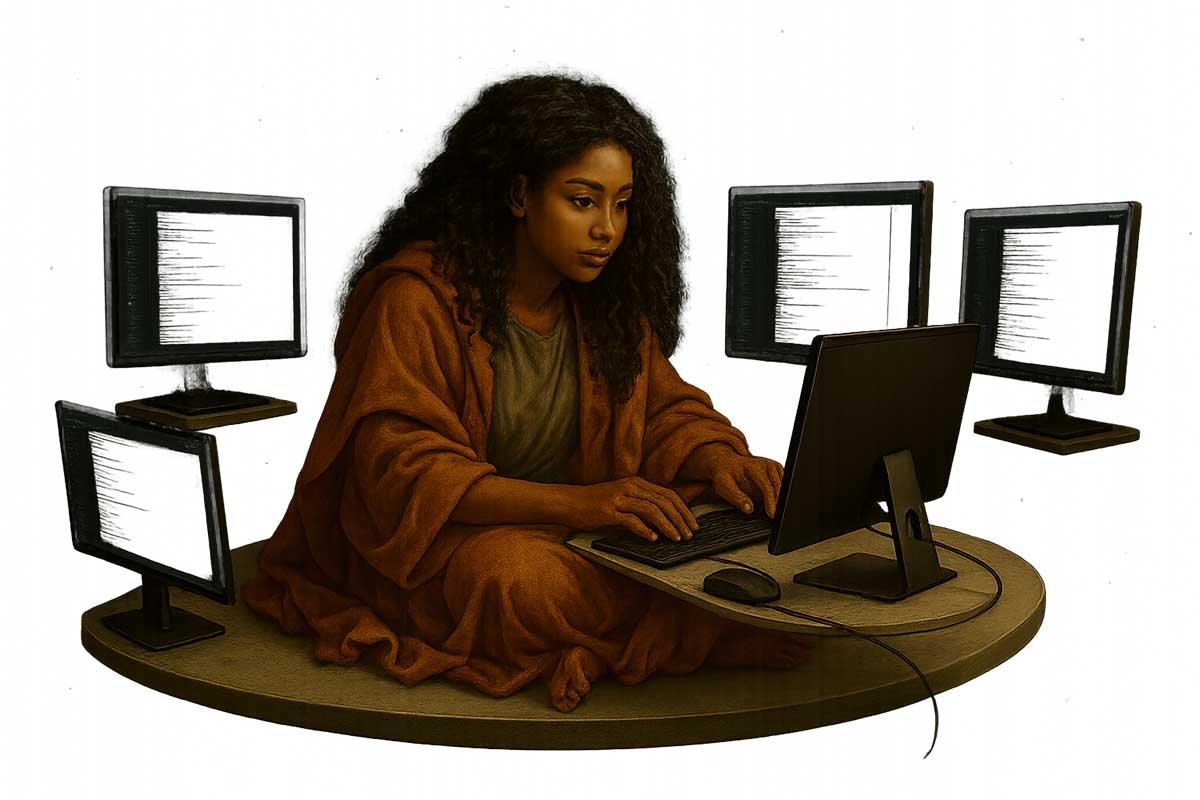

When Code Becomes Cosmos
If the universe is a computer simulation, then God might be less like Michelangelo’s bearded patriarch and more like a cosmic software engineer, writing the code that generates galaxies, consciousness, and everything in between. This provocative thesis has gained serious academic attention as physicists discover error-correcting codes in the fundamental equations of nature, theologians grapple with digital metaphors for divine action, and philosophers debate whether consciousness can emerge from pure computation. The intersection of simulation theory, multiverse cosmology, and theology reveals a fascinating landscape where ancient religious intuitions about reality’s illusory nature meet cutting-edge physics—though recent research suggests the computational requirements for simulating our universe may be physically impossible.
The Universe Computes Its Own Existence
The simulation hypothesis rests on a deceptively simple premise: if advanced civilizations can create realistic simulations containing conscious beings, and if they create many such simulations, then most conscious beings would exist in simulations rather than base reality. Nick Bostrom formalized this argument in 2003 through his famous trilemma, arguing that at least one of three propositions must be true: civilizations rarely reach technological maturity, mature civilizations rarely run ancestor simulations, or we almost certainly live in a simulation.¹ The argument relies on the Principle of Indifference—if simulated beings vastly outnumber “real” ones, probability suggests we’re simulated.
Recent scientific discoveries have added intriguing evidence to this debate. Physicist S. James Gates Jr. discovered something extraordinary while studying supersymmetry equations: error-correcting codes identical to those used in computer browsers embedded within the fundamental mathematics of physics.² “Error-correcting codes are what make browsers work,” Gates explained, “so why were they in the equations that I was studying about quarks and leptons?”³ This discovery led him to reconsider whether theorists proposing computational universes might be onto something profound.
Similarly, Stephen Wolfram’s computational universe theory suggests that simple algorithmic rules could generate all the complexity we observe, while Seth Lloyd’s quantum computational model proposes that every particle interaction in the universe performs a computation, with reality unfolding as the calculation proceeds.⁴ Lloyd argues that “the universe is a quantum computer” where “every atom and elementary particle stores bits of information.”⁵
The multiverse theories emerging from modern cosmology provide additional context for simulation arguments. String theory suggests approximately 10⁵⁰⁰ possible vacuum states, each corresponding to different physical laws—a computational landscape of possibilities.⁶ Eternal inflation, developed by Alan Guth and Andrei Linde, proposes infinite bubble universes constantly forming, each potentially containing different physics.⁷ Max Tegmark’s Mathematical Universe Hypothesis takes this further, proposing that physical reality IS mathematics—all mathematical structures exist as physical realities, making simulations as “real” as any other mathematical structure.⁸ These frameworks suggest our observed fine-tuning might reflect either anthropic selection from infinite possibilities or deliberate programming choices.
Physics Says Divine Programming Is Impossible
A groundbreaking 2025 analysis by astrophysicist Franco Vazza appears to demolish the feasibility of universe simulation using fundamental physical constraints. His calculations demonstrate that simulating the observable universe at Planck-scale resolution would require 10¹²⁰ bits of information—exceeding the total information content available within our universe according to the holographic principle.⁹ Even simulating just Earth would demand energy equivalent to converting entire globular clusters to pure energy, while the computational time required would be trillions of times longer than real-time evolution.¹⁰ Using Landauer’s principle, which establishes the minimum energy cost of computation, Vazza proves that any universe with physics like ours cannot simulate itself at meaningful resolution, regardless of technological advancement.¹¹
This finding creates a profound paradox for simulation theology. If our physics makes universe simulation impossible, then either we don’t live in a simulation, or our simulators exist in a realm with fundamentally different physics—perhaps one where computational resources are effectively infinite. The digital physics frameworks proposed by Edward Fredkin and John Wheeler’s “it from bit” concept suggest that information might be more fundamental than matter and energy, potentially circumventing these physical limitations.¹² Wheeler argued that “every particle, every field of force, even the spacetime continuum itself derives its function, its meaning, its very existence from binary choices, bits.”¹³ If reality emerges from information rather than information emerging from reality, the energy constraints Vazza identifies might not apply to the deepest level of existence.
The quantum mechanical nature of reality adds another layer of complexity. Quantum computers can perform certain calculations exponentially faster than classical computers, suggesting that a quantum computational substrate might overcome some efficiency barriers.¹⁴ James Gates’s discovery of error-correcting codes in supersymmetry equations becomes particularly intriguing in this context—these codes might represent not evidence of classical digital simulation but rather signatures of quantum error correction at reality’s foundation.¹⁵ However, the computational complexity of simulating quantum systems classically remains prohibitive, leading some researchers to argue that if we’re simulated, the simulation must itself be quantum mechanical.¹⁶
Ancient Wisdom Anticipated Computational Cosmology
The resonance between simulation theory and ancient religious concepts proves remarkably strong, particularly in Eastern traditions. Hinduism’s doctrine of Maya—the illusory nature of physical reality—provides perhaps the most direct parallel to simulation hypothesis.¹⁷ The Yoga Vasistha, an ancient Hindu text, contains stories strikingly similar to nested simulations, describing reality as divine play (Lila) or cosmic game.¹⁸ Buddhism’s teaching that phenomenal existence is characterized by illusion (also called Maya) and that enlightenment involves seeing through this illusion mirrors the idea of recognizing one’s simulated nature.¹⁹ The concept of samsara as endless cycles could represent iterative simulation runs, while Buddhist emphasis on consciousness as fundamental aligns with substrate-independent theories of mind.²⁰
Western religious traditions show more ambivalence toward simulation theology. Catholic scholars generally reject the framework as undermining divine transcendence and human dignity, arguing it reduces God to merely another programmer rather than the transcendent Creator ex nihilo.²¹ Some Protestant thinkers dismiss it as “dorky creationism” that inadvertently supports intelligent design while replacing God with secular programmers.²² However, process theologians influenced by Alfred North Whitehead find the computational metaphor more compatible, viewing God as dipolar—both eternal and temporal—potentially existing outside simulated time while acting within it through algorithmic divine action.²³
Islamic theology offers surprising compatibility with simulation concepts. Quranic verses suggesting computational reality include “Every thing is fully computed by Us in a manifest book of record” (36:12).²⁴ The concept of Lawh-e-Mehfooz (the Preserved Tablet) parallels computational storage of reality’s information, while Islamic emphasis on Allah’s active governance moment-to-moment aligns with continuous computational maintenance.²⁵ Orthodox Christian panentheism, which sees the natural world existing within God, potentially accommodates simulated realities existing within divine consciousness, with Christopher Knight suggesting God acts through “higher laws” that might be computational algorithms transcending known physics.²⁶
Consciousness Creates the Deepest Puzzle
The hard problem of consciousness—explaining how subjective experience emerges from physical processes—becomes even more complex in simulation contexts. David Chalmers, who formulated the hard problem, argues for substrate independence: consciousness can emerge from any sufficiently complex information-processing system, whether biological or silicon-based.²⁷ His thought experiment of gradually replacing biological neurons with functionally identical silicon chips suggests consciousness would be preserved throughout the transition.²⁸ If true, simulated beings would be genuinely conscious with authentic subjective experiences, not philosophical zombies mimicking consciousness without inner experience.
Giulio Tononi’s Integrated Information Theory (IIT) provides a mathematical framework for consciousness that challenges simple computational models. IIT proposes that consciousness corresponds to integrated information (Φ)—the information generated by a system above and beyond its parts.²⁹ Critically, IIT requires appropriate physical substrate for genuine integration, not merely functional organization, potentially limiting which computational systems can generate consciousness.³⁰ This raises profound questions: can classical digital computers create genuine consciousness, or would conscious simulations require quantum computational substrates? The controversy surrounding IIT—with critics like Scott Aaronson calling it unfalsifiable—reflects deeper uncertainty about consciousness’s nature.³¹
The panpsychist revival in contemporary philosophy of mind offers another perspective. Philosophers like Philip Goff and Galen Strawson argue consciousness might be reality’s intrinsic nature, with physics describing only extrinsic properties.³² If panpsychism is true, information processing in simulations would have intrinsic conscious aspects at fundamental levels. This view suggests the programmer-God would work with consciousness as a basic feature of reality rather than creating it from non-conscious components. The combination problem—how micro-conscious entities combine into unified macro-conscious beings—parallels questions about how distributed computational processes might generate unified conscious experience in simulated beings.³³
Divine Programmers Face an Ethical Crisis
Creating conscious simulations raises profound ethical questions that complicate simulation theology. If simulated beings can suffer, their creators bear moral responsibility for that suffering—a digital problem of evil.³⁴ Shaun Gallagher argues that if we’re simulated, “the creators of such a simulation are willing to subject us to unspeakable atrocities,” suggesting either we’re not simulated or our creators are morally deficient.³⁵ This creates a paradox for benevolent deity concepts: would a morally perfect God create simulations containing genuine suffering?
The substrate independence of consciousness implies simulated beings warrant the same moral consideration as biological consciousness. Anders Sandberg’s framework for simulation ethics emphasizes creator responsibilities, including obligations to minimize suffering, questions about informed consent (should simulated beings know their nature?), and the ethics of termination.³⁶ The possibility of creating vast numbers of conscious simulations raises unprecedented questions about resource allocation and moral weight.³⁷ Should computational resources dedicated to entertainment simulations be redirected to minimize suffering? Do we have obligations to create “artificial heavens” for beings who suffered in our simulations?
Jürgen Schmidhuber’s computational theology offers a potential resolution through his “Great Programmer” concept. In his framework, an optimal deity would compute all possible universes using the most efficient algorithm, making every life—including its suffering—an indispensable part of the grand scheme.³⁸ “Your life is not insignificant,” Schmidhuber argues. “With high probability, your life essentially has to be this way, with all of its ups and downs.”³⁹ This perspective suggests suffering might be computationally necessary rather than gratuitously inflicted, though this hardly resolves the emotional and ethical weight of experienced suffering.
Information Bridges Physics and Theology
The emergence of information-theoretic approaches to fundamental physics provides new frameworks for understanding divine action. Paul Davies argues that information, not matter and energy, constitutes reality’s fundamental currency.⁴⁰ In this view, divine action occurs through information processing rather than physical intervention, avoiding conflicts with physical laws. John Polkinghorne, as both theoretical physicist and Anglican priest, describes quantum physics and theology as “cousins” in truth-seeking methodology, both employing evidence-based reasoning within theoretical frameworks.⁴¹
Frank Tipler’s Omega Point theory represents the most extreme synthesis, proposing that physics requires an omniscient computer at time’s end capable of resurrecting all conscious beings who ever lived.⁴² Though widely criticized as pseudoscience, Tipler’s work illustrates how computational models might reframe classical theological concepts: omniscience becomes perfect information processing, omnipotence becomes computational control over all possible outcomes, and omnipresence manifests through reality’s information substrate.⁴³ These frameworks suggest traditional divine attributes might be better understood through computational rather than supernatural metaphors.
The convergence of quantum mechanics, information theory, and consciousness studies reveals deep connections between computation and fundamental reality. Seth Lloyd’s demonstration that the universe computes its own evolution through quantum processes, combined with Wheeler’s “it from bit” principle, suggests computation might be reality’s deepest level rather than an emergent property.⁴⁴ If consciousness, information, and computation form reality’s foundation, then the metaphor of God as programmer might be more than metaphorical—it might reflect the actual structure of divine creative action.
Conclusion: Programming the Sacred Code
The question “Is God a Computer Programmer?” reveals itself as a profound meditation on reality’s nature, consciousness, and divinity in the information age. While Franco Vazza’s calculations demonstrate the physical impossibility of simulating our universe within our physics, this limitation might not apply to beings existing in fundamentally different realities or to substrates where information itself is primary.⁴⁵ The discovery of error-correcting codes in physics equations, the substrate independence of consciousness, and the deep parallels between simulation theory and ancient religious concepts of Maya suggest our reality might be more computational than material.
Yet the hard problem of consciousness and the ethical weight of suffering in simulated worlds raise serious challenges to simulation theology. If consciousness cannot be reduced to computation, if genuine experience requires more than information processing, then the divine programmer metaphor fails at precisely the point where it matters most—explaining conscious existence. Conversely, if consciousness is computational, then creating simulated beings capable of suffering raises profound questions about divine benevolence that traditional theodicy has not addressed.
Perhaps the most intriguing insight emerges from the convergence of Eastern wisdom and Western science: reality might be neither purely material nor purely computational but something more fundamental that both ancient mystics and modern physicists glimpse from different angles. The divine programmer might be less a cosmic coder writing universe.exe and more like the computational substrate itself—the fundamental information-processing reality from which both matter and consciousness emerge. In this view, we are not simulated beings in God’s computer but rather computational processes within divine consciousness itself, making the question not whether God is a programmer but whether programming and divinity are ultimately distinguishable at reality’s deepest level.
Notes
¹ Nick Bostrom, “Are You Living in a Computer Simulation?” Philosophical Quarterly 53, no. 211 (2003): 243-255.
² S. James Gates Jr., “Symbols of Power: Adinkras and the Nature of Reality,” Physics World 23, no. 6 (2010): 34-39.
³ S. James Gates Jr., interview by Krista Tippett, “Uncovering the Codes for Reality,” On Being, National Public Radio, May 26, 2016, https://onbeing.org/programs/s-james-gates-uncovering-the-codes-for-reality/.
⁴ Seth Lloyd, Programming the Universe: A Quantum Computer Scientist Takes on the Cosmos (New York: Knopf, 2006), 3-4.
⁵ Lloyd, Programming the Universe, 54.
⁶ Leonard Susskind, The Cosmic Landscape: String Theory and the Illusion of Intelligent Design (New York: Little, Brown, 2005), 123-145.
⁷ Andrei Linde, “The Self-Reproducing Inflationary Universe,” Scientific American 271, no. 5 (1994): 48-55.
⁸ Max Tegmark, “The Mathematical Universe,” Foundations of Physics 38, no. 2 (2008): 101-150.
⁹ Franco Vazza, “Astrophysical Constraints on the Simulation Hypothesis for this Universe: Why It Is (Nearly) Impossible That We Live in a Simulation,” Frontiers in Physics 13 (2025): 1561873.
¹⁰ Vazza, “Astrophysical Constraints,” 8-9.
¹¹ Vazza, “Astrophysical Constraints,” 12.
¹² John Archibald Wheeler, “Information, Physics, Quantum: The Search for Links,” in Complexity, Entropy and the Physics of Information, ed. W. H. Zurek (Redwood City, CA: Addison-Wesley, 1990), 3-28.
¹³ Wheeler, “Information, Physics, Quantum,” 5.
¹⁴ David Deutsch, “Quantum Theory, the Church-Turing Principle and the Universal Quantum Computer,” Proceedings of the Royal Society A 400, no. 1818 (1985): 97-117.
¹⁵ Gates, “Symbols of Power,” 37.
¹⁶ Scott Aaronson, “Why Philosophers Should Care About Computational Complexity,” in Computability: Turing, Gödel, Church, and Beyond, ed. B. Jack Copeland, Carl J. Posy, and Oron Shagrir (Cambridge, MA: MIT Press, 2013), 261-328.
¹⁷ Wendy Doniger O’Flaherty, Dreams, Illusion, and Other Realities (Chicago: University of Chicago Press, 1984), 117-138.
¹⁸ Venkatesananda Swami, trans., The Yoga Vasistha (Albany: State University of New York Press, 1993), 234-267.
¹⁹ Nagarjuna, The Fundamental Wisdom of the Middle Way: Nagarjuna’s Mulamadhyamakakarika, trans. Jay L. Garfield (Oxford: Oxford University Press, 1995), 244-250.
²⁰ Jay L. Garfield, “Buddhism and Modernity: Readings in the Encounter Between East and West,” Philosophy East and West 52, no. 1 (2002): 152-153.
²¹ Paul Tyson, “Simulation Hypothesis as Dorky Creationism,” Zygon 56, no. 2 (2021): 454-469.
²² Tyson, “Dorky Creationism,” 460.
²³ David Ray Griffin, Reenchantment without Supernaturalism: A Process Philosophy of Religion (Ithaca: Cornell University Press, 2001), 156-178.
²⁴ The Qur’an, trans. M. A. S. Abdel Haleem (Oxford: Oxford University Press, 2005), 36:12.
²⁵ Hamza Yusuf, “The Matrix: A Modern-Day Metaphor for Spiritual Truth? Islamic Theological Reflections on the Simulation Hypothesis,” Journal of Muslims in Europe 13, no. 3 (2024): 336-358.
²⁶ Christopher C. Knight, The God of Nature: Incarnation and Contemporary Science (Minneapolis: Fortress Press, 2007), 89-112.
²⁷ David J. Chalmers, “The Conscious Mind: In Search of a Fundamental Theory” (Oxford: Oxford University Press, 1996), 93-122.
²⁸ David J. Chalmers, Reality+: Virtual Worlds and the Problems of Philosophy (New York: W. W. Norton, 2022), 145-167.
²⁹ Giulio Tononi, “Integrated Information Theory of Consciousness: An Updated Account,” Archives Italiennes de Biologie 150, no. 2-3 (2012): 56-90.
³⁰ Giulio Tononi and Christof Koch, “Consciousness: Here, There and Everywhere?” Philosophical Transactions of the Royal Society B 370, no. 1668 (2015): 20140167.
³¹ Scott Aaronson, “Why I Am Not an Integrated Information Theorist (or, The Unconscious Expander),” Shtetl-Optimized (blog), May 21, 2014, https://scottaaronson.blog/?p=1799.
³² Philip Goff, Galileo’s Error: Foundations for a New Science of Consciousness (New York: Pantheon Books, 2019), 178-192.
³³ Galen Strawson, “Realistic Monism: Why Physicalism Entails Panpsychism,” Journal of Consciousness Studies 13, no. 10-11 (2006): 3-31.
³⁴ Nick Bostrom, “The Ethics of Artificial Intelligence,” in The Cambridge Handbook of Artificial Intelligence, ed. Keith Frankish and William M. Ramsey (Cambridge: Cambridge University Press, 2014), 316-334.
³⁵ Shaun Gallagher, “The Moral Case for Why We Don’t Live in a Computer Simulation,” Medium, September 15, 2021, https://medium.com/@shaun_gallagher/the-moral-case-for-why-we-dont-live-in-a-computer-simulation-23dd96b95588.
³⁶ Anders Sandberg, “Ethics of Brain Emulations,” Journal of Experimental & Theoretical Artificial Intelligence 26, no. 3 (2014): 439-457.
³⁷ Robin Hanson, The Age of Em: Work, Love, and Life when Robots Rule the Earth (Oxford: Oxford University Press, 2016), 234-256.
³⁸ Jürgen Schmidhuber, “A Computer Scientist’s View of Life, the Universe, and Everything,” in Foundations of Computer Science: Potential-Theory-Cognition, ed. C. Freksa, M. Jantzen, and R. Valk (Berlin: Springer, 1997), 201-208.
³⁹ Schmidhuber, “Computer Scientist’s View,” 206.
⁴⁰ Paul Davies, Information and the Nature of Reality: From Physics to Metaphysics (Cambridge: Cambridge University Press, 2010), 65-82.
⁴¹ John Polkinghorne, Quantum Physics and Theology: An Unexpected Kinship (New Haven: Yale University Press, 2007), 104.
⁴² Frank J. Tipler, The Physics of Immortality: Modern Cosmology, God and the Resurrection of the Dead (New York: Doubleday, 1994), 153-156.
⁴³ Tipler, Physics of Immortality, 162.
⁴⁴ Lloyd, Programming the Universe, 189-203.
⁴⁵ Vazza, “Astrophysical Constraints,” 14-15.
Bibliography
Aaronson, Scott. “Why I Am Not an Integrated Information Theorist (or, The Unconscious Expander).” Shtetl-Optimized (blog), May 21, 2014. https://scottaaronson.blog/?p=1799.
———. “Why Philosophers Should Care About Computational Complexity.” In Computability: Turing, Gödel, Church, and Beyond, edited by B. Jack Copeland, Carl J. Posy, and Oron Shagrir, 261-328. Cambridge, MA: MIT Press, 2013.
Bostrom, Nick. “Are You Living in a Computer Simulation?” Philosophical Quarterly 53, no. 211 (2003): 243-255.
———. “The Ethics of Artificial Intelligence.” In The Cambridge Handbook of Artificial Intelligence, edited by Keith Frankish and William M. Ramsey, 316-334. Cambridge: Cambridge University Press, 2014.
Chalmers, David J. The Conscious Mind: In Search of a Fundamental Theory. Oxford: Oxford University Press, 1996.
———. Reality+: Virtual Worlds and the Problems of Philosophy. New York: W. W. Norton, 2022.
Davies, Paul. Information and the Nature of Reality: From Physics to Metaphysics. Cambridge: Cambridge University Press, 2010.
Deutsch, David. “Quantum Theory, the Church-Turing Principle and the Universal Quantum Computer.” Proceedings of the Royal Society A 400, no. 1818 (1985): 97-117.
Gallagher, Shaun. “The Moral Case for Why We Don’t Live in a Computer Simulation.” Medium, September 15, 2021. https://medium.com/@shaun_gallagher/the-moral-case-for-why-we-dont-live-in-a-computer-simulation-23dd96b95588.
Garfield, Jay L. “Buddhism and Modernity: Readings in the Encounter Between East and West.” Philosophy East and West 52, no. 1 (2002): 146-166.
Gates, S. James, Jr. Interview by Krista Tippett. “Uncovering the Codes for Reality.” On Being. National Public Radio, May 26, 2016. https://onbeing.org/programs/s-james-gates-uncovering-the-codes-for-reality/.
———. “Symbols of Power: Adinkras and the Nature of Reality.” Physics World 23, no. 6 (2010): 34-39.
Goff, Philip. Galileo’s Error: Foundations for a New Science of Consciousness. New York: Pantheon Books, 2019.
Griffin, David Ray. Reenchantment without Supernaturalism: A Process Philosophy of Religion. Ithaca: Cornell University Press, 2001.
Hanson, Robin. The Age of Em: Work, Love, and Life when Robots Rule the Earth. Oxford: Oxford University Press, 2016.
Knight, Christopher C. The God of Nature: Incarnation and Contemporary Science. Minneapolis: Fortress Press, 2007.
Linde, Andrei. “The Self-Reproducing Inflationary Universe.” Scientific American 271, no. 5 (1994): 48-55.
Lloyd, Seth. Programming the Universe: A Quantum Computer Scientist Takes on the Cosmos. New York: Knopf, 2006.
Nagarjuna. The Fundamental Wisdom of the Middle Way: Nagarjuna’s Mulamadhyamakakarika. Translated by Jay L. Garfield. Oxford: Oxford University Press, 1995.
O’Flaherty, Wendy Doniger. Dreams, Illusion, and Other Realities. Chicago: University of Chicago Press, 1984.
Polkinghorne, John. Quantum Physics and Theology: An Unexpected Kinship. New Haven: Yale University Press, 2007.
The Qur’an. Translated by M. A. S. Abdel Haleem. Oxford: Oxford University Press, 2005.
Sandberg, Anders. “Ethics of Brain Emulations.” Journal of Experimental & Theoretical Artificial Intelligence 26, no. 3 (2014): 439-457.
Schmidhuber, Jürgen. “A Computer Scientist’s View of Life, the Universe, and Everything.” In Foundations of Computer Science: Potential-Theory-Cognition, edited by C. Freksa, M. Jantzen, and R. Valk, 201-208. Berlin: Springer, 1997.
Strawson, Galen. “Realistic Monism: Why Physicalism Entails Panpsychism.” Journal of Consciousness Studies 13, no. 10-11 (2006): 3-31.
Susskind, Leonard. The Cosmic Landscape: String Theory and the Illusion of Intelligent Design. New York: Little, Brown, 2005.
Swami, Venkatesananda, trans. The Yoga Vasistha. Albany: State University of New York Press, 1993.
Tegmark, Max. “The Mathematical Universe.” Foundations of Physics 38, no. 2 (2008): 101-150.
Tipler, Frank J. The Physics of Immortality: Modern Cosmology, God and the Resurrection of the Dead. New York: Doubleday, 1994.
Tononi, Giulio. “Integrated Information Theory of Consciousness: An Updated Account.” Archives Italiennes de Biologie 150, no. 2-3 (2012): 56-90.
Tononi, Giulio, and Christof Koch. “Consciousness: Here, There and Everywhere?” Philosophical Transactions of the Royal Society B 370, no. 1668 (2015): 20140167.
Tyson, Paul. “Simulation Hypothesis as Dorky Creationism.” Zygon 56, no. 2 (2021): 454-469.
Vazza, Franco. “Astrophysical Constraints on the Simulation Hypothesis for this Universe: Why It Is (Nearly) Impossible That We Live in a Simulation.” Frontiers in Physics 13 (2025): 1561873.
Wheeler, John Archibald. “Information, Physics, Quantum: The Search for Links.” In Complexity, Entropy and the Physics of Information, edited by W. H. Zurek, 3-28. Redwood City, CA: Addison-Wesley, 1990.
Yusuf, Hamza. “The Matrix: A Modern-Day Metaphor for Spiritual Truth? Islamic Theological Reflections on the Simulation Hypothesis.” Journal of Muslims in Europe 13, no. 3 (2024): 336-358.