
The 100 year-old proven farm revolution transforming soil, wine, and scientific debate
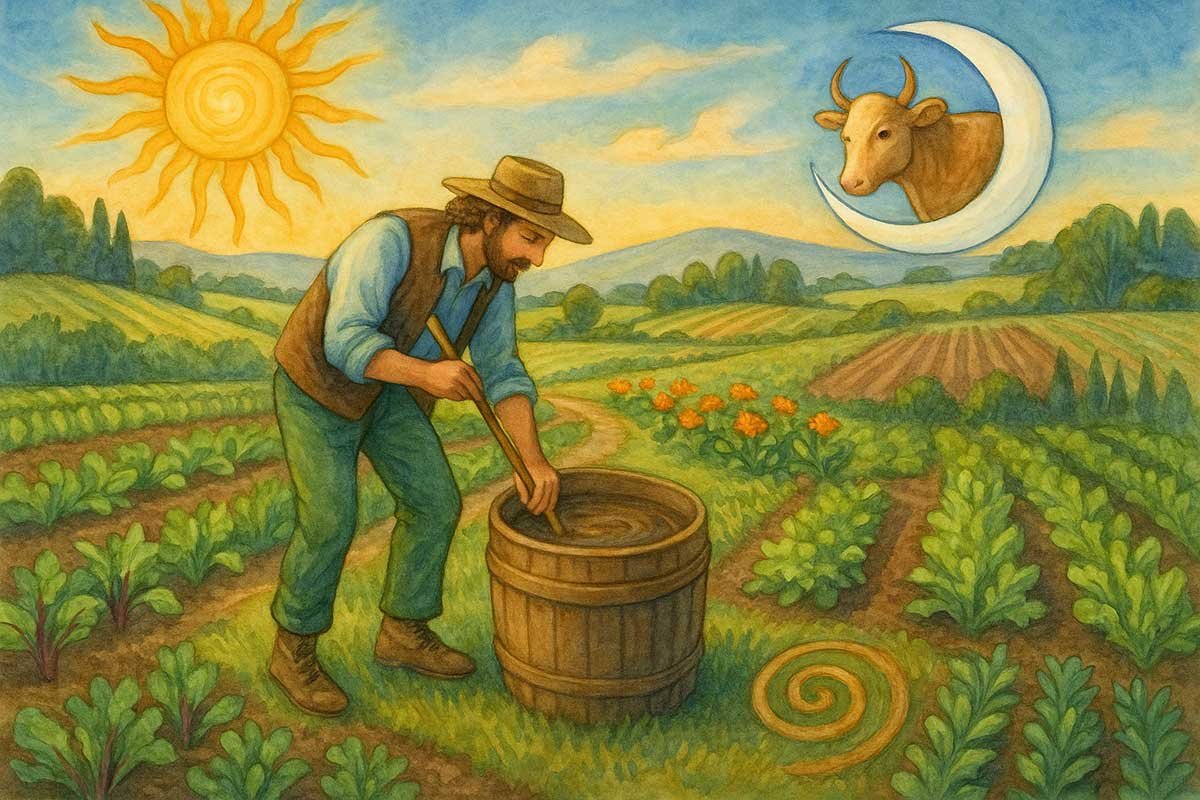
In the rolling vineyards of Burgundy, where some of the world’s most prestigious wines originate, a quiet revolution unfolds each morning before dawn. Winemakers at Domaine de la Romanée-Conti—whose bottles command thousands of dollars—can be found stirring cow manure in precise vortices, consulting lunar calendars, and burying quartz-filled cow horns in their fields. This is biodynamic agriculture: a holistic farming philosophy that views the farm as a living organism connected to cosmic rhythms, and it’s spreading across 255,000 hectares in 65 countries worldwide.¹
Born from the spiritual-scientific worldview of Austrian philosopher Rudolf Steiner in 1924, biodynamic farming preceded the organic movement by decades, establishing the world’s first ecological certification system through Demeter International in 1928.² Today, this approach stands at the intersection of ancient wisdom and cutting-edge soil science, generating both devoted practitioners and skeptical scientists. As climate change intensifies and consumers increasingly demand sustainable food production, biodynamics offers a radical reimagining of agriculture—one that promises enhanced soil health, superior product quality, and farm resilience, while challenging conventional scientific paradigms.
Agricultural practices that treat farms as living organisms
At its core, biodynamic agriculture revolutionizes farming by treating the entire farm as a self-contained living organism. This holistic approach extends far beyond organic farming’s prohibition of synthetic chemicals, integrating cosmic influences, specific preparations, and mandatory biodiversity preservation into a comprehensive agricultural system.³
The foundation of biodynamic practice rests on nine preparations, numbered BD 500-508, which practitioners believe channel cosmic and terrestrial forces to enhance soil vitality and plant health.⁴ Preparation 500, made from cow manure fermented in cow horns buried during winter months, exemplifies the method’s unique approach. Farmers pack fresh manure from lactating cows into horns, bury them pointing downward, and retrieve them in spring after transformation by soil forces. The resulting substance—applied at homeopathic dilutions of one palm-full per acre—reportedly enhances soil life and root development through what practitioners describe as concentrated life forces.⁵
Similarly mystical-sounding preparations include horn silica (501), created from ground quartz crystals buried in horns over summer to capture light forces, and six compost preparations using medicinal plants like yarrow, chamomile, and valerian.⁶ Each preparation requires specific cosmic timing and elaborate procedures that skeptics dismiss as “magic spells” but practitioners swear by.⁷
The biodynamic calendar adds another layer of complexity, timing all farm activities according to lunar and planetary positions. Based on research by Maria Thun, farmers plant root crops during “earth constellation” days when the moon passes through Taurus, Virgo, or Capricorn, while reserving “fruit days” in fire signs for harvesting grapes.⁸ Scientific reviews of over 100 papers have found no reliable evidence for lunar effects on plant physiology, yet biodynamic farmers report consistent benefits from following these cosmic rhythms.⁹
Perhaps most distinctively, Demeter certification requires dedicating minimum 10% of farmland to biodiversity preservation—creating habitats for beneficial insects, birds, and soil organisms.¹⁰ This ecosystem approach, combined with mandatory livestock integration and closed-loop nutrient cycling, creates farms that function as largely self-sustaining organisms rather than input-dependent production units.
Wine production where terroir meets the cosmos
Nowhere has biodynamic agriculture gained more prestigious adherents than in viticulture. The roll call of biodynamic wineries reads like a who’s who of fine wine: Domaine de la Romanée-Conti in Burgundy, Nicolas Joly in the Loire Valley, and Olivier Humbrecht in Alsace have all embraced cosmic viticulture.¹¹ These producers report that biodynamic methods enhance terroir expression—that ineffable sense of place that distinguishes great wines.
Biodynamic viticulture extends the general agricultural practices with wine-specific applications. Winemakers spray preparation 501 on vines during specific growth phases to enhance photosynthesis and concentrate flavors.¹² Harvest timing follows the biodynamic calendar religiously, with many estates picking only on fruit days for optimal quality.¹³ In the cellar, biodynamic winemaking emphasizes minimal intervention: indigenous yeasts rather than commercial strains, reduced sulfite levels (maximum 100 ppm versus higher conventional limits), and timing of bottling according to lunar cycles.¹⁴
A Fortune Magazine blind tasting found nine out of ten biodynamic wines superior to their conventional counterparts, while Italian research documented enhanced cherry and floral notes in biodynamic Sangiovese.¹⁵ Professional sommeliers increasingly report distinctive characteristics in biodynamic wines: enhanced minerality, better balance, and superior aging potential. Yet scientific studies yield mixed results—a recent Swiss five-year vineyard trial found no significant effects from preparations 500 and 501 on vine physiology, yield, or wine quality.¹⁶
The wine industry’s embrace of biodynamics illustrates a broader pattern: premium producers adopt these methods not from scientific conviction but from empirical experience of improved quality. As one Burgundian vigneron explained, “I don’t understand why it works, but my vines are healthier and my wines more expressive since converting to biodynamics.”
Philosophical foundations rooted in anthroposophy challenge scientific orthodoxy
Understanding biodynamics requires grappling with its esoteric philosophical foundations in Rudolf Steiner’s anthroposophy—literally “wisdom of the human being.” Steiner, whose intellectual journey began with editing Goethe’s scientific works, developed a worldview claiming humans could achieve heightened consciousness to directly perceive spiritual realities.¹⁷ His “spiritual science” sought to apply natural science’s rigor to supersensible realms, proposing that trained individuals could objectively research spiritual dimensions.¹⁸
In June 1924, responding to farmers’ concerns about declining soil fertility following chemical fertilizer adoption, Steiner delivered eight lectures at Schloss Koberwitz in Silesia. These talks, known as the Agriculture Course, introduced revolutionary concepts: farms as living organisms, integration of cosmic and terrestrial forces, and specific preparations to mediate these influences.¹⁹ Importantly, Steiner presented these as “hints” for experimental validation, not dogmatic prescriptions, establishing an experimental circle to test his suggestions.²⁰
Central to anthroposophical agriculture is the concept of formative forces beyond physical matter. Steiner described four bodies comprising living beings: the physical mineral structure, the etheric body governing life processes, the astral body as seat of consciousness, and the spiritual ego.²¹ Plants, possessing physical and etheric bodies, respond to cosmic influences from planetary movements and zodiacal forces that conventional science cannot measure.
This philosophical framework has attracted fierce criticism from mainstream scientists. Holger Kirchmann of the Swedish University of Agricultural Sciences characterized Steiner’s instructions as “occult and dogmatic,” arguing they cannot contribute to sustainable agriculture.²² Linda Chalker-Scott of Washington State University found “no evidence” that biodynamic preparations improve soil quality beyond standard organic methods.²³ Critics argue that anthroposophy’s reliance on claimed clairvoyant insights and non-falsifiable spiritual concepts places it outside legitimate scientific discourse.
Yet defenders point to practical results. As researchers from the Goetheanum note, critics often ignore substantial biodynamic research showing measurable benefits.²⁴ Some scholars suggest the movement’s holistic thinking and ecological approach have positively influenced broader sustainable agriculture development, even if specific esoteric claims remain unproven. The tension between spiritual worldview and empirical results continues to define biodynamic agriculture’s contested position in contemporary farming.
Scientific evidence reveals benefits despite controversial methods
The scientific evaluation of biodynamic farming presents a complex picture of clear benefits alongside questionable claims. A comprehensive review of 147 peer-reviewed publications from 1985-2018 reveals a research field growing slowly—averaging only five papers annually—but producing increasingly rigorous studies.²⁵
The DOK trial in Switzerland, comparing biodynamic, organic, and conventional systems since 1978, provides the most robust long-term data. Results show biodynamic plots maintaining soil fertility with 65% less nitrogen input and 40% less phosphorus than conventional systems.²⁶ Soil organic carbon declined only 0.40% in biodynamic plots versus 0.74% in organic systems over 42 years.²⁷ Biodynamic soils hosted 25% more microorganisms and showed enhanced mycorrhizal fungi diversity—crucial for nutrient uptake and soil structure.²⁸
Meta-analyses reveal biodynamic farming ranking highest for soil ecological quality among all systems studied. Christian Christel’s 2021 analysis of approximately 100 studies found 70% improvement in soil biological indicators for biodynamic versus conventional farming, with 43% of indicators superior even to organic systems.²⁹ These improvements include enhanced microbial biomass, enzyme activity, and soil structure.
However, biodynamic methods consistently produce 13-34% lower yields than conventional farming for most crops, similar to organic systems.³⁰ The preparations themselves—the unique biodynamic element—show limited effects when tested in isolation. Multiple controlled studies found no significant impacts from preparations 500 and 501 on plant growth or soil properties when other management factors were controlled.³¹
The scientific consensus suggests biodynamic benefits derive primarily from excellent organic management—composting, crop rotation, biodiversity preservation—rather than cosmic influences or homeopathic preparations. As one researcher concluded, “The system works, but not necessarily for the reasons practitioners believe.”
Environmental benefits extend from soil to atmosphere
Despite yield limitations, biodynamic farming demonstrates compelling environmental advantages. Soil health improvements stand out: enhanced water retention (averaging 12% improvement), increased organic matter, and superior structure that reduces erosion.³² The mandatory biodiversity requirement creates measurable ecosystem benefits—biodynamic farms support 50-80% more earthworms, 35% more bird species, and three to seven times more bee species than conventional operations.³³
Carbon sequestration potential offers particular promise for climate mitigation. Long-term studies show biodynamic systems better maintaining soil carbon than even organic methods.³⁴ Combined with reduced external inputs and enhanced on-farm nutrient cycling, biodynamic farms demonstrate lower greenhouse gas emissions per unit area, though emissions per unit product may be similar due to lower yields.³⁵
Water quality benefits from the absence of synthetic pesticides and fertilizers, with reduced nitrate leaching protecting groundwater. The enhanced soil structure improves infiltration, reducing runoff and erosion during extreme weather events—increasingly important as climate change intensifies.
Product quality assessments reveal advantages in nutritional content and food safety. Multiple studies document higher polyphenol levels in biodynamic produce: Batavia lettuce, red beets, and potatoes all showed elevated antioxidant activity compared to conventional and organic alternatives.³⁶ Biodynamic milk demonstrated optimal omega-6 to omega-3 ratios and higher vitamin E content.³⁷ The complete absence of pesticide residues and Demeter’s zero-tolerance GMO policy (versus 0.9% allowance in other organic standards) provide additional safety assurances.³⁸
Taste differences, while subjective, consistently favor biodynamic products in professional evaluations. The higher dry matter content contributes to concentrated flavors and extended shelf life.³⁹ These quality attributes help explain consumer willingness to pay 10-50% premiums despite limited understanding of biodynamic principles.⁴⁰
Comparisons with organic farming reveal subtle but significant differences
While biodynamic and organic farming share fundamental principles—prohibiting synthetic chemicals, emphasizing soil health, promoting biodiversity—important distinctions set them apart. Organic certification focuses primarily on prohibited substances and practices, allowing farmers to substitute approved inputs for synthetic ones. Biodynamic certification demands a systems transformation: the entire farm must be certified, not individual fields; minimum biodiversity preservation is mandatory, not optional; the nine preparations must be applied regularly; and livestock integration is expected where feasible.⁴¹
These requirements create measurably different outcomes. The Christel meta-analysis found biodynamic farms outperforming organic operations on 43% of soil quality indicators.⁴² Biodiversity measures consistently favor biodynamic systems, partly due to the mandatory 10% habitat preservation. The emphasis on closed-loop fertility through on-farm composting and limited external inputs creates greater farm self-sufficiency.
Certification standards differ dramatically. Demeter processing standards are 19 times more detailed than generic organic rules, with stricter limits on additives and processing aids.⁴³ The philosophical distinction runs deeper: organic farming essentially practices “chemical-free” conventional agriculture, while biodynamics envisions farms as living organisms integrated with cosmic rhythms.
Yet practical differences often blur. Many excellent organic farmers practice biodiversity preservation and holistic management without biodynamic certification. Some biodynamic farms differ little from good organic operations beyond applying the preparations. As one researcher noted, “The best organic and biodynamic farms often look remarkably similar—it’s the average farms where differences become apparent.”⁴⁴
Economic viability surprises skeptics
Despite lower yields and higher labor requirements, biodynamic farming demonstrates surprising economic resilience. A seven-year Brazilian study found biodynamic soybean operations achieving 150% higher net income than conventional farms. While yields dropped 3.6% and operational costs rose 4.4%, premium prices of 57% more than offset these disadvantages. Gross margins doubled and capital income increased 167%.⁴⁵
Similar patterns emerge globally. Indian cotton-soybean-wheat rotations showed 8% higher gross margins for biodynamic systems. New Zealand research found biodynamic dairy farms equally profitable per hectare as conventional operations.⁴⁶ The key lies in premium pricing—Demeter-certified products command 10-30% premiums in Europe and up to 50% in specialized markets.⁴⁷
Certification costs, while substantial, prove manageable for committed farmers. Initial Demeter certification in the United States costs approximately $4,000-5,000 over three years, with annual fees of $1,200-1,500 thereafter.⁴⁸ These expenses pale compared to premium revenues for successful operations.
Consumer willingness to pay these premiums continues growing. Wine consumers show particular enthusiasm—studies document 22% willing to pay $5-16 more per bottle for biodynamic wines.⁴⁹ General food consumers, especially millennials and urban professionals, increasingly seek biodynamic products for perceived health and environmental benefits. The global biodynamic market has grown at 13% annually since 2012, with particular strength in Europe and expanding North American demand.⁵⁰
The future of farming in cosmic harmony
Biodynamic agriculture occupies a unique position in contemporary sustainable farming: scientifically controversial yet practically successful, spiritually grounded yet economically viable, traditionally rooted yet increasingly relevant for future challenges. The measurable benefits—enhanced soil health, biodiversity preservation, premium product quality—occur whether one believes in cosmic forces or not.
As climate change demands agricultural transformation and consumers seek deeper connections with food production, biodynamics offers valuable insights. The emphasis on farm organisms, closed-loop systems, and biodiversity integration provides models for resilient agriculture. The movement’s influence extends beyond certified farms—Community Supported Agriculture, farm-based education, and holistic management practices all show biodynamic fingerprints.⁵¹
Yet significant challenges remain. The esoteric philosophy alienates many scientists and farmers. Labor intensity limits large-scale adoption. Consumer education lags behind market growth. Perhaps most critically, feeding nine billion people may require higher yields than biodynamic methods currently achieve.
The resolution may lie in selective adoption—implementing biodynamic principles that demonstrate clear benefits while remaining agnostic about cosmic influences. As one pragmatic farmer observed, “I follow the practices that work and skip the philosophy lectures.” This approach preserves biodynamics’ ecological wisdom while avoiding ideological barriers to adoption.
Ultimately, biodynamic agriculture reminds us that farming is more than input-output equations—it’s a relationship between humans, land, and larger living systems we’re only beginning to understand. Whether guided by cosmic forces or ecological principles, the biodynamic vision of farms as living organisms offers pathways toward truly sustainable agriculture. In vineyards and vegetable fields worldwide, farmers continue stirring preparations at dawn, consulting celestial calendars, and tending the land with reverence—creating abundant harvests that nourish both people and planet.
Notes
- “Biodynamic agriculture,” Wikipedia, accessed August 5, 2025, https://en.wikipedia.org/wiki/Biodynamic_agriculture; “Guide to Biodynamic Farming,” Kiss the Ground, accessed August 5, 2025, https://kisstheground.com/education/resources/biodynamic-farming/.
- “Biodynamic agriculture,” Wikipedia; “History,” Demeter, accessed August 5, 2025, https://www.demeter.de/history.
- “What is Biodynamic Agriculture?” Whole Foods Market, accessed August 5, 2025, https://www.wholefoodsmarket.com/quality-standards/organic/biodynamic-agriculture.
- “Biodynamic agriculture,” Wikipedia.
- “Farmer to Farmer,” Demeter USA, accessed August 5, 2025, https://www.demeter-usa.org/for-farmers/for-farmers-archive/biodynamic-preparations.asp; “Cow Horn Manure Preparation 500: How To Prepare?” Biodynamic Trainee, accessed August 5, 2025, https://biodynamictrainee.com/preparations/bd500/.
- “Biodynamic preparations 500-508,” Château Monty, accessed August 5, 2025, https://chateaumonty.com/biodynamic-preparations-500-508/.
- Holger Kirchmann, “Biodynamic Farming- An Occult Form of Organic Farming,” Journal of Agricultural and Environmental Ethics 7, no. 2 (1994): 173-187.
- “The biodynamic sowing and planting calendar,” Biodynamic Association UK, accessed August 5, 2025, https://www.biodynamic.org.uk/the-biodynamic-sowing-and-planting-calendar/.
- “Biodynamic agriculture,” Wikipedia.
- “What is Biodynamic Agriculture?” Whole Foods Market; “Demeter Biodynamic Certification,” Demeter USA, accessed August 5, 2025, https://www.demeter-usa.org/certification/.
- “Biodynamic wine,” Wikipedia, accessed August 5, 2025, https://en.wikipedia.org/wiki/Biodynamic_wine.
- “Getting Into Biodynamic Wine,” Wine Folly, accessed August 5, 2025, https://winefolly.com/deep-dive/biodynamic-wine-guide/.
- “Biodynamic Wine & The Effect Lunar Cycles have on Winemaking,” Sandalo Organic Estates, accessed August 5, 2025, https://sandaloestates.com/blog/biodynamic-wine-the-effect-lunar-cycles-have-on-winemaking/.
- “Biodynamic wine,” Wikipedia.
- “Wine quality under integrated, organic and biodynamic management using image-forming methods and sensory analysis,” Chemical and Biological Technologies in Agriculture, accessed August 5, 2025, https://chembioagro.springeropen.com/articles/10.1186/s40538-021-00261-4.
- “Effects of biodynamic preparations 500 and 501 on vine and berry physiology, pedology and the soil microbiome,” OENO One, accessed August 5, 2025, https://oeno-one.eu/article/view/7218.
- “Who Was Rudolf Steiner?” Biodynamic Association, accessed August 5, 2025, https://www.biodynamics.com/steiner.html.
- “Who Was Rudolf Steiner? (Life and Philosophy),” TheCollector, accessed August 5, 2025, https://www.thecollector.com/who-was-rudolf-steiner-life-philosophy/.
- “The Agriculture Course, Koberwitz Whitsun 1924,” Josephine Porter Institute, accessed August 5, 2025, https://jpibiodynamics.org/products/the-agriculture-course-koberwitz-whitsun-1924-rudolf-steiner-and-the-beginnings-of-biodynamics-by-peter-selg.
- “Who Was Rudolf Steiner?” Biodynamic Association.
- “Biodynamic agriculture,” Wikipedia.
- Kirchmann, “Biodynamic Farming- An Occult Form of Organic Farming.”
- Linda Chalker-Scott, “The Science Behind Biodynamic Preparations: A Literature Review,” HortTechnology 23, no. 6 (2013): 814-819.
- “Research in biodynamic food and farming – a review,” ResearchGate, accessed August 5, 2025, https://www.researchgate.net/publication/338463463_Research_in_biodynamic_food_and_farming_-_a_review.
- Christopher Brock et al., “A review of scientific research on biodynamic agriculture,” Organic Agriculture 12 (2022): 373-396.
- “The DOK Long-Term System Comparison,” Agroscope, accessed August 5, 2025, https://www.agroscope.admin.ch/agroscope/en/home/topics/environment-resources/monitoring-analytics/long-term-trials/dok.html.
- Hans-Martin Krause et al., “Biological soil quality and soil organic carbon change in biodynamic, organic, and conventional farming systems after 42 years,” Agronomy for Sustainable Development 42 (2022): 117.
- “DOK study compares soil quality of different cropping systems after 42 years of agricultural use,” Sektion für Landwirtschaft, accessed August 5, 2025, https://www.sektion-landwirtschaft.org/en/research/sv/dok-study-compares-soil-quality-of-different-cropping-systems-after-42-years-of-agricultural-use.
- Christian Christel et al., “Impact of farming systems on soil ecological quality: a meta-analysis,” Environmental Chemistry Letters 19 (2021): 4603-4625.
- “Biodynamic agriculture,” Wikipedia.
- Chalker-Scott, “The Science Behind Biodynamic Preparations.”
- John P. Reganold, “Significance of gravimetric versus volumetric measurements of soil quality under biodynamic, conventional, and continuous grass management,” Journal of Soil and Water Conservation 50, no. 3 (1995): 298-305.
- Christel et al., “Impact of farming systems on soil ecological quality.”
- Krause et al., “Biological soil quality and soil organic carbon change.”
- “DOK trial shows that biodynamic agriculture releases fewer greenhouse gases,” Sektion für Landwirtschaft, accessed August 5, 2025, https://www.sektion-landwirtschaft.org/en/research/sv/dok-trial-shows-that-biodynamic-agriculture-releases-fewer-greenhouse-gases.
- “Research in biodynamic food and farming – a review,” ResearchGate.
- Ton Baars, “Biodynamic Farming Method for Sustainable Production of Quality Food,” Advances in Plants & Agriculture Research 6, no. 4 (2017): 00209.
- “Guide to Biodynamic Farming,” Kiss the Ground.
- “What is Biodynamic and Why Does it Taste So Good,” LivingMaxwell, accessed August 5, 2025, https://livingmaxwell.com/what-is-biodynamic-why-tastes-so-good.
- “Biodynamic wines explained,” Decanter, accessed August 5, 2025, https://www.decanter.com/learn/biodynamic-wines-explained-472503/.
- “Biodynamic Certification,” BDA Certification, accessed August 5, 2025, https://bdcertification.org.uk/index.php/bd-certification/.
- Christel et al., “Impact of farming systems on soil ecological quality.”
- “Demeter Biodynamic Certification,” Demeter USA.
- John P. Reganold and Alan S. Palmer, “Soil quality and profitability of biodynamic and conventional farming systems: A review,” Journal of Sustainable Agriculture 10, no. 4 (1995): 36-45.
- Juan P. Zaller et al., “Soybean crop profitability: biodynamic vs conventional farming in a 7-yr case study in Brazil,” Renewable Agriculture and Food Systems 36, no. 4 (2021): 373-382.
- Brock et al., “A review of scientific research on biodynamic agriculture.”
- “Demeter International,” Wikipedia, accessed August 5, 2025, https://en.wikipedia.org/wiki/Demeter_International.
- “Is the Cost of Organic or Biodynamic Certification Worth It?” CENTRALAS, accessed August 5, 2025, https://www.centralaswine.com/blog/is-the-cost-of-organic-or-biodynamic-certification-worth-it.
- Cristián Alarcón Ferrari et al., “Consumer Willingness to Pay for Sustainable Wine—The Chilean Case,” Sustainability 14, no. 17 (2022): 10910.
- Vincent Weckert et al., “Biodynamic farming as a resource for sustainability transformations: Potential and challenges,” Agricultural Systems 200 (2022): 103424.
- “Who Was Rudolf Steiner?” Biodynamic Association.
Bibliography
Alarcón Ferrari, Cristián, et al. “Consumer Willingness to Pay for Sustainable Wine—The Chilean Case.” Sustainability 14, no. 17 (2022): 10910.
Baars, Ton. “Biodynamic Farming Method for Sustainable Production of Quality Food.” Advances in Plants & Agriculture Research 6, no. 4 (2017): 00209.
BDA Certification. “Biodynamic Certification.” Accessed August 5, 2025. https://bdcertification.org.uk/index.php/bd-certification/.
Biodynamic Association. “Who Was Rudolf Steiner?” Accessed August 5, 2025. https://www.biodynamics.com/steiner.html.
Biodynamic Association UK. “The biodynamic sowing and planting calendar.” Accessed August 5, 2025. https://www.biodynamic.org.uk/the-biodynamic-sowing-and-planting-calendar/.
Biodynamic Trainee. “Cow Horn Manure Preparation 500: How To Prepare?” Accessed August 5, 2025. https://biodynamictrainee.com/preparations/bd500/.
Brock, Christopher, et al. “A review of scientific research on biodynamic agriculture.” Organic Agriculture 12 (2022): 373-396.
CENTRALAS. “Is the Cost of Organic or Biodynamic Certification Worth It?” Accessed August 5, 2025. https://www.centralaswine.com/blog/is-the-cost-of-organic-or-biodynamic-certification-worth-it.
Chalker-Scott, Linda. “The Science Behind Biodynamic Preparations: A Literature Review.” HortTechnology 23, no. 6 (2013): 814-819.
Château Monty. “Biodynamic preparations 500-508.” Accessed August 5, 2025. https://chateaumonty.com/biodynamic-preparations-500-508/.
Chemical and Biological Technologies in Agriculture. “Wine quality under integrated, organic and biodynamic management using image-forming methods and sensory analysis.” Accessed August 5, 2025. https://chembioagro.springeropen.com/articles/10.1186/s40538-021-00261-4.
Christel, Christian, et al. “Impact of farming systems on soil ecological quality: a meta-analysis.” Environmental Chemistry Letters 19 (2021): 4603-4625.
Decanter. “Biodynamic wines explained.” Accessed August 5, 2025. https://www.decanter.com/learn/biodynamic-wines-explained-472503/.
Demeter. “History.” Accessed August 5, 2025. https://www.demeter.de/history.
Demeter USA. “Demeter Biodynamic Certification.” Accessed August 5, 2025. https://www.demeter-usa.org/certification/.
———. “Farmer to Farmer.” Accessed August 5, 2025. https://www.demeter-usa.org/for-farmers/for-farmers-archive/biodynamic-preparations.asp.
Josephine Porter Institute. “The Agriculture Course, Koberwitz Whitsun 1924.” Accessed August 5, 2025. https://jpibiodynamics.org/products/the-agriculture-course-koberwitz-whitsun-1924-rudolf-steiner-and-the-beginnings-of-biodynamics-by-peter-selg.
Kirchmann, Holger. “Biodynamic Farming- An Occult Form of Organic Farming.” Journal of Agricultural and Environmental Ethics 7, no. 2 (1994): 173-187.
Kiss the Ground. “Guide to Biodynamic Farming.” Accessed August 5, 2025. https://kisstheground.com/education/resources/biodynamic-farming/.
Krause, Hans-Martin, et al. “Biological soil quality and soil organic carbon change in biodynamic, organic, and conventional farming systems after 42 years.” Agronomy for Sustainable Development 42 (2022): 117.
LivingMaxwell. “What is Biodynamic and Why Does it Taste So Good.” Accessed August 5, 2025. https://livingmaxwell.com/what-is-biodynamic-why-tastes-so-good.
OENO One. “Effects of biodynamic preparations 500 and 501 on vine and berry physiology, pedology and the soil microbiome.” Accessed August 5, 2025. https://oeno-one.eu/article/view/7218.
Reganold, John P. “Significance of gravimetric versus volumetric measurements of soil quality under biodynamic, conventional, and continuous grass management.” Journal of Soil and Water Conservation 50, no. 3 (1995): 298-305.
Reganold, John P., and Alan S. Palmer. “Soil quality and profitability of biodynamic and conventional farming systems: A review.” Journal of Sustainable Agriculture 10, no. 4 (1995): 36-45.
ResearchGate. “Research in biodynamic food and farming – a review.” Accessed August 5, 2025. https://www.researchgate.net/publication/338463463_Research_in_biodynamic_food_and_farming_-_a_review.
Sandalo Organic Estates. “Biodynamic Wine & The Effect Lunar Cycles have on Winemaking.” Accessed August 5, 2025. https://sandaloestates.com/blog/biodynamic-wine-the-effect-lunar-cycles-have-on-winemaking/.
Sektion für Landwirtschaft. “DOK study compares soil quality of different cropping systems after 42 years of agricultural use.” Accessed August 5, 2025. https://www.sektion-landwirtschaft.org/en/research/sv/dok-study-compares-soil-quality-of-different-cropping-systems-after-42-years-of-agricultural-use.
———. “DOK trial shows that biodynamic agriculture releases fewer greenhouse gases.” Accessed August 5, 2025. https://www.sektion-landwirtschaft.org/en/research/sv/dok-trial-shows-that-biodynamic-agriculture-releases-fewer-greenhouse-gases.
TheCollector. “Who Was Rudolf Steiner? (Life and Philosophy).” Accessed August 5, 2025. https://www.thecollector.com/who-was-rudolf-steiner-life-philosophy/.
Weckert, Vincent, et al. “Biodynamic farming as a resource for sustainability transformations: Potential and challenges.” Agricultural Systems 200 (2022): 103424.
Whole Foods Market. “What is Biodynamic Agriculture?” Accessed August 5, 2025. https://www.wholefoodsmarket.com/quality-standards/organic/biodynamic-agriculture.
Wikipedia. “Biodynamic agriculture.” Accessed August 5, 2025. https://en.wikipedia.org/wiki/Biodynamic_agriculture.
———. “Biodynamic wine.” Accessed August 5, 2025. https://en.wikipedia.org/wiki/Biodynamic_wine.
———. “Demeter International.” Accessed August 5, 2025. https://en.wikipedia.org/wiki/Demeter_International.
Wine Folly. “Getting Into Biodynamic Wine.” Accessed August 5, 2025. https://winefolly.com/deep-dive/biodynamic-wine-guide/.
Zaller, Juan P., et al. “Soybean crop profitability: biodynamic vs conventional farming in a 7-yr case study in Brazil.” Renewable Agriculture and Food Systems 36, no. 4 (2021): 373-382.